Last updated: September 24, 2026 · Originally published: May 7, 2026 · By Alex Petrov
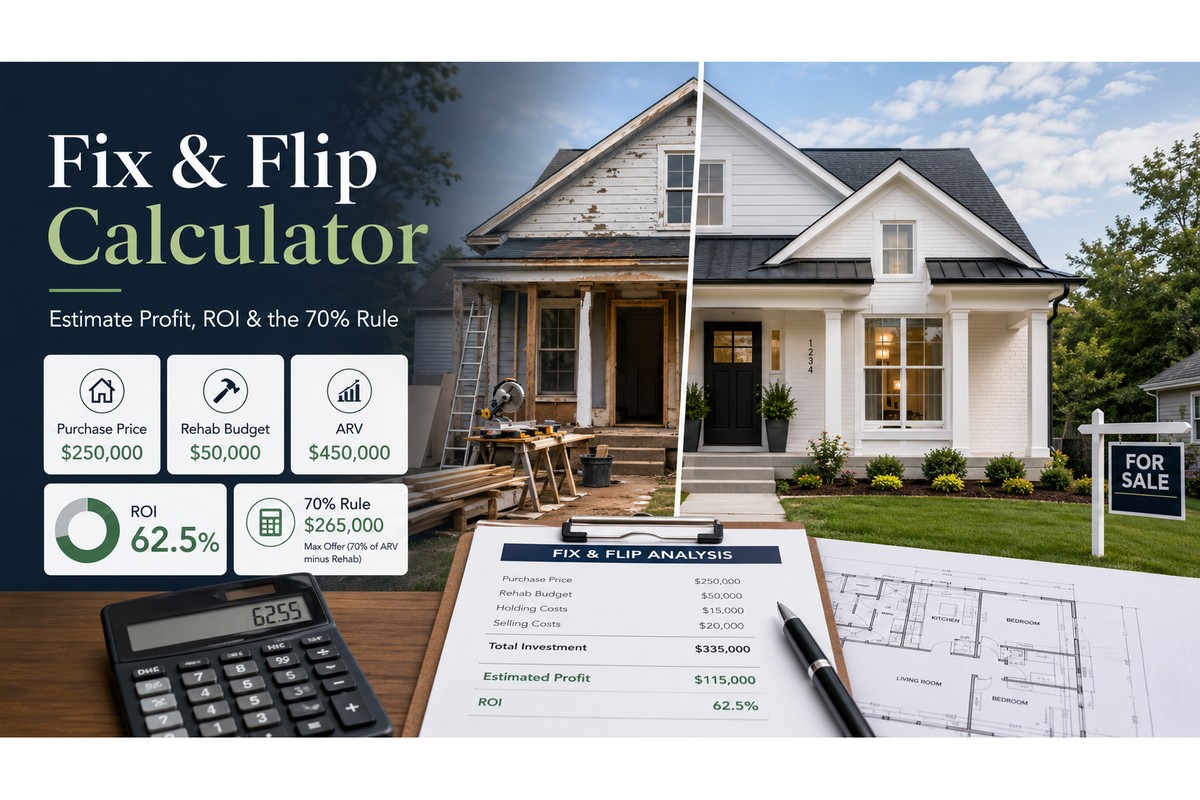
A fix and flip deal lives or dies on three numbers: purchase price, rehab cost, and after-repair value. Get any one of them wrong by 10%, and the profit you projected on paper turns into a loss at the closing table.
Flipping is not buy-and-hold. There is no rent to cushion a bad estimate. Every month you hold the property, hard money interest and holding costs chip away at your margin. The math has to work before you buy, not after.
This guide covers the fix and flip formula, how to estimate profit and ROI, what the 70% rule actually screens for, and the mistakes that turn promising flips into expensive lessons.
Every calculation ties directly to the Fix & Flip Calculator, so you can plug in your own deal as you read.
:
What Fix and Flip Analysis Means
Fix and flip analysis projects the total profit and return on investment for buying a property below market value, renovating it, and selling at after-repair value (ARV). Unlike rental analysis where income compounds over years, a flip is a single transaction with a defined timeline, typically 4 to 8 months.
At its core, the question is simple: after purchase, rehab, financing, holding costs, and sale costs, is there enough profit left to justify the risk and the capital tied up? Most experienced flippers target 20% or higher ROI to compensate for the execution risk that comes with every renovation project.
How to Analyze a Fix and Flip: Step by Step
Step 1: Establish ARV from comps. Pull 3 to 5 recent sales of renovated properties within half a mile. Use the median instead of the highest. If you cannot find solid comps, the deal has too much valuation risk.
Step 2: Estimate rehab costs. Walk the property with a contractor. Get line-item estimates rather than a single lump sum. Add 10% to 15% contingency on top of the total. Every experienced flipper budgets for surprises.
Step 3: Run the full cost stack. Purchase price plus closing costs plus rehab plus contingency plus financing costs (points, interest) plus monthly holding costs (taxes, insurance, utilities) plus sale costs (agent commission, closing). The calculator handles all of this automatically.
Inputs and Outputs
Inputs:
- Purchase Price — your offer amount
- ARV — after-repair value based on comps
- Rehab Budget — total renovation cost
- Contingency — 10% to 15% buffer for overruns
- Hold Period — months from purchase to sale
- Financing — hard money (LTC%, rate, points) or cash
- Holding Costs — taxes, insurance, utilities per month
- Sale Costs — agent commission plus closing (typically 7% to 9% of ARV)
Outputs:
- Total Profit ($) — net proceeds minus total cash invested
- ROI (%) — profit divided by cash invested
- 70% Rule Max Offer — quick screen price
- Break-Even Sale Price — minimum ARV to avoid a loss
- Annualized ROI — return adjusted for hold period
- Profit per Month — profit divided by hold period
The Fix and Flip Formula
Flip Profit = Net Sale Proceeds – Total Cash Invested
Where:
- Net Sale Proceeds = ARV – Sale Costs – Remaining Loan Balance
- Total Cash Invested = Down Payment + Closing Costs + Rehab (unfunded portion) + Contingency + Holding Costs + Loan Points + Loan Interest
- ROI = Flip Profit / Total Cash Invested x 100
Worked example (SFR flip, Atlanta GA, 2026 assumptions):
- Purchase price: $145,000 (off-market, needs full renovation)
- ARV: $260,000 (based on 4 comparable renovated sales within 0.5 miles)
- Rehab: $42,000 + 10% contingency = $46,200
- Financing: hard money at 85% LTC, 12% interest, 2 points
- Hold period: 5 months
- Holding costs: $475/mo (taxes $145, insurance $150, utilities $180)
- Sale costs: 8% of ARV
Costs:
- Loan amount (85% of $187,000): $158,950
- Cash down: $28,050
- Closing costs (2.5%): $3,625
- Contingency (not financed): $4,200
- Loan points (2%): $3,179
- Interest (12%, 5 months): $7,948
- Holding costs (5 months): $2,375
- Total cash invested: $49,376
Sale:
- ARV: $260,000
- Sale costs (8%): $20,800
- Loan payoff: $158,950
- Net sale proceeds: $80,250
Result:
- Profit: $80,250 – $49,376 = $30,874
- ROI: $30,874 / $49,376 = 62.5%
- Profit per month: $6,175
- 70% Rule max offer: $260,000 x 0.70 – $42,000 = $140,000 (purchase $145,000 slightly above)
Result: 62.5% ROI. Strong flip. The deal slightly exceeds the 70% rule max offer ($145K vs $140K) but the profit margin is wide enough to absorb that. Hard money interest is the biggest cost at $7,948 — finishing one month early saves $1,590. Run your own deal with the Fix & Flip Calculator.
Now compare: same property at $185,000 purchase (retail, on-market). Rehab $45,000, same financing and timeline. Profit drops to $4,225 and ROI falls to 6.8%. One month of overrun turns it into a loss. The $40,000 price difference is the entire profit.
What Your Result Means
| Rating | ROI | What It Means |
|---|---|---|
| Exceptional | 50%+ | Top-quartile flip. Usually requires off-market acquisition or significant forced appreciation. Strong buffer against overruns. |
| Strong | 30% – 49% | Above-average margin for 2026. Healthy safety buffer if rehab or timeline runs over by 10-15%. |
| Solid | 20% – 29% | Market-average for hard-money flips in 2026. Acceptable but leaves limited room for error. |
| Weak | 10% – 19% | Execution risk often exceeds profit margin. One surprise (foundation, HVAC, permit delay) erases the gain. |
| Critical | 0% – 9% | Barely positive. Any overrun produces a loss. Most experienced flippers would pass. |
| Loss | Below 0% | Projected loss before you start. reconsider the assumptions. |
Fix and Flip ROI Benchmarks
| Market | Typical Flip ROI (2026) | Notes |
|---|---|---|
| Georgia (Atlanta) | 25% – 50% | Strong flip market. Lower entry prices, growing demand for renovated homes. |
| Texas (DFW, Houston) | 20% – 40% | High property taxes reduce net margin. Fast-growing suburbs offer better spreads. |
| Florida (Tampa, Jacksonville) | 20% – 35% | Insurance costs rising. Permit timelines can add 1-2 months. |
| Ohio (Cleveland, Columbus) | 30% – 60% | Low purchase prices create high percentage returns. Smaller absolute profits. |
| California | 10% – 25% | High entry cost compresses ROI. Permits and regulations add time and expense. |
| North Carolina | 25% – 45% | Charlotte and Raleigh metros growing. Rehab costs still reasonable. |
The 70% Rule Explained
Max Offer = (ARV x 0.70) – Rehab Cost
Think of the 70% rule as a quick screen rather than an underwriting standard. If a deal fails the 70% rule, it is not automatically bad. If it passes, it is not automatically good. The rule exists to give you a fast filter when evaluating 20 deals a week.
In practice, the 70% rule builds in roughly 20% for profit and 10% for holding, financing, and sale costs. In 2026 with hard money rates above 11%, the 10% cost allowance is often too thin. Some investors use 65% instead of 70% to account for higher financing costs.
Always run the full calculation after the 70% rule screen. The 70% Rule Calculator handles the quick screen, and the Fix & Flip Calculator handles the full analysis.
When Fix and Flip Analysis Matters
Deal screening. Run the 70% rule first. If the deal passes, run the full analysis with actual rehab estimates and financing terms. Kill 90% of deals in the first 30 seconds and spend real time only on the top 10%.
Offer negotiation. The “Find Max Purchase Price” mode tells you the highest offer that still hits your target ROI. If your floor is 25% ROI and the calculator says max offer is $150,000, you know exactly where to anchor your negotiation.
Comparing financing options. Hard money at 12% with 2 points versus private money at 9% with 0 points versus all cash. Each option changes your ROI because the cost structure differs. Run all three scenarios to see which maximizes return on your specific capital.
BRRRR exit planning. Some investors flip some properties and BRRRR others. The fix and flip calculator tells you the flip profit, and the BRRRR Calculator tells you the hold return. Compare both exits on the same deal to decide which strategy fits.
Real-World Applications
Estimating true rehab cost. Most new flippers underestimate rehab by 20-30%. The calculator forces you to add contingency explicitly. If your contractor quotes $40,000, the model should show $44,000-$46,000 after contingency. That delta is the difference between a profitable flip and a breakeven.
Measuring the cost of delays. Every month over your projected timeline costs hard money interest plus holding costs. On a $160,000 loan at 12%, one extra month costs $1,600 in interest alone plus $400-500 in holding. Two months of overrun can cut profit by $4,000-5,000. The calculator shows this explicitly when you adjust hold period.
Investor presentations. If you are raising private money, a clean profit projection with full cost breakdown shows lenders and partners that you have done the math. Export the analysis to PDF for loan applications and investor pitch decks.
Industry Standards
- ATTOM Data Solutions (2025 Year-End Flipping Report): Median gross flip profit in the US was $72,000 in 2025 with a 27.5% gross ROI. However, gross ROI does not subtract financing or holding costs. Net ROI after all costs is typically 15-25% for most flippers.
- Hard money market (2026): Rates range from 10% to 14% with 1 to 3 origination points. LTC typically 80% to 90% of purchase plus rehab. Terms 6 to 18 months. Source: industry surveys from LendingHome and Kiavi.
- Sale costs benchmark: Agent commission 5% to 6% plus seller closing costs 1.5% to 2.5% = total 7% to 9% of ARV. Discount brokers can reduce commission to 3% to 4% but may limit exposure.
Limitations of Fix and Flip Analysis
ARV is an estimate, not a guarantee. The entire profit projection depends on the property selling at ARV. If the market shifts 5% during your hold period, or if your comps were optimistic, the sale price drops and profit compresses or disappears. Always use conservative comps and stress-test at ARV minus 5% and minus 10%.
Rehab costs are estimates until the walls are open. A $40,000 rehab can become $55,000 when you discover knob-and-tube wiring, foundation cracks, or asbestos. The calculator models contingency percentage but cannot predict property-specific surprises. A 10% contingency covers minor overruns but not major structural issues.
Before-tax analysis. Flip profit is typically taxed as ordinary income (25% to 37% federal bracket) plus state income tax where applicable. A $30,000 pre-tax profit may become $19,000-$22,000 after taxes. Use the Capital Gains Tax Calculator for an estimate, but consult a CPA for your specific situation.
When Not to Flip
When the spread between purchase and ARV is under 30%. If you are buying at $200,000 and ARV is $240,000, the gross spread is $40,000. After rehab, financing, holding, and sale costs, there is little to no profit left. Flips need wide spreads to absorb execution risk.
When you cannot verify ARV with recent comps. If the last comparable sale was 6 months ago or in a different condition tier, your ARV is a guess. Flipping on a guess is gambling. Wait for better data or pass on the deal.
Common Fix and Flip Mistakes
Using the seller’s ARV. Wholesalers and sellers inflate ARV to make the deal look profitable. Always pull your own comps from MLS or a licensed agent. The 5 minutes this takes can save you $20,000.
Forgetting holding costs and interest. New flippers calculate profit as ARV minus purchase minus rehab. That misses financing costs ($8,000-$15,000 on a typical hard money deal) and holding costs ($2,000-$4,000 for a 5-month hold). These hidden costs are where projected $40K profit becomes actual $20K profit.
Underestimating timeline. Permit delays, contractor no-shows, material shortages, inspection failures. Budget 1 to 2 extra months beyond your contractor’s estimate. At hard money rates above 11%, each month delay costs $1,500-$2,500 in interest alone.
FAQ
What is a good ROI for a fix and flip in 2026?
Target 20% to 30% net ROI (after all costs including financing). Above 30% is strong. Below 15% is too thin once you account for execution risk. Remember that flip income is taxed as ordinary income, so a 25% pre-tax ROI becomes roughly 16% to 18% after taxes.
What is the 70% rule in house flipping?
Max Offer = (ARV x 0.70) minus Rehab Cost. It is a quick screening tool, meant for fast filtering, not final decisions. The 30% margin roughly covers profit (20%) plus costs (10%). In 2026 with higher financing costs, some flippers use 65% instead. Always run a full analysis after the initial screen.
Should I use hard money or cash for a flip?
Hard money costs more (12%+ rate, 2+ points) but lets you do more deals with the same capital. Cash saves $10,000-$15,000 in financing costs per deal but ties up all your capital in one project. If you have enough cash for 3 deals using hard money versus 1 deal using cash, hard money often produces more total profit across the portfolio.
How long should a typical flip take?
Plan for 5 to 8 months total from purchase to sale: 1 month for permits and planning, 2 to 4 months for rehab, 1 to 2 months for listing and closing. Every month over this timeline costs $1,500 to $2,500 in hard money interest plus holding costs.
Is flip profit taxed as capital gains?
Usually no. The IRS typically treats flippers as dealers, not investors. Flip profit is taxed as ordinary income at your marginal rate (25% to 37% federal) plus self-employment tax in some cases. Holding a property longer than 12 months before selling may qualify for long-term capital gains rates, but this defeats the purpose of a flip. Consult a CPA.
What is ARV and how do I estimate it?
ARV (After Repair Value) is the estimated market value of the property after renovation. Estimate it using 3 to 5 recent sales (within 6 months) of renovated properties in the same neighborhood with similar size and features. Use the median, skip the outlier at the top and use the middle of the range. If you cannot find at least 3 solid comps, the ARV is unreliable and the deal is risky.
How much contingency should I budget?
10% minimum on cosmetic rehabs (paint, flooring, fixtures). 15% to 20% on structural or gut renovations. 25% on pre-1970 properties where you do not know what is behind the walls. Contingency is not a luxury — it is the line item that separates profitable flippers from those who lose money.
Can I use this calculator for wholesale deals?
Partially. The 70% rule and max offer price apply to wholesaling (finding the price an end buyer would pay). But wholesale profit is the assignment fee, something different from the flip profit. Use the “Find Max Purchase Price” mode to determine what a flipper would pay, then subtract your assignment fee to find your max offer to the seller.
Run Your Fix & Flip Numbers
5 calculation modes including max purchase price and max rehab budget. Full cost breakdown with hard money, holding costs, and sale expenses.
Open Fix & Flip Calculator
Related Calculators
- ARV Calculator — estimate after-repair value from comps
- 70% Rule Calculator — quick max offer screening
- Rehab Cost Estimator — room-by-room renovation budget
- House Flipping Profit Calculator — simplified profit projection
- Hard Money Loan Calculator — compare financing costs
- BRRRR Calculator — compare flip exit vs hold exit
- Capital Gains Tax Calculator — estimate tax on sale
- Closing Costs Calculator — purchase and sale cost estimates
Disclaimer: This article is for educational purposes only and does not constitute financial, investment, legal, or tax advice. Real estate investing involves significant risk, including the potential loss of capital. All numbers, rates, and projections are illustrative examples and may not reflect your specific situation. Consult qualified financial, legal, and tax professionals before making any investment decisions.
Leave a Reply