Published: October 26, 2026 · By Alex Petrov
Section 8 rental investing changed my portfolio. Three of my 22 rental units accept Section 8 vouchers. Those three units have a combined vacancy rate of 1.2% over the past four years — compared to 4.8% across my market-rate units. The government deposits rent directly into my bank account on the first of every month, regardless of whether the tenant remembers to pay. After 14 years of landlording, Section 8 rental investing is the closest thing to guaranteed income I have found in real estate.
But Section 8 is not a magic solution. Inspections are strict, bureaucratic timelines are slow, and some landlords have horror stories about property damage that make them swear off the program entirely. The truth — as with most things in real estate — is in the numbers. This guide walks through how the Housing Choice Voucher program actually works, what it pays, how to qualify your property, and whether Section 8 rental investing makes financial sense for your portfolio. Run your numbers with the rental property calculator to see how voucher income compares to market rent on your specific property.
How Section 8 Works: The Basics for Landlords
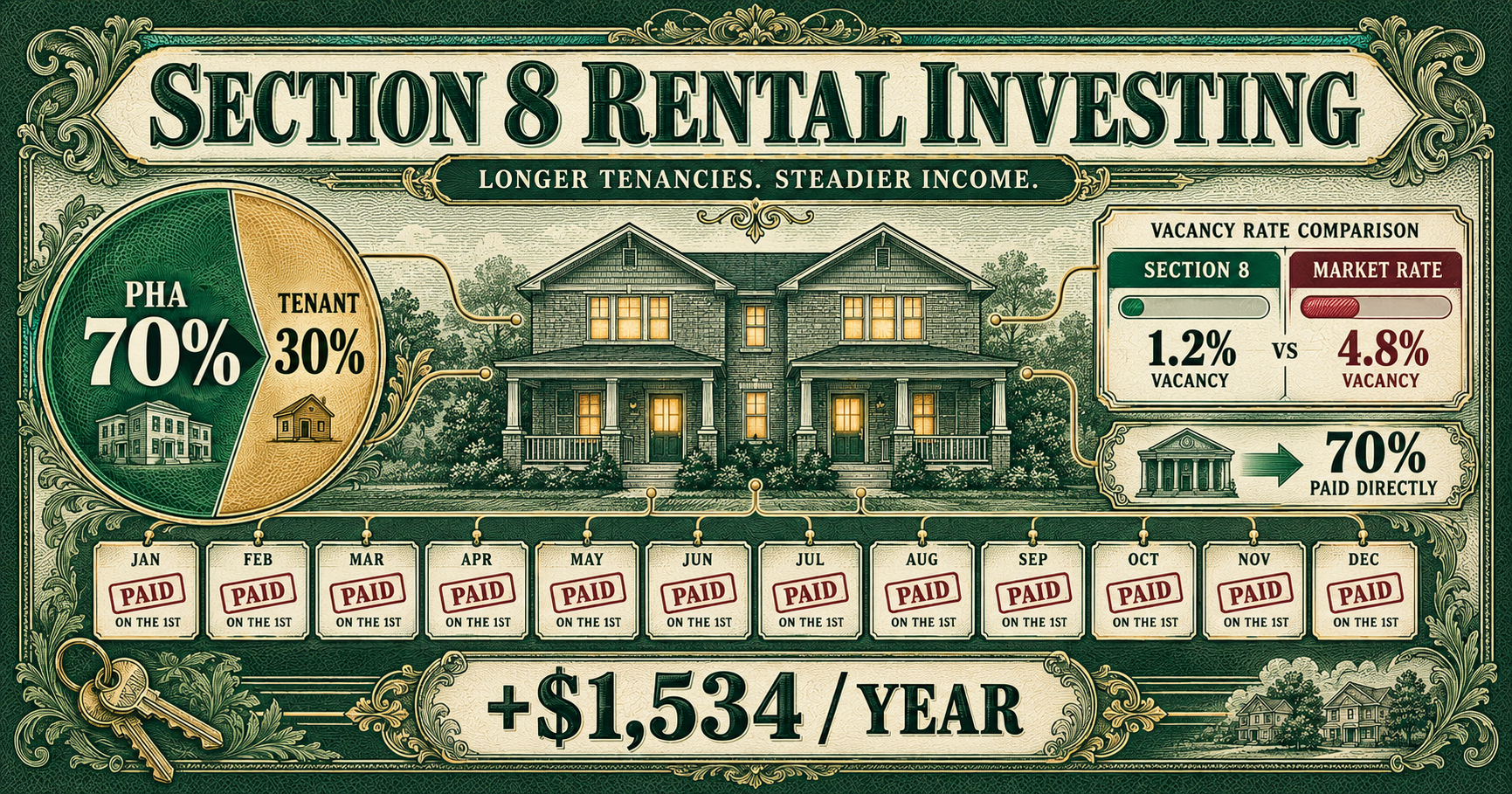
The Housing Choice Voucher Program (Section 8) is administered by the U.S. Department of Housing and Urban Development (HUD) through local Public Housing Authorities (PHAs). The government pays a portion of the tenant’s rent directly to the landlord. The tenant pays the remainder — typically 30% of their adjusted gross income.
The Payment Split
On a $1,200/month rental where the PHA payment standard is $1,200 and the tenant’s income produces a $360 tenant portion:
- PHA pays you: $840/month — direct deposit, guaranteed on the 1st
- Tenant pays you: $360/month — collected like normal rent
- Your total: $1,200/month
The PHA portion (70% in this example) arrives like clockwork. The tenant portion (30%) carries the same collection risk as any rental income — but it is a much smaller amount, which reduces your exposure. If the tenant does not pay their $360, you are still collecting $840 from the government while pursuing the balance.
Payment Standards vs Market Rent
Each PHA sets a “payment standard” — the maximum rent the voucher will cover in that area, based on HUD’s Fair Market Rent (FMR) calculations. According to HUD’s FMR data, payment standards typically match or slightly exceed local market rents for comparable properties. In many markets, Section 8 rents are at or above what you would collect from market-rate tenants — especially in Class B and C neighborhoods.
Check your local PHA’s payment standard against your market rent. If the payment standard equals or exceeds what you charge, Section 8 rental investing gives you the same income with lower vacancy risk. Use the rent estimator to compare your market rate against FMR.
Financial Advantages of Section 8 Rental Investing
The financial case for section 8 rental investing tells a compelling story for landlords who run the analysis instead of relying on stereotypes.
1. Dramatically Lower Vacancy
One key advantage of section 8 rental investing: waiting lists in most cities are 2-5 years long. Voucher holders who find a unit that passes inspection do not leave voluntarily — the alternative is going back on a years-long waiting list. My Section 8 tenants average 4.2 years of tenure versus 2.1 years for my market-rate tenants. That is half the turnover, which means half the turnover cost ($1,500-$3,000 saved per avoided turnover).
Nationally, Section 8 tenants have an average tenure of 4-6 years, compared to 2-3 years for market-rate renters. On a $1,200/month rental, reducing turnover from one event per year to one every three years saves $3,000-$6,000 annually in vacancy loss and turnover costs. Factor this into your vacancy rate calculation.
2. Guaranteed Partial Payment
The PHA portion of rent (typically 60-70%) arrives via direct deposit on a predictable schedule. No chasing rent. No late payment drama. No eviction costs for the government portion. The only collection risk is the tenant’s 30% share — a much smaller amount to manage.
In my portfolio, late payment rate on Section 8 units is 8% (on the tenant portion only). Late payment rate on market-rate units is 12% (on the full rent amount). The effective late-payment dollar exposure on Section 8 is 70% lower because the guaranteed portion eliminates most of the risk.
3. Rent Increases Built Into the System
PHAs adjust payment standards annually based on HUD’s Fair Market Rent calculations. When local rents rise, payment standards follow — typically with a 12-month lag. You request a rent increase through the PHA, they verify it is within the payment standard, and the new rate takes effect. The process is more bureaucratic than a market-rate increase, but it tracks the market over time.
4. Larger Tenant Pool
In markets with tight housing supply, accepting vouchers expands your applicant pool significantly. Some landlords who switch from “no vouchers” to “vouchers accepted” fill vacancies 40-60% faster because they are tapping a pool of pre-qualified tenants with guaranteed partial payment.
Financial Disadvantages: What to Budget For
Inspection Costs and Standards
Section 8 requires a Housing Quality Standards (HQS) inspection before move-in and annually thereafter. Your property must meet specific standards: working smoke detectors, no peeling paint (especially in pre-1978 homes — lead paint), functioning plumbing and electrical, adequate heating, and safe structural condition.
Most well-maintained rental properties pass without issues. But if your property fails, you must complete repairs before the tenant can move in and the PHA starts paying. Budget $200-$1,000 for pre-inspection repairs on older properties. Annual reinspection catches deferred maintenance — which is actually a good thing, even if it feels like a hassle.
Bureaucratic Timeline
The Section 8 process is slower than market-rate leasing. From voucher holder inquiry to first rent check: 30-60 days (versus 14-21 days for market-rate). This includes PHA approval of the unit, inspection scheduling, and lease approval. If the inspection fails, add 2-4 weeks for repairs and reinspection. Budget an additional 2-4 weeks of vacancy for your first Section 8 tenant compared to market-rate.
Rent May Be Capped Below Market
In rapidly appreciating markets, PHA payment standards may lag behind actual market rents by 6-12 months. If your market rent is $1,500 but the payment standard is $1,350, you either accept less or wait for the next FMR adjustment. In stable or slow-growth markets, this is rarely an issue — payment standards typically match or exceed market rent for the property type.
Tenant Damage Risk
The most common concern about section 8 rental investing is property damage. The data does not support the stereotype. According to a 2024 study by the National Low Income Housing Coalition, damage rates for voucher holders are statistically comparable to market-rate tenants when controlling for property age, location, and income level. The key variable is tenant screening — not voucher status. Screen Section 8 applicants with the same rigor as any tenant. Use our tenant screening checklist.
How to Qualify Your Property for Section 8
- Contact your local PHA. Find your PHA at HUD’s PHA contact directory. Tell them you want to list your property as voucher-eligible.
- Ensure the property meets HQS. Review the HQS checklist: working smoke detectors, no exposed wiring, functioning plumbing, adequate heating/cooling, no lead paint hazards, secure doors and windows.
- Set your rent at or below the payment standard. Check your PHA’s current payment standard for your unit type (1BR, 2BR, etc.) and zip code. Price accordingly.
- List as “Section 8 accepted.” Add this to your Zillow, Apartments.com, and Facebook Marketplace listings. Many voucher holders specifically search for Section 8-friendly landlords.
- Screen tenants normally. You can still screen for credit, rental history, and background — the same criteria you use for market-rate tenants. The voucher does not exempt tenants from your screening standards.
- Complete the PHA paperwork. The PHA will send you a Request for Tenancy Approval (RFTA) and Housing Assistance Payment (HAP) contract. Review with your attorney if needed.
- Schedule inspection. The PHA inspector visits your property. If it passes, the lease and HAP contract are executed, and rent payments begin.
Worked Example: Section 8 vs Market Rate on the Same Property
Here is a real comparison from one of my duplexes — Unit A is market-rate, Unit B accepts Section 8. Same building, same floor plan, same condition.
| Metric | Unit A (Market Rate) | Unit B (Section 8) |
|---|---|---|
| Monthly rent | $1,150 | $1,150 (at payment standard) |
| PHA portion | $0 | $805 (70%) |
| Tenant portion | $1,150 | $345 (30%) |
| Late payments/year | 1.4 months | 0.3 months (tenant portion only) |
| Avg tenure | 1.8 years | 4.5 years |
| Turnover cost/year | $1,667 (one turnover/1.8yr) | $556 (one turnover/4.5yr) |
| Vacancy days/year | 22 days | 4 days |
| Annual vacancy loss | $836 | $153 |
| Effective annual income | $11,557 | $13,091 |
Unit B (Section 8) collects $1,534 more per year than Unit A despite the same listed rent — entirely because of lower vacancy, fewer turnovers, and more reliable payment on the government portion. Over a 5-year hold, that is $7,670 in additional income from the Section 8 unit. Model both scenarios in the rental property calculator with different vacancy assumptions.
Which Markets and Property Types Work Best
Section 8 rental investing as a section 8 rental investing strategy works best in markets where:
- Payment standards match or exceed market rent. This is common in Class B and C neighborhoods in Midwest and Southeast markets (Indianapolis, Memphis, Columbus, Columbia SC).
- PHA waiting lists are long. Longer waiting lists = more demand for Section 8 units = faster tenant placement and longer retention.
- Property values are moderate. $100,000-$250,000 properties in areas where the rent-to-price ratio supports cash flow. The cap rate calculator helps you evaluate whether the deal works at Section 8 rent levels.
Property types that work well: Single-family homes and duplexes in residential neighborhoods. Voucher holders with families prefer houses over apartments for the space and school district access. 3-4 bedroom homes have the highest demand because family-size vouchers have larger payment standards.
Markets where Section 8 is less effective: High-cost markets (San Francisco, New York, Boston) where payment standards lag significantly behind market rents. In these markets, accepting vouchers means accepting below-market rent — which may not make financial sense.
Source of Income Discrimination Laws
Important legal context: a growing number of states and cities now prohibit landlords from refusing tenants based on their source of income — which includes Section 8 vouchers. As of 2026, 21 states plus Washington DC have statewide source-of-income protections. Many additional cities have local ordinances.
In states with SOI protections, you cannot advertise “no Section 8” or reject an applicant solely because they use a voucher. You can still screen based on credit, rental history, income-to-rent ratio (using the tenant’s total income including voucher), and background — the same criteria applied to all applicants. Check your state and local laws before setting your voucher policy.
Common Mistakes in Section 8 Rental Investing
- Skipping tenant screening because “the government pays.” The voucher guarantees a portion of rent — it does not guarantee a good tenant. Screen every applicant using the same criteria. A voucher holder with three prior evictions is still a high-risk tenant.
- Not budgeting for inspection repairs. Older properties may need $500-$2,000 in work to pass HQS. Budget this before listing as Section 8-friendly, not after the inspector fails the unit.
- Pricing above the payment standard. If your rent exceeds the PHA payment standard, the tenant must pay the difference — which may make the unit unaffordable for voucher holders. Price at or slightly below the payment standard for fastest placement.
- Expecting instant rent. The first payment takes 30-60 days from lease signing while PHA paperwork processes. Budget one month of vacancy for your first Section 8 tenant.
- Ignoring Section 8 because of stereotypes. The data shows comparable or better financial performance for Section 8 units when vacancy, turnover, and payment reliability are factored in. Run the numbers before dismissing the program.
Tax Implications of Section 8 Income
Section 8 rental investing income is taxed identically to market-rate rental income. The PHA payment is ordinary rental income reported on Schedule E. All standard rental deductions apply: depreciation, mortgage interest, repairs, insurance, property taxes, management fees, and travel. There is no special tax treatment — positive or negative — for accepting vouchers. See our rental property tax deductions guide for the full list of deductible expenses.
Frequently Asked Questions
How much does Section 8 pay landlords?
Section 8 pays landlords the difference between the PHA payment standard and the tenant’s portion (typically 30% of tenant income). On a $1,200/month rental, the PHA might pay $800-$900 and the tenant pays $300-$400. Payment standards vary by location and unit size — check your local PHA for exact amounts. In many Class B/C markets, Section 8 rental investing provides the same or higher effective income than market-rate renting when you factor in lower vacancy and turnover.
Is Section 8 worth it for landlords?
Yes, in most markets. The financial analysis typically favors Section 8: guaranteed partial payment, 50-70% lower vacancy, 2x longer tenant tenure, and comparable property damage rates. The tradeoffs are bureaucratic timelines (30-60 days to first payment) and annual inspections. Run both scenarios in the rental property calculator — compare market-rate rent with 7% vacancy versus Section 8 rent with 2% vacancy. The Section 8 scenario usually wins on effective annual income.
Can I reject a Section 8 tenant?
It depends on your location. In 21 states plus DC, source-of-income discrimination is illegal — you cannot reject someone solely for using a voucher. In other states, landlords may choose whether to accept vouchers. Regardless of location, you can still screen Section 8 applicants using the same criteria as market-rate applicants: credit score, rental history, background check, and income verification (using total income including voucher amount).
What are the inspection requirements for Section 8?
Properties must pass Housing Quality Standards (HQS) inspection before move-in and annually. Key requirements: working smoke/CO detectors, no peeling paint (especially lead paint in pre-1978 homes), functioning plumbing and electrical, adequate heating, secure windows and doors, and safe structural condition. Most well-maintained properties pass. Budget $200-$1,000 for pre-inspection repairs on older properties.
How do I sign up to accept Section 8 tenants?
Contact your local Public Housing Authority (PHA) — find yours at HUD’s PHA directory. Tell them you want to list your property. Ensure it meets HQS standards. Set rent at or below the local payment standard. List as “Section 8 accepted” on rental platforms. When a voucher holder applies, the PHA handles paperwork, inspection scheduling, and HAP contract. Timeline from contact to first rent: 60-90 days.
Run the Numbers Before You Decide
Section 8 rental investing through section 8 rental investing is not about charity — it is about financial performance. The data consistently shows lower vacancy, longer tenancies, and guaranteed partial payment. The bureaucratic cost (inspections, paperwork, slower initial placement) is real but quantifiable. For most landlords in moderate-cost markets, the numbers favor accepting vouchers.
Start with the math: open the rental property calculator, model your property at market rent with typical 5-8% vacancy, then model it at the Section 8 payment standard with 1-2% vacancy. Compare the effective annual income. Check your local PHA payment standard against your rent estimate. If the numbers work — and they usually do in Class B/C markets — Section 8 rental investing deserves a place in your portfolio strategy.