Last updated: October 21, 2026 · Originally published: May 17, 2026 · By Alex Petrov
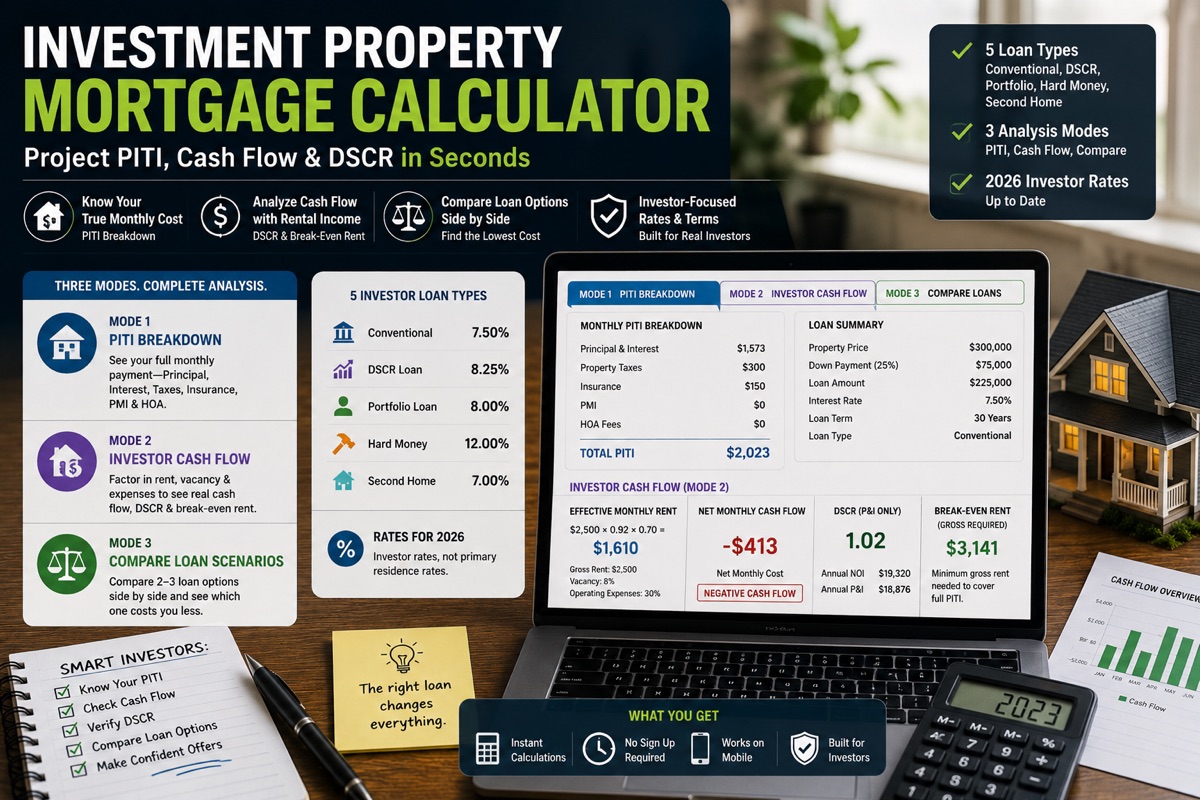
Will this rental property actually put money in your pocket each month — or quietly bleed your savings dry? That question haunts every investor staring at a listing, and a basic spreadsheet won’t answer it. The property cash flow calculator on this page gives you a Cash Flow Verdict, Break-even Occupancy, and Debt Coverage Ratio in one screen. Stop guessing whether $200/month is healthy or dangerously thin — plug in purchase price, rent, and expenses, and let the math decide. Use the free Property Cash Flow Calculator to run your own numbers.
Most free cash flow tools online spit out a single number: monthly cash flow. That’s like a doctor telling you “your blood pressure is 130” without saying whether that’s good or bad. This property cash flow calculator goes further. It assigns a four-tier Cash Flow Verdict (STRONG, GOOD, THIN, or NEGATIVE), calculates Break-even Occupancy so you know exactly how many months of vacancy you can absorb, and runs a Cash Flow Composition Breakdown showing where every rent dollar actually lands — debt service, property management, maintenance, taxes, insurance, and your pocket.
Real questions this tool answers: “Will this rental actually cash flow positive at 7.5% investor rates?” “How many vacant months can I handle before losing money?” “My DCR is 1.15 — should I worry?” “Where does each rent dollar go?” Most property cash flow calculators give you one number and leave you stranded. This one delivers a Verdict plus the metrics to back it up. Numbers alone don’t tell you if a deal is solid — Verdicts do.
This calculator analyzes investment property cash flow using 2026 investor financing rates (7.5% Conventional, 25% down payment). It is not designed for primary residence purchases or consumer mortgage scenarios. For rent-versus-buy decisions on a personal home, use the Rental Property Calculator instead. Cash flow displayed is Year 1 stabilized monthly average — actual months will vary. Enter your numbers above and get your Verdict, Break-even Occupancy, DCR, and full composition breakdown in seconds. The property cash flow calculator handles this.
On This Page
- How to Use the Property Cash Flow Calculator
- Inputs and Outputs
- How the Property Cash Flow Calculator Works
- What Real Estate Cash Flow Actually Means
- How to Read Cash Flow Verdict, Break-even, and DCR
- Property Cash Flow Benchmarks for 2026
- Cash Flow Strategy by Investor Type
- Common Use Cases
- How This Calculator Aligns with Investor Conventions
- Limitations of This Calculator
- Common Mistakes in Cash Flow Analysis
- Frequently Asked Questions
- Related Calculators
How to Use the Property Cash Flow Calculator
From inputs to Verdict, Break-even Occupancy, and DCR
Step 1: Enter purchase price, financing, and rent
Start with the property basics: purchase price, down payment percentage, mortgage rate, and loan term. Then enter your expected monthly rent and any other monthly income (laundry, parking, storage). This property cash flow calculator defaults to 2026 investor financing — 7.5% Conventional 30-year with 25% down. These are not consumer mortgage rates. If you’re analyzing a primary residence, the Mortgage Investment Calculator is a better fit. Investor rates reflect higher risk pricing that lenders apply to non-owner-occupied properties.
Step 2: Use % or $ mode for operating expenses
The calculator offers two modes for entering operating expenses. Percentage mode (the default) applies commonly used rates: property management at 8% of rent, maintenance and repairs at 5%, and CapEx reserves at 5%. Dollar mode lets you plug in verified actual amounts from county tax records, insurance quotes, and HOA statements. Total operating expenses on a typical rental run 30%–35% of gross rent. If your defaults produce a total under 25%, something is probably missing — double-check every category. Use the property cash flow calculator to verify.
Step 3: Read the Cash Flow Verdict at the top
The Verdict appears at the top of your results. It synthesizes Monthly Cash Flow and DCR into a single answer across four tiers. STRONG means monthly cash flow hits $300 or more with DCR at 1.25 or above — comfortable margin with lender-grade coverage. GOOD requires at least $100/month and DCR of 1.10 or higher — the realistic target for most 2026 investors. THIN flags cash flow between $0 and $100, or DCR between 1.00 and 1.10 — technically positive but fragile. NEGATIVE means the property loses money each month or DCR falls below 1.00 — operational red flag. The property cash flow calculator shows this clearly.
Step 4: Check Break-even Occupancy and DCR for cushion
Break-even Occupancy answers the vacancy question directly. It tells you the minimum occupancy rate required to cover all expenses plus debt service. A property with 85% Break-even Occupancy can tolerate roughly 1.8 months of vacancy per year before losing money. The five-tier scale runs from Strong Cushion (below 80%) through Normal (80%–90%), Thin (90%–95%), Razor-Thin (95%–100%), to Infeasible (above 100%). Run this tool to check.
DCR (Debt Coverage Ratio) frames the same question from the lender’s angle. DCR of 1.25 means the property generates 25% more income than its debt payments require — the threshold most DSCR lenders demand for approval. DCR of 1.10 means only 10% more income than payments, which is tight. Below 1.00, the property’s NOI cannot cover debt service at all. This calculator’s DCR matches DSCR Calculator output within 0.01. The calculator computes this instantly.
Step 5: Stress-test with scenarios before committing
The calculator automatically generates three scenarios. Conservative drops rent by 5%, adds 5 percentage points to vacancy, increases maintenance by 3 points, and bumps property tax by 20%. Base uses your exact inputs. Optimistic increases rent by 5%, reduces vacancy by 3 points, and trims maintenance by 2 points. If a deal shows NEGATIVE Verdict under the conservative scenario, think twice before signing. A quick the calculator run confirms this.
One thing to keep front of mind: the Monthly Cash Flow figure is a Year 1 stabilized average. That does not mean you’ll deposit exactly $385 on the first of every month. Some months you’ll collect full rent with zero repair calls. Other months, a tenant moves out, you spend $2,400 on turnover costs, and cash flow goes negative for 6 weeks. Seasonal expenses concentrate in certain quarters. Plan for a few negative months even when annual cash flow is solidly positive. Plug numbers into this tool.
Pro Tips
Verify rent comps are realistic. Rent is the highest-use input in any property cash flow calculator. Inflating your rent estimate by $200/month can artificially shift a Verdict from THIN to GOOD on paper — but reality won’t cooperate. Pull comps from Rentometer or Zillow rent estimates, then shave 5% for a safety margin.
OpEx defaults are minimums, not ceilings. Property management at 8%, maintenance at 5%, and CapEx at 5% gives you 18% in operational expenses alone. Add property tax, insurance, and any HOA, and total OpEx should land between 30% and 35% of rent. If your calculator shows total operating expenses under 25%, you’re almost certainly missing line items. The calculator reveals this gap.
Break-even Occupancy reveals fragility. A property showing 95% Break-even Occupancy has less than one month of vacancy tolerance per year. Standard tenant turnover alone chews up 1–2 months between move-out, cleaning, marketing, and lease-up. Properties at 95%+ Break-even are Year-1-fragile regardless of how attractive the monthly cash flow number looks. This tool handles this.
Negative cash flow isn’t always a deal-killer. Year 1 negative cash flow with DCR above 1.0 can be acceptable for appreciation plays — the property covers its debt operationally, and you fund the growth period out of pocket. But Year 1 negative cash flow combined with DCR below 1.0 is a genuine red flag: the property loses money even before considering your equity injection. Use the calculator to verify.
Inputs and Outputs
What goes in, what comes out
Calculator Inputs
| Input | Required | Default |
|---|---|---|
| Property & Financing | ||
| Purchase Price | Yes | — |
| Down Payment % | No | 25% (investor) |
| Mortgage Rate % | No | 7.5% (2026 investor) |
| Loan Term (years) | No | 30 |
| Closing Costs % | No | 3% |
| Income | ||
| Monthly Rent | Yes | — |
| Other Monthly Income | No | $0 |
| Vacancy % | No | 8% |
| Operating Expenses (toggle %/$) | ||
| Property Tax | No | 1.2% of value annually |
| Insurance | No | $1,800/year |
| HOA (Monthly) | No | $0 |
| Property Management % | No | 8% |
| Maintenance & Repairs % | No | 5% |
| CapEx Reserve % | No | 5% |
| Utilities (Monthly) | No | $0 |
| Other Expenses (Monthly) | No | $0 |
Calculator Outputs
| Output | Formula | Purpose |
|---|---|---|
| Cash Flow Verdict | 4-tier synthesis of CF + DCR | Single answer: is this deal good? |
| Monthly Cash Flow | (NOI − Annual Debt Service) / 12 | Primary metric — monthly pocket money |
| Annual Cash Flow | NOI − Annual Debt Service | Full year view |
| Cash Flow Yield % | Annual CF / Total Cash Invested × 100 | Return on cash deployed (= Cash-on-Cash) |
| Break-even Occupancy % | (OpEx + Debt Service) / Gross Rent | Vacancy tolerance (signature metric) |
| Operating Expense Ratio % | Total OpEx / EGI | Expense efficiency |
| DCR (Debt Coverage Ratio) | NOI / Annual Debt Service | Lender perspective on coverage |
| NOI (Annual) | EGI − Total OpEx | Pre-debt operating income |
| Annual Debt Service | Monthly P&I × 12 | Total annual mortgage payments |
| Cash Flow Composition | Stacked breakdown of rent allocation | Where each rent dollar goes |
How the Property Cash Flow Calculator Works
The math behind every output
Cash flow math is straightforward addition and subtraction. What sets this property cash flow calculator apart is the depth of the breakdown — every expense category isolated, Break-even Occupancy as a signature metric, and cross-calculator consistency with other tools on this site.
Here’s the step-by-step formula chain:
Effective Gross Income (EGI):
EGI = Monthly Rent × 12 × (1 − Vacancy%)
Total Operating Expenses:
Total OpEx = Property Tax + Insurance + HOA + (Rent × 12 × PM%) + (Rent × 12 × Maintenance%) + (Rent × 12 × CapEx%) + Utilities × 12 + Other × 12
Net Operating Income:
NOI = EGI − Total OpEx
Cross-calculator invariant: matches NOI Calculator output within $10.
Debt Service:
Monthly P&I = Loan Amount × [r(1+r)^n] / [(1+r)^n − 1]
Annual Debt Service = Monthly P&I × 12
Where r = monthly rate, n = total months.
Cash Flow:
Monthly Cash Flow = (NOI − Annual Debt Service) / 12
Annual Cash Flow = NOI − Annual Debt Service
Cash Flow Yield (equals Cash-on-Cash Return):
Cash Flow Yield % = (Annual Cash Flow / Total Cash Invested) × 100
Total Cash Invested = Down Payment + Closing Costs. Matches Cash-on-Cash Calculator within 0.1 percentage points.
Break-even Occupancy (signature metric):
Break-even Occupancy % = (Total OpEx + Annual Debt Service) / (Monthly Rent × 12) × 100
Debt Coverage Ratio:
DCR = NOI / Annual Debt Service
Matches DSCR Calculator within 0.01.
Worked Example: Standard Suburban Rental
Consider a standard US suburban rental property with 25% down at the current 7.5% investor rate:
| Input | Value |
|---|---|
| Purchase Price | $150,000 |
| Down Payment | 25% ($37,500) |
| Mortgage Rate / Term | 7.5% / 30 years |
| Monthly Rent | $1,800 |
| Vacancy | 8% |
| Property Tax | 1.2% of value ($1,800/yr) |
| Insurance | $1,800/year |
| PM / Maint / CapEx | 8% / 5% / 5% |
| Output | Value |
|---|---|
| Loan Amount | $112,500 |
| Monthly P&I | ~$786 |
| Effective Gross Income | ~$19,872 |
| Total OpEx | ~$7,800 |
| NOI | ~$12,072 |
| Annual Debt Service | $9,432 |
| Annual Cash Flow | ~$2,640 |
| Monthly Cash Flow | ~$220 |
| DCR | ~1.28 |
| Break-even Occupancy | ~87% |
| Verdict | GOOD |
Properties under $200K at 7.5% rates often land in the $150–$250 monthly cash flow range with Break-even Occupancy between 85% and 90%. That puts them squarely in GOOD Verdict territory. But verify rent comps carefully — inflating rent by just $150/month can push Break-even Occupancy from 87% to 95%, which is Razor-Thin territory masquerading as a solid deal.
What Real Estate Cash Flow Actually Means
Operational view vs lifetime ROI
Cash flow is the operational lens on a rental property. Rent collected minus all operating expenses minus debt service equals what actually lands in your account each month. It measures one thing: monthly check size. A separate question entirely — total return on investment — blends cash flow with appreciation, loan paydown, and tax benefits across a multi-year hold period. A property can deliver strong ROI and negative monthly cash flow at the same time. That’s not a contradiction. It’s just two different questions answered by two different calculators.
Experienced investors track cash flow separately because it funds daily life. ROI funds retirement. Both matter, but they answer fundamentally different questions. “Can this rental cover its debt and put money in my pocket?” belongs to the cash flow lens — and that’s what this property cash flow calculator answers. “What’s my total return over a 7-to-10-year hold?” requires an ROI lens and a different toolset entirely. Beginners regularly skip cash flow analysis, fixate on projected appreciation, and then get blindsided when negative monthly cash flow drains their reserves before the appreciation thesis plays out.
In the 2026 investor environment, cash flow is compressed relative to the 2018–2021 ultra-low-rate era. Properties that generated $400 or more per month at 4% interest rates now frequently show $50–$200 at 7.5%. That shift doesn’t make rental investing non-viable — it just narrows the margin. Stabilized cash flow represents Year 1 average performance. Individual months will deviate due to vacancies, repairs, tenant turnover, and seasonal maintenance spikes. Variance is normal. Planning for it is necessary.
How to Read Cash Flow Verdict, Break-even, and DCR
Interpreting your cash flow analysis
The Verdict is the headline — a synthesized answer to “is this a good cash flow deal?” Break-even Occupancy reveals vacancy tolerance. DCR confirms the lender perspective. And OER (Operating Expense Ratio) exposes expense efficiency. Together, these four metrics give you a broader view. How to read each one.
Cash Flow Verdict Tiers
| Verdict | Criteria | What It Means |
|---|---|---|
| STRONG | CF ≥ $300 AND DCR ≥ 1.25 | Comfortable margin + lender approval territory |
| GOOD | CF ≥ $100 AND DCR ≥ 1.10 | illustrative investor target — solid but not lavish |
| THIN | CF $0–100 OR DCR 1.00–1.10 | Technically positive — verify every assumption |
| NEGATIVE | CF < $0 OR DCR < 1.00 | Property loses money or can’t cover debt — reconsider |
Break-even Occupancy Interpretation
| Range | Tier | Vacancy Tolerance |
|---|---|---|
| Below 80% | Strong Cushion | 2.4+ months vacancy per year tolerable |
| 80%–90% | Normal | 1.2–2.4 months — typical investor tolerance |
| 90%–95% | Thin | 0.6–1.2 months — verify rent and expenses |
| 95%–100% | Razor-Thin | Almost zero cushion — one bad month hurts |
| Above 100% | Infeasible | Property cannot break even at any occupancy |
DCR (Debt Coverage Ratio) in Plain Language
DCR of 1.00 means the property’s income exactly equals debt payments — zero cushion. At 1.10, the property generates 10% more income than debt requires. At 1.25, it generates 25% more — and that’s the threshold where DSCR lenders typically approve loans. At 1.50, you’re generating 50% more than needed, which is genuinely strong but rare at 2026 rates. Below 1.00, NOI doesn’t cover the mortgage, and you’re subsidizing the property from personal funds every month.
OER (Operating Expense Ratio)
OER divides total operating expenses by effective gross income. Below 35% is efficient. Between 35% and 50% is typical for most rental properties. Above 50% signals something is off — high taxes, excessive management fees, or deferred maintenance creating outsized repair costs. Investigate any property showing OER above 50% before making an offer.
Remember that the Monthly Cash Flow figure displayed is a Year 1 stabilized average. In practice, some months will produce nothing — the tenant vacated, you paid for cleaning, and the unit sat empty for three weeks. Other months, you’ll collect full rent with no repair requests and pocket double the average. Over twelve months, the actual performance should converge toward the displayed figure. Don’t quit a W-2 job based on $385/month shown on screen — build a three-month cash reserve before depending on rental income.
Property Cash Flow Benchmarks for 2026
Illustrative patterns, not statistical datasets
These ranges reflect typical patterns across US rental markets. They are not measured statistics, not predictions for your specific property, and not guarantees. Local rents, expenses, tax rates, and financing terms create enormous variation. The calculator’s output on your actual inputs takes precedence over any benchmark listed here.
Monthly Cash Flow Ranges (planning-default investor rates)
| Market Type | Typical Monthly CF |
|---|---|
| Standard markets (mixed Midwest/Southeast) | $50–$200/month positive |
| Strong cash flow markets (Sunbelt, Midwest value) | $200–$500/month |
| Coastal compressed markets | $0–$100 or negative (appreciation play) |
| All-cash purchases ($200K–$400K) | $400–$1,500/month (NOI = Cash Flow) |
Break-even Occupancy Benchmarks
Solid deals land below 85% Break-even Occupancy, meaning you can tolerate 2+ months of vacancy per year. The typical investor tolerance zone sits between 85% and 92%. Thin deals hit 92%–97%. Razor-thin is 97%–99%. Anything at or above 100% is mathematically infeasible — the property can never break even.
DCR Benchmarks
DCR above 1.50 represents a strong cushion, though it’s increasingly rare at 2026 rates. The 1.25–1.50 band is lender-friendly territory. Between 1.10 and 1.25, the deal is acceptable but tight — one unexpected expense month could temporarily push DCR below 1.0. Between 1.00 and 1.10, the margin is marginal. Below 1.00, the property is operationally infeasible without ongoing cash infusions.
2026 Investor Financing Rate Ranges
| Loan Type | Typical Rate |
|---|---|
| Conventional 30-year (investor) | ~7.5% |
| DSCR (no W-2 required) | ~8.25% |
| Portfolio lender | ~8.5% |
Cash Flow Strategy by Investor Type
Different investors need different metrics
Beginner Investor
If you’re buying your first rental, lean heavily on the Cash Flow Verdict. It synthesizes multiple metrics into a single answer so you don’t have to interpret raw numbers yourself. Target a GOOD or STRONG Verdict with Break-even Occupancy at 90% or below and DCR of 1.25 or higher. Beginners often fixate on high Monthly Cash Flow numbers without checking DCR — that’s dangerous. A property showing $350/month with DCR of 1.05 is far more fragile than one showing $180/month with DCR of 1.30. The stabilized cash flow disclaimer matters doubly for first-timers: you will experience negative cash flow months. Plan reserves accordingly.
Cash-Flow-Focused Investor
You’re buying primarily for monthly income. Monthly Cash Flow, Break-even Occupancy, and DCR are your critical metrics. Target $200+ per month, Break-even below 90%, and DCR at 1.20 or above. Be cautious with Cash Flow Yield percentage in isolation — it mirrors Cash-on-Cash return and doesn’t capture appreciation or tax benefits. Use the Cash-on-Cash Calculator to confirm yield alignment, but remember that yield alone doesn’t tell you about vacancy resilience.
Appreciation-Play Investor
You’re buying in markets where property values climb faster than rents — coastal metros, emerging suburbs, gentrifying neighborhoods. Cash flow may be thin or even negative. That’s acceptable if DCR stays above 1.0 (property covers debt operationally) and you can fund variance from personal reserves. This property cash flow calculator confirms the operational floor. For the full picture including projected appreciation, use a complete ROI calculator.
Lender / Underwriting Perspective
If you’re pre-qualifying for a DSCR loan, DCR and OER are your primary outputs. Lenders want DCR at 1.25 minimum and OER under 50%. Monthly Cash Flow is irrelevant from the lender’s seat — they care about whether the property’s income covers the debt obligation with margin. Use the DSCR Calculator for full underwriting analysis.
High-Volume Portfolio Operator
When you own 10+ units, the Cash Flow Composition Breakdown becomes your most valuable output. It reveals which expense category dominates across your portfolio — maybe property management eats 10% instead of 8%, or maintenance consistently runs 7% instead of 5%. OER comparison across properties spots outliers. Lower your OER through in-house property management, amortized CapEx planning, and portfolio-level insurance negotiations.
Common Use Cases
When to reach for this tool
Pre-Offer Cash Flow Check
You found a listing that looks promising. Before writing an offer, spending $500 on inspection, or tying up earnest money, run it through the property cash flow calculator. Plug in the asking price, estimated rent from comps, and default expenses. If the Verdict comes back THIN or NEGATIVE at asking price, you know your offer needs to be lower — or the deal isn’t worth pursuing. Takes 90 seconds and saves thousands in dead-end pursuit costs.
Refinance Decision
You already own a rental and you’re considering a refinance. Model the new rate and loan amount to see how Monthly Cash Flow, DCR, and Break-even Occupancy shift. Maybe your current 6.5% rate becomes 7.5% on a cash-out refi — the calculator shows whether cash flow survives the higher payment or drops into THIN territory.
Rent Increase Impact Analysis
Lease renewal is approaching. Run three scenarios: current rent, rent plus $50, and rent plus $100. Watch how Monthly Cash Flow and Break-even Occupancy shift with each increment. A $100 rent increase on a $1,500/month property might move Break-even from 92% to 86% — a meaningful improvement in vacancy resilience.
Lender DCR Pre-Check
Before approaching a DSCR lender, confirm that the property hits their 1.25 DCR minimum. This calculator’s DCR output matches the DSCR Calculator within 0.01, so your number is lender-accurate. Walking into a lender conversation with DCR already calculated saves time and demonstrates investor sophistication.
Expense Audit on Existing Rental
Your rental’s cash flow is $150/month lower than projected. Switch to dollar mode, enter actual expenses from your bookkeeping, and review the Cash Flow Composition Breakdown. It might reveal that insurance jumped 30% since purchase, or that maintenance is running at 8% instead of the budgeted 5%. The composition visualization pinpoints the leak.
New Market Screening
Researching an unfamiliar market — say, you’re comparing Memphis to Indianapolis to Birmingham. Model 5–10 representative properties in each market using median rents and typical purchase prices. Compare Verdicts, Break-even Occupancy, and DCR across submarkets to identify which area consistently produces GOOD or STRONG deals at your target price point.
How This Calculator Aligns with Investor Conventions
Standard formulas with enhanced decision support
The core formulas powering this property cash flow calculator — NOI, DCR, Break-even Occupancy, OER — match commonly used methodology used by industry survey data, Stessa, RentalRedi, and real estate finance textbooks. The default operating expense breakdown (property management at 8%, maintenance at 5%, CapEx reserve at 5% = 18% operational, plus property tax and insurance separately) reflects broad investor consensus.
What this calculator adds beyond raw metrics: the Cash Flow Verdict layer (four tiers) and Break-even Occupancy interpretation provide lightweight decision support on top of traditional cash flow analysis. This is a Phase 20 Decision Lite pattern — not a replacement for professional judgment, but a structured framework that helps investors contextualize their numbers rather than staring at raw output wondering “is this good?”
Limitations of This Calculator
What it can and cannot tell you
1. Investor Analysis Only — Not Primary Residence
This calculator defaults to 7.5% Conventional 30-year with 25% down — investor financing rates. These are not consumer mortgage rates for owner-occupied purchases. For primary residence analysis, use the Mortgage Investment Calculator. For house-hack scenarios, use this calculator for the rental component and a separate mortgage tool for the owner-occupied portion.
2. Year 1 Stabilized — Not Month-by-Month Projection
The calculator produces a Year 1 stabilized monthly average. It does not model specific vacancy timing, individual tenant turnover events, one-time repair shocks (furnace replacement, roof leak, appliance failure), or seasonal expense concentration. Treat the output as a planning benchmark, not a month-by-month budget. Real performance will fluctuate around the average.
3. Single Year Focus — Not Lifetime ROI
This tool answers “what’s my Year 1 cash flow?” It does not project returns across a 5-year, 10-year, or 30-year hold period. For lifetime ROI analysis incorporating appreciation, principal paydown, and tax benefits, use a complete ROI calculator or the Rental Property Calculator for Year 1 operations breakdown.
4. Verdict Aids Judgment — Doesn’t Replace It
The Cash Flow Verdict synthesizes Monthly Cash Flow and DCR into a tier. It does not guarantee outcomes. A STRONG Verdict still requires competent property management, stable local market conditions, responsible tenants, and adequate property condition. The Verdict is a decision aid, not a decision maker.
5. Tax Assumptions Simplified
All operating expenses are pre-tax. The calculator does not model depreciation tax shields, mortgage interest deductions, bonus depreciation, or capital gains implications. Consult a CPA for actual tax projections — the after-tax cash flow picture often looks meaningfully different from the pre-tax figure shown here.
6. Not a Substitute for Professional Advice
This is an educational tool for screening and comparison. Before committing capital to any property: engage a real estate attorney for contract review, consult a CPA for tax planning, hire a licensed property inspector, and verify local market conditions with an experienced agent. This calculator does not constitute investment advice.
When Not to Use This Calculator
- Primary residence rent vs. buy: Use a Rent vs. Buy Calculator
- Lifetime ROI across a long hold: Use a Real Estate ROI Calculator
- Lender DSCR underwriting detail: Use the DSCR Calculator
- Pre-debt operating income only: Use the NOI Calculator
- Property-level yield without financing: Use the Cap Rate Calculator
Common Mistakes in Cash Flow Analysis
Five errors that wreck projections
1. Inflating the Rent Assumption
Rent is the highest-use input in any property cash flow calculator. Optimistic by $200/month shifts a Verdict from THIN to GOOD on paper — but you’ll never collect rent that the market won’t support. Pull real comps from Rentometer or Zillow, then shave 5% for a safety margin. If the deal only works at top-of-market rent, the deal doesn’t work.
2. Underestimating Operating Expenses
Beginners routinely skip CapEx reserves (5%), underbudget maintenance (5%), or assume they won’t need property management (8%). Total operating expenses below 25% of gross rent should raise a red flag — typical rentals run 30%–35%. Missing even one category by $150/month shifts annual cash flow by $1,800 and can move a Verdict from GOOD to THIN.
3. Trusting Monthly Cash Flow Without Checking DCR
A property showing $300/month cash flow sounds appealing. But if DCR sits at 1.05, one above-average expense month wipes out the entire cushion. DCR below 1.20 means the property’s income barely exceeds its debt obligation. Always cross-reference Monthly Cash Flow with DCR — $180/month with DCR 1.30 is healthier than $300/month with DCR 1.05.
4. Ignoring Break-even Occupancy
A property with 95% Break-even Occupancy can tolerate only 0.6 months of vacancy per year — roughly 18 days. Standard tenant turnover alone consumes 3–6 weeks between notice, cleaning, marketing, showing, and lease signing. Properties at 95%+ Break-even are structurally fragile in Year 1 regardless of how attractive the cash flow number appears.
5. Expecting Stable Monthly Cash Flow
Stabilized cash flow is a Year 1 average, not a wire transfer you receive on the 1st of every month like clockwork. Some months you’ll collect full rent with zero expenses. Other months, the water heater dies ($1,200), the tenant gives notice ($0 rent for a month), and you pay a leasing fee ($800). Build a three-month cash reserve before counting on rental income for living expenses.
Frequently Asked Questions
Common questions about property cash flow and the calculator
Is this calculator for primary residence or investment property?
Investment property only. Default financing is 7.5% Conventional 30-year with 25% down — standard planning-default investor rates. This is not designed for primary residence purchases, which carry different rates (typically lower), different down payment requirements (as low as 3%–5%), and different tax treatment. For owner-occupied analysis, use a standard mortgage calculator. For house-hack scenarios where you occupy one unit and rent others, use this property cash flow calculator for the rental units and a separate mortgage tool for the owner-occupied portion.
Why is my Monthly Cash Flow lower than expected?
The most common culprit: 2026 investor interest rates. At 7.5% or higher, debt service is significantly more expensive than the 3.5%–4.5% rates available during 2018–2021. A property that generated $400/month cash flow at 4% may produce only $50–$150 at 7.5% with identical rent and expenses. Also check your operating expense categories — beginners frequently miss CapEx reserve, underestimate property tax, or use outdated insurance quotes. Toggle to dollar mode and enter verified actuals from county records and insurer quotes.
What’s a “good” Monthly Cash Flow at 2026 rates?
The Verdict tiers provide the framework. STRONG requires $300+ per month with DCR at 1.25 or above — increasingly rare on properties under $200K at current rates. GOOD needs at least $100/month with DCR at 1.10+ — this is the realistic target for most investors in 2026. THIN covers the $0–$100 range or DCR between 1.00 and 1.10 — viable but fragile. Don’t fixate solely on the dollar amount. A deal producing $400/month with DCR of 1.05 is far more vulnerable than one producing $150/month with DCR of 1.30.
What is Break-even Occupancy and why does it matter?
Break-even Occupancy equals (Total OpEx + Annual Debt Service) divided by Annual Gross Rent. It answers “what occupancy rate do I need just to break even?” If Break-even Occupancy is 85%, you need 85% occupancy — meaning you can absorb roughly 1.8 months of vacancy per year before the property goes negative. Most ROI calculators don’t display this metric. Below 90% is solid. Above 95% is razor-thin. It’s the single best indicator of vacancy resilience in any cash flow analysis.
How does DCR differ from DSCR?
Same formula: NOI divided by Annual Debt Service. Different terminology. DCR (Debt Coverage Ratio) is the generic real estate term used across commercial and residential investment. DSCR (Debt Service Coverage Ratio) is the lender-specific label used in DSCR loan products. This calculator’s DCR output matches the DSCR Calculator within 0.01 — they compute the same number.
Why is the Cash Flow stabilized — what does that mean?
Stabilized cash flow is a Year 1 monthly average. Real months won’t match exactly. In a typical year, you might see two months at $0 (tenant moved out, unit vacant during turnover), eight months well above average (full rent, no repairs), and two months slightly below (minor maintenance calls). Over twelve months, the actual average converges toward the displayed figure. Build a three-month cash reserve to handle the variance without stress.
Why do you exclude appreciation from cash flow?
Appreciation isn’t cash you can deposit. You can’t pay a plumber with unrealized equity gains. Cash flow is strictly operational — rent collected minus expenses minus debt equals spendable money. Appreciation absolutely matters for total return over a multi-year hold, but it doesn’t pay bills on the 1st of the month. Properties with negative cash flow but strong appreciation potential are appreciation plays — viable strategies, but not “cash flow deals.” Different approach, different calculator.
What if I’m buying all-cash with no mortgage?
The calculator handles all-cash purchases cleanly. Set down payment to 100% (or loan amount to $0). With no debt service, Annual Cash Flow equals NOI. DCR displays as N/A since there’s no debt to cover. Cash Flow Yield is computed against the full purchase price plus closing costs. All-cash maximizes monthly cash flow but typically reduces overall ROI compared to used purchases due to the opportunity cost of tying up the full purchase amount.
How accurate are the default operating expense percentages?
Defaults reflect investor consensus: property management at 8%, maintenance at 5%, CapEx at 5% equals 18% in operational expenses. Combined with property tax, insurance, and HOA, total operating expenses typically land at 30%–35% of gross rent. These are reasonable starting points for screening. For actual purchase decisions, verify every number: pull county property tax records, get insurance quotes, request the HOA financial statement, and confirm local PM rates. Toggle the calculator to dollar mode and enter verified figures.
Can I save and compare multiple scenarios?
Yes. The Saved Scenarios feature below the calculator stores up to 20 scenarios for free. Save different properties, financing options, rent assumptions, or expense structures, then compare them side by side on the Compare Real Estate Deals page. Particularly useful when screening multiple properties in a new market or evaluating different loan products on the same property.
Related Calculators
Specialized tools for related questions
- Cash-on-Cash Calculator — Year 1 cash yield on invested capital. Matches this calculator’s Cash Flow Yield within 0.1 percentage points.
- NOI Calculator — Pre-debt operating income. Matches this calculator’s NOI output within $10.
- Cap Rate Calculator — Property-level yield without financing. Useful for comparing properties regardless of loan terms.
- DSCR Calculator — Lender underwriting perspective. Matches this calculator’s DCR within 0.01.
- Rental Property Calculator — Year 1 operations breakdown with additional detail on expense categories.
- Mortgage Investment Calculator — Investor mortgage detail including amortization schedule and equity buildup.
This property cash flow calculator is the operational lens — it answers “what’s my monthly cash flow and is it healthy?” Specialized calculators listed above handle related questions in more depth. Most investor workflows use three to five tools together: this one for cash flow, the NOI Calculator for pre-debt income, the Cap Rate Calculator for unlevered yield, and the DSCR Calculator for lender qualification.
Frequently Asked Questions
Is this calculator free?
Yes, all calculators on ArvCalc are completely free with no signup required. Enter your numbers and get instant results. You can save results as PDF or share via URL.
How accurate are the calculator results?
The calculator performs exact mathematical calculations based on your inputs. The accuracy depends on how realistic your assumptions are — use actual market data for rent, taxes, insurance, and vacancy rather than optimistic estimates. Always verify key inputs with local data.
Can I save my calculations?
Yes. Use the Share button to generate a URL with your inputs saved, or export results as PDF. You can also bookmark the shared URL to return to your analysis later.
What inputs do I need?
At minimum: property value, rental income, and basic expenses (taxes, insurance). For more accurate analysis, add vacancy rate, maintenance reserves, property management fee, and financing details. The more inputs you provide, the more accurate the output.
Do I need to create an account?
No. All calculators work instantly without registration, login, or email. Just enter your numbers and get results. No data is stored on our servers.
Leave a Reply