Rental property analysis is the single step that separates profitable investors from the rest. Buying without running the numbers is gambling with six figures. A deal that looks profitable on a listing sheet can bleed cash for years once you factor in vacancy, maintenance, and debt service.
This guide walks through every step of rental property analysis: what to calculate, which inputs matter most, how to interpret results, and where the math breaks down. All examples use 2026 market data and assumptions you can verify.
None of this is meant to sell you on real estate. The goal is to give you a rental property analysis framework that tells you before you close whether a deal earns its keep or wastes your capital.
Every section below ties directly to the inputs and outputs of our Rental Property Calculator, so you can follow along with your own numbers.

:
- What Rental Property Analysis Actually Means
- How to Use the Calculator
- Inputs and Outputs Explained
- The Core Formulas
- What Your Result Means
- Total Return Benchmarks by Market
- When Total Return Analysis Matters Most
- Real-World Applications
- Industry Standards
- Limitations
- When Not to Rely on This Analysis
- Common Mistakes
- FAQ
What Rental Property Analysis Actually Means
Rental property analysis is the process of projecting all income, expenses, and equity events over a multi-year hold period to determine whether a deal meets your return threshold. Unlike single-year metrics such as cap rate or cash-on-cash, a full analysis accounts for rent growth, expense inflation, loan amortization, and the eventual sale or refinance.
The most important output is Total Return: the sum of cumulative cash flow plus net sale proceeds, divided by total cash invested. When paired with IRR (Internal Rate of Return), these two numbers tell you both how much you made and how efficiently your capital worked over time.
How to Analyze a Rental Property: Step by Step
Step 1: Gather property-level data. You need the purchase price, expected monthly rent (use actual comps from Zillow, Rentometer, or local MLS instead of the seller’s pro forma), vacancy rate for the submarket, and a realistic operating expense breakdown. For expenses, request the seller’s trailing-12-month P&L and verify each line against local benchmarks.
Step 2: Define your financing terms. Enter your down payment percentage, interest rate, and loan term. For 2026, conventional investment property rates sit between 7.0% and 8.0% for 25% down. DSCR loans run 7.5% to 9.0%. If you’re paying cash, skip this section entirely.
Step 3: Set growth assumptions and hold period. Conservative rent growth for most US markets in 2026 is 2% to 3% annually. Expense growth typically runs 0.5 to 1 percentage point higher than rent growth. Choose a hold period that matches your strategy: 5 years for a value-add play, 7 to 10 years for buy-and-hold, 15 to 30 years for long-term wealth building.
Inputs and Outputs Explained
Inputs:
- Purchase Price — the contract price, not the appraised value
- Monthly Rent — gross rent per unit times the number of units
- Other Monthly Income — parking, laundry, storage, pet fees
- Vacancy Rate — percentage of gross rent lost to turnover and vacant months (5% to 10% for most markets)
- Operating Expenses — property taxes, insurance, property management (8% to 10% of collected rent), maintenance, HOA if applicable, and a capital expenditure reserve (typically 5% to 8% of gross rent)
- Down Payment — 20% to 25% for conventional, 15% to 30% for DSCR
- Interest Rate & Loan Term — current market rate and amortization period
- Rent Growth & Expense Growth — annual escalation percentages
- Hold Period — years before exit
- Exit Method — Cap Rate exit (professional standard) or Appreciation exit (simpler model)
Outputs:
- Total Return (%) — cumulative profit as a percentage of total cash invested
- IRR — annualized return accounting for the timing of every cash flow
- Year 1 Cash-on-Cash — first-year cash flow divided by total cash invested
- Year 1 DSCR — does rent cover the mortgage?
- Year-by-Year Cash Flow — projected NOI and cash flow for each year of the hold
- Equity at Exit — estimated net proceeds from sale after paying off the remaining loan balance and sale costs
The Core Formulas
Total Return = (Cumulative Cash Flow + Net Sale Proceeds – Total Cash Invested) / Total Cash Invested x 100
Breaking that down into its components:
- Year N NOI = Gross Rent x (1 + Rent Growth)^(N-1) x (1 – Vacancy) + Other Income – Expenses x (1 + Expense Growth)^(N-1)
- Annual Debt Service = Monthly mortgage payment x 12 (fixed for the life of the loan)
- Year N Cash Flow = Year N NOI – Annual Debt Service
- Exit Sale Price (Cap Rate method) = Final Year NOI / Exit Cap Rate
- Net Sale Proceeds = Sale Price – Remaining Loan Balance – Sale Costs
- Total Cash Invested = Down Payment + Closing Costs + Rehab + Cash Reserves
Worked example (single-family rental, Tampa FL, 2026 assumptions):
- Purchase price: $340,000
- Down payment: 25% ($85,000)
- Closing costs: 2.5% ($8,500)
- Monthly rent: $2,400
- Vacancy: 7%
- Annual operating expenses: $10,800 (taxes $4,300, insurance $2,100, management 8% = $2,150, maintenance $2,250)
- Loan: $255,000 at 7.25%, 30-year term
- Rent growth: 3%/year, expense growth: 3.5%/year
- Hold period: 10 years, exit cap rate: 6.0%
Year 1:
- Gross rent: $2,400 x 12 = $28,800
- Effective gross income: $28,800 x (1 – 0.07) = $26,784
- NOI: $26,784 – $10,800 = $15,984
- Annual debt service: $1,740/mo x 12 = $20,875
- Year 1 cash flow: $15,984 – $20,875 = -$4,891 (negative in Year 1)
- Year 1 DSCR: $15,984 / $20,875 = 0.77x
Year 10:
- Year 10 gross rent: $28,800 x (1.03)^9 = $37,577
- Year 10 effective gross: $37,577 x 0.93 = $34,947
- Year 10 expenses: $10,800 x (1.035)^9 = $14,719
- Year 10 NOI: $34,947 – $14,719 = $20,228
- Year 10 cash flow: $20,228 – $20,875 = -$647
Exit:
- Sale price: $20,228 / 0.06 = $337,129
- Remaining loan balance after 10 years: $220,091
- Sale costs (6%): $20,228
- Net sale proceeds: $337,129 – $220,091 – $20,228 = $96,810
Total return:
- Cumulative 10-year cash flow: -$28,396 (negative every year)
- Total cash invested: $85,000 + $8,500 = $93,500
- Total return: (-$28,396 + $96,810 – $93,500) / $93,500 = -26.8%
This deal loses money. The Tampa example shows a common trap in 2026: when purchase price is too high relative to rents and rates sit above 7%, even 3% annual rent growth cannot rescue cash flow over a 10-year hold. At a 6.0% exit cap rate, the sale price barely exceeds the original purchase price. The calculator’s Result Intelligence System would flag this as a Loss.
Now consider the same property at $290,000 (a 15% price reduction after negotiation):
- Down payment: $72,500, closing costs: $7,250, total cash: $79,750
- Loan: $217,500 at 7.25%, monthly payment: $1,484
- Year 1 NOI: $15,984 (same rent and expenses)
- Year 1 cash flow: $15,984 – $17,805 = -$1,821
- Year 10 NOI: $20,228
- Exit sale price at 6.0% cap: $337,129
- Remaining balance: $187,725
- Net sale proceeds: $337,129 – $187,725 – $20,228 = $129,176
- Cumulative cash flow: $2,301
- Total return: ($2,301 + $129,176 – $79,750) / $79,750 = 64.9%
A $50,000 price reduction turned a loss into a 65% total return. This is why running the analysis before making an offer matters more than any other step in the process.
What Your Result Means
Each deal gets rated on a six-tier scale based on 10-year Total Return with 25% down and current interest rates:
| Rating | Total Return Range | What It Means in Practice |
|---|---|---|
| Exceptional | 150%+ | Top-quartile outcome. Typically requires forced appreciation through rehab, rent increases, or BRRRR execution. IRR above 15%. |
| Strong | 100% – 149% | Above-market return. Common in high-growth Sun Belt metros with 3-4% annual rent growth. IRR 10% to 14%. |
| Solid | 60% – 99% | Market-average for a 2026 buy-and-hold at 25% down and 7% to 8% rate. Most deals that pencil land here. IRR 6% to 10%. |
| Weak | 30% – 59% | Below market. May be acceptable if you have a strong appreciation thesis or plan to refinance into a lower rate within 2 to 3 years. |
| Critical | 0% – 29% | Barely positive. Opportunity cost likely exceeds actual return. Your cash would earn more in a money market fund. |
| Loss | Below 0% | You lose money. reconsider the assumptions or renegotiate hard. |
A 78% total return in Atlanta means something different than 78% in San Francisco. In Atlanta, that result competes against local deals returning 90% to 130%. In San Francisco, the same 78% beats most alternatives. Always compare against the local market rather than a national benchmark.
Total Return Benchmarks by Market and Property Type
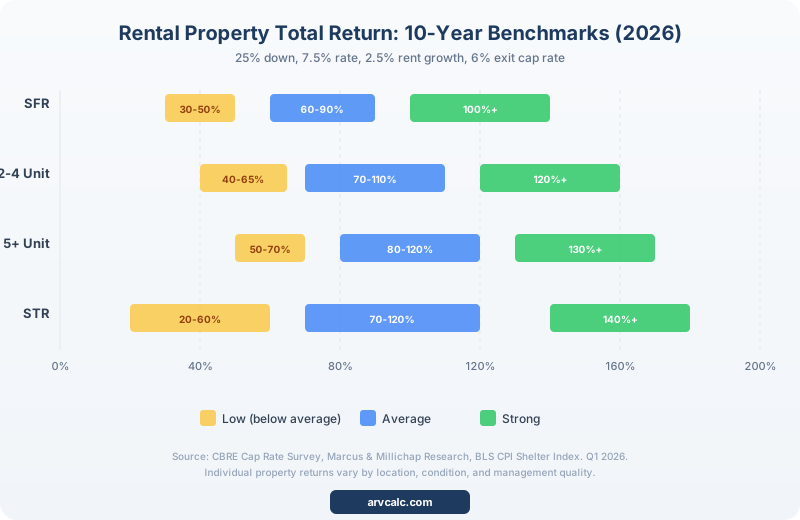
Below are typical 10-year total return ranges for stabilized rental properties purchased in 2026 at 25% down and prevailing interest rates. Ranges are derived from CBRE cap rate surveys, Marcus & Millichap research reports, and historical rent growth data from the Bureau of Labor Statistics CPI shelter index.
| Property Type | Low | Average | Strong |
|---|---|---|---|
| Single-Family Rental | 30% – 50% | 60% – 90% | 100%+ |
| Small Multifamily (2-4) | 40% – 65% | 70% – 110% | 120%+ |
| Large Multifamily (5+) | 50% – 70% | 80% – 120% | 130%+ |
| Short-Term Rental | 20% – 60% | 70% – 120% | 140%+ |
| State / Market | Typical 10-Year Total Return | Notes |
|---|---|---|
| Texas (DFW, Houston, San Antonio) | 80% – 130% | No state income tax. Strong rent growth in DFW suburbs. Property taxes are high (2.0% to 2.5%). |
| Georgia (Atlanta metro) | 90% – 130% | Consistent 3-4% rent growth since 2020. Lower property taxes than Texas. |
| Florida (Tampa, Jacksonville, Orlando) | 70% – 110% | Population growth supports rents. Insurance costs ($3,000 to $6,000/year) cut into NOI. |
| Ohio (Cleveland, Columbus, Cincinnati) | 100% – 150% | Low entry prices. Higher vacancy and tenant turnover in some zip codes. |
| California (LA, SF, San Diego) | 30% – 70% | High prices compress cash flow. Returns depend heavily on appreciation. Rent control in many cities. |
| North Carolina (Charlotte, Raleigh) | 85% – 125% | Strong job growth. Rising insurance costs after recent hurricane seasons. |
When Total Return Analysis Matters Most
Buy and Hold. This is the core use case. If you plan to hold a property for 7 to 30 years, total return and IRR are the only metrics that capture the full picture: annual cash flow, loan paydown, and exit equity. A property with thin Year 1 cash flow but strong rent growth can outperform a high-yield property with flat rents over a decade.
BRRRR (Buy, Rehab, Rent, Refinance, Repeat). Run the analysis twice. First with the rehab loan terms and short hold period (6 to 12 months). Then again with refinanced terms and the stabilized rent. The second run shows your long-term return on the cash left in the deal after the refinance.
Portfolio Comparison. When evaluating multiple potential acquisitions, total return and IRR let you compare deals on equal footing even when they have different hold periods, financing structures, or price points. A $150,000 duplex in Cleveland and a $450,000 single-family in Austin are incomparable on price alone but directly comparable on IRR.
Value-Add. If you’re buying below market, making improvements, and raising rents, the analysis captures the lift. Enter current rents for Year 1, then set a higher rent growth rate for the first 2 to 3 years to model the value-add period before growth normalizes.
Real-World Applications
Negotiating purchase price. Run your rental property analysis at asking price first. If the total return falls below your threshold, work backward. The “Find Max Purchase Price” mode tells you the highest price that still hits your target return. Bring that number to the negotiating table with the full analysis behind it.
Screening deals at scale. Rental property analysis doesn’t have to take hours. Investors who underwrite 50 to 100 properties per month need a fast filter. Enter rough numbers (listing price, Zillow rent estimate, market-average expenses) to get a ballpark total return in under 60 seconds. Kill the bottom 90% of deals immediately and run detailed analysis only on the top 10%.
Presenting to lenders or partners. A total return projection with year-by-year cash flow shows lenders and equity partners that you’ve done the math. Export the analysis as a PDF to include in your loan application or investor pitch deck.
Industry Standards and Benchmarks
Different stakeholders use different return thresholds. Here are the standards that shape how institutional and retail investors evaluate deals:
- Fannie Mae / Freddie Mac (FHFA guidelines, 2024 update): Require minimum 1.20x to 1.25x DSCR for multifamily loans. This translates to a property that generates at least 20% to 25% more income than its debt payments. Deals below 1.20x typically need rate buydowns or larger down payments.
- CCIM Institute (Certified Commercial Investment Member) framework: Teaches investors to evaluate deals using IRR as the primary return metric, with hurdle rates of 8% to 15% depending on risk profile. Single-tenant NNN properties target the low end; value-add multifamily targets the high end.
- Private equity / syndication sponsors: Most multifamily syndicators target 15% to 20% IRR for their investors over a 5 to 7 year hold. They achieve this through forced appreciation (renovations, rent increases, expense reduction) and use. Limited partners typically receive an 8% preferred return before the sponsor takes a promote.
- Individual investor benchmarks (a 2025 industry survey of buy-and-hold investors): Survey data shows most buy-and-hold investors target 8% to 12% cash-on-cash in Year 1 and 100%+ total return over a 10-year hold. Roughly 40% of respondents in 2025 accepted lower first-year returns in exchange for higher projected appreciation.
Limitations of Rental Property Analysis
Assumption sensitivity. Total return projections are only as accurate as the inputs. A 1 percentage point change in annual rent growth can shift 10-year total return by 15 to 25 percentage points. Use the calculator’s sensitivity table to stress-test your assumptions before committing.
Tax treatment is excluded. The calculator produces before-tax returns. Depending on your income bracket, depreciation deductions (straight-line over 27.5 years for residential), mortgage interest deductions, and state income tax can significantly change your after-tax return. A CPA familiar with real estate can model the tax impact on your specific situation.
Capital expenditure timing. The model spreads maintenance costs evenly across all years. In reality, a $12,000 roof replacement in Year 6 or a $8,000 HVAC install in Year 9 hits your cash flow in lumps. Budget a capex reserve (5% to 8% of gross rent) in your expense inputs to partially account for this, but recognize that the year-by-year projections smooth over these spikes.
When Not to Rely on This Analysis
Development and ground-up construction. This calculator models stabilized rental properties with existing income. If you’re building new units, your cash flow timeline starts at zero, construction costs replace purchase price, and lease-up risk adds uncertainty that a standard rental model cannot capture. Use a development pro forma instead.
Properties with major deferred maintenance. If the property needs $50,000+ in immediate repairs before it can be rented, the analysis understates your true cash outlay and timeline. Use the Fix & Flip Calculator or BRRRR Calculator for the acquisition/rehab phase, then run the rental analysis on the stabilized property.
Common Mistakes in Rental Property Analysis
Using pro forma rents instead of actual comps. The most common rental property analysis mistake starts with the income line. Sellers and brokers quote rents that the property could achieve after renovations, not what it collects today. Base your analysis on current lease agreements or verified market comps. If you plan to raise rents after improvements, model that as higher rent growth in Years 1 through 3, not as the starting rent.
Ignoring Year 1 cash flow. Many investors fixate on 10-year total return while ignoring that the property loses money every month for the first 3 years. Negative cash flow means you fund the gap from savings. If you can’t sustain $300 to $500 per month in negative cash flow for 2 to 3 years, the deal doesn’t work for you regardless of the 10-year projection.
Comparing deals across different hold periods. A 120% total return over 15 years is not better than 90% over 7 years. Use IRR to compare deals with different time horizons. The 7-year deal at 90% likely has a higher IRR because your capital is working for fewer years to produce nearly the same return.
FAQ
What is a good Total Return for rental property in 2026?
For a 10-year hold with 25% down and a 7% to 8% interest rate, 60% to 100% total return is market-average. Above 100% is strong. Below 30% underperforms a passive index fund. These ranges assume 2% to 3% annual rent growth and a 6% exit cap rate.
What is the difference between Total Return and IRR?
Total Return tells you how much profit you made as a percentage of cash invested. IRR tells you the annualized rate at which your money grew, accounting for the timing of each cash flow. A 100% total return over 10 years is roughly a 7% to 8% IRR. Over 5 years, the same 100% total return implies a 15% IRR because your money doubled faster.
How does hold period affect Total Return?
Longer holds almost always produce higher total returns because you collect more years of cash flow and more loan amortization. But IRR often peaks at 7 to 10 years because the marginal cash flow added in years 11 through 30 grows more slowly. The “best” hold period depends on your opportunity cost and what else you could deploy the equity into.
Should I use Cap Rate exit or Appreciation exit method?
Cap Rate exit is the professional standard. It sets the sale price based on the property’s income at exit (Final Year NOI / Exit Cap Rate). Appreciation exit simply grows the purchase price at a fixed annual rate and ignores whether the property’s income supports that price. Use Cap Rate exit for analysis you plan to share with lenders or partners. Use Appreciation exit only for quick sanity checks.
Does this calculator include taxes?
No. All results are before income tax. Depreciation, mortgage interest deductions, capital gains tax at sale, and potential 1031 exchange benefits are excluded. After-tax returns vary widely by investor, so a before-tax baseline keeps the analysis comparable across different tax situations. Use the Capital Gains Tax Calculator to estimate your tax liability at exit.
Why is Year 1 cash flow negative on many 2026 deals?
Interest rates above 7% push monthly mortgage payments higher than many properties’ NOI can cover. A $300,000 property at 7.5% and 25% down has a $1,573/month payment. If monthly NOI is $1,300, you’re negative $273/month. This is common in 2026 and doesn’t automatically make the deal bad if rent growth turns cash flow positive by Year 3 to 4 and total return over 10 years meets your target.
What rent growth rate should I use?
The Bureau of Labor Statistics CPI shelter index has averaged 3.2% annual rent growth nationally from 2015 through 2025. Conservative underwriting uses 2% to 3%. High-growth Sun Belt metros (Austin, Nashville, Raleigh) have seen 4% to 6% over the past 5 years, but projecting those rates for a full decade is aggressive. Use 3% as a baseline and stress-test at 1.5% and 4.5%.
Can I analyze a short-term rental (Airbnb) with this calculator?
You can, but use the Airbnb / STR Calculator for a more accurate model. STR income varies seasonally, and vacancy rates of 25% to 40% are normal depending on the market. If you use the standard rental calculator, input your projected average monthly income after accounting for seasonal dips and cleaning/management fees as part of expenses.
Run Your Rental Property Analysis
3 calculation modes including reverse-solve for target rent and max purchase price. Year-by-year projections with built-in sensitivity analysis.
Open Rental Property Calculator
Related Calculators
- Cap Rate Calculator — measure property yield before financing
- Cash-on-Cash Calculator — first-year return on actual cash invested
- DSCR Calculator — check if rent covers the mortgage
- NOI Calculator — detailed operating income breakdown
- ROI Calculator — simplified return on investment
- IRR Calculator — annualized return with time value of money
- BRRRR Calculator — buy, rehab, rent, refinance, repeat analysis
- Mortgage Calculator — investment property loan payments and amortization
Disclaimer: This article is for educational purposes only and does not constitute financial, investment, legal, or tax advice. Real estate investing involves significant risk, including the potential loss of capital. All numbers, rates, and projections are illustrative examples and may not reflect your specific situation. Consult qualified financial, legal, and tax professionals before making any investment decisions.
Leave a Reply