
Cap rate is the first number experienced landlords check when evaluating a rental deal. It tells you how much income a property generates relative to its price, before financing costs. Get it wrong, and you lock your capital into a building that barely breaks even.
Below is a practical breakdown of cap rate ranges by property type and US market tier in 2026, along with the pitfalls that trip up buyers who rely on this metric alone.
:
Cap Rate Formula
Cap rate (capitalization rate) expresses annual property income as a percentage of its value, ignoring debt:
Cap Rate = (Net Operating Income / Property Value) x 100
Worked example (single-family rental, Dallas TX, 2026 assumptions):
- Gross annual rent: $36,000 ($3,000/mo)
- Vacancy allowance 7%: -$2,520
- Operating expenses (taxes $4,200, insurance $1,800, management 8% = $2,880, maintenance $2,400, misc $1,200): -$12,480
- NOI: $36,000 – $2,520 – $12,480 = $21,000
- Purchase price: $310,000
- Cap rate: $21,000 / $310,000 = 6.77%
Is 6.77% a good cap rate? For a single-family rental in Dallas, yes. That 6.77% means the property earns about 6.8 cents per dollar of value each year before any mortgage payment. Run your own numbers with the Cap Rate Calculator.
Good Cap Rate Ranges for Rental Property in 2026
What counts as a good cap rate varies widely. No single number qualifies as “good” everywhere. A 5% cap rate is strong in Manhattan but weak in Memphis. The table below reflects ranges reported by CBRE, Marcus & Millichap, and CoStar for stabilized US properties as of Q1 2026:
| Property Type | Typical Range | Good | Excellent |
|---|---|---|---|
| Single-Family Rental | 4.5% – 6.5% | 6% – 7% | 7%+ |
| Small Multifamily (2-4 units) | 5.0% – 7.5% | 7% – 8% | 8%+ |
| Large Multifamily (5+ units) | 5.5% – 8.0% | 7.5% – 9% | 9%+ |
| Commercial / Mixed-Use | 6.0% – 10.0% | 8% – 10% | 10%+ |
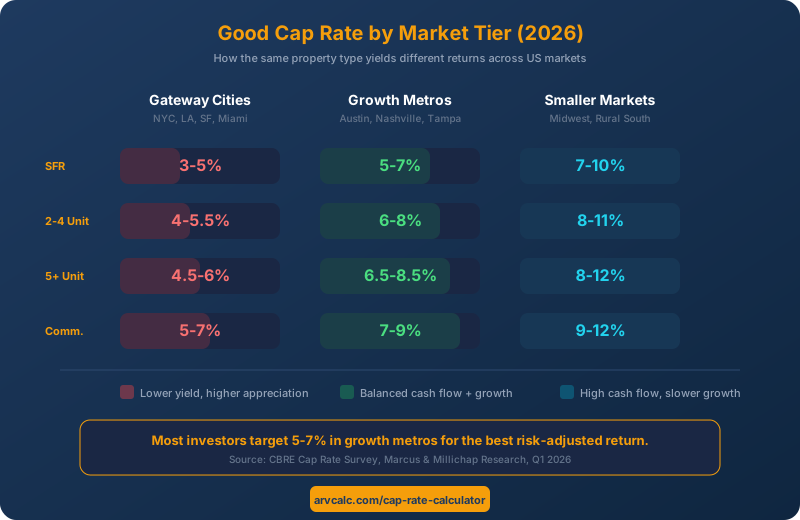
How Geography Shifts the Numbers
- Gateway cities (NYC, LA, SF, Miami): 3% – 5%. You’re paying for tenant demand and long-run appreciation. Cash flow is thin.
- Growth metros (Austin, Nashville, Raleigh, Tampa, Phoenix): 5% – 7%. Rent growth has been 4-6% annually in these markets since 2020, which helps cap rates hold up even as prices rise.
- Smaller cities and rural areas: 7% – 12%. Strong monthly cash flow on paper. But higher turnover, longer vacancy gaps, and fewer property managers to choose from.
Takeaway: Most investors building a portfolio in 2026 do well targeting 5-7% in growth metros. That range balances current income with rent appreciation.
When a High Cap Rate Is Actually a Red Flag
Sorting Zillow by cap rate and buying the highest number is a recipe for headaches. Why a property might show 11% when everything around it trades at 6%:
Common reasons for inflated cap rates:
- Pro forma rents instead of actual collected rents. The listing says $1,400/unit but tenants are paying $1,100.
- Deferred capex. The roof has 2 years left, HVAC is 18 years old. You’ll spend the first year’s NOI on replacements.
- Declining neighborhood. Population loss, rising crime, school closures. The property is cheap for a reason.
- Missing expenses. No management fee (owner self-manages), no capex reserve, no vacancy factor. Strip those out and the “11% deal” is really 6%.
Before trusting any seller’s numbers, rebuild the NOI yourself. The NOI Calculator walks you through every expense line item.
Cap Rate vs. Other Metrics
However, cap rate has a blind spot: it ignores how you pay for the property. Two investors can buy the same building at the same cap rate, but the one with 80% LTV earns a completely different return on their cash. That’s why you need more than one number:
| Metric | What It Shows | Financing? | Calculator |
|---|---|---|---|
| Cap Rate | Unused property yield | No | Cap Rate |
| Cash-on-Cash | Return on your actual cash outlay | Yes | CoC |
| DSCR | Does rent cover the mortgage? | Yes | DSCR |
| NOI | Dollar income after operating costs | No | NOI |
| Total ROI | Cash flow + equity + appreciation | Yes | Full Analysis |
Run all five on any deal with the free calculator suite.
5 Ways to Raise Your Existing Property’s Cap Rate
- Audit current rents against comps. Pull 3-5 comparable listings within half a mile. If you’re $75-150/unit below market, send 60-day rent increase notices. On a 4-unit, even $100/unit/month adds $4,800/year to NOI.
- Add billable services. Coin laundry ($200-400/unit/year), assigned parking ($50-75/space/month), pet rent ($25-50/pet/month). These have near-zero operating cost.
- Cut vacancy days — beyond just vacancy rate. The difference between 21-day and 7-day turns on a $1,500 unit is $700 per turnover. Pre-list before tenants move out, offer signing bonuses for quick leases.
- Shop insurance and appeal taxes. Get 3 insurance quotes annually (typical savings 10-15%). File a tax assessment appeal if comps support a lower value. Both hit NOI directly.
- Targeted renovations with rent premiums. A $4,000 kitchen refresh (counters, hardware, paint) can support $125-200/month rent increase. Payback period: under 3 years.
What Cap Rate Does NOT Tell You
Cap rate is useful, but it has real blind spots. Relying on it alone will cost you money:
- No financing impact. A 7% cap rate property with a 7.5% mortgage rate actually loses money on a financed basis. Always check DSCR and cash-on-cash alongside cap rate.
- Static snapshot. Cap rate uses trailing or current NOI. It says nothing about whether rents are rising, expenses are spiking, or the neighborhood is changing.
- No capex visibility. NOI excludes capital expenditures (roof, HVAC, parking lot). A property with a healthy cap rate can still drain cash if it needs a $40,000 roof next year.
- Ignores appreciation. In high-cost markets, most of the return comes from value growth, not income. Cap rate misses that entirely.
- Assumes stabilized occupancy. The formula breaks down for vacant or repositioning properties. If the building is 60% occupied, the current cap rate is meaningless.
Bottom line: cap rate is a screening tool rather than a decision tool. Use it to filter deals quickly, then dig deeper with full cash flow analysis.
Common Mistakes Investors Make When Using Cap Rate
Cap rate is a simple metric, but simple doesn’t mean easy. I see investors of all experience levels make the same errors. These mistakes can cost you thousands in missed profit or, worse, a bad deal you cannot exit. Here are five of the most frequent errors I encounter.
Using Market Averages Blindly
The biggest trap is comparing every property to a single “average” cap rate for your city. A 6.5% average in a metro area does not mean every 6.5% deal is good. Market averages blend Class A, B, and C properties, different neighborhoods, and different property conditions. A 6.5% cap for a stabilized Class A property in a prime location might be fair. The same 6.5% cap for a Class C property in a declining area signals you are overpaying for risk. You must adjust your target cap rate based on property condition, tenant quality, and location. Use the rental property calculator to test different cap rate scenarios against your specific property class, not the city average.
Ignoring Financing Costs
Cap rate measures property income, not your personal return. A 7% cap property looks good until you factor in a 7.5% conventional mortgage. If your debt cost is higher than your cap rate, you have negative leverage (debt cost exceeds cap rate). Your cash flow will be zero or negative. Many new investors buy based on cap rate alone, then find their actual monthly cash flow is underwater. You must run the full numbers with your specific loan terms. The cash-on-cash calculator shows your true return after debt service. Never commit to a deal based on cap rate without first modeling your financing.
Using Pro Forma NOI Instead of Actuals
Sellers love to show you “pro forma” net operating income. They assume full occupancy at market rents with zero vacancies. Real life is different. I always ask for trailing 12-month income and expense statements. If the actual NOI is 20% lower than the pro forma, your cap rate drops from 7% to 5.6%. That is a different deal entirely. Always verify expenses, especially property management (5-10%), repairs (5-15%), and vacancy (5-8%). Use the compare deals calculator to run both the pro forma and actual NOI side by side. If the seller cannot provide actuals, assume the worst case.
Confusing Cap Rate with Total Return
Cap rate is a snapshot of current income yield. It does not account for appreciation, loan paydown, or tax benefits. Two properties can have the same 7% cap rate but vastly different total returns. One might be in a growing market with 5% annual appreciation. Another might be in a stagnant market with zero appreciation. The first property gives you a 12% total return (7% income + 5% appreciation). The second gives you only 7%. Do not buy solely on cap rate. Factor in market growth trends and your hold period. A low cap rate in a high-growth area often beats a high cap rate in a no-growth area.
Applying Cap Rate to Small Residential Properties
Cap rate works best for commercial multifamily (5+ units) where expenses are standardized. For single-family rentals and small multifamily (2-4 units), the numbers are less reliable. Small properties have higher expense ratios per unit. A single-family home might have a 40% expense ratio while a 100-unit building might have 30%. If you use a standard 35% expense assumption on a single-family home, your cap rate will be overstated. Adjust your expense ratio upward for smaller properties. Also, small property valuation is driven more by comparable sales than by income. Use cap rate as a sanity check, not your primary valuation tool, for 1-4 unit properties.
Strategy Guide by Investor Type
Cap rate is not a one-size-fits-all number. Your target cap rate should match your investment strategy, experience level, and financing structure. Here is how different investor types should approach cap rate in 2026.
Beginner Investors
If you are new to real estate investing, your priority is safety and cash flow. Do not chase high cap rates in risky areas. A 10% cap rate in a declining neighborhood comes with tenant problems, high vacancy, and expensive repairs. You might end up with negative cash flow after your first eviction. Target properties with a cap rate between 6% and 8% in stable, growing markets. These properties are easier to manage and easier to sell if you need to exit. Use the rental property calculator to model your first deal with conservative assumptions. Assume 8% vacancy and 10% repairs. If the deal still shows positive cash flow at a 6.5% cap rate, you have a solid foundation. Do not borrow above 75% LTV. Your first deals should be simple and survivable.
Experienced Investors
Experienced investors have the skill and capital to handle higher risk for higher reward. You can target cap rates of 8% to 10% in B-class neighborhoods or value-add properties. You know how to force appreciation through renovations, better management, or repositioning. You can also use creative financing to improve your return. For example, you might buy a property at a 7% cap rate but use a DSCR loan at 8.25% (2026 rate). That is negative leverage on the surface. But if you can increase rents by 15% in the first year, your effective cap rate jumps to 8.05%. Your cash flow turns positive. You also benefit from appreciation in a recovering market. Use the compare deals calculator to run multiple scenarios. Compare a 7% cap with conventional financing versus an 8% cap with DSCR financing. The higher cap plus value-add often wins over time. Experienced investors can also self-manage to save 5-8% in property management fees, effectively boosting their cap rate by that amount.
BRRRR Investors
The BRRRR method (Buy, Rehab, Rent, Refinance, Repeat) requires a specific cap rate approach. Your purchase cap rate is less important than your “after-repair” cap rate. You want to buy at a discount, add value through rehab, then refinance based on the new, higher value. Here is the math: You buy a distressed property at a 10% cap rate based on current rents. After a $50,000 rehab, you increase rents by 30%. Your new NOI supports a 7.5% cap rate valuation. You refinance at 75% LTV using a conventional loan at 7.5% (2026 rate). You pull out all your initial capital. Your cash-on-cash return becomes infinite because you have no money left in the deal. The key metric is the spread between your purchase cap rate and your refinance cap rate. A wider spread means more forced equity. Use the cash-on-cash calculator to model your BRRRR deal step by step. Enter your purchase price, rehab costs, new rent, and refinance terms. If your cash-on-cash return is above 15% after refinancing, the deal works. BRRRR investors should target a minimum 2% cap rate spread between purchase and after-repair value.
2026 Market Context: How Current Rates Affect Cap Rate
The 2026 market is different from the low-rate environment of 2020-2021. Interest rates are higher, and that changes how you should use and interpret cap rates. Here is the current picture based on 2026 data.
Financing Costs Are Higher Than Cap Rates
In 2026, conventional mortgage rates are around 7.5% for investment properties. DSCR loans are at 8.25%. Hard money is at 12%. Many stabilized properties in good areas trade at cap rates between 5% and 7%. This means your financing cost is higher than your income yield. You have negative leverage (debt cost exceeds cap rate). Your cash flow will be thin or negative if you put only 20% down. To make deals work, you must either put more equity down (30-40%) or find properties with higher cap rates (8% or more). The cash-on-cash calculator is essential here. It shows your actual return after debt service. A 7% cap property with 20% down and a 7.5% loan might give you a 2% cash-on-cash return. That is below most investor targets. You need a 9% cap rate to get a 6-8% cash-on-cash return with 20% down in 2026.
Cap Rate Compression Is Slowing
During the low-rate years, cap rates compressed as buyers paid higher prices for the same income. That trend has paused. With rates at 7.5%, buyers are demanding higher cap rates to compensate. Sellers are reluctant to lower prices. This creates a bid-ask spread that slows transaction volume. As an investor, you have more negotiating power. You can offer below asking price and justify it with current financing costs. Use the compare deals calculator to show the seller how their asking price translates to a 6% cap rate, while your offer at a 7% cap rate is fair based on 2026 debt costs. Be patient. Deals that sit on the market for 60+ days become negotiable.
Hard Money Is a Short-Term Tool
Hard money at 12% is expensive. It is only appropriate for short-term fix-and-flip or BRRRR deals where you hold for 6-12 months. Do not use hard money for a buy-and-hold rental. The 12% interest will destroy your cap rate. If you buy a property at a 7% cap with hard money, your negative cash flow will be severe. You will be forced to refinance quickly. Make sure your exit strategy is clear before signing a hard money note. The rental property calculator can model your holding costs during the rehab period. Include interest payments, property taxes, and insurance. If your total holding cost exceeds 5% of the purchase price, the deal is too risky.
Cap Rate Spreads Are Widening by Asset Class
In 2026, the spread between Class A and Class C cap rates is wider than historical averages. Class A properties in prime locations trade at 4.5% to 5.5% caps. Class C properties in secondary markets trade at 8% to 10%. This spread reflects higher perceived risk in lower-quality assets. Experienced investors can profit from this spread by buying Class C properties with strong fundamentals and improving them to Class B. The cap rate compression from 9% to 7% can generate significant equity. Beginners should stick with Class B properties at 6-7% caps. The risk is manageable, and the financing works at 7.5% conventional rates if you put 25-30% down.
Rate Changes and Cap Rate Impact
If and when the Federal Reserve lowers rates — timing is uncertain — cap rates would likely compress again. Lower rates historically compress cap rates. Properties bought at today’s higher cap rates will appreciate as buyers accept lower yields. This is a long-term opportunity. If you buy a 7.5% cap property today with a 7.5% loan, your cash flow is neutral. But if rates drop to 6% in 2027, your property value increases by roughly 10-15% (assuming same NOI). You gain appreciation without doing any work. This is the strategic play for 2026: buy for cash flow neutral today, profit from cap rate compression tomorrow. Use the compare deals calculator to model a 1% cap rate drop in year two. See how your total return jumps from 7% to 12% or more. That is the real power of buying in a high-rate market.
FAQ
Is a 10% cap rate a good cap rate for rental property?
In most US metros, 10% is well above average and signals strong cash flow. But double-check the NOI inputs. A 10% cap rate in a market where 6% is normal usually means the seller is using optimistic projections, or the property has issues that suppress the price. If the income is verified and the building is in decent shape, 10% is a strong buy.
What is a bad cap rate vs a good cap rate?
Below 4% outside of gateway cities (NYC, SF, LA) usually means you’re overpaying relative to income. At 3% or less, you’re betting almost entirely on price appreciation. That can work in high-demand markets, but it’s speculation, not income investing.
Does cap rate include the mortgage?
No. Cap rate uses NOI, which covers operating expenses only (taxes, insurance, management, repairs). Debt service is excluded by design so you can compare properties regardless of how they’re financed. For a metric that includes your loan, use Cash-on-Cash Return.
How do interest rates affect cap rates?
Higher borrowing costs tend to push cap rates up because buyers pay less for the same income stream. Between 2022 and 2024, cap rates expanded roughly 50-150 basis points across property types as the Fed raised rates. As of early 2026, rates have stabilized and cap rate movement has slowed.
Can I buy a low cap rate property and still make money?
Yes, if your thesis is appreciation or value-add. A 4.5% cap rate in a market growing 8% annually can deliver strong total returns. The key requirement: the property must still cover its mortgage. Run it through the DSCR Calculator first. If DSCR is below 1.0, the rent doesn’t cover the loan and you’ll feed the property cash every month.
What Cap Rate Should You Target?
Quick framework:
- Cash flow priority: 7-10% in secondary/tertiary markets
- Balanced: 5-7% in growth metros
- Appreciation priority: 4-6% in primary markets with job/population growth
Use a good cap rate target to narrow your search, then verify with cash-on-cash, DSCR, and a full proforma. One metric never tells the whole story.
Run the Numbers on Your Next Deal
Instant cap rate with sensitivity analysis and performance benchmarks.
Open Cap Rate Calculator
Disclaimer: This article is for educational purposes only and does not constitute financial, investment, legal, or tax advice. Real estate investing involves significant risk, including the potential loss of capital. All numbers, rates, and projections are illustrative examples and may not reflect your specific situation. Consult qualified financial, legal, and tax professionals before making any investment decisions.
Leave a Reply