
Net operating income is the single number that determines what a rental property is worth. Every cap rate, every DSCR ratio, every commercial appraisal starts with NOI. Get it wrong, and every metric downstream is garbage.
This guide covers how to calculate net operating income for real estate, what to include in expenses, what to leave out, and how to interpret your result using 2026 market benchmarks.
What makes NOI useful is that it strips away financing and focuses on the property itself. Two investors can buy the same building with different loans and different returns, but the NOI is identical. That makes it the only apples-to-apples comparison tool in real estate.
Every section below ties to the inputs and outputs of our NOI Calculator. Follow along with your own deal.
:
What Is Net Operating Income?
Net operating income (NOI) measures how much money a property generates after paying all operating costs but before any mortgage payments. It answers one question: does this building make money on its own, regardless of how you finance it?
Lenders, appraisers, and institutional buyers all start with NOI. It feeds directly into cap rate (NOI / price), DSCR (NOI / debt service), and the income approach to valuation (price = NOI / cap rate). If your NOI calculation is off by 10%, every downstream number is off by 10%.
How to Calculate NOI: Step by Step
Step 1: Enter gross rental income. Add up the annual rent for every unit at full occupancy. Use actual lease amounts or verified market comps from Zillow, Rentometer, or local MLS. Do not use the seller’s pro forma projections.
Step 2: Add other income and set vacancy. Include laundry, parking, storage, pet fees, and any other recurring revenue. Set vacancy to the submarket average: 5% to 8% for most US metros, higher for rural or seasonal markets.
Step 3: Enter operating expenses. Include property taxes, insurance, property management (8% to 10% of collected rent), maintenance, landscaping, pest control, and a capital expenditure reserve. Do not include mortgage payments, depreciation, or income tax.
Inputs and Outputs
Inputs:
- Gross Rental Income — total annual rent at 100% occupancy
- Other Income — laundry, parking, storage, pet fees
- Vacancy Rate — percentage of gross rent lost to turnover (5% to 8%)
- Operating Expenses — taxes, insurance, management, maintenance, reserves
- Number of Units (optional) — for per-unit analysis
Outputs:
- Net Operating Income — the primary result
- Effective Gross Income (EGI) — rent after vacancy plus other income
- NOI Margin — NOI as percentage of gross rent (how much income you keep)
- Expense Ratio — operating expenses as percentage of EGI
- Implied Property Value — NOI divided by various cap rates (4% to 10%)
- NOI per Unit — for comparing multifamily properties
The NOI Formula
NOI = Effective Gross Income – Operating Expenses
Where:
- Effective Gross Income (EGI) = Gross Rent x (1 – Vacancy Rate) + Other Income
- Operating Expenses = Taxes + Insurance + Management + Maintenance + Reserves + Misc
Worked example (4-unit property, Dallas TX, 2026 assumptions):
- 4 units at $1,350/mo each = $64,800/yr gross rent
- Other income (laundry + parking): $2,400/yr
- Vacancy rate: 6%
Step 1 — Effective Gross Income:
- EGI = $64,800 x (1 – 0.06) + $2,400 = $60,912 + $2,400 = $63,312
Step 2 — Operating Expenses:
- Property taxes: $7,200
- Insurance: $3,200
- Property management (8% of EGI): $5,065
- Maintenance and repairs: $4,800
- Misc (pest, landscaping, supplies): $1,200
- Total operating expenses: $21,465
Step 3 — NOI:
- NOI = $63,312 – $21,465 = $41,847/yr
- NOI Margin = $41,847 / $64,800 = 64.6%
- Expense Ratio = $21,465 / $63,312 = 33.9%
- NOI per unit = $41,847 / 4 = $10,462/yr
Result: At a 7% cap rate, this property is worth $41,847 / 0.07 = $597,814. At 8%, it’s worth $523,088. The NOI determines the price range for any serious buyer. Run your own numbers with the NOI Calculator.
What Your NOI Result Means
The calculator rates every property by NOI Margin (how much of gross rent reaches operating income). Higher margin means more cushion against vacancies and expense surprises.
| Rating | NOI Margin | What It Means |
|---|---|---|
| Institutional Grade | 60%+ | Unusually high income retention. Typical of well-managed large multifamily with low per-unit costs. Supports premium valuations and aggressive advantage. |
| Strong Performer | 50% – 59% | More than half of rent reaches the operating line. Solid cushion against vacancy spikes or unexpected repairs. Attractive to lenders. |
| Solid | 40% – 49% | Standard range for stabilized single-family and small multifamily. Manageable but limited room for error. One bad tenant turnover can eat a quarter’s margin. |
| Weak | 25% – 39% | Thin margins. Common in high-tax states (NJ, IL, NY) or properties with deferred maintenance. Vulnerable to any expense increase. |
| Critical | Below 25% | Most of the rent goes to expenses. Cash flow is fragile or negative once you add debt service. Needs rent increases or expense reduction before acquisition. |
A 45% NOI margin in Texas (low property taxes relative to rents) is weaker than 45% in New Jersey (high taxes eat a larger share). Always compare against the local market norm rather than a national average.
NOI Benchmarks by Property Type and Market
| Property Type | Typical NOI Margin | Typical Expense Ratio | Notes |
|---|---|---|---|
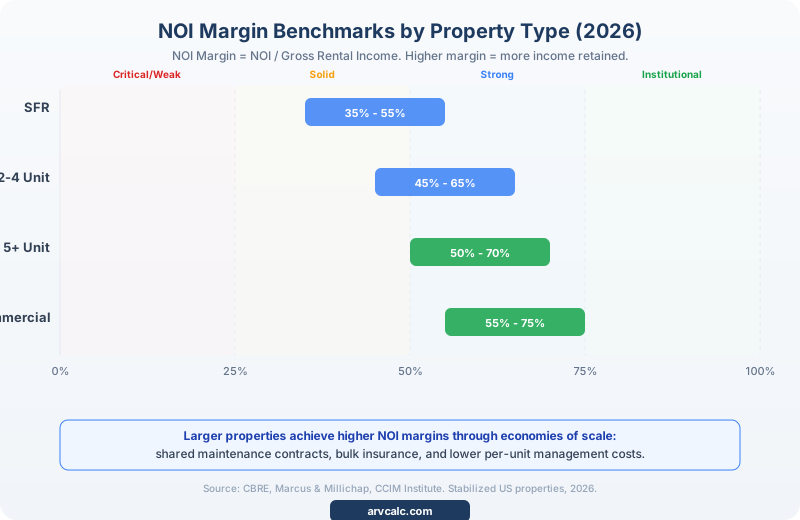
| Single-Family Rental | 35% – 55% | 45% – 65% | Higher per-unit management cost. Vacancy hits harder (100% or 0%). |
| Small Multifamily (2-4) | 45% – 65% | 35% – 55% | Shared structure lowers insurance and maintenance per unit. |
| Large Multifamily (5+) | 50% – 70% | 30% – 50% | Professional management at scale. Economies on maintenance and insurance. |
| Commercial / Mixed-Use | 55% – 75% | 25% – 45% | NNN leases shift expenses to tenants. Highest margins in the sector. |
| State | Typical NOI Margin (SFR) | Notes |
|---|---|---|
| Texas | 40% – 55% | Property tax rates 2.0% to 2.5% compress margins despite strong rents. |
| Florida | 45% – 58% | No state income tax. Insurance costs $3,000 to $6,000/yr hurt coastal properties. |
| California | 35% – 48% | Prop 13 keeps taxes low for long-term owners. High insurance and maintenance costs. |
| Georgia | 48% – 62% | Lower taxes and insurance than coastal states. Strong rent growth in Atlanta metro. |
| Arizona | 45% – 58% | Low maintenance costs (no snow, no humidity damage). Property tax ~0.6%. |
| Colorado | 42% – 55% | High rents offset by rising insurance and property tax reassessments. |
| New York | 30% – 45% | High taxes, insurance, and compliance costs. Rent control in NYC limits upside. |
| Washington | 42% – 55% | No state income tax. Seattle rents strong but property taxes rising. |
When NOI Matters Most
Buy and Hold. NOI is your starting point for every acquisition. Calculate it before looking at financing. If the NOI doesn’t support a reasonable cap rate for the market, no loan structure will save the deal.
BRRRR. Run NOI twice. First with current (pre-rehab) rents to understand what you’re buying. Then with projected rents after improvements. The delta between the two NOIs determines how much value you’re creating through forced appreciation.
Commercial and Multifamily. Banks price commercial loans almost entirely on NOI. The appraisal uses income approach (value = NOI / cap rate), and the loan amount is based on DSCR (NOI / debt service). A $5,000 increase in annual NOI at a 6% cap rate adds $83,333 to the property’s appraised value.
Portfolio Comparison. Comparing a $200,000 duplex to a $600,000 fourplex on price alone is meaningless. Comparing their NOI margins tells you which property operates more efficiently and which has more room for expense optimization.
Real-World Applications
Deal screening. Pull the listing price and estimate NOI from rent comps and market-average expenses. Divide NOI by the asking price to get cap rate. If cap rate is below your minimum threshold (say 6%), move on. Takes 60 seconds per deal.
Offer negotiation. Rebuild the seller’s NOI with your own vacancy and expense estimates. Sellers commonly understate vacancy (using 3% when the market is 7%) and omit management fees. The gap between seller’s NOI and your NOI is your negotiating advantage.
Refinance analysis. Lenders recalculate NOI during refinance. If you’ve raised rents or reduced expenses since purchase, your NOI is higher, supporting a larger loan and potentially pulling cash out. Use the NOI Calculator to project where your NOI will be at refinance time.
Industry Standards
- Fannie Mae / Freddie Mac (2024 Multifamily Seller Guide): Require minimum 1.20x to 1.25x DSCR, which means NOI must exceed annual debt service by at least 20% to 25%. Fannie requires trailing-12-month actual trailing-12-month NOI rather than projections, for stabilized properties.
- CCIM Institute (CI 101 curriculum): Defines NOI as gross income minus vacancy and operating expenses, explicitly excluding debt service, depreciation, and income taxes. CCIM certification exams test this definition precisely.
- Common lender underwriting: Most commercial lenders apply a 5% to 10% “haircut” to the borrower’s stated NOI as a stress test. If your deal only works at your exact NOI number with zero margin, the lender will decline it.
- Appraisal Standards (USPAP 2024-2025): Income approach requires NOI based on market rent (not contract rent) for appraisal purposes, unless the subject property has long-term leases.
Limitations of NOI
NOI ignores financing entirely. A property with $50,000 NOI looks the same whether you pay cash or take a $400,000 loan. But your actual return depends heavily on advantage. Use DSCR and Cash-on-Cash to see how financing changes the picture.
It’s a point-in-time snapshot. NOI captures one year of operations. It doesn’t account for rent growth, expense inflation, or capital expenditures that happen in lumps (roof replacement in Year 5, HVAC in Year 8). Use the Rental Property Calculator for multi-year projections.
No appreciation component. A property in Austin with 4% annual appreciation and a property in Cleveland with 0% appreciation can have identical NOIs. The total return over 10 years will be dramatically different, but NOI won’t show that.
When Not to Rely on NOI
New construction and development. There is no rental income during construction. NOI is meaningless until the property is built, leased, and stabilized. Use a development pro forma with construction timeline and lease-up assumptions instead.
Owner-occupied properties. If you live in one unit of a fourplex, your “rental income” for that unit is zero. NOI calculated with three paying units and one empty unit understates the property’s market NOI. Calculate with all units at market rent for comparison purposes, then adjust for your personal unit separately.
Common Mistakes in NOI Calculations
Including mortgage payments. The most frequent error. Mortgage principal and interest are financing costs — these belong to financing, not operations. NOI must exclude all debt service. If your NOI includes the mortgage, you’re calculating cash flow, not NOI.
Skipping vacancy. Zero percent vacancy does not exist. Even in the tightest rental markets, turnover between tenants costs 2 to 4 weeks of rent plus cleaning and minor repairs. Budget 5% to 8% vacancy for long-term rentals, 20% to 30% for short-term rentals.
Omitting property management. Self-managing saves money today but creates an artificially high NOI. Budget 8% to 10% of collected rent for management whether you hire a PM or not. When you eventually sell, the buyer’s appraiser will deduct it, and your property will be worth less than you expected.
FAQ
Is NOI the same as cash flow?
No. NOI is income before debt service. Cash flow is income after debt service. NOI = EGI minus expenses. Cash flow = NOI minus mortgage payments. A property can have positive NOI and negative cash flow if the mortgage is large enough.
What is a good NOI for a rental property?
It depends on the property type and market. For single-family rentals, NOI margins of 45% to 55% are solid. For multifamily, 55% to 65% is strong. The absolute dollar amount matters less than the margin and how it compares to local benchmarks.
Should I include a management fee even if I self-manage?
Yes. Always include 8% to 10% management in your NOI calculation. Self-managing is a labor decision, not a property characteristic. Your time has value. And when you sell or refinance, the appraiser will deduct management regardless of whether you currently pay for it.
How do lenders use NOI?
Lenders divide NOI by annual debt service to get DSCR (Debt Service Coverage Ratio). Most require DSCR of 1.20x to 1.25x minimum. A $50,000 NOI with $40,000 annual debt service = 1.25x DSCR. If your NOI drops, DSCR drops, and the lender may not approve the loan. Use the DSCR Calculator to check.
What is the difference between NOI and EBITDA?
EBITDA (Earnings Before Interest, Taxes, Depreciation, and Amortization) is a corporate finance metric. NOI is real estate-specific. The main difference: EBITDA starts from total revenue including non-property income, while NOI only counts property operating income. For a single rental property with no business operations, they produce similar numbers.
Can NOI be negative?
Yes. If operating expenses exceed effective gross income, NOI is negative. This means the property loses money even before any mortgage payment. Common causes: high vacancy (above 25%), deferred maintenance requiring expensive repairs, or below-market rents on inherited leases. Negative NOI properties are acquisition candidates only if rents can be raised or expenses cut.
How is NOI used to value a property?
The income approach to valuation: Property Value = NOI / Cap Rate. If a property generates $50,000 NOI and comparable properties sell at 7% cap rates, the property is worth $50,000 / 0.07 = $714,286. This is how commercial appraisers and institutional buyers price buildings. Use the Cap Rate Calculator to run this analysis.
What is the 50% rule for NOI?
You may have heard of the 50% rule — a rough screening heuristic: assume operating expenses equal 50% of gross rent, making NOI approximately 50% of gross rent. It is not accurate for actual underwriting. Real expense ratios range from 30% (well-managed commercial) to 65% (older SFR with high taxes). Use it only for 30-second deal screening, then run actual numbers with the NOI Calculator.
Calculate Your Property’s NOI
3 calculation modes: forward NOI, required income, and max expenses. Instant implied property value at multiple cap rates.
Open NOI Calculator
Related Calculators
- Cap Rate Calculator — convert NOI to property yield
- DSCR Calculator — check if NOI covers the mortgage
- Cash-on-Cash Calculator — return on actual cash invested
- Rental Property Calculator — multi-year total return projection
- Multifamily Calculator — analyze 5+ unit buildings
- PM Fee Calculator — management cost impact on NOI
- Vacancy Rate Calculator — measure vacancy losses
- ROI Calculator — total return on investment
Disclaimer: This article is for educational purposes only and does not constitute financial, investment, legal, or tax advice. Real estate investing involves significant risk, including the potential loss of capital. All numbers, rates, and projections are illustrative examples and may not reflect your specific situation. Consult qualified financial, legal, and tax professionals before making any investment decisions.
Leave a Reply