Last updated: November 3, 2026 · Originally published: November 4, 2026 · By Alex Petrov
The BRRRR strategy South Carolina market offers two standout cities for investors. I ran BRRRR numbers across all five South Carolina markets over the past three months. Two cities stand out — Columbia and Spartanburg — where you can still buy distressed properties below 70% of ARV and recover 90%+ of your capital on refinance. The other three markets have gotten harder. Charleston entry prices have pushed past $250,000 for fixers. Greenville margins are tightening every quarter. Myrtle Beach has seasonal vacancy that kills your DSCR at refi.
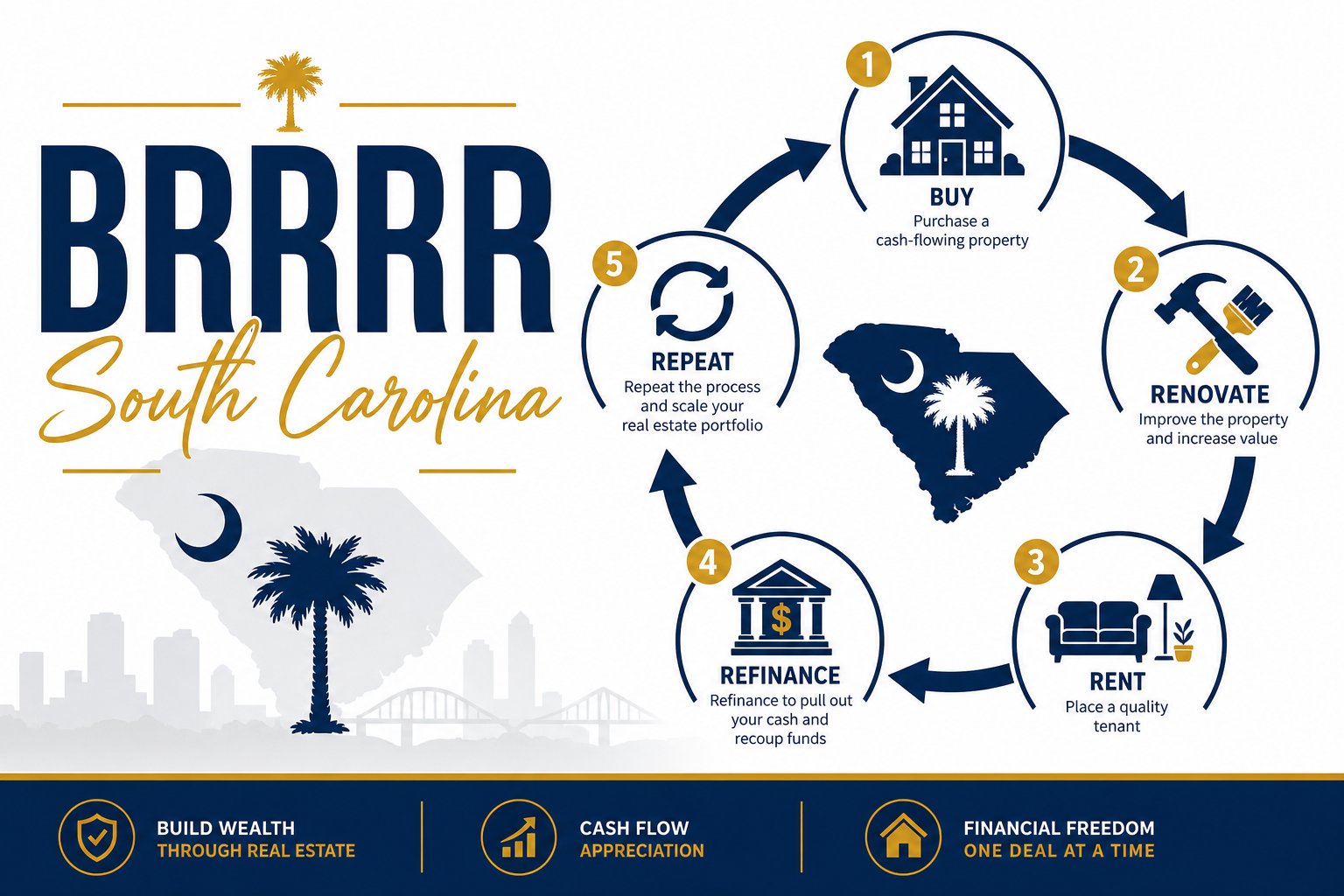
This BRRRR strategy South Carolina guide breaks down each market with real numbers, two worked examples, and the SC-specific costs that trip up investors from other states. Run your own deal through the South Carolina BRRRR calculator pre-loaded with local data.
BRRRR Strategy South Carolina: Why It Works in 2026
The BRRRR strategy South Carolina method benefits from a specific set of conditions that do not exist in many other states:
- Low property taxes (0.86%): Keeps your PITIA payment lower after refi, improving your DSCR. Compare this to Texas (1.80%) or Ohio (1.59%) — on a $250,000 ARV property, that is $1,850-$2,350 less per year in taxes.
- Affordable rehab costs: General contractor rates in Columbia and Spartanburg run 15-25% below the national average. A full kitchen and bath renovation that costs $45,000 in Charlotte costs $32,000-$38,000 in Columbia.
- Strong rental demand: Military bases (Fort Jackson, Shaw AFB, Joint Base Charleston), universities (USC, Clemson area, Coastal Carolina), and steady migration from Northeast and West Coast states keep vacancy rates low.
- Landlord-friendly laws: According to SC landlord-tenant law, no rent control, 5-day notice for nonpayment, 30-45 day eviction timeline. Fast evictions mean you recover possession quickly if a tenant stops paying — critical for BRRRR since you need stable cash flow for the refinance.
- No seasoning restrictions from local lenders: Several SC-based DSCR lenders offer 3-month seasoning instead of the typical 6 months, compressing your BRRRR cycle.
Best SC Markets for BRRRR: Ranked
| Market | Distressed Buy Price | Avg Rehab | ARV Target | BRRRR Viable? |
|---|---|---|---|---|
| Columbia | $130,000-$170,000 | $35,000-$55,000 | $220,000-$260,000 | Strong — best BRRRR market in SC |
| Spartanburg | $110,000-$150,000 | $30,000-$50,000 | $190,000-$230,000 | Strong — lowest entry point |
| Greenville | $170,000-$220,000 | $40,000-$60,000 | $270,000-$320,000 | Moderate — tighter margins |
| Myrtle Beach | $180,000-$240,000 | $40,000-$60,000 | $290,000-$350,000 | Moderate — seasonal vacancy risk |
| Charleston | $250,000-$330,000 | $50,000-$80,000 | $380,000-$450,000 | Difficult — high entry, thin margins |
Columbia leads because the spread between distressed purchase and ARV is widest relative to rehab cost. A $155,000 buy with $45,000 rehab ($200,000 total) against a $245,000 ARV gives you a 70% rule ratio of 81.6% — tight but workable. In Spartanburg, a $125,000 buy with $40,000 rehab ($165,000 total) against a $210,000 ARV gives 78.6% — more comfortable margin.
Worked Example #1: Columbia BRRRR
Here is a real BRRRR strategy South Carolina scenario in Columbia:
- Property: 3BR/2BA ranch near USC campus, built 1972, 1,350 sqft
- Purchase price: $155,000 (distressed — needs full kitchen, bathrooms, flooring)
- Hard money loan: 85% of purchase ($131,750) at 11.5%, 2 points ($3,100)
- Cash to close: $23,250 + $3,100 points + $4,200 closing costs = $30,550
- Rehab budget: $45,000 (kitchen $12,000, 2 baths $9,000, flooring $6,500, paint $3,500, HVAC service $2,800, electrical updates $4,200, landscaping $2,000, contingency $5,000)
- Holding costs during rehab (3 months): Hard money interest $3,785, insurance $375, utilities $450, taxes $502 = $5,112
- Total cash invested: $30,550 + $45,000 + $5,112 = $80,662
After rehab:
- ARV (appraised): $245,000 — verified with 4 comps within 0.5 miles sold in last 90 days
- Rent: $1,250/month (market rate for updated 3BR in the area)
- Refinance at 75% ARV: $183,750 DSCR loan at 7.25%, 30-year fixed
- Payoff hard money: $131,750 + accrued interest
- Cash back at closing: $183,750 – $135,535 (HM payoff) – $5,510 (refi costs) = $42,705
- Net cash left in deal: $80,662 – $42,705 = $37,957
- Capital recovered: 53%
Monthly after refi: PITIA $1,398 (P&I $1,253 + tax $201 + insurance $133). Rent $1,250. Monthly cash flow: -$148. DSCR: 0.89.
This deal is cash-flow negative after refinance — common for BRRRR at 2026 rates. The value is recovering $42,705 to recycle into the next acquisition. When rates drop and you refinance again, the deal turns positive. Model this exact scenario in the SC BRRRR calculator.
Worked Example #2: Spartanburg BRRRR
Spartanburg offers the lowest entry point for BRRRR strategy South Carolina:
- Property: 3BR/1.5BA bungalow near downtown, built 1965, 1,100 sqft
- Purchase price: $125,000 (estate sale — dated but structurally sound)
- Hard money loan: 85% of purchase ($106,250) at 11.5%, 2 points ($2,500)
- Cash to close: $18,750 + $2,500 + $3,400 = $24,650
- Rehab budget: $40,000 (kitchen $10,000, bath update $5,500, flooring $5,000, paint $3,000, roof repair $4,500, windows $6,000, electrical $3,000, contingency $3,000)
- Holding costs (3 months): $4,280
- Total cash invested: $68,930
After rehab:
- ARV: $210,000
- Rent: $1,100/month
- Refinance at 75% ARV: $157,500 DSCR loan at 7.25%
- Cash back at closing: $157,500 – $109,930 (HM payoff) – $4,725 (refi costs) = $42,845
- Net cash left in deal: $68,930 – $42,845 = $26,085
- Capital recovered: 62.2%
Monthly PITIA after refi: $1,188. Rent: $1,100. Cash flow: -$88/month. DSCR: 0.93. Closer to break-even than the Columbia deal, with less total capital at risk. Spartanburg works for investors with limited starting capital who want to cycle through deals quickly.
Compare both scenarios side by side with the deal comparison tool. Check refinance qualification with the SC DSCR calculator.
SC-Specific BRRRR Costs That Catch Investors
The 6% Assessment Trap
South Carolina assesses investment property at 6% of market value versus 4% for owner-occupied. When you buy a previously owner-occupied home and convert it to a rental, your property tax jumps 40-50% at the next reassessment. If the seller was paying $1,400/year on a $245,000 home at the 4% rate, your tax bill becomes approximately $2,100/year at the 6% rate. Budget the higher assessment from day one — not the seller’s current tax bill — when running your BRRRR strategy South Carolina numbers.
Permits and Inspection Timelines
SC requires permits for structural, electrical, plumbing, and HVAC work per SC Residential Builders Commission regulations. Timelines vary significantly by county — Charleston can take 4-6 weeks for permit review while Columbia and Greenville process in 2-3 weeks. Budget $200-$800 for permit fees depending on scope. Pulling permits adds time but protects your ARV — unpermitted work gets flagged during the refinance appraisal and can kill your deal.
Refinance Seasoning Requirements
Most DSCR lenders require 3-6 months of ownership before they refinance based on appraised value instead of purchase price. Plan your timeline: 1-2 months for purchase and closing, 2-3 months for renovation, 1 month for tenant placement, then wait for the seasoning period. Total BRRRR cycle: 6-9 months. Some SC-based lenders offer 3-month seasoning — ask before you close on the purchase.
Insurance During Rehab
Standard landlord policies do not cover properties under renovation. You need builder’s risk or vacant property insurance during the rehab phase — $100-$250/month depending on property value and renovation scope. Switch to a standard landlord policy once the tenant moves in. Inland SC rates (Spartanburg, Columbia): $1,500-$1,600/year. Coastal rates (Charleston, Myrtle Beach): $3,200-$3,800/year. This difference alone can determine whether a coastal BRRRR cash flows. See our landlord insurance guide for detailed rate comparisons.
Attorney-Required Closings
South Carolina requires a licensed attorney at every real estate closing — both purchase and refinance. Attorney fees: $800-$1,500 per closing. Since BRRRR involves two closings (buy and refi), budget $1,600-$3,000 total in attorney costs. This is not optional and cannot be negotiated away. Factor it into your total cost calculation. Use the SC closing costs guide for the complete breakdown.
Financing the BRRRR Buy in South Carolina
Hard money is the standard acquisition financing for BRRRR. Current SC hard money terms:
- Interest rates: 10-13% (most at 11-12%)
- Points: 2-3 origination points
- LTV: 80-85% of purchase price
- Rehab coverage: Up to 100% of rehab budget, held in escrow, released in draws as work completes
- Term: 6-12 months (request 12 — it costs the same and gives you a buffer)
- Minimum credit score: 620-660 depending on lender
Calculate your total hard money cost with the hard money loan calculator. On a $155,000 purchase with $45,000 rehab at 11.5% and 2 points, your total financing cost for a 6-month hold is approximately $14,000-$16,000.
After stabilization (tenant in place, paying rent), refinance into a DSCR loan at 75% of appraised ARV. The DSCR lender cares about the property’s income — not your personal income or tax returns. Minimum DSCR for most lenders: 1.0. At current rates, many SC BRRRR deals land at 0.85-0.95 DSCR, so you may need to accept higher rates or bring a larger down payment to get the refi done.
5 BRRRR Mistakes That Kill SC Deals
- Using the seller’s tax bill. The seller paid the 4% owner-occupied rate. You will pay the 6% investment rate. A $700/year difference on a $240,000 property does not sound like much until you realize it drops your DSCR from 1.01 to 0.92 — below most lenders’ minimums.
- Skipping permits to save time. Unpermitted work shows up during the refinance appraisal. The appraiser notes it. The lender flags it. Your refinance gets delayed or denied. The $500 you saved on permits costs you $3,000+ in extended hard money interest.
- Overestimating coastal ARVs. Charleston and Myrtle Beach comps are volatile — seasonal sales create false ceilings. Use sold comps from the same quarter, not list prices. An ARV miss of 10% on a $400,000 Charleston property means $30,000 less at refinance.
- Ignoring insurance in the DSCR calculation. The $2,300/year gap between inland and coastal insurance is the difference between a deal that refinances and one that does not. Always get three insurance quotes before making an offer. Use real premiums in the SC BRRRR calculator, not statewide averages.
- Running only one exit scenario. What if the ARV comes in 8% low? What if rates jump 50 basis points before you refi? What if the property sits vacant for 6 weeks between rehab and tenant placement? Run the downside scenarios. If the deal only works under perfect conditions, it is not a deal — it is a bet.
BRRRR Timeline: Month by Month in SC
| Month | Phase | Action | Cost |
|---|---|---|---|
| 1 | Acquisition | Hard money close, permits filed | Down payment + points + closing |
| 2-3 | Rehab | Renovation, inspections, draws from escrow | Rehab budget + holding costs |
| 4 | Stabilize | List for rent, tenant screening, lease signed | Marketing + screening costs |
| 5-6 | Season | Collect rent, document income, order appraisal | Standard operating expenses |
| 6-7 | Refinance | DSCR loan closes, hard money paid off | Refi closing costs ($4,000-$6,000) |
| 7+ | Hold/Repeat | Cash flows (or recycle capital into next deal) | PITIA + operating expenses |
The fastest SC BRRRR cycles run 5-6 months with 3-month seasoning lenders. Budget for 7-9 months to be realistic — permit delays, rehab surprises, and tenant placement can each add 2-4 weeks.
Frequently Asked Questions
Is South Carolina good for BRRRR?
Yes, particularly Columbia and Spartanburg where distressed properties are available at $110,000-$170,000 with ARVs of $190,000-$260,000. The BRRRR strategy South Carolina approach works well because of low property taxes (0.86%), affordable rehab costs compared to coastal markets, and strong rental demand from universities and military installations.
How much capital do I need for BRRRR in South Carolina?
With hard money financing covering 85% of purchase plus rehab, you need $25,000-$70,000 in cash for a typical SC BRRRR deal: 15-20% down payment on purchase, closing costs, holding costs during rehab, and reserves. Columbia deals require $60,000-$80,000 total. Spartanburg deals start at $50,000-$65,000. If the refinance recovers 50-65% of capital, you can recycle that cash into the next deal within 6-9 months.
What is the best SC market for BRRRR?
Columbia is the best SC market for BRRRR — lowest distressed property prices relative to ARV ($130,000-$170,000 buy, $220,000-$260,000 ARV), stable rental demand from USC and Fort Jackson, and rehab costs 15-25% below the national average. Spartanburg is second with even lower entry ($110,000-$150,000) but slightly less rental demand and lower ARVs.
How long does a BRRRR cycle take in South Carolina?
A typical SC BRRRR cycle takes 6-9 months: 1-2 months for purchase and closing, 2-3 months for renovation, 1 month for tenant placement, and 3-6 months seasoning before refinance. Permit delays can add 2-4 weeks in some SC counties. Budget for 9 months on your first deal to account for the learning curve.
Can I BRRRR in Charleston?
BRRRR is possible but difficult in Charleston due to high entry prices ($250,000+ for distressed properties) and tight margins. Rehab costs run $50,000-$80,000, and insurance adds $3,200/year versus $1,500 inland. The numbers work better in North Charleston and suburbs where distressed properties are available at lower prices. For most investors, Columbia and Spartanburg offer significantly stronger BRRRR returns with less capital at risk.
Are BRRRR deals cash-flow positive in South Carolina?
Most SC BRRRR deals are slightly cash-flow negative (-$50 to -$200/month) after refinance at 2026 rates (7.0-7.5%). The strategy is not about immediate cash flow — it is about capital recycling. You recover 50-65% of your invested capital at refinance and redeploy it. When interest rates decrease and you refinance again, the deals turn cash-flow positive. The properties also build equity through appreciation and mortgage paydown.
What DSCR do I need to refinance a BRRRR in SC?
Most DSCR lenders require a minimum 1.0 DSCR, though some accept 0.75 DSCR at higher interest rates (add 0.5-1.0% to the rate). At current SC rents and 7.25% rates, many BRRRR deals land at 0.85-0.95 DSCR. Options: accept the rate premium for sub-1.0 DSCR, bring more cash to reduce the loan amount, or wait for rates to drop. Check your deal with the SC DSCR calculator.
Start Your South Carolina BRRRR Analysis
The BRRRR strategy South Carolina approach works best in Columbia and Spartanburg where the spread between distressed purchase price and ARV is wide enough to recover meaningful capital at refinance. Do not start with coastal markets — the entry prices, insurance costs, and permit timelines compress your margins to the point where one surprise kills the deal.
Run your SC BRRRR numbers through the South Carolina BRRRR calculator with real data: actual purchase price, itemized rehab budget, verified comps for ARV, and real insurance quotes. Check your refinance math with the SC DSCR calculator. Estimate your ARV with the ARV calculator. And budget your hard money costs with the hard money loan calculator before making an offer.
The investors who succeed with BRRRR in South Carolina are the ones who run three scenarios for every deal: best case, expected case, and worst case. If the worst case still leaves you with a property you can hold and not bleed cash, it is a deal worth pursuing. If the worst case means you are stuck with negative cash flow and no path to refinance, walk away and find the next one. South Carolina has enough inventory that you do not need to force a deal that does not work.