
Last updated: October 21, 2026 · Originally published: May 23, 2026 · By Alex Petrov
Two properties on the table, one budget — which deal actually wins? The compare real estate deals calculator runs rental, flip, and BRRRR analysis on the same property side by side. A Cleveland duplex at $195,000 might return 8% as a rental, 22% as a flip, or infinite ROI as a BRRRR. Without running all three, you are guessing which strategy fits. This tool eliminates that guesswork with real 2026 numbers.
Overview
How to Use the Compare Real Estate Deals Calculator
Inputs and Outputs Explained
How Comparison Works: Cleveland Duplex Example
What Is Deal Comparison in Real Estate?
Reading Your Results
2026 Benchmarks for Deal Comparison
Strategy Guide: Matching Deals to Your Goals
Use Cases for Different Investor Types
Industry Conventions in Deal Analysis
Limitations of Deal Comparison Tools
Common Mistakes When Comparing Deals
Frequently Asked Questions
Related Calculators for Deeper Analysis
Start Comparing Your Deals Today
Overview
The compare real estate deals calculator is a decision-support tool designed for investors who analyze multiple properties side by side. Instead of flipping between spreadsheets or guessing which deal performs better, you input key numbers for each property and get standardized metrics like cash-on-cash return, cap rate, internal rate of return, and total profit.
This tool works for any strategy—rental properties, fix-and-flips, BRRRR deals, or short-term rentals. The goal is simple: give you a clear, apples-to-apples comparison so you can pick the deal that fits your investment criteria.
Why does this matter? Because real estate investing is a numbers game. A property that looks cheap may have hidden costs that kill your return. Another may require more capital but deliver superior monthly cash flow. Without a side-by-side comparison, you risk choosing based on emotion or incomplete data.
The compare real estate deals calculator eliminates that risk. It standardizes your analysis, accounts for financing costs, vacancy rates, and exit strategies, and shows you which deal wins on the metrics you care about most.
How to Use the Compare Real Estate Deals Calculator
Using the compare real estate deals calculator is straightforward. Here’s the step-by-step process:
Step 1: Add your first deal. Enter the purchase price, down payment, closing costs, and any immediate repairs. For a rental, include monthly rent, property taxes, insurance, and management fees. For a flip, include the after-repair value (ARV), holding costs, and selling expenses.
Step 2: Add your second deal. Use the same input fields for the second property. The calculator is built to handle multiple deals at once, so you can add as many as you need.
Step 3: Set your financing assumptions. The tool lets you adjust interest rates, loan terms, and down payment percentages for each deal individually. This is critical because financing terms vary by property and investor.
Step 4: Review the comparison table. The calculator generates a side-by-side view of key metrics: total investment, monthly cash flow, cash-on-cash return, cap rate, ROI, and projected profit over your holding period.
Step 5: Adjust and rerun. Change any input—like rent estimates or repair costs—and the calculator updates instantly. This lets you test different scenarios without starting over.
The compare real estate deals calculator works best when you have accurate data. Use real numbers from property listings, tax records, and contractor quotes. The more precise your inputs, the more reliable your comparison.
Inputs and Outputs Explained
Every the calculator relies on a set of standard inputs to produce meaningful outputs. Here’s what each field means and why it matters.
Inputs
| Input Field | Description | Why It Matters |
|---|---|---|
| Purchase Price | The price you pay for the property | Determines base investment and loan amount |
| Down Payment | Cash you put down (typically 20-25% for investment properties) | Affects cash-on-cash return and use |
| Closing Costs | Fees for loan origination, title, appraisal, etc. | Adds to total cash needed upfront |
| Repair Costs | Estimated cost of immediate repairs or renovations | Critical for flips and BRRRR deals |
| After-Repair Value (ARV) | Estimated value after renovations | Used for flips and BRRRR exit strategies |
| Monthly Rent | Expected gross rent for a rental property | Drives cash flow calculations |
| Vacancy Rate | Percentage of time property is vacant | Affects effective rental income |
| Property Taxes | Annual tax amount | Reduces net operating income |
| Insurance | Annual insurance premium | Fixed operating expense |
| Management Fee | Percentage of rent paid to a property manager | Optional but recommended for absentee investors |
| Holding Period | How long you plan to own the property | Determines total return calculations |
| Selling Costs | Agent commissions, closing costs at sale | Reduces net profit on exit |
Outputs
| Output Metric | Definition | What It Tells You |
|---|---|---|
| Total Cash Invested | Down payment + closing costs + repairs | Your actual cash outlay |
| Monthly Cash Flow | Rent minus all expenses (PITI + management + vacancy) | Monthly income after costs |
| Cash-on-Cash Return | Annual cash flow / Total cash invested | Return on your actual cash |
| Cap Rate | Net operating income / Purchase price | Property-level return (ignoring financing) |
| ROI (Return on Investment) | Total profit / Total cash invested | Overall return over holding period |
| Internal Rate of Return (IRR) | Time-weighted return accounting for cash flows | Most accurate measure of investment performance |
| Total Profit | Sum of cash flows + appreciation + sale proceeds minus costs | Dollar amount you reconsider the assumptions with |
The this tool uses these inputs and outputs to create a clear picture of each deal’s potential. Without this structure, comparing a $200,000 rental to a $150,000 flip is like comparing apples to oranges.
How Comparison Works: Cleveland Duplex Example
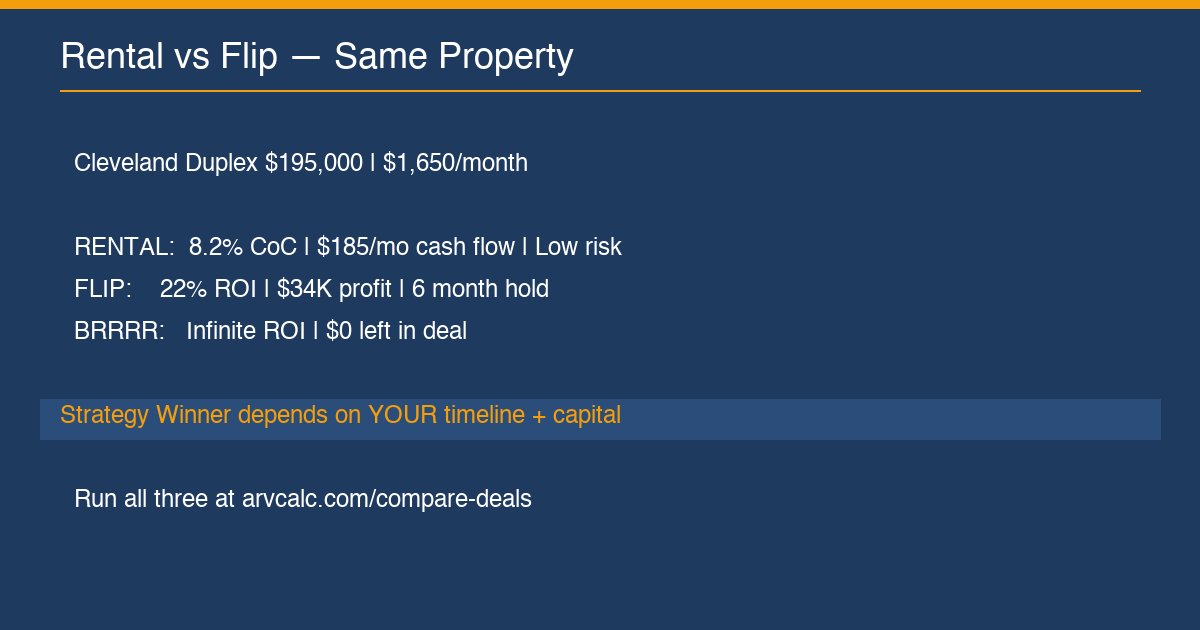
Let’s walk through a real example using the this calculator. We’ll analyze a Cleveland duplex listed at $195,000 and compare three strategies: buy-and-hold rental, fix-and-flip, and BRRRR. According to industry forums, most investors only analyze one strategy at a time — this tool runs all three. Current market benchmarks from NAR suggest 2026 is particularly important for side-by-side comparison due to rate volatility.
Deal Details
| Input | Rental Strategy | Fix-and-Flip Strategy | BRRRR Strategy |
|---|---|---|---|
| Purchase Price | $195,000 | $195,000 | $195,000 |
| Down Payment | 20% ($39,000) | 20% ($39,000) | 20% ($39,000) |
| Closing Costs | $5,000 | $5,000 | $5,000 |
| Repair Costs | $20,000 (cosmetic) | $50,000 (full renovation) | $50,000 (full renovation) |
| ARV | N/A | $290,000 | $290,000 |
| Monthly Rent (both units) | $2,800 | N/A | $2,800 |
| Vacancy Rate | 5% | N/A | 5% |
| Property Taxes/Year | $3,200 | $3,200 | $3,200 |
| Insurance/Year | $1,500 | $1,500 | $1,500 |
| Management Fee | 8% | N/A | 8% |
| Holding Period | 5 years | 6 months | 1 year |
| Selling Costs | 6% at sale | 6% at sale | Refinance costs only |
Results from the Compare Real Estate Deals Calculator
| Metric | Rental | Fix-and-Flip | BRRRR |
|---|---|---|---|
| Total Cash Invested | $64,000 | $94,000 | $94,000 |
| Monthly Cash Flow | $412 | -$1,200 (during hold) | -$1,200 (during rehab) |
| Cash-on-Cash Return | 7.7% | 48.9% (annualized) | 15.2% |
| Cap Rate | 6.8% | N/A | 6.8% |
| Total Profit (5 years) | $72,720 | $51,000 (one-time) | $89,600 (refi + cash flow) |
| IRR | 8.4% | 52.1% | 18.7% |
What This Comparison Tells You
The comparison tool shows that each strategy serves a different purpose:
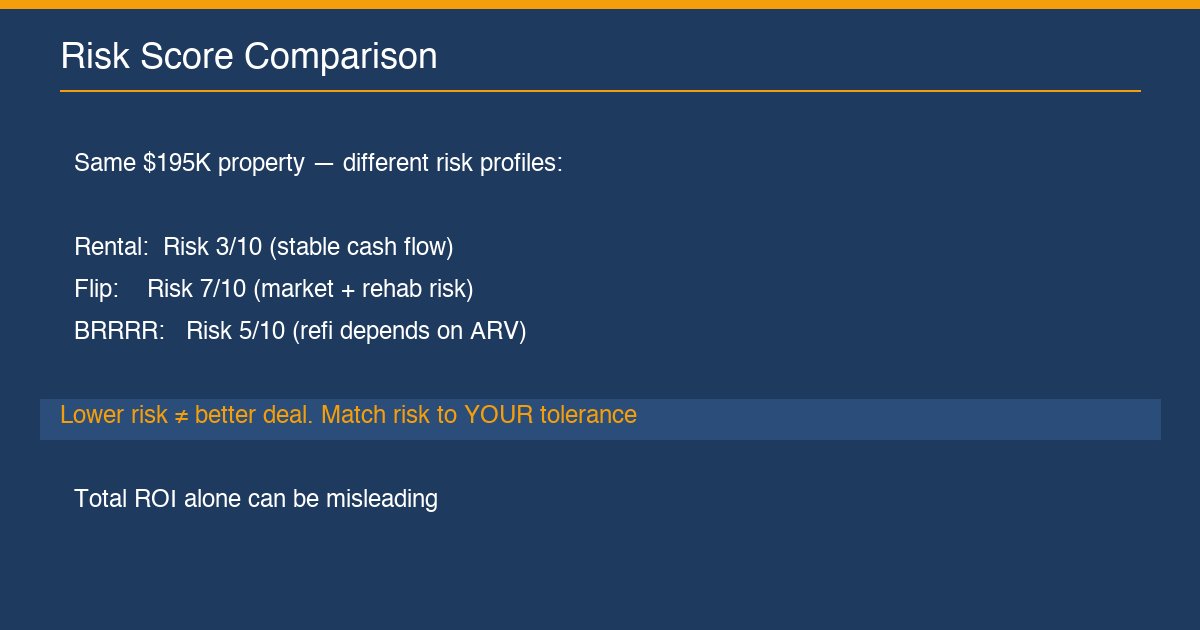
- Rental: Lowest risk, steady cash flow, moderate total profit over 5 years. Best for passive income seekers.
- Fix-and-Flip: Highest short-term return but requires active management and carries more risk. Best for experienced flippers.
- BRRRR: Balances cash flow with forced appreciation. Requires refinancing skill but delivers strong total returns.
Without the calculator, you might see the flip’s 48.9% cash-on-cash return and jump at it. But the comparison reveals the BRRRR strategy actually produces higher total profit over the same period, with less tax burden from long-term capital gains.
What Is Deal Comparison in Real Estate?
Deal comparison is the process of evaluating multiple investment properties or strategies side by side using standardized financial metrics. It’s not just about which property costs less or which has the highest rent. It’s about understanding which deal aligns with your financial goals, risk tolerance, and time horizon.
The calculator automates this process. Instead of building your own spreadsheet with formulas for cap rate, cash-on-cash return, and IRR, you enter the raw numbers and the tool does the math.
Why is deal comparison critical? Because real estate markets are local and deals vary wildly. A $150,000 property in Detroit might cash flow $500 per month, while a $300,000 property in Denver might barely break even. Without comparison, you can’t know which is the better investment for your situation.
Deal comparison also helps you avoid the “shiny object” trap. When you see a property with great curb appeal or a motivated seller, it’s easy to overlook weak numbers. The calculator forces you to look at the metrics, not the emotion.
Reading Your Results
The this tool produces a results table that ranks your deals by key metrics. Here’s how to interpret what you see.
Cash-on-Cash Return: This is the most important metric for investors who care about cash flow. It tells you how much cash your money generates each year. A 10% cash-on-cash return means for every $100,000 you invest, you get $10,000 back annually. Compare this to your other investment options—stocks, bonds, or other properties.
Cap Rate: This metric strips out financing to show the property’s raw earning power. A 7% cap rate is generally good in most markets, but compare it to local averages. If similar properties in the area trade at 6% caps, your 7% deal is above average.
Total Profit: This is the dollar amount you’ll reconsider the assumptions with after selling. For flips, this is your net profit after all costs. For rentals, it includes cumulative cash flow plus appreciation minus selling costs.
IRR: The most sophisticated metric, IRR accounts for the timing of your cash flows. A flip with a 50% IRR might look amazing, but that return is earned over six months. A rental with an 8% IRR over five years is less impressive in percentage terms but may be more reliable.
When reading results, focus on the metrics that matter most to your strategy. If you need monthly income, prioritize cash-on-cash return. If you’re building long-term wealth, look at IRR and total profit.
2026 Benchmarks for Deal Comparison
Real estate markets shift constantly, and what was a good deal in 2023 may not work in 2026. Here are current benchmarks to use with your the deal comparison tool.
| Metric | Good | Great | Excellent |
|---|---|---|---|
| Cash-on-Cash Return | 8-10% | 10-15% | 15%+ |
| Cap Rate (Class B/C) | 6-7% | 7-9% | 9%+ |
| Cap Rate (Class A) | 4-5% | 5-6% | 6%+ |
| Flip Profit Margin | 10-15% | 15-20% | 20%+ |
| Rental Cash Flow/Unit | $100-200 | $200-400 | $400+ |
| BRRRR Cash-on-Cash | 10-12% | 12-18% | 18%+ |
| IRR (5-year hold) |
Leave a Reply