An investor budgets $30,000 to flip a tired 1970s ranch, swings by the property twice, and writes an offer the same afternoon. Six weeks into the job, the contractor calls with a $22,000 surprise: the original knob-and-tube wiring has to go, the subfloor under the kitchen is rotted, and the roof has one layer too many for another overlay. That $30K budget just became $52K — and the deal math no longer works. The single fix is knowing the cost to rehab a house room by room, scope by scope, before you write the offer.
- Light cosmetic rehab: $15,000 – $30,000 (paint, flooring, fixtures, landscaping)
- Moderate rehab: $30,000 – $75,000 (kitchen, bathrooms, roof, HVAC, some electrical/plumbing)
- Full gut rehab: $75,000 – $150,000+ (complete systems replacement, structural work, total interior)
Per-square-foot ranges: $20–$45 (cosmetic), $45–$90 (moderate), $90–$150+ (full gut).
Average Cost to Rehab a House by Scope
Before you break the budget into rooms, you need a scope category. Every property falls into one of three tiers, and each tier carries a predictable cost band. The table below uses national averages for a single-family home in the 1,200–1,600 sqft range — the typical target for fix-and-flip and BRRRR investors.
| Scope | What’s Included | Cost Range | $/sqft |
|---|---|---|---|
| Cosmetic | Paint (interior + exterior), flooring, light fixtures, hardware, landscaping, minor plumbing fixtures | $15,000 – $30,000 | $20 – $45 |
| Moderate | Everything above plus kitchen update, one or two bathrooms, roof repair or replacement, HVAC service or replacement, partial electrical update | $30,000 – $75,000 | $45 – $90 |
| Full Gut | Complete systems (electrical, plumbing, HVAC), structural repairs, full kitchen and bath remodels, new roof, windows, siding, foundation work | $75,000 – $150,000+ | $90 – $150+ |
These ranges assume investor-grade finishes — solid materials that buyers expect in the local market without custom cabinetry, luxury tile, or high-end appliances. Matching your finish level to the neighborhood is one of the fastest ways to control the cost to rehab a house without cutting corners that come back as inspection issues.
For a deeper overview of the full investment process, the fix-and-flip guide on ArvCalc walks through acquisition, financing, rehab, and exit strategy in one place.
Room-by-Room Rehab Costs
The most reliable way to estimate the cost to rehab a house is to price each room separately, then add them up. Contractors who bid the whole job at once often leave out line items that appear later as change orders. Going room by room forces those conversations upfront.
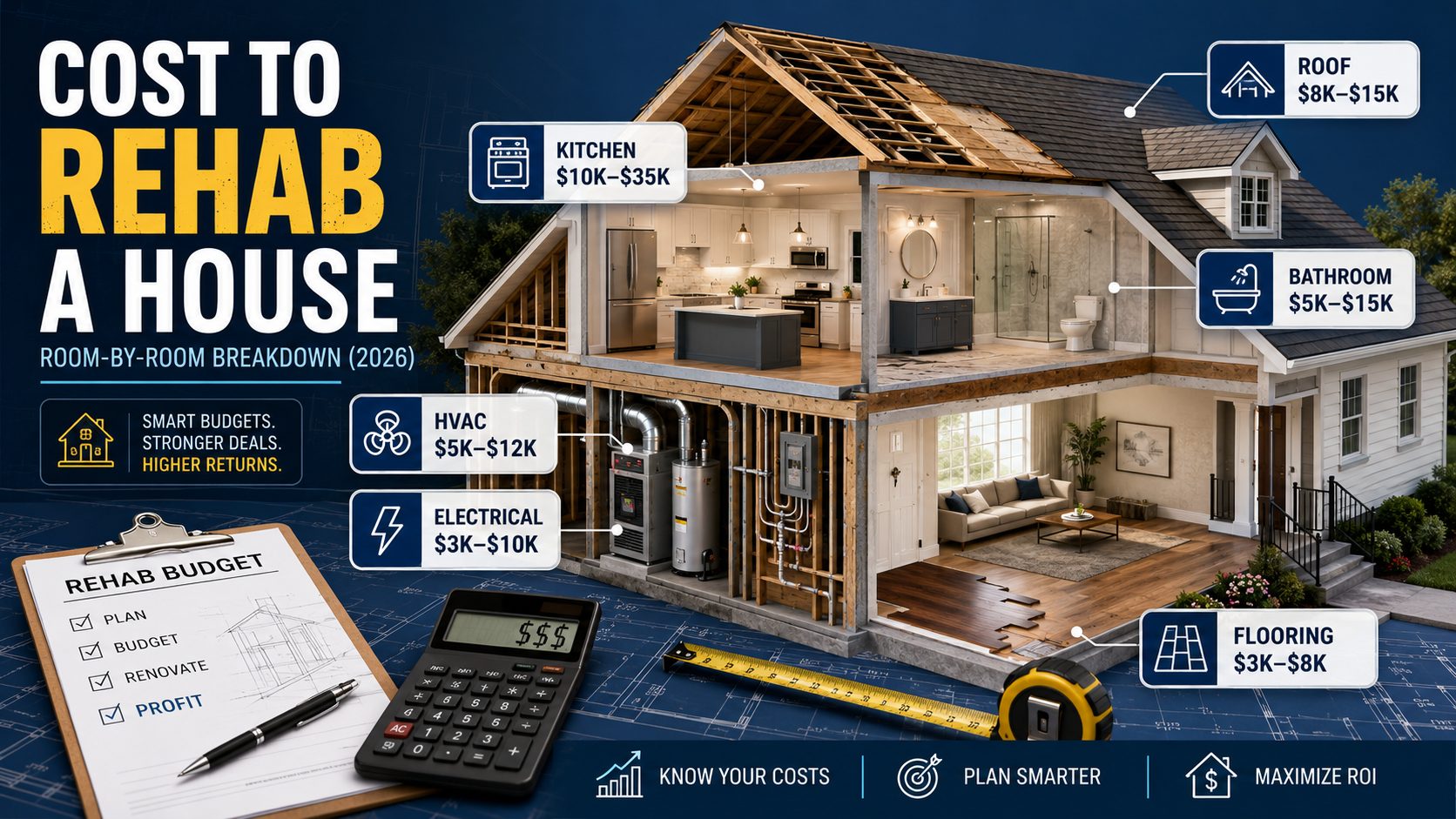
Kitchen: $10,000 – $35,000
The kitchen is usually the single largest line item in a flip. Buyers notice it first, and appraisers value updated kitchens more than almost any other upgrade. For investor-grade work on a standard 120–180 sqft kitchen, budget as follows:
- Cabinets: $3,000–$8,000 for semi-custom RTA (ready-to-assemble) or stock cabinets. Custom cabinetry starts at $15,000 and has no place in a flip budget.
- Countertops: $1,200–$3,500 for granite or quartz remnants; laminate runs $400–$800 but can hurt resale in higher-price markets.
- Appliances: $1,500–$4,000 for a matching stainless set (fridge, range, dishwasher, microwave). Scratch-and-dent appliance stores can cut this by 30%.
- Flooring: $600–$2,000 for LVP or tile.
- Lighting: $300–$800 for under-cabinet lights and a new flush-mount or pendant fixture.
- Plumbing (sink, faucet, disposal): $400–$1,200.
- Labor (demo, installation, painting): $2,500–$6,000 depending on market.
A mid-range investor kitchen in a $180,000–$250,000 ARV market typically lands at $14,000–$20,000 all-in. Spend more only when comparable sales in the neighborhood show updated kitchens commanding a clear premium.
Bathroom: $5,000 – $15,000
A full bathroom gut — vanity, tile, tub/shower, toilet, fixtures, and drywall — runs $7,000–$12,000 for a standard 5×8 hall bath when you use investor-grade materials. A half-bath (toilet and sink only) can be done for $2,500–$4,500.
- Vanity + sink: $300–$900 (box-store freestanding vanities do the job).
- Tile (floor + surround): $800–$2,500 for material; $1,200–$3,000 labor.
- Tub/shower: $400–$1,200 for an acrylic tub/shower combo; walk-in tile shower adds $2,000–$5,000.
- Toilet: $150–$400 installed.
- Fixtures (faucet, towel bars, mirror, light): $300–$700.
Primary bathrooms in higher-end markets justify the upgrade to a tile shower, double vanity, and heated floor. In entry-level price points, spend the minimum that passes inspection and photographs well.
Roof: $8,000 – $15,000
Roof condition is a make-or-break item for most lenders and buyers. An inspector calling out a failed roof can kill a deal at closing. The cost to rehab a house almost always includes at least a roof inspection, and often a full replacement.
- Asphalt shingle replacement (1,400–1,800 sqft home): $8,000–$14,000 for one layer tear-off and replacement with 30-year architectural shingles.
- Overlay (if code allows and only one existing layer): $5,500–$9,000. Saves money short-term but may not satisfy buyer inspectors.
- Partial repair (isolated damage, flashing, valley): $1,500–$4,000.
- Gutters and downspouts: $800–$2,200 if they need replacement.
Get the roof inspected by a third party — not just the contractor who wants to sell you a new one. A good inspector can tell you if a repair will last 3–5 years or if replacement is the only real option.
HVAC: $5,000 – $12,000
A new central HVAC system (furnace + air conditioner) for a 1,400 sqft home runs $5,500–$10,000 installed. Mini-split systems — common in additions or homes without ductwork — cost $1,500–$4,500 per zone installed. If the existing system is under 10 years old, a service and inspection ($150–$400) may be all you need.
- Full system replacement (gas furnace + AC): $6,000–$10,000.
- Ductwork repair or replacement: $1,500–$4,000.
- Mini-split (one zone): $2,500–$4,500 installed.
- Service, cleaning, new filters: $150–$400.
HVAC is non-negotiable for buyers. A home without working heat or air conditioning either fails inspection or requires an escrow holdback at closing.
Flooring: $3,000 – $8,000 per 1,000 sqft
Flooring transforms a space faster than almost anything else. Material choice depends on the market and the room.
- Luxury vinyl plank (LVP): $2.50–$5.00/sqft material + $1.50–$3.00/sqft install. Most popular choice for flips — durable, waterproof, looks like hardwood.
- Hardwood (real): $6–$12/sqft material + $4–$8/sqft install. Hard to justify on investor budgets unless the market demands it or existing hardwood can be refinished ($2–$4/sqft).
- Porcelain tile: $3–$8/sqft material + $6–$12/sqft install. Use in bathrooms, kitchens, and entry areas.
- Carpet: $1.50–$3.50/sqft material + $0.75–$1.50/sqft install. Bedrooms only; buyers in most markets now prefer hard surfaces throughout.
For a 1,400 sqft home with LVP in the main areas and tile in baths, budget $6,000–$11,000 total including labor and demo of old flooring.
Electrical: $3,000 – $10,000
Old electrical is one of the fastest ways to blow up a flip budget. Pre-1970 homes often have outdated panels, aluminum wiring, or no GFCI protection — all of which trigger permit requirements and remediation costs.
- Panel upgrade (100A to 200A): $1,200–$3,000 installed.
- Partial rewire (one or two circuits): $800–$2,500.
- Full rewire (knob-and-tube or aluminum): $8,000–$20,000+ depending on home size. This is a deal-killer if you haven’t priced it.
- GFCI outlets, smoke/CO detectors (code compliance): $300–$800.
- New fixtures throughout: $600–$2,000 for a full home re-fixture.
Any electrical work beyond basic fixture swaps requires permits in most jurisdictions. Budget for the permit and the inspection — and for the time delays that come with them.
Plumbing: $2,000 – $8,000
Plumbing surprises fall into two buckets: cosmetic (fixture swaps) and structural (repipe, sewer line). Know which bucket you’re in before you buy.
- Fixture replacement (sinks, faucets, toilets, shower valves): $800–$2,500 for the whole house.
- Water heater replacement: $900–$1,800 for a 40-gallon gas unit installed.
- Partial repipe (galvanized or failed copper): $2,500–$6,000.
- Full PEX repipe: $5,000–$12,000 for a 1,400 sqft home.
- Sewer scope + repair: A sewer scope costs $150–$350 and is one of the best $200 you’ll spend on due diligence. Sewer line replacement runs $4,000–$15,000 depending on depth and length.
Exterior / Siding / Windows: $5,000 – $15,000
Curb appeal sells homes. A buyer forms an opinion before they step inside, so exterior work delivers a clear return.
- Exterior paint (1,400 sqft home): $2,500–$5,000 for pressure wash, prime, and two coats.
- Vinyl siding replacement: $7,000–$16,000 for a typical ranch.
- Window replacement (single to double-pane, per window): $400–$900 installed. A full-house replacement on 10–14 windows: $5,000–$12,000.
- Front door + entry: $800–$2,500 for a pre-hung steel door with hardware.
- Landscaping (cleanup, mulch, sod): $500–$2,500.
Foundation: $5,000 – $25,000
Foundation issues scare buyers and lenders. The range here is wide because “foundation problem” can mean anything from a hairline crack in a block wall ($500–$1,500 to seal) to full pier-and-beam underpinning ($15,000–$40,000+).
- Crack injection/sealing (minor): $500–$2,500.
- Crawlspace encapsulation: $4,000–$10,000.
- Basement waterproofing: $5,000–$15,000.
- Pier installation (helical or push piers, per pier): $1,500–$3,000 each; most projects need 8–14 piers.
Get a structural engineer’s report ($400–$700) before you rely on a foundation contractor’s assessment. Engineers have no financial interest in selling you piers.
According to Angi’s national cost data, whole-house remodel costs range widely based on scope and region — their surveys align closely with the ranges above for investor-grade work.
Worked Example: Full Rehab on a 1,400 sqft 3BR/2BA
Here’s a realistic line-by-line estimate for a moderate-to-full rehab on a 1970s ranch in a Midwest market with a $175,000–$185,000 ARV. This is the type of deal where understanding rehab costs before submitting an offer means the difference between a profitable flip and a loss.
| Line Item | Estimated Cost |
|---|---|
| Kitchen (cabinets, counters, appliances, plumbing, electrical) | $16,500 |
| Master bathroom (tile, vanity, shower, fixtures) | $9,200 |
| Hall bathroom (tub/shower combo, vanity, tile) | $6,800 |
| Roof (full tear-off and replace, 1,600 sqft) | $10,500 |
| HVAC (new gas furnace + AC unit) | $7,800 |
| Flooring (LVP throughout + tile in baths) | $7,200 |
| Electrical (panel upgrade, GFCI, new fixtures) | $4,200 |
| Plumbing (water heater, fixture swap, minor repipe) | $3,400 |
| Interior paint (walls, ceilings, trim) | $3,800 |
| Exterior paint + front door | $3,500 |
| Windows (8 replacements) | $4,800 |
| Landscaping + driveway seal | $1,800 |
| Permits + inspections | $1,200 |
| Dumpster + hauling | $900 |
| Subtotal | $81,600 |
| Contingency (12%) | $9,800 |
| Total Rehab Budget | $91,400 |
Now apply the 70% rule to find the maximum allowable offer (MAO):
- ARV: $180,000
- Rehab budget: $62,000 (stripped-down version without contingency for illustration)
- MAO = ($180,000 × 0.70) – $62,000 = $126,000 – $62,000 = $64,000
If the seller wants $85,000, the deal doesn’t work at a $62K rehab budget. But now you know exactly why — and you can either walk away, negotiate harder, or verify whether your rehab estimate can be tightened. Use the 70% rule calculator to run these numbers instantly for any deal, and the fix-and-flip calculator to stress-test the full profit scenario.
Plug your rehab estimate and target ARV into ArvCalc’s free tools to see your max offer, projected profit, and whether the deal clears your return threshold.
- ARV Calculator — estimate after-repair value from comps
- Fix & Flip Calculator — full profit projection with holding costs
- Hard Money Loan Calculator — model your financing costs
Regional Rehab Cost Comparison
The cost to rehab a house shifts dramatically based on where the property sits. Labor availability, material transport costs, local code requirements, and cost of living all influence what you’ll actually pay. The table below compares per-square-foot rehab costs across four major investor markets so you can calibrate your budget to a specific region rather than relying on national averages alone.
| Region | Cosmetic $/sqft | Moderate $/sqft | Full Gut $/sqft | Labor Premium |
|---|---|---|---|---|
| Texas | $15–$25 | $35–$55 | $70–$100 | Low |
| Florida | $20–$30 | $40–$60 | $80–$120 | Medium |
| California | $30–$50 | $60–$90 | $100–$160 | High |
| Northeast | $25–$40 | $50–$75 | $90–$140 | High |
Texas offers the lowest rehab costs per square foot thanks to competitive labor markets and lower material transport costs, though investors should factor in the state’s high property taxes when modeling total deal costs — see the full Texas closing costs breakdown for details. Florida sits in the middle, with hurricane code requirements (impact windows, tie-downs) adding cost that mainland investors don’t always anticipate — run your post-rehab rental numbers through the Florida rental property calculator to see if a BRRRR strategy pencils out after the higher rehab spend. California and the Northeast carry the highest labor premiums, driven by licensing requirements, union prevalence, and high cost of living for trades workers.
How to Estimate Rehab Costs Before You Buy
The most accurate estimates come from walking the property with a clipboard, not from square-footage rules of thumb. Here’s the process experienced flippers use.
1. Walk Every Room With a Scope of Work Template
A scope of work (SOW) template lists every possible line item — roof, HVAC, kitchen, each bathroom, flooring, paint, electrical, plumbing, foundation, exterior — and forces you to make a decision on each one: skip it, repair it, or replace it. You can download SOW templates from BiggerPockets or build your own from the room-by-room breakdown above.
On the walk, note conditions for everything you can see. Pull back the carpet corners to check subfloor condition. Run the faucets. Flush every toilet. Check the panel box age and amperage. Look at the roof from the yard with binoculars. Open the crawlspace hatch if there is one.
2. Get 2–3 Contractor Bids
One bid is a guess. Two bids reveal the range. Three bids tell you where the market actually is. Send each contractor the same SOW so you’re comparing apples to apples. A bid that’s 40% lower than the other two either means the contractor missed something or plans to add it back as a change order mid-project.
3. Add a 10–15% Contingency
Every experienced flipper builds a contingency into their budget — not because they’re pessimistic, but because they’re honest. Hidden subfloor rot, a failed plumbing stack, a city inspector who requires a grounded outlet in a room you weren’t touching — these things happen. A 10–15% contingency keeps a single surprise from turning a deal into a loss.
4. Verify Your ARV Before You Commit
Your rehab budget only matters relative to your ARV. A $55,000 rehab on a home with a $120,000 ARV may be fatal to the deal, while the same $55,000 on a $250,000 ARV is perfectly reasonable. Use the ARV calculator, the methodology described in this guide to calculating ARV, or the step-by-step after repair value calculator guide to set your ceiling before you price the rehab.
The Remodeling Magazine Cost vs. Value Report provides national and regional data on which renovations return the most at resale — useful for calibrating which upgrades are worth the spend in your specific market.
5 Costs That Blow Up Rehab Budgets
Understanding the cost to rehab a house in theory is one thing. Knowing what kills budgets in practice is another. These five items account for the majority of rehab overruns.
1. Permits
Many investors try to avoid permits to save time and money. That decision routinely costs more when the work needs to be torn out and redone for an inspection, when a buyer’s lender requires permitted work to close, or when the city flags unpermitted additions during a sale. Permit costs vary by jurisdiction — $500–$3,000 for a typical flip — but the cost of unpermitted work getting flagged is always higher.
2. Mold and Asbestos
Mold remediation runs $1,500–$6,000 for contained areas and $10,000–$30,000+ for widespread infestation behind walls or under flooring. Asbestos abatement (common in pre-1980 homes in popcorn ceilings, floor tile, and pipe insulation) costs $1,000–$3,000 for limited removal and much more for full encapsulation. Neither can be estimated without testing, and neither can be skipped without liability.
3. Structural Surprises
Rotted sill plates, failed floor joists, and load-bearing walls that aren’t where you expected them are discovered after demo, not before. A structural issue that adds $8,000–$20,000 to a job mid-stream can push you into negative territory on a deal that looked fine on paper. This is why experienced investors always budget a contingency and why sewer scopes and foundation inspections are worth every dollar.
4. Scope Creep
Scope creep is the slow accumulation of “while we’re at it” decisions. While you’re doing the kitchen, the investor decides to move the laundry room. While the electrician is there, add a few recessed lights in the living room. Each change feels small in isolation. Together, they can add $10,000–$20,000 to a project and delay the timeline by weeks. Lock your scope before demo starts and require written change orders for anything that wasn’t in the original bid.
5. Contractor Delays
Every week a flip sits under rehab, you’re paying holding costs: hard money interest (typically 10–14% annually), insurance, taxes, and utilities. A 90-day flip that runs to 150 days because of contractor delays or material backlogs adds $3,000–$8,000 in holding costs that weren’t in the budget. Factor carrying costs into every deal, and account for delays when you model your timeline. The hard money loan calculator makes it easy to see how extra weeks affect your total cost of capital.
Common Mistakes When Estimating Rehab Costs
Mistake 1: Using Per-Square-Foot Estimates Without a Room Walk
The “$25 per square foot” estimate works as a rough sanity check — nothing more. Two homes with identical square footage can have wildly different rehab costs based on the condition of the systems, the age of the roof, and whether the kitchen has been touched since 1985. Always walk the property and price line by line before locking in a budget.
Mistake 2: Not Separating Labor From Materials
Material costs are searchable and predictable. Labor costs vary dramatically by market, season, and contractor availability. In competitive construction markets (Texas, Florida, California), labor runs 40–60% of total project cost. In slower markets, it may be 30–40%. When you get contractor bids, always ask for a breakdown — what’s materials, what’s labor. This lets you identify where negotiation is possible and where costs are fixed.
Mistake 3: Underestimating Demo Costs
Demo is physical work that takes time and creates waste. A full kitchen demo, three dumpster loads, and hauling fees can easily run $2,500–$4,500 before a single new item is installed. Some investors forget to price demo entirely, then wonder why their first contractor bid is 15% over budget.
Mistake 4: Skipping the Sewer and Roof Inspections
These two inspections together cost $350–$700. A failed sewer line or a roof that needs full replacement instead of repair can change the economics of a deal completely. If you are buying at the right price relative to total renovation costs, you need to know what the two biggest hidden-cost items actually are before you close. See the beginner’s guide to flipping for a complete due diligence checklist.
Disclaimer: The cost figures in this article are national averages for informational purposes only. Actual rehab costs vary significantly by property condition, location, local labor rates, material prices, and contractor availability. Always obtain multiple contractor bids and consult licensed professionals before making financial decisions. This content does not constitute financial, legal, or construction advice.
Frequently Asked Questions
What is the average cost to rehab a house?
The average cost to rehab a house ranges from $15,000 to $150,000+ depending on scope. Light cosmetic work runs $15,000–$30,000. Moderate rehabs covering kitchen, bathrooms, roof, and HVAC typically cost $30,000–$75,000. Full gut rehabs on older homes run $75,000–$150,000 or more.
How much does it cost to rehab a house per square foot?
Per-square-foot rehab costs run $20–$45 for cosmetic-only work, $45–$90 for moderate rehabs, and $90–$150+ for full gut renovations. These are national averages; labor rates in high-demand markets like California or New York are typically higher by 20–40%.
What is the most expensive part of rehabbing a house?
For most flips, the kitchen is the single largest line item at $10,000–$35,000. Structural repairs — foundation piers, full rewire, full repipe — can exceed kitchen costs when present. Roof replacement ($8,000–$15,000) and full HVAC replacement ($5,000–$12,000) are the next largest recurring expenses.
How do you estimate rehab costs on a property?
Walk every room with a scope of work template and record the condition of each system and surface. Price each line item using local contractor rates, then get 2–3 bids from licensed contractors working off the same scope. Add a 10–15% contingency for unknown discoveries. Always order a roof inspection and sewer scope before closing. The 70% rule guide on ArvCalc walks through how to tie your rehab estimate to your offer price.
Is the 70% rule applied before or after rehab costs?
After. The formula is: Maximum Allowable Offer = (ARV × 0.70) – Rehab Costs. If ARV is $200,000 and rehab is $50,000, the max offer is $90,000. Use the 70% rule calculator to run this automatically.
How long does it take to rehab a house for flipping?
A cosmetic rehab takes 4–8 weeks. A moderate rehab with kitchen, bathrooms, roof, and HVAC typically runs 8–14 weeks. A full gut rehab can take 4–6 months or longer. Permits, material lead times, and contractor scheduling are the most common causes of delays — each of which adds holding costs to your budget.
What rehab costs are most often underestimated by investors?
The most commonly underestimated costs are permits and inspection fees, mold or asbestos remediation, structural repairs found after demo, demo and hauling costs, and holding costs from project delays. A 10–15% contingency on every rehab budget absorbs these surprises without requiring you to predict exactly what they’ll be. Getting rehab numbers right from the start is the single biggest factor separating profitable flips from break-even projects.
Leave a Reply