Last updated: September 24, 2026 · Originally published: July 8, 2026 · By Alex Petrov
A flipper in Columbus bought a distressed ranch based on a gut-feel ARV of $280,000 — no comps pulled, no adjustments run. When the deal closed and the rehab was done, actual sold comps in that zip code supported only $245,000, and he walked away $18,000 in the hole after holding costs. That gap came from skipping one step: running the numbers through a proper after repair value calculator before making an offer.
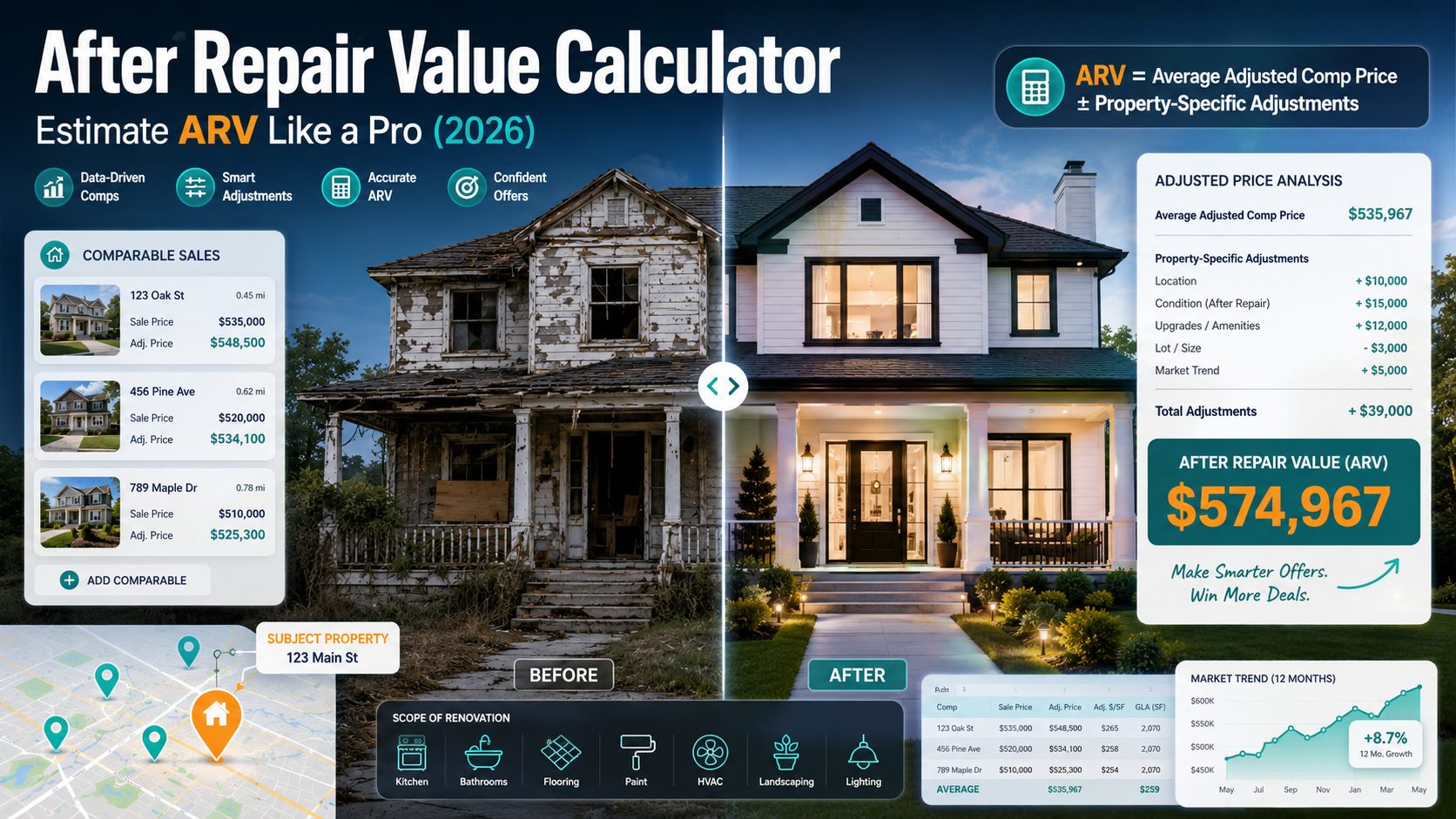
What an after repair value calculator does: It takes comparable sales data from your target neighborhood, applies dollar adjustments for differences in bedrooms, bathrooms, square footage, and condition, then outputs an estimated post-renovation market value for your property. The core formula is:
ARV = Average Adjusted Comp Price ± Property-Specific Adjustments
That number drives your max offer, your rehab budget, and your projected profit — on every flip, BRRRR deal, or wholesale assignment you run.
What Is After Repair Value (And Why You Need a Calculator)
After repair value (ARV) is what a property will be worth on the open market after all renovations are complete and it’s in fully updated, sellable condition. It’s not the current as-is value. It’s not a wish number. It’s a data-backed estimate of what a ready buyer will pay when your rehab is done.
Lenders, investors, appraisers, and wholesalers all use ARV differently, but they’re all asking the same core question: what does finished look like in dollars?
For the full definition and background on how ARV fits into real estate investing, Investopedia’s ARV overview is a solid reference point.
Why ARV Matters for Flippers
Fix-and-flip investors use ARV as the ceiling for everything. Your rehab budget, your financing terms, your profit margin — all of it works backward from ARV. Overshoot ARV by $20,000 and you’ve already lost money before you swing a hammer. Our fix and flip calculator builds this entire stack from ARV down.
Why ARV Matters for BRRRR Investors
In a BRRRR deal (Buy, Rehab, Rent, Refinance, Repeat), the refinance step depends on ARV. Your lender will order an appraisal after rehab, and that appraised value determines how much equity you can pull out. If your ARV estimate was inflated, you’ll leave money on the table — or worse, you won’t fully recover your capital.
Why ARV Matters for Wholesalers
Wholesalers don’t rehab, but their buyers do. If you assign a contract at a price that leaves your end buyer no room after ARV, they’ll back out or never close with you again. Accurate ARV is what makes deals spreadable. BiggerPockets’ community resources on ARV cover this from the wholesale angle in detail.
The ARV Formula
The formula itself is straightforward. The skill is in the inputs:
ARV = Average Adjusted Comparable Sale Price ± Subject Property Adjustments
Run your own numbers with the free after repair value calculator — enter comps, adjustments, and get your ARV estimate instantly.
How an After Repair Value Calculator Works
An after repair value calculator takes raw comp data and does the adjustment math for you. Here’s what goes in, what comes out, and why each piece matters.
Inputs
- Subject property details: Address, square footage, bed/bath count, garage, lot size, year built, current condition.
- Comparable sales (comps): At least 3–5 recently sold properties (ideally within 90 days, within 0.5 miles) that are similar in size and style to your subject property post-rehab.
- Adjustment values: Dollar amounts assigned to differences between each comp and your subject property. These are the most judgment-dependent inputs.
- Market trend factor (optional): Some calculators allow you to apply a monthly appreciation or depreciation rate if the market is moving fast.
Outputs
- Estimated ARV: The headline number — your post-rehab market value estimate.
- Price per square foot: A secondary check. If your ARV implies $225/sqft but the neighborhood averages $180/sqft, something is off.
- Confidence range: Better calculators show a low/mid/high range based on comp variance. Tight comp spread = high confidence. Wide spread = be conservative.
- Adjusted comp values: Each comp’s sale price after adjustments. You can spot outliers immediately.
You can run all of this directly in our ARV calculator — no spreadsheet required.
Step-by-Step: Running an ARV Calculator
- Enter your subject property. Address, beds, baths, sqft, garage spaces, lot size, condition (poor / fair / good / updated).
- Pull 3–5 comps. Use MLS, Zillow, Redfin, or county records. Sold within 90 days, within 0.5 miles, similar size (within 20% of subject sqft).
- Enter each comp’s details. Sale price, beds, baths, sqft, garage, lot size, condition, sale date.
- Review the adjustments. The calculator flags where each comp differs from your subject property and applies dollar adjustments.
- Read the output. Take the adjusted average, check it against the price-per-sqft neighborhood average, and note the confidence range.
- Apply the 70% rule. Max offer = (ARV × 0.70) − estimated rehab costs. Our 70% rule calculator runs this automatically once you have an ARV.
How to Find and Adjust Comps
This is the skill that separates investors who consistently make money from those who guess and hope. No after repair value calculator can save you if your comp inputs are wrong.
Where to Find Comps
- MLS (via agent access or PropStream): The gold standard. Includes sold prices, days on market, condition photos, and MLS remarks. If you’re not an agent, build a relationship with one who runs comps for free in exchange for future business.
- Zillow: Filter by “Sold” and set your date range to 90 days. Check the “Zestimate History” tab to understand price trends. Good for quick checks, but MLS data is more reliable.
- Redfin: Often more accurate than Zillow on price history. Filter by sold date, square footage range, and bed/bath count. Redfin also shows days on market, which signals demand.
- County assessor / recorder records: Public record deed transfers show actual transaction prices. Slower to access but useful for off-market deals where Zillow data lags.
- Your own network: Local wholesalers and agents often share recent pocket sales that never hit the MLS. These comps are gold in tight markets.
Comp Selection Rules
- Sold within 90 days (120 days max in slow markets)
- Within 0.5 miles in urban areas; 1 mile in suburban; up to 5 miles in rural
- Same property type (ranch to ranch, not ranch to two-story)
- Square footage within ±20% of subject post-rehab size
- Same school district (a street can separate two very different price zones)
- Similar lot size, especially in markets where land matters
Adjustment Values: A Reference Table
Every market is different, but these ranges reflect what appraisers and experienced investors use in mid-tier US markets (think Memphis, Indianapolis, Kansas City, Cleveland, Birmingham). High-cost markets (Denver, Austin, Seattle) will have higher adjustment amounts — always calibrate to local price-per-sqft data.
| Feature Difference | Typical Adjustment (Mid-Market) | Notes |
|---|---|---|
| Each bedroom (±1) | $5,000 – $10,000 | Higher in 3BR vs 2BR transition |
| Each full bathroom (±1) | $6,000 – $12,000 | Master bath en suite commands premium |
| Half bathroom (±1) | $3,000 – $5,000 | Lower premium than full bath |
| Each 100 sqft of GLA (±) | $50 – $120 per sqft × 100 | Use neighborhood avg $/sqft as base |
| Garage (attached 1-car vs none) | $5,000 – $10,000 | Higher where winters are harsh |
| Garage (2-car vs 1-car) | $4,000 – $7,000 | Market-dependent |
| Condition (updated vs average) | $8,000 – $20,000 | Full cosmetic rehab = “updated” |
| Lot size (per 1,000 sqft over/under) | $500 – $3,000 | Low weight in urban infill markets |
| Basement (finished vs unfinished) | $10,000 – $25,000 | Applies where basements are common |
| Pool (in/out) | $5,000 – $15,000 | Sometimes negative in cold markets |
Keep a running spreadsheet of adjustments by zip code. After 10–15 deals, you’ll know your market’s adjustment ranges better than most agents.
Worked Example: 3BR/2BA Ranch in Memphis, TN
Here’s a real-world scenario. You’re looking at a distressed 3-bedroom, 2-bath ranch at 1,150 square feet in Midtown Memphis. The ARV target assumes a full cosmetic rehab: new kitchen, updated baths, fresh paint, refinished floors, new HVAC. Let’s run the after repair value calculator step by step.
Subject Property (Post-Rehab)
- 3 BR / 2 BA / 1,150 sqft
- 1-car attached garage
- 6,200 sqft lot
- Condition: Updated (post-rehab assumption)
Comparable Sales Found
| Comp | Sale Price | Beds/Baths | Sqft | Garage | Condition | Sold |
|---|---|---|---|---|---|---|
| Comp A | $192,000 | 3/2 | 1,200 | 2-car | Updated | 45 days ago |
| Comp B | $179,000 | 3/2 | 1,100 | 1-car | Updated | 62 days ago |
| Comp C | $188,500 | 3/2 | 1,175 | 1-car | Updated | 30 days ago |
| Comp D | $195,000 | 3/2 | 1,250 | None | Updated | 55 days ago |
Adjustments Table
All adjustments are made to bring each comp “in line” with the subject property. If the comp is better, we subtract from its price. If it’s inferior, we add.
| Comp | Sale Price | Sqft Adj. | Garage Adj. | Total Adj. | Adjusted Price |
|---|---|---|---|---|---|
| Comp A | $192,000 | −$5,000 (50 sqft bigger) | −$5,000 (2-car vs 1-car) | −$10,000 | $182,000 |
| Comp B | $179,000 | +$5,000 (50 sqft smaller) | $0 (same 1-car) | +$5,000 | $184,000 |
| Comp C | $188,500 | −$2,500 (25 sqft bigger) | $0 (same 1-car) | −$2,500 | $186,000 |
| Comp D | $195,000 | −$10,000 (100 sqft bigger) | +$6,000 (no garage) | −$4,000 | $191,000 |
Average adjusted comp price: ($182,000 + $184,000 + $186,000 + $191,000) ÷ 4 = $185,750
Comp C was the cleanest match (sold 30 days ago, almost identical specs), so we weight it slightly higher in our judgment call. Final estimated ARV: $187,500.
Applying the 70% Rule
With an ARV of $187,500 and an estimated rehab budget of $38,000 (full cosmetic: kitchen, baths, flooring, paint, HVAC service, landscaping):
- 70% of ARV: $187,500 × 0.70 = $131,250
- Less rehab: $131,250 − $38,000 = $93,250 max offer
- Projected sell price: $187,500
- Total costs: $93,250 (purchase) + $38,000 (rehab) + ~$15,000 (holding, closing, financing) = $146,250
- Projected gross profit: ~$41,250
For a detailed rehab budget breakdown, check our guide on cost to rehab a house and our guide on the 70% rule in real estate flipping.
Run Your Own ARV in Minutes
Enter your comps and property details into our free ARV calculator — it handles the adjustments automatically and outputs an estimated after repair value with a confidence range. Then pair it with the fix and flip calculator to see your full deal stack: max offer, rehab budget, projected profit, and return on investment.
Need financing? Our hard money loan calculator shows what your monthly payments and total cost of capital look like at various ARV-based LTVs.
ARV vs. Appraised Value: What Lenders Actually Use
Your ARV estimate and the lender’s appraised value are related but not the same thing — and confusing them is one of the most common expensive mistakes in this business.
ARV is your investor estimate. You pull it from comps, apply adjustments, and use it to set your offer and rehab budget. It’s a working number. It can be updated as you gather more data or as the market shifts.
Appraised value is what a licensed appraiser tells the lender the property is worth after rehab. The appraiser uses the same comp-based methodology, but they’re bound by USPAP guidelines, lender overlays, and their own professional judgment. They also have access to full MLS history, which you may not.
Here’s where friction happens: your ARV is $215,000 based on three comps you pulled from Zillow. The lender’s appraiser comes in at $196,000 because they used four comps, one of which was a distressed sale you overlooked. That $19,000 gap changes your refinance proceeds on a BRRRR or triggers a loan shortfall on a flip’s construction draw schedule.
How to Minimize the Gap
- Use MLS data. Appraisers have full MLS access. Zillow and Redfin sometimes lag on sales by 30–45 days. If you can partner with an agent to pull real MLS comps, your estimate will track much closer to the appraiser’s.
- Be conservative on adjustments. Appraisers tend to apply smaller adjustments than investors do, especially for condition. If you’re adding $20,000 for a cosmetic rehab and the appraiser adds $12,000, your ARV will always come in high.
- Document your rehab scope. When the appraiser does the after-rehab inspection, having a full scope-of-work document showing what was done — and quality photos of before/after — gives them what they need to justify the value.
- Don’t cherry-pick. If there’s a distressed sale nearby, the appraiser will find it. Include it in your analysis and adjust accordingly, or note specifically why it’s not a valid comp (estate sale, foreclosure, non-arms-length transaction).
If you’re doing a BRRRR and the refinance LTV is critical to recovering your capital, track your deal’s return metrics with our cap rate calculator alongside your ARV analysis.
5 Mistakes That Lead to Wrong ARV Estimates
Every experienced investor has blown an ARV. The reasons are almost always the same five things.
1. Using Comps That Are Too Far Away
A property three miles away in a different school district is not a comp, even if the houses look identical on the outside. In cities like Chicago, Detroit, or Baltimore, values can swing $40,000 over six blocks. Keep comps tight — 0.5 miles in urban markets — and be extra cautious when a highway, railroad, or major arterial road separates your subject property from a potential comp.
2. Ignoring Condition Differences
Comparing your post-rehab subject property to comps that sold in “average” condition will inflate your ARV. An “updated” comp sold for $195,000; an identical house in average condition sold for $174,000 on the same street. That $21,000 spread is your condition adjustment. If your rehab truly delivers updated condition, you earn it. If your scope cuts corners, you don’t. Using the wrong condition tier in your after repair value calculator inputs will throw your number off immediately.
3. Cherry-Picking High Comps
It’s tempting to grab the three highest comps on the block and call that your ARV. Sellers do this all the time. But buyers — and appraisers — look at the full picture. If four comps range from $165,000 to $195,000 and you only used the $190,000 and $195,000 ones, your ARV is wishful thinking, not analysis. Always include at least one low comp and understand why it sold low before excluding it.
4. Not Accounting for Market Trends
A comp that sold six months ago in a declining market isn’t a fair benchmark today. In markets where median prices are dropping 1–2% per month (certain Florida condo markets in 2024–2025, for example), using older comps without a time adjustment can overstate ARV by 6–12%. Run your comps fresh. If the market is moving, apply a monthly adjustment to older sales.
5. Skipping the Interior Inspection
Drive-by comps pulled from public records don’t show deferred maintenance, layout problems, or ceiling heights. A 1,200 sqft house with a chopped-up floor plan sells for less than an open-plan 1,200 sqft house — even with identical finishes. Before finalizing your ARV, walk through or review interior photos of every comp. The after repair value calculator gives you the math, but you still have to feed it real-world context.
For a full walkthrough of the flipping process that surrounds this ARV work, our beginner’s guide to flipping a house covers the end-to-end deal flow.
Frequently Asked Questions
{
“@context”: “https://schema.org”,
“@type”: “FAQPage”,
“mainEntity”: [
{
“@type”: “Question”,
“name”: “What is an after repair value calculator?”,
“acceptedAnswer”: {
“@type”: “Answer”,
“text”: “An after repair value calculator is a tool that estimates what a property will be worth after renovations are complete. It takes comparable sold properties, applies dollar adjustments for differences in size, bedrooms, bathrooms, garage, and condition, and outputs a projected post-rehab market value. Investors use it to set max offer prices, size rehab budgets, and evaluate deal profitability before committing capital.”
}
},
{
“@type”: “Question”,
“name”: “How accurate is an after repair value calculator?”,
“acceptedAnswer”: {
“@type”: “Answer”,
“text”: “Accuracy depends entirely on the quality of comps and adjustments you feed in. With clean, recent, nearby MLS comps and accurate property data, an ARV calculator can get within 3–5% of an appraiser’s number. Using outdated or mismatched comps, skipping condition adjustments, or pulling data from markets with low sales volume will produce less reliable results. Always cross-check your ARV against neighborhood price-per-square-foot averages.”
}
},
{
“@type”: “Question”,
“name”: “What is the ARV formula?”,
“acceptedAnswer”: {
“@type”: “Answer”,
“text”: “ARV = Average Adjusted Comparable Sale Price ± Subject Property Adjustments. You take 3–5 recently sold similar properties, adjust each one’s sale price for differences from your subject property (bedrooms, bathrooms, square footage, garage, condition), average the adjusted prices, and apply any remaining subject-specific factors. The result is your estimated after repair value.”
}
},
{
“@type”: “Question”,
“name”: “How many comps do I need for a reliable ARV?”,
“acceptedAnswer”: {
“@type”: “Answer”,
“text”: “Three comps is the minimum. Five is better. More than six and you start to dilute the relevance of each one. Prioritize recency and proximity over quantity — three comps sold in the last 45 days within 0.3 miles are far more reliable than eight comps spread over six months and two miles. In thin markets with low sales volume, you may need to expand your search criteria, but document why each comp was included.”
}
},
{
“@type”: “Question”,
“name”: “What’s the difference between ARV and market value?”,
“acceptedAnswer”: {
“@type”: “Answer”,
“text”: “Current market value is what the property would sell for today, in its current as-is condition. ARV is what it will be worth after a specific scope of renovations is completed. The gap between the two is where investors make their money — they buy at or below current market value, add value through rehab, and sell at ARV. A property with a current value of $90,000 and an ARV of $175,000 offers a $85,000 value-add spread to work with.”
}
},
{
“@type”: “Question”,
“name”: “Can I use Zillow’s Zestimate as an ARV?”,
“acceptedAnswer”: {
“@type”: “Answer”,
“text”: “No. The Zestimate is an automated valuation based on public data — it doesn’t account for your specific rehab scope, interior condition, or local market nuances an investor considers. Zillow is useful for quickly spotting sold properties to use as comps, but the Zestimate itself should never be your ARV. Run proper comps with adjustments through an after repair value calculator instead.”
}
},
{
“@type”: “Question”,
“name”: “How does ARV affect the 70% rule?”,
“acceptedAnswer”: {
“@type”: “Answer”,
“text”: “The 70% rule says your maximum all-in purchase price should be no more than 70% of ARV minus your estimated rehab costs. So if ARV is $200,000 and rehab is $40,000, your max offer is ($200,000 × 0.70) − $40,000 = $100,000. A 10% ARV overestimate — say, calling it $220,000 instead of $200,000 — shifts your max offer to $114,000, a $14,000 overpay that could wipe out your profit margin. Getting ARV right is the most consequential number in the formula.”
}
}
]
}
What is an after repair value calculator?
An after repair value calculator is a tool that estimates what a property will be worth after renovations are complete. It takes comparable sold properties, applies dollar adjustments for differences in size, bedrooms, bathrooms, garage, and condition, and outputs a projected post-rehab market value. Investors use it to set max offer prices, size rehab budgets, and evaluate deal profitability before committing capital.
How accurate is an after repair value calculator?
Accuracy depends entirely on the quality of comps and adjustments you feed in. With clean, recent, nearby MLS comps and accurate property data, an after repair value calculator can get within 3–5% of an appraiser’s number. Using outdated or mismatched comps, skipping condition adjustments, or pulling data from markets with low sales volume will produce less reliable results. Always cross-check your ARV against neighborhood price-per-square-foot averages.
What is the ARV formula?
ARV = Average Adjusted Comparable Sale Price ± Subject Property Adjustments. You take 3–5 recently sold similar properties, adjust each one’s sale price for differences from your subject property (bedrooms, bathrooms, square footage, garage, condition), average the adjusted prices, and apply any remaining subject-specific factors. The result is your estimated after repair value.
How many comps do I need for a reliable ARV?
Three comps is the minimum. Five is better. More than six and you start to dilute the relevance of each one. Prioritize recency and proximity over quantity — three comps sold in the last 45 days within 0.3 miles are far more reliable than eight comps spread over six months and two miles. In thin markets with low sales volume, you may need to expand your search criteria, but document why each comp was included.
What’s the difference between ARV and market value?
Current market value is what the property would sell for today, in its current as-is condition. ARV is what it will be worth after a specific scope of renovations is completed. The gap between the two is where investors make money — they buy at or below current market value, add value through rehab, and sell at ARV. A property with a current value of $90,000 and an ARV of $175,000 offers an $85,000 value-add spread to work with.
Can I use Zillow’s Zestimate as an ARV?
No. The Zestimate is an automated valuation based on public data — it doesn’t account for your specific rehab scope, interior condition, or local market nuances an experienced investor considers. Zillow is useful for quickly identifying sold properties to use as comps, but the Zestimate itself should never substitute for a proper after repair value calculator run with real comps and manual adjustments.
How does ARV affect the 70% rule?
The 70% rule says your maximum all-in purchase price should be no more than 70% of ARV minus your estimated rehab costs. If ARV is $200,000 and rehab is $40,000, your max offer is ($200,000 × 0.70) − $40,000 = $100,000. A 10% ARV overestimate — calling it $220,000 instead of $200,000 — shifts your max offer to $114,000, a $14,000 overpay that could erase your profit margin entirely. Getting ARV right is the most consequential number in this formula. Use our 70% rule calculator to run these numbers automatically once you have an ARV in hand.
Leave a Reply