Last updated: September 24, 2026 · Originally published: July 10, 2026 · By Alex Petrov
A 0.75% difference in investment property interest rates on a $300,000 loan costs you $47,000 more over 30 years — that’s a full down payment on another deal. Most investors spend weeks analyzing cap rates and rehab budgets but call exactly one lender. Rate shopping is where the real money is made.
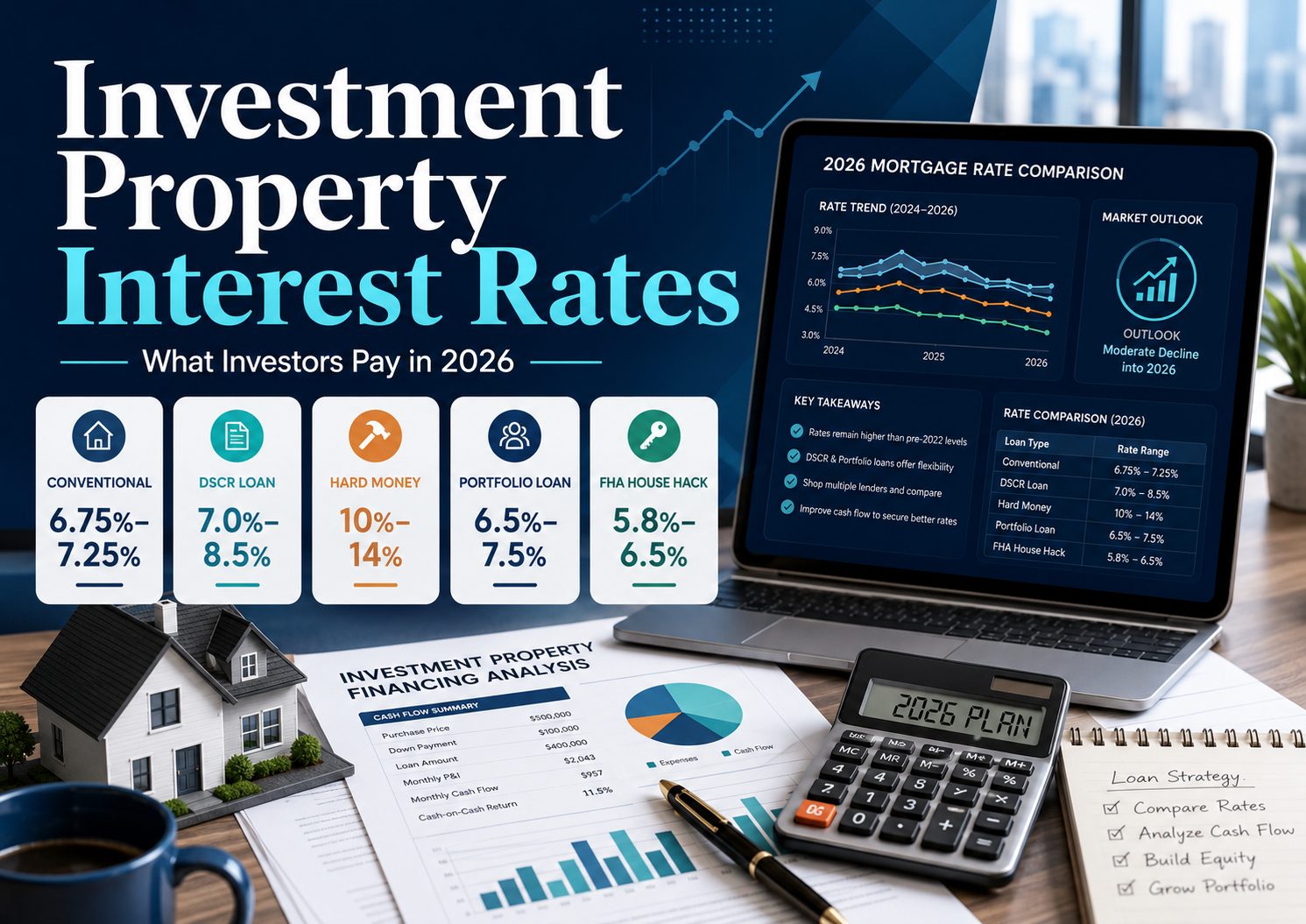
Quick Summary — Investment Property Interest Rates in 2026:
- Conventional loans (15-25% down): 6.75% – 7.25%
- DSCR loans: 7.0% – 8.5%
- Hard money loans: 10% – 14%
- Portfolio / credit union loans: 6.5% – 7.5%
- FHA (house hack, 1-4 units): 5.8% – 6.5%
- VA loans (if eligible): 5.5% – 6.2%
Investment property rates run 0.5% – 1.5% higher than primary residence rates. Conventional primary home rates currently sit at approximately 5.8% – 6.5% on a 30-year fixed.
Current Investment Property Interest Rates by Loan Type
Not all loans are created equal. The rate you get depends on loan type, your down payment, credit score, property type, and whether the lender keeps the loan or sells it. Here’s where investment property interest rates stand across the major loan categories in mid-2026.
| Loan Type | Rate Range | Down Payment | Typical Term | Best For | Key Limitation |
|---|---|---|---|---|---|
| Conventional | 6.75% – 7.25% | 15% – 25% | 15 or 30 yr fixed | Strong W-2 borrowers | 4-10 financed property cap (Fannie/Freddie) |
| DSCR Loan | 7.0% – 8.5% | 20% – 30% | 30 yr fixed / ARM | Self-employed, portfolio investors | Higher rate; DSCR ≥ 1.0-1.25 required |
| Hard Money | 10% – 14% | 10% – 30% (LTV-based) | 6 – 24 months | Fix-and-flip, fast close | Not for long holds; balloon risk |
| Portfolio / Credit Union | 6.5% – 7.5% | 20% – 30% | 5/1 ARM to 30 yr | Investors with 10+ properties | Relationship-dependent; limited availability |
| FHA (house hack) | 5.8% – 6.5% | 3.5% | 30 yr fixed | First-time investors, 2-4 unit | Must occupy one unit; MIP required |
| VA Loan | 5.5% – 6.2% | 0% | 30 yr fixed | Veterans, active military | Must occupy one unit (1-4 units); eligibility required |
Conventional loans are the most common path for investors with solid W-2 income and credit scores above 720. Fannie Mae and Freddie Mac guidelines allow financing on up to 10 properties, but you’ll pay a loan-level price adjustment (LLPA) that bumps investment property interest rates above primary residence pricing.
DSCR loans skip income verification entirely and qualify you based on the rental income the property generates. They’re the go-to for self-employed investors or those who’ve already maxed out conventional financing. Run your numbers through the DSCR calculator before applying — lenders typically want a ratio of 1.20 or higher for the best rates.
Hard money loans sit at the top of the rate range for a reason: speed and flexibility. Use them for acquisitions and rehabs, then refinance into a DSCR or conventional product. Model the full carrying cost with the hard money loan calculator so you don’t get surprised by the blended cost of capital.
FHA and VA loans deliver the lowest investment property interest rates available — but you have to live in one of the units for at least 12 months. For newer investors, this house-hack strategy is genuinely one of the best ways to start building a portfolio. Read the full breakdown in the first rental property guide.
Why Investment Property Interest Rates Are Higher
The spread between investment property rates and primary residence rates isn’t arbitrary. Lenders have hard data showing that non-owner-occupied loans default at higher rates, especially during economic stress. A homeowner who loses income fights to keep their house. An investor with a negative-cash-flow rental walks away faster.
Four structural factors drive the premium:
1. Default Risk Profile
Fannie Mae’s own data shows investment property loans default at roughly 2-3x the rate of owner-occupied loans when controlling for credit score and LTV. That risk is priced in through higher rates and more restrictive underwriting standards. According to Freddie Mac research, non-owner-occupied properties consistently show Improved loss severity after foreclosure as well — lenders lose more per default because properties sit vacant and depreciate faster without an owner maintaining them.
2. Reserve Requirements
Conventional investment property loans require 6-12 months of PITI (principal, interest, taxes, insurance) in liquid reserves after closing. For a $2,000/month payment, that’s $12,000 to $24,000 you can’t deploy into another deal. The reserve requirement is both underwriting friction and a signal of the Improved risk lenders associate with these loans.
3. Secondary Market Pricing
Most conventional mortgages end up bundled into mortgage-backed securities. Investors in those securities demand higher yields for non-owner-occupied loans, and that demand flows directly into the rates lenders quote you. DSCR loans, by contrast, often stay in lender portfolios or go to private secondary buyers — which is partly why DSCR pricing has its own supply-and-demand dynamics separate from the Freddie/Fannie market.
4. Loan-Level Price Adjustments
Fannie Mae and Freddie Mac charge LLPAs — extra fees expressed as a percentage of the loan amount — on investment properties. These get baked into your rate at closing or paid as points. On a $300,000 investment property with 20% down and a 720 credit score, the LLPA can add 1.5% to 3.5% of the loan amount, which translates to roughly 0.25% to 0.75% in rate depending on how your lender structures it.
How Investment Property Interest Rates Affect Your Deal
Abstract rate discussions don’t mean much until you see the numbers on an actual property. Let’s run the same $250,000 purchase at three different investment property interest rates and see what changes.
Assumptions: $250,000 purchase price, 25% down ($62,500), $187,500 loan, 30-year fixed. Gross monthly rent: $1,850. Monthly operating expenses (taxes, insurance, vacancy, maintenance, property management): $680.
| Metric | 6.5% Rate | 7.5% Rate | 8.5% Rate |
|---|---|---|---|
| Monthly P&I Payment | $1,185 | $1,311 | $1,441 |
| Monthly Cash Flow | −$15 | −$141 | −$271 |
| Annual Cash Flow | −$180 | −$1,692 | −$3,252 |
| DSCR | 0.99 | 0.89 | 0.81 |
| Total Interest Paid (30 yr) | $238,860 | $284,460 | $331,560 |
Notice what that 1% rate difference does. Going from 6.5% to 7.5% costs $1,512 more per year and flips a barely-breakeven deal into one bleeding $141/month. A deal that pencils at 6.5% may not work at all at 8.5%. That’s why investment property interest rates need to be in your underwriting before you make an offer, not after.
Run these exact numbers on your next acquisition with the property cash flow calculator and the investment property mortgage calculator. Plug in three rate scenarios for every deal — it takes two minutes and shows you how much rate sensitivity you’re taking on.
Run Your Rate Scenarios Before Making an Offer
Don’t guess how rate changes affect your deal. Model every scenario in seconds.
How to Get the Lowest Investment Property Interest Rate
Investment property interest rates aren’t fixed for you — they vary by lender, borrower profile, and deal structure. These seven strategies give you the most control over what you actually pay.
1. Get Quotes From at Least Three Lenders
This one move saves more money than any other strategy. Bankrate’s research consistently shows that borrowers who get three or more rate quotes save an average of $1,500+ over the first five years of their loan. For investment properties, where lenders vary more on pricing, the spread between the best and worst quote can easily be 0.5% or more. Use a mortgage broker who has access to wholesale rates — they’re often lower than what retail lenders quote directly.
2. Buy Down Points Strategically
One discount point costs 1% of the loan amount and typically reduces your rate by 0.25%. On a $200,000 loan, that’s $2,000 to save $500/year in interest. Your break-even is four years. If you’re holding the property long-term, buying points makes mathematical sense. If you’re planning to sell or refinance within five years, don’t bother — you won’t recoup the cost. Always model the full hold period before paying points.
3. Increase Your Down Payment
Putting 25% down instead of 20% often drops investment property interest rates by 0.125% to 0.375% because it reduces lender LTV risk and can lower your LLPA tier. Run the math both ways: a bigger down payment competes with that same capital deployed in another deal. For the down payment analysis, use the investment property down payment guide.
4. Strengthen Your Credit Score
Most lenders quote investment property interest rates in credit score tiers: 620-659, 660-679, 680-699, 700-719, 720-739, and 740+. The difference between a 699 and a 720 score can be 0.25% to 0.50% in rate. Pay down revolving balances below 30% utilization, dispute any errors on your report, and avoid opening new credit lines in the 90 days before applying.
5. Consider an Adjustable-Rate Mortgage
A 5/1 or 7/1 ARM typically prices 0.5% to 1.0% below a 30-year fixed. If you’re planning to sell within five to seven years or anticipate refinancing when rates drop, an ARM can save you several thousand dollars. The risk: rates adjust at the end of the fixed period. Model the worst-case adjustment scenario before choosing this path.
6. Work With Portfolio Lenders
Portfolio lenders keep loans on their own balance sheet instead of selling them to Fannie or Freddie. They set their own rules, which means they sometimes offer more competitive investment property interest rates for borrowers who don’t fit the agency mold — particularly those with LLC ownership, high property counts, or complex income situations. Community banks and credit unions are the first places to look.
7. Build a Lender Relationship Before You Need It
Investors with existing checking, savings, or business accounts at a community bank often get pricing breaks that aren’t advertised publicly. This takes time to build, but it pays dividends across multiple deals. Start the relationship on your first or second deal, not your fifth.
Rate Lock Strategy for Investment Purchases
Rate locks protect you from rate increases between your application approval and closing. On an investment property, where underwriting takes longer than a primary purchase, this matters more than most investors realize.
Standard lock periods run 30, 45, or 60 days. Investment property closings often push past 30 days because of reserve documentation, entity structuring (if buying in an LLC), and appraisal scheduling. A 45-day lock is usually the right default for investment deals.
When to lock: Lock as soon as your offer is accepted and you have a clear read on your timeline to close. Floating your rate means betting that rates move down — which they sometimes do, but the downside risk is asymmetric. A 0.25% increase while you’re floating costs more per month than a 0.25% decrease would save.
Float-down options let you capture a rate decrease after locking, usually for a fee of 0.25% to 0.5% of the loan amount. They make sense when rates are actively moving down or when your lock period is long (60+ days). Ask your lender upfront if they offer float-down provisions — not all do.
Extension fees: If your closing slips past your lock expiration, you’ll pay an extension fee — typically 0.125% to 0.25% per week. Build buffer into your timeline and communicate with your lender early if the close date is at risk. A $150 phone call (figuratively speaking) beats a $1,000 extension fee.
LLC closings require extra planning. Some lenders won’t lock a rate until they’ve reviewed the operating agreement and confirmed the entity structure. Confirm your lender’s LLC policy before you’re under contract, not after. Read the full breakdown on DSCR loan structures in the DSCR loans guide.
Common Mistakes Investors Make With Mortgage Rates
Rate mistakes compound. A bad rate on deal one affects how much capital you have for deal two. These are the four that show up most often.
Mistake 1: Calling One Lender and Stopping There
The first lender you call gives you a quote, and it sounds reasonable, so you go with it. This is the most expensive mistake in real estate financing. Investment property interest rates vary by 0.25% to 0.75% between lenders on the same day for the same borrower profile. Getting two more quotes takes an hour and can save you $50,000 over the life of the loan. There’s no loyalty discount in mortgage lending — shop every deal.
Mistake 2: Ignoring the Total Cost of Points
Lenders often present rate options alongside point costs without giving you the full picture. A quote of 6.75% with 1.5 points is not the same as 7.0% with zero points — you’re paying $3,000 upfront (on a $200K loan) for the lower rate. Calculate the break-even in months. If you’re not holding that long, the low-rate option is actually more expensive. The investment property mortgage calculator can model this comparison directly.
Mistake 3: Choosing the Lowest Payment Over the Best Rate
A 40-year amortization or interest-only loan drops your monthly payment — but you’re paying interest far longer. On a $200,000 loan, a 30-year fixed at 7.0% costs $278,000 in total interest. An interest-only loan at 7.0% for 10 years, then converting to a 20-year amortization, costs more when you run the full numbers. Always compare total cost of financing, not just monthly payment, when evaluating loan structures.
Mistake 4: Not Modeling Rate Sensitivity in Your Underwriting
You underwrite the deal at the rate you expect to get. The actual rate comes in 0.25% higher. You close anyway because you’re already in it. Then rates stay Improved and the deal doesn’t cash flow the way you modeled. The fix is simple: run every deal at your expected rate, at +0.5%, and at +1.0%. If the deal breaks at +0.5%, it’s too rate-sensitive. Use the rental property analysis guide for a full underwriting framework.
Disclaimer: The mortgage rates listed are estimates based on market conditions as of mid-2026 and are provided for educational and illustrative purposes only. Actual rates will vary based on your credit score, loan amount, down payment, property type, lender, and other qualifying factors. Nothing constitutes financial, legal, or mortgage lending advice. Consult a licensed mortgage professional before making financing decisions. Rate data referenced from Freddie Mac and Bankrate.
Frequently Asked Questions About Investment Property Interest Rates
{
“@context”: “https://schema.org”,
“@type”: “FAQPage”,
“mainEntity”: [
{
“@type”: “Question”,
“name”: “What are current investment property interest rates in 2026?”,
“acceptedAnswer”: {
“@type”: “Answer”,
“text”: “In mid-2026, investment property interest rates on conventional 30-year fixed loans range from approximately 6.75% to 7.25% for borrowers with strong credit and 20-25% down. DSCR loans run higher at 7.0%-8.5%, while FHA house-hack loans (requiring owner occupancy) offer rates of 5.8%-6.5%. Your actual rate depends on credit score, loan type, down payment, and lender.”
}
},
{
“@type”: “Question”,
“name”: “How much higher are investment property rates than primary residence rates?”,
“acceptedAnswer”: {
“@type”: “Answer”,
“text”: “Investment property rates typically run 0.5% to 1.5% higher than primary residence rates for the same borrower. In 2026, conventional primary home loans are priced around 5.8%-6.5%, while the equivalent investment property loan runs 6.75%-7.25%. The premium exists because lenders face higher default risk on non-owner-occupied properties.”
}
},
{
“@type”: “Question”,
“name”: “What credit score do I need for the best investment property interest rates?”,
“acceptedAnswer”: {
“@type”: “Answer”,
“text”: “A score of 740 or above puts you in the best pricing tier for conventional investment property loans. Scores between 700-739 are still competitive. Below 700, you’ll pay meaningfully higher rates and may face limited lender options. For DSCR loans, minimum scores start at 620-640, but the best DSCR rates go to borrowers at 720+.”
}
},
{
“@type”: “Question”,
“name”: “Can I use an FHA loan to buy an investment property?”,
“acceptedAnswer”: {
“@type”: “Answer”,
“text”: “You can use an FHA loan to purchase a 1-4 unit property as long as you live in one unit as your primary residence for at least 12 months. This ‘house hacking’ strategy lets you access FHA’s lower rates (5.8%-6.5%) and 3.5% down payment on what is effectively an investment property. After 12 months, you can move out and rent all units.”
}
},
{
“@type”: “Question”,
“name”: “What is a DSCR loan and how do the rates compare to conventional investment loans?”,
“acceptedAnswer”: {
“@type”: “Answer”,
“text”: “A DSCR (Debt Service Coverage Ratio) loan qualifies based on the rental income the property generates, not your personal income. This makes it popular with self-employed investors or those with many properties. DSCR rates in 2026 run from 7.0%-8.5%, which is 0.25%-1.25% higher than conventional investment loans. The trade-off is flexibility — no income documentation, no limit on the number of financed properties.”
}
},
{
“@type”: “Question”,
“name”: “Should I use a 15-year or 30-year mortgage for an investment property?”,
“acceptedAnswer”: {
“@type”: “Answer”,
“text”: “A 15-year mortgage typically offers rates 0.5%-0.75% lower than a 30-year fixed, but monthly payments are 40%-50% higher. For cash flow-focused investors, the 30-year is usually the better choice — lower payments protect your cash flow. Investors optimizing for equity paydown or with strong cash flow may prefer the 15-year. Model both scenarios using a mortgage calculator before deciding.”
}
},
{
“@type”: “Question”,
“name”: “How do investment property interest rates affect DSCR qualification?”,
“acceptedAnswer”: {
“@type”: “Answer”,
“text”: “Directly and significantly. DSCR is calculated as gross rental income divided by total debt service (monthly mortgage payment including taxes and insurance). As investment property interest rates rise, the monthly payment increases, which drops your DSCR. A property that qualifies at a 1.25 DSCR at 6.5% may drop below the 1.0 minimum at 8.5%, disqualifying it entirely. Always recalculate DSCR at your actual rate, not your estimated rate.”
}
}
]
}
What are current investment property interest rates in 2026?
In mid-2026, investment property interest rates on conventional 30-year fixed loans range from approximately 6.75% to 7.25% for borrowers with strong credit and 20-25% down. DSCR loans run higher at 7.0%-8.5%, while FHA house-hack loans (requiring owner occupancy) offer rates of 5.8%-6.5%. Your actual rate depends on credit score, loan type, down payment, and lender.
How much higher are investment property rates than primary residence rates?
Investment property rates typically run 0.5% to 1.5% higher than primary residence rates for the same borrower. In 2026, conventional primary home loans are priced around 5.8%-6.5%, while the equivalent investment property loan runs 6.75%-7.25%. The premium exists because lenders face higher default risk on non-owner-occupied properties.
What credit score do I need for the best investment property interest rates?
A score of 740 or above puts you in the best pricing tier for conventional investment property loans. Scores between 700-739 are still competitive. Below 700, you’ll pay meaningfully higher rates and may face limited lender options. For DSCR loans, minimum scores start at 620-640, but the best DSCR rates go to borrowers at 720+.
Can I use an FHA loan to buy an investment property?
You can use an FHA loan to purchase a 1-4 unit property as long as you live in one unit as your primary residence for at least 12 months. This house-hacking strategy lets you access FHA’s lower rates (5.8%-6.5%) and 3.5% down payment on what is effectively an investment property. After 12 months, you can move out and rent all units.
What is a DSCR loan and how do the rates compare to conventional investment loans?
A DSCR (Debt Service Coverage Ratio) loan qualifies based on the rental income the property generates, not your personal income. This makes it popular with self-employed investors or those with many properties. DSCR rates in 2026 run from 7.0%-8.5%, which is 0.25%-1.25% higher than conventional investment loans. The trade-off is flexibility — no income documentation, no limit on the number of financed properties. Use the DSCR calculator to check where your deal stands.
Should I use a 15-year or 30-year mortgage for an investment property?
A 15-year mortgage typically offers rates 0.5%-0.75% lower than a 30-year fixed, but monthly payments are 40%-50% higher. For cash flow-focused investors, the 30-year is usually the better choice — lower payments protect your cash flow. Investors optimizing for equity paydown or with strong cash flow may prefer the 15-year. Model both scenarios with the investment property mortgage calculator before deciding.
How do investment property interest rates affect DSCR qualification?
Directly and significantly. DSCR is calculated as gross rental income divided by total debt service (monthly mortgage payment including taxes and insurance). As investment property interest rates rise, the monthly payment increases, which drops your DSCR. A property that qualifies at a 1.25 DSCR at 6.5% may drop below the 1.0 minimum at 8.5%, disqualifying it entirely. Always recalculate DSCR at your actual rate quote, not your estimated rate. See BiggerPockets’ mortgage forum for real investor discussions on how rate changes affected their financing.
Don’t Let Rate Uncertainty Kill Your Deal Analysis
Model every deal at multiple rate scenarios before you go under contract. Our calculators run the full cash flow, DSCR, and mortgage comparison in seconds — no spreadsheet required.
Leave a Reply