Last updated: October 21, 2026 · Originally published: May 14, 2026 · By Alex Petrov
Your loan-to-value ratio is the first number every lender checks — and the one most borrowers calculate wrong. The loan to value calculator above tells you in seconds whether your deal fits typical lending ranges, how much cash you need upfront, and how much equity sits between you and a rejection letter. Get it right before you waste time on an application that won’t go anywhere. Use the free LTV Calculator to run your own numbers.
However, LTV is deceptively simple. Divide the loan amount by the property value. That’s it. Verify.
But the implications ripple through every part of your deal — the rate you’re offered, whether you’ll pay mortgage insurance, how much cash stays in your pocket, and whether the lender picks up the phone at all. For example, a borrower in Tampa who walked into a lender meeting in March 2026 with an 82% LTV on a $425,000 duplex got quoted a rate 0.75 points higher than the same deal at 75% LTV. On a 30-year term, that gap costs $47,000 in extra interest. This is why running a loan to value calculator using a loan to value calculator before your lender conversation isn’t optional — it’s the minimum due diligence.
This article breaks down LTV from the ground up: what it is, how to calculate it, what the thresholds mean for different loan types, and how to use the loan to value calculator to test your deal before anyone pulls your credit. Whether you’re buying your first rental, refinancing a property you’ve held for five years, or evaluating a cash-out refi, the math starts here.
On This Page
What Is Loan-to-Value Ratio?
The single ratio that gates every mortgage decision
Loan-to-Value (LTV) measures what percentage of a property’s value is financed with debt. The loan to value calculator shows this clearly. It answers a straightforward question: how much of this property does the bank own versus how much do you own?
The loan to value calculator uses a simple formula:
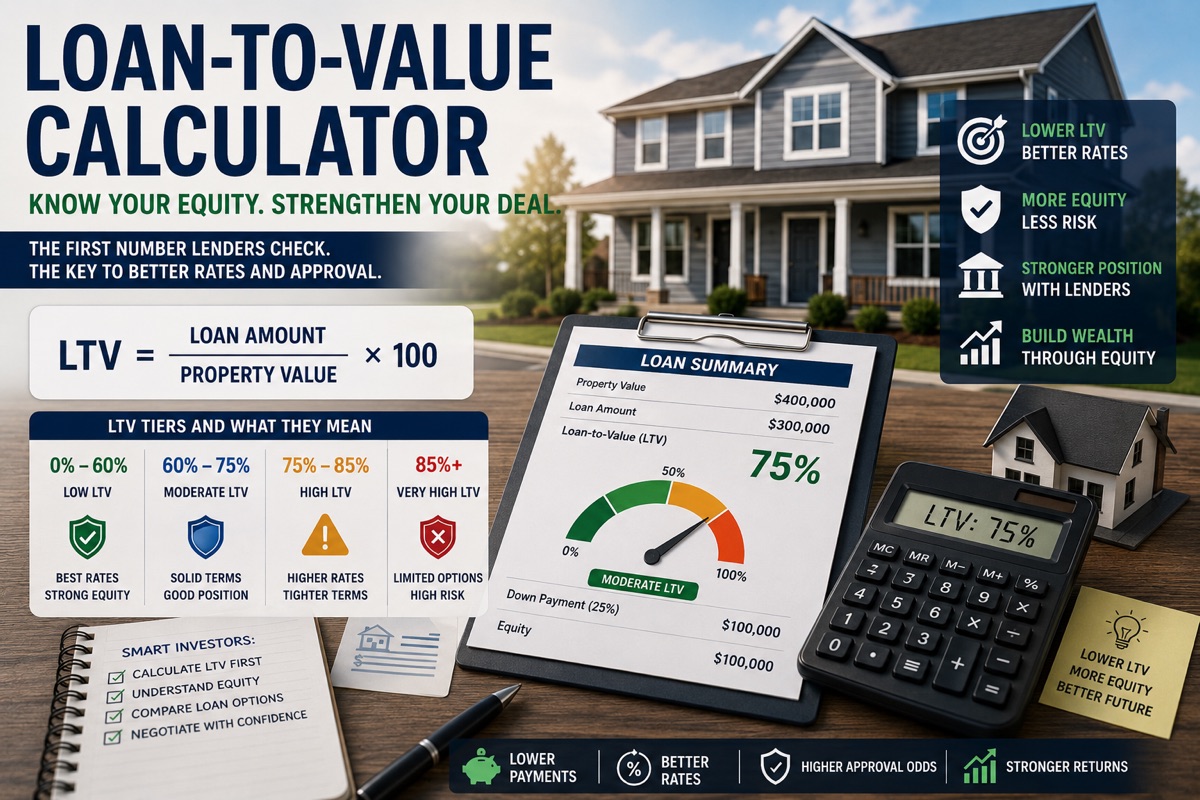
LTV = Loan Amount / Property Value x 100
If you’re buying a $500,000 property and borrowing $375,000, your LTV is 75%. The loan to value calculator confirms that you’re putting 25% down and the lender is covering the other 75%. The lower that number, the less risk the lender carries — and the better your terms tend to be.
LTV is not a profitability metric. It doesn’t tell you whether a deal will cash flow, whether the property will appreciate, or whether the neighborhood is trending up. The loan to value calculator measures one thing: use. How much of someone else’s money are you using relative to the property’s value? That single ratio — which any loan to value calculator reveals instantly — shapes everything downstream in the lending process.
Here’s what the loan to value calculator makes clear. LTV and down payment are two sides of the same coin, but they’re not the same thing. Down payment is the dollar amount you bring to closing. LTV is the ratio between your loan and the property value. A 25% down payment on a $400,000 property means a $300,000 loan and a 75% LTV. As a result, change the property value and the LTV shifts even if the loan stays the same — which is exactly what happens in a refinance when the appraisal comes in higher or lower than expected.
How to Use the calculator
From property value to LTV in three steps
Step 1: Enter property value
Start with the property’s current market value. For a purchase, this is your contract price or appraised value — whichever the lender uses (typically the lower of the two). For a refinance, it’s the appraised value. Don’t use the Zestimate or what your neighbor’s house sold for two years ago. Lenders care about the number on the appraisal report, and that number drives the LTV calculation. Check with this tool before committing.
Step 2: Enter loan amount or down payment
For purchases, you can enter either the loan amount directly or the down payment percentage. The calculator figures out the other number. If you’re putting 20% down on a $350,000 property, that’s $70,000 down and a $280,000 loan. The calculator returns an LTV of 80%. The calculator handles this automatically.
For refinances, enter your current loan balance (or the new loan amount you’re seeking). If you owe $220,000 on a property now worth $310,000, the calculator shows an LTV of 71%. That’s well within most conventional refinance limits.
Step 3: Select transaction type
The calculator adjusts context notes based on your transaction type. A purchase LTV depends on the lender program and appraisal. A standard refinance may be limited by seasoning requirements. A cash-out refinance typically faces stricter LTV caps — often 70-75% instead of 80%. And hard money or bridge loans use different math entirely, often based on ARV (after-repair value) or LTC (loan-to-cost) rather than standard LTV. A quick the tool check confirms this.
Step 4: Review your results
The calculator returns your LTV percentage, your equity position, required down payment (for purchases), and available equity (for refinances). Color-coded status badges show where your LTV falls relative to common lender thresholds. Green means strong equity, blue means solid positioning, amber signals tighter terms ahead, and red means you’re above most conventional limits. Plug your numbers into the calculator to see.
Why LTV Actually Matters to Lenders and Investors
The downstream effects of a single percentage
LTV isn’t just a qualification threshold. It’s a pricing mechanism. Lenders use it to set your interest rate, determine whether you’ll pay private mortgage insurance, decide how much documentation to require, and in some cases, whether to fund the loan at all. This tool makes this comparison easy.
Rate pricing tiers
Most lenders price loans using LTV-based adjustments called Loan-Level Price Adjustments (LLPAs). Fannie Mae’s LLPA matrix shows the granularity — a borrower with 740 credit and 75% LTV gets a materially better adjustment than the same borrower at 80% LTV. On a $400,000 loan, these adjustments can translate to 0.25-0.75% in rate difference. Over 30 years, that’s $20,000 to $60,000 in additional interest. This is exactly what the calculator reveals.
In Jacksonville, FL, a 2026 deal at 75% LTV on a $380,000 single-family rental locked at 7.25%. The same borrower, same property, same credit score at 82% LTV would have locked at 7.875%. Monthly payment difference: $148. Over the loan’s life: $53,280. The calculator quantifies this tradeoff instantly.
Mortgage insurance triggers
Cross above 80% LTV on a conventional loan and private mortgage insurance (PMI) kicks in. PMI runs $50 to $250 per month depending on loan size, credit score, and LTV level. It protects the lender, not you. On an investment property, this cost stacks on top of already-higher investor rates and can be the difference between a deal that cash flows and one that bleeds money monthly. Every the tool run reflects this reality.
Lender program eligibility
Different loan products have different LTV ceilings. Here’s where most deals get sorted:
| Loan Type | Typical Max LTV | Notes |
|---|---|---|
| Conventional (Owner-Occupied) | 95-97% | PMI required above 80% |
| Conventional (Investment) | 75-80% | Higher rates, 20-25% down typical |
| FHA | 96.5% | Owner-occupied only, MIP required |
| VA | 100% | Eligible veterans, no down payment |
| DSCR | 75-80% | Property income qualifies, no W-2 |
| Hard Money / Bridge | 65-75% | Based on ARV or as-is value |
| Cash-Out Refinance | 70-75% | Stricter than rate-term refi |
| Commercial (5+ units) | 65-75% | DSCR-driven underwriting |
Walk into a lender conversation with an LTV above their program maximum and you’ve wasted everyone’s time. The loan to value calculator eliminates that risk in 10 seconds.
LTV Tiers: Low, Moderate, High, and Aggressive
What your LTV percentage actually signals to lenders — and
Low LTV: Below 60%
Strong equity cushion. You own more of the property than you owe. Lenders see minimal risk, which translates to the best available rates and terms. This range is common for investors who’ve held properties for several years and seen appreciation, or borrowers making large down payments. A property in Charlotte, NC purchased for $290,000 in 2021 now appraised at $365,000 with a remaining balance of $198,000 sits at 54% LTV — firmly in the “lender loves you” territory. Your the calculator output depends on this.
The trade-off: your cash is tied up in the property. Every dollar of equity is a dollar not deployed into another deal. For investors scaling a portfolio, low LTV means safety but slower growth. This tool catches this gap immediately.
Moderate LTV: 60-75%
The sweet spot for most real estate transactions. Balanced risk and return. Lenders are comfortable, rates are competitive, and you’re not over-used. A 75% LTV — which matches a 25% down payment — is the default for most investment property loans. It avoids PMI, meets the threshold for most conventional and DSCR programs, and leaves enough equity to weather a moderate market correction without going underwater. The calculator answers this in seconds.
High LTV: 75-85%
Underwriting gets tighter here. Expect rate adjustments, possible PMI on conventional loans, and more scrutiny on income, reserves, and property condition. Some investor loan programs won’t go above 80% at all. At 85% LTV, your equity cushion is thin — a 15% drop in property value puts you underwater. In markets that experienced 10-15% corrections in 2022-2023, borrowers at 85% LTV felt it fast. That is what the calculator is for.
Very High LTV: Above 85%
Aggressive territory. For investment properties, very few lenders will touch deals above 85% LTV. Owner-occupied properties have more options (FHA at 96.5%, VA at 100%), but investor financing at this level typically pushes you toward specialty lenders with higher rates and additional fees. The risk is real: at 90% LTV, a 10% market dip eliminates your equity entirely.
| LTV Range | Risk Level | Typical Lender Response | PMI? |
|---|---|---|---|
| Below 60% | Low | Best rates, easy approval | No |
| 60-75% | Moderate | Competitive rates, standard terms | No |
| 75-80% | Moderate-High | Rate adjustments, more scrutiny | No (at 80%) |
| 80-85% | High | PMI, higher rates, limited programs | Yes (conventional) |
| Above 85% | Very High | Limited options, specialty lenders | Yes |
The Down Payment Trade-Off
How much more cash actually buys you better terms
Every percentage point of down payment moves your LTV — and the pricing impact isn’t linear. Going from 80% to 75% LTV might shave 0.25% off your rate. Going from 75% to 70% might only shave 0.125%. The question isn’t “what’s the lowest LTV I can get?” — it’s “where does the extra cash stop earning its keep?”
Let’s run the numbers on a $400,000 property:
| Down Payment | Loan Amount | LTV | Estimated Rate | Monthly P&I |
|---|---|---|---|---|
| $60,000 (15%) | $340,000 | 85% | 8.00% | $2,495 |
| $80,000 (20%) | $320,000 | 80% | 7.625% | $2,276 |
| $100,000 (25%) | $300,000 | 75% | 7.375% | $2,072 |
| $120,000 (30%) | $280,000 | 70% | 7.25% | $1,910 |
| $160,000 (40%) | $240,000 | 60% | 7.125% | $1,617 |
Going from 85% to 75% LTV costs an extra $40,000 upfront but saves $423/month in P&I — that’s $5,076 per year. The extra $40,000 effectively earns a 12.7% annual return through payment reduction alone, before considering the rate improvement’s effect on total interest. Hard to beat that with a savings account.
But going from 75% to 60% LTV costs another $60,000 and only saves $455/month more. The return on that marginal cash drops to 9.1%. Still good, but you’ve now tied up $160,000 in a single property. For an investor building a portfolio, that $60,000 might be the down payment on a second rental. The loan to value calculator helps you see these exact trade-offs for your specific numbers.
LTV for Refinances and Cash-Out Scenarios
How LTV works when you already own the property
Refinance LTV flips the calculation. Instead of “how much am I putting down?”, the question becomes “how much equity have I built?” Your loan balance divided by the current appraised value gives your refinance LTV. If the property has appreciated since purchase, your LTV may be lower than when you bought it — even if you haven’t paid down much principal.
Rate-and-term refinance
You’re replacing your existing mortgage with a new one at (hopefully) better terms. Most conventional programs allow up to 80% LTV for rate-and-term refis on investment properties. You bought a $350,000 property in Phoenix with 25% down ($262,500 loan). Two years later, it appraises at $390,000 and your balance is $255,000. Your LTV is now 65% — well within refi limits and positioned for strong pricing.
Cash-out refinance
This is where LTV constraints bite hardest. Most lenders cap cash-out refis at 70-75% LTV for investment properties — sometimes 65% for certain programs. You can’t just extract all your equity. Using the Phoenix example: at a $390,000 appraisal and 75% max LTV, your maximum new loan is $292,500. Subtract your $255,000 existing balance and you can pull out approximately $37,500 in cash (before closing costs and reserves).
The calculator shows this equity extraction estimate. But keep in mind: it excludes closing costs (typically 2-3% of the new loan), reserve requirements (many lenders want 6 months of PITI in the bank post-close), and any lender holdbacks. The actual cash you receive will be less than the raw equity number.
BRRRR strategy and LTV
For BRRRR investors (Buy, Rehab, Rent, Refinance, Repeat), LTV on the refinance is the exit gate. You buy a distressed property at $180,000, rehab it for $45,000, and it appraises at $300,000 after repairs. At 75% LTV, your cash-out refi loan is $225,000. That covers your $180,000 purchase and $45,000 rehab — you’ve recycled all your capital and kept the property. But if the appraisal comes in at $270,000 instead, your max loan at 75% LTV drops to $202,500 — $22,500 short. That gap stays trapped in the deal. Run the tool with conservative appraisal estimates to stress-test your exit.
LTV Limits by Property Type
Different property types face different LTV ceilings
Not all properties are created equal in a lender’s eyes. A single-family primary residence gets the most generous LTV treatment. Move to investment property, multi-family, or commercial, and the limits tighten. The Federal Housing Finance Agency (FHFA) sets conforming loan limits that affect how much you can borrow at standard terms — go above those limits and you’re in jumbo territory with different LTV rules.
| Property Type | Max LTV (Purchase) | Max LTV (Cash-Out Refi) |
|---|---|---|
| Primary Residence (1 unit) | 95-97% | 80% |
| Primary Residence (2-4 units) | 85-95% | 75% |
| Investment (1 unit) | 75-80% | 70-75% |
| Investment (2-4 units) | 70-75% | 65-70% |
| Commercial (5+ units) | 65-75% | 60-70% |
Primary residence loans often allow significantly higher LTV than investment properties. An FHA borrower can put 3.5% down on a primary residence (96.5% LTV), while the same borrower buying an investment property needs 20-25% down (75-80% LTV). This gap is intentional — lenders know that people prioritize their own home’s mortgage over an investment property during financial stress. The risk premium shows up in both rate and LTV limits.
Hard Money Loans and LTV: A Different Animal
Why standard LTV doesn’t apply to bridge financing
Hard money lenders don’t think like conventional lenders. While a bank cares about your LTV based on as-is value, a hard money lender often works with two different metrics:
LTV based on ARV (After-Repair Value): How much is the property worth after renovations? Most hard money lenders cap at 70-75% of ARV. If the ARV is $300,000, you can borrow up to $225,000 — and that loan covers both the purchase and rehab costs.
LTC (Loan-to-Cost): What’s the total project cost including purchase price and rehab? Hard money lenders may fund 85-90% of total cost. On a $180,000 purchase with $50,000 in rehab ($230,000 total), an 85% LTC lender will go to $195,500.
the calculator uses standard as-is LTV. If you enter a hard money scenario, the calculator will flag that hard money loans often use ARV or LTC instead of standard LTV — and results may not match what your lender calculates. For hard money deal analysis, the Hard Money Loan Calculator handles ARV-based math directly.
LTV vs. CLTV: What’s the Difference?
When a second lien changes the picture
LTV considers only your first mortgage against the property value. CLTV (Combined Loan-to-Value) adds up all liens — first mortgage, second mortgage, HELOC, and any other debt secured by the property — and divides by the property value.
Example: Property worth $500,000. First mortgage: $325,000. HELOC: $50,000.
- LTV = $325,000 / $500,000 = 65%
- CLTV = ($325,000 + $50,000) / $500,000 = 75%
Many lenders cap CLTV at 75-80% even if your first-mortgage LTV is comfortable. This matters when you’re considering adding a HELOC or second mortgage to an existing property. The calculator assumes a single first mortgage — CLTV for second liens is not included. If you have multiple loans on the property, calculate CLTV manually by adding all loan balances and dividing by current value.
Worked Examples: LTV in Real Scenarios
Three deals, three different LTV stories
Example 1: First rental purchase in Memphis, TN (2026)
Property price: $215,000. Down payment: 25% ($53,750). Loan: $161,250.
LTV = $161,250 / $215,000 = 75%
At 75% LTV, this deal qualifies for most conventional investor programs. No PMI. With a 720 credit score and 7.5% rate, monthly P&I runs about $1,128. The investor checked the DSCR Calculator and confirmed that $1,400/month rent produces a DSCR of 1.18 — enough for a DSCR loan program. The LTV passes the first test; now the income metrics determine everything else.
Example 2: Cash-out refinance in Denver, CO
Original purchase: $420,000 in 2022. Current balance: $385,000. Current appraisal: $465,000.
Current LTV = $385,000 / $465,000 = 82.8%
This LTV is too high for a cash-out refi — most programs require 75% or less. At 75% max LTV, the maximum new loan would be $348,750 — which is actually less than the current balance. No cash-out available. The investor needs more appreciation or faster principal paydown before this deal works. The calculator shows this instantly, saving a $500 appraisal fee and weeks of waiting.
Example 3: BRRRR exit in Indianapolis, IN
Purchase: $135,000. Rehab: $40,000. Total invested: $175,000. Post-rehab appraisal: $240,000.
Refinance LTV at 75% = $180,000 loan / $240,000 value
The $180,000 refi loan covers the full $175,000 investment and returns $5,000 (before closing costs). That’s a successful BRRRR — capital recycled, property retained. But if the appraisal had come in at $220,000, the max loan at 75% would be $165,000 — leaving $10,000 trapped. Running the calculator at different appraisal values shows exactly where the break-even appraisal sits.
Common Mistakes When Calculating LTV
Five errors that cost money or kill deals — and
Using purchase price instead of appraised value
Lenders use the lower of purchase price or appraised value for purchase transactions. If you’re buying at $350,000 but the appraisal comes in at $330,000, your LTV is based on $330,000 — not your contract price. At 75% LTV, your max loan drops from $262,500 to $247,500. That $15,000 gap has to come out of your pocket or the seller needs to renegotiate.
Forgetting about multiple liens for CLTV
Your first mortgage LTV might be 70%, but if you’ve got a $50,000 HELOC on the same property, your CLTV could be 82%. Lenders check both. The calculator focuses on single first-mortgage LTV — if you have second liens, add them manually.
Confusing LTV with LTC in hard money deals
A hard money lender saying “we’ll lend 75% LTV” likely means 75% of ARV, not 75% of what you’re paying for the property today. On a property you’re buying for $150,000 with an ARV of $250,000, 75% of ARV is $187,500, while 75% of purchase price is only $112,500. The difference is enormous. Make sure you know which value the lender is referencing.
Ignoring rate pricing tiers
Borrowers fixate on qualifying at a certain LTV and miss the pricing step-downs available at lower LTVs. The difference between 80% and 75% LTV might only be $20,000 more cash at closing but saves thousands over the loan’s life. Always run this tool at a few different LTV levels to see the full picture.
Applying owner-occupant LTV limits to investment properties
Just because FHA allows 96.5% LTV on a primary residence doesn’t mean you can put 3.5% down on a rental. Investment property programs have their own — tighter — LTV limits. Mixing up the two categories wastes time and leads to rejected applications.
How LTV Connects to DSCR, Cap Rate, and Cash Flow
LTV in the context of your full deal analysis
LTV measures use. It doesn’t tell you whether the property generates income, whether the deal is profitable, or whether the cap rate meets your targets. But it influences all of those things by determining how much you borrow and at what rate.
LTV and DSCR: Higher LTV means a bigger loan, which means higher debt service. That pushes your DSCR down. A property with 1.25 DSCR at 75% LTV might drop to 1.05 at 85% LTV — below most lender minimums. Check both metrics together using the DSCR Calculator.
LTV and Cash Flow: Same logic. Bigger loan = bigger monthly payment = less cash left over from rent. A deal that cash flows $200/month at 75% LTV might bleed $150/month at 85% LTV. Run both scenarios in the Mortgage Calculator to see the exact impact.
LTV and Cap Rate: Cap rate is property-level (NOI / Value) and doesn’t depend on financing. But your choice of LTV determines how much of that cap rate flows to you versus the lender. A 7% cap rate property at 75% LTV and 7.5% interest sends most of the spread to debt service. The same property with 50% LTV or an all-cash purchase keeps the full cap rate return.
LTV is one input in a multi-variable decision. It sets the financing foundation. The other calculators build the operating and return analysis on top of it.
Limitations of This Calculator
What LTV alone cannot tell you
- Does NOT guarantee loan approval. LTV is one of many factors lenders evaluate. Credit score, income (or DSCR), reserves, property condition, and market conditions all play a role.
- Does NOT include credit, income, or DSCR analysis. A passing LTV doesn’t mean the deal underwrites. Use the DSCR Calculator to check income coverage.
- Assumes a single first mortgage. Combined LTV (CLTV) for second liens, HELOCs, and subordinate debt is not calculated. If you have multiple loans, add balances manually.
- Does NOT calculate monthly payments. LTV tells you about use, not cost. Use the Mortgage Calculator for PITI and cash flow projections.
- Cash-out estimates are gross figures. They exclude closing costs (2-3% of new loan), lender reserve requirements, title fees, and any holdbacks. Actual cash received will be lower.
- Hard money results may not match lender calculations. Hard money lenders typically use ARV or LTC rather than as-is LTV. Results here are based on standard LTV only.
This calculator is an educational screening tool. Before committing capital, get an actual appraisal, current rate quotes from a licensed lender, and professional advice appropriate to your situation.
Frequently Asked Questions
Common questions about LTV and the calculator
What is a good LTV ratio for an investment property?
Most investment property lenders prefer 75% LTV or lower. At this level, you avoid PMI, qualify for better rate pricing, and maintain a 25% equity cushion. Some DSCR programs accept up to 80%, but expect higher rates. Below 70% LTV gets you the best available terms. The “right” LTV depends on your strategy — aggressive growth investors tolerate higher LTV to deploy less cash per deal, while conservative investors prefer lower LTV for stability and pricing.
How do I calculate LTV for a refinance?
Divide your current loan balance by the property’s current appraised value. If you owe $280,000 on a property appraised at $400,000, your LTV is 70%. For a cash-out refinance, use the new (higher) loan amount you’re seeking instead of your current balance. Keep in mind that refinance LTV may be limited by appraisal value and seasoning requirements — some programs require 6-12 months of ownership before allowing a cash-out refi at full appraised value.
What’s the difference between LTV and CLTV?
LTV uses only your first mortgage balance. CLTV (Combined Loan-to-Value) adds all liens together — first mortgage, second mortgage, HELOC, and any other secured debt. Your LTV might be 70% while your CLTV is 82% because of a HELOC. Most lenders check both numbers. This calculator models single first-mortgage LTV only; calculate CLTV by adding all loan balances and dividing by property value.
Does LTV affect my interest rate?
Yes, directly. Lenders use Loan-Level Price Adjustments (LLPAs) that add basis points to your rate at higher LTVs. The jumps are most pronounced at 80%, 85%, and 90% LTV. On a $300,000 loan, the rate difference between 75% and 85% LTV can be 0.5-0.75%, costing $30,000-$50,000 in extra interest over 30 years. Running the loan to value calculator at multiple LTV levels shows you exactly where the pricing breaks occur for your deal.
Can I get a loan above 80% LTV on an investment property?
It’s possible but uncommon. Most conventional investor programs cap at 80% LTV, and DSCR programs typically hold the same line. Some portfolio lenders and specialty programs may go to 85% with compensating factors — strong credit (740+), significant reserves (12+ months), or high DSCR. Expect to pay a rate premium of 0.5-1.0% and possibly mortgage insurance. For owner-occupied properties, the options are much wider: FHA allows 96.5%, VA allows 100%.
What happens if my appraisal comes in low?
Your LTV goes up, because the denominator (property value) shrinks while your loan amount stays the same. On a $350,000 purchase with 25% down, you planned for 75% LTV. If the appraisal comes in at $325,000, your LTV jumps to 80% (using the lower appraised value). You’ll either need to bring more cash to closing, renegotiate the purchase price, challenge the appraisal, or accept worse loan terms at the higher LTV.
How does LTV change over time?
Two forces push your LTV down after purchase: principal paydown through regular mortgage payments, and property appreciation. On a 30-year loan at 7.5%, roughly 15% of your payment goes to principal in Year 1 (the rest is interest). Appreciation varies by market — some areas see 3-5% annual gains, others stagnate. A $400,000 property at 75% LTV that appreciates 4% annually and pays down normally drops to about 65% LTV within 5 years. That’s when refinancing or equity extraction becomes viable.
Related Calculators
Continue your analysis with these tools
- DSCR Calculator — Check whether the property’s income covers the debt. LTV determines loan size; DSCR determines if that loan is approvable.
- Mortgage Calculator — Estimate monthly PITI and cash flow. Once you know your LTV and loan amount, see what the payments actually look like.
- Debt Yield Calculator — Lender risk metric independent of interest rate or loan term. Used alongside LTV in commercial underwriting.
- Hard Money Loan Calculator — ARV and LTC-based lending analysis for flips and bridge loans where standard LTV doesn’t apply.
- Real Estate ROI Calculator — Full return analysis including appreciation, tax benefits, and equity build over a multi-year hold.
- BRRRR Calculator — Model the Buy-Rehab-Rent-Refinance-Repeat strategy where refinance LTV determines your capital recovery.
Disclaimer: This article is for educational purposes only and does not constitute financial, investment, legal, or tax advice. Real estate investing involves significant risk, including the potential loss of capital. All numbers, rates, and projections are illustrative examples and may not reflect your specific situation. Consult qualified financial, legal, and tax professionals before making any investment decisions.
Frequently Asked Questions
Is this calculator free?
Yes, all calculators on ArvCalc are completely free with no signup required. Enter your numbers and get instant results. You can save results as PDF or share via URL.
How accurate are the calculator results?
The calculator performs exact mathematical calculations based on your inputs. The accuracy depends on how realistic your assumptions are — use actual market data for rent, taxes, insurance, and vacancy rather than optimistic estimates. Always verify key inputs with local data.
Can I save my calculations?
Yes. Use the Share button to generate a URL with your inputs saved, or export results as PDF. You can also bookmark the shared URL to return to your analysis later.
What inputs do I need?
At minimum: property value, rental income, and basic expenses (taxes, insurance). For more accurate analysis, add vacancy rate, maintenance reserves, property management fee, and financing details. The more inputs you provide, the more accurate the output.
Do I need to create an account?
No. All calculators work instantly without registration, login, or email. Just enter your numbers and get results. No data is stored on our servers.
Leave a Reply