Last updated: October 21, 2026 · Originally published: May 21, 2026 · By Alex Petrov
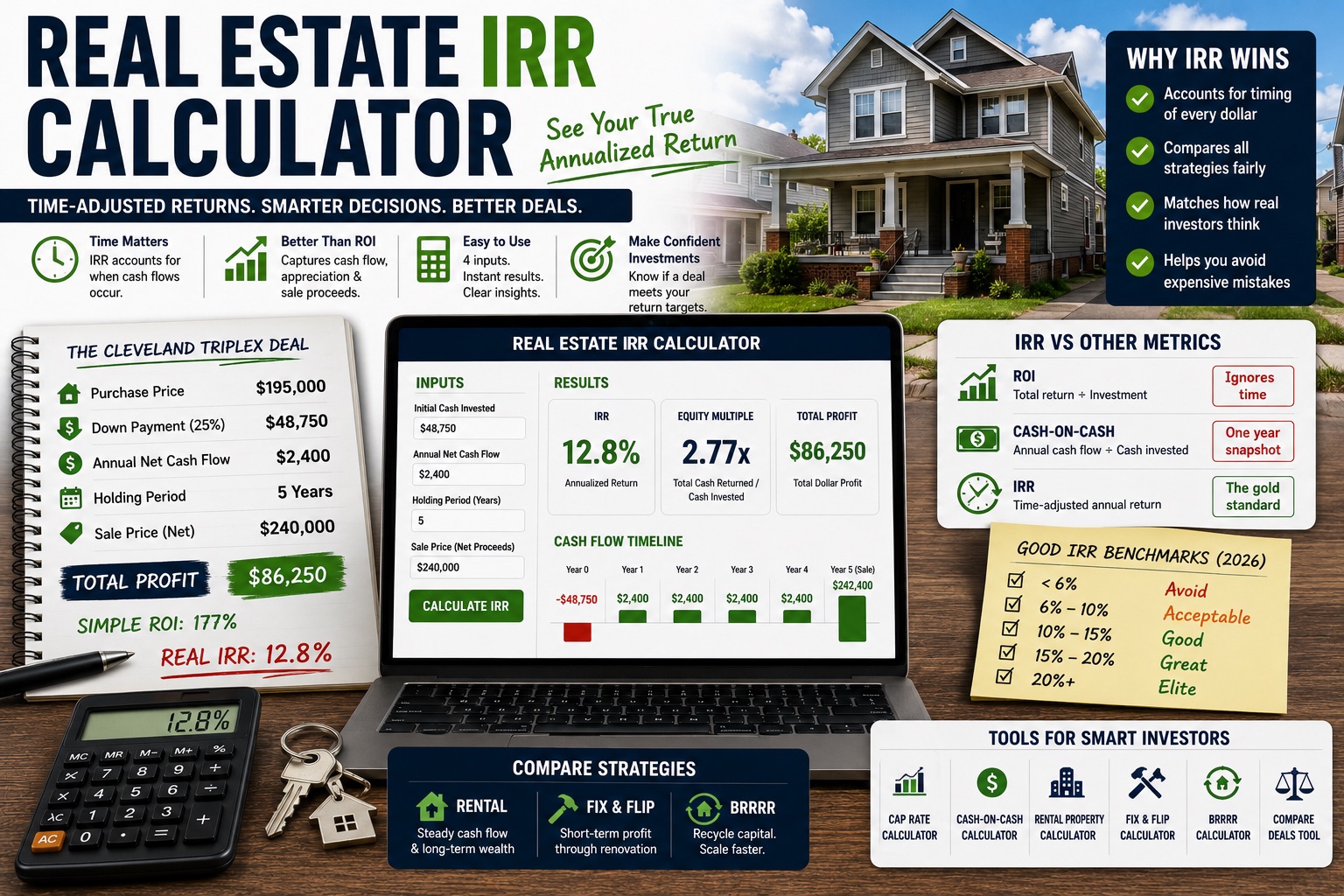
You find a Cleveland triplex for $195,000. You put $48,750 down, net $2,400 a year in cash flow, and sell it for $240,000 after five years. Your total profit is $86,250. Simple ROI says 177%. But your real, time-adjusted return is just 12.8% annually. That is the brutal difference between simple math and the Internal Rate of Return. If you are not using a real estate IRR calculator, you are likely overestimating your returns by a significant margin. Let’s fix that today.
Why IRR Matters More Than Simple ROI
Time is the silent killer of returns.
Simple ROI tells you how much total cash you made versus what you put in. It ignores the year that profit arrives. A $50,000 profit over two years is vastly different from the same profit over ten years, but simple ROI treats them identically. This is where a real estate IRR calculator becomes key. It forces you to account for the timing of every dollar—your down payment today, cash flow each year, and the big lump sum at sale.
In 2026, with conventional loans at 7.5% and hard money at 12%, the cost of capital is high. If your IRR is below your borrowing cost, you are destroying wealth, not building it. The real estate IRR calculator is the only tool that shows you this truth.
How to Use the Real Estate IRR Calculator in 4 Steps
It is simpler than you think.
Most investors overcomplicate this. Here is the exact workflow I use every time I underwrite a deal.
Step 1: Input your initial cash investment.
This is your total cash outlay at closing: down payment, closing costs, and any immediate repairs. For that Cleveland triplex, that was $48,750. Do not include loan proceeds; the calculator only cares about cash you personally put in.
Step 2: Enter annual net cash flow.
This is your rental income minus all operating expenses, including debt service, property management, vacancy reserves, and CapEx. For our example, that was $2,400 per year. Be conservative here; optimistic cash flow is the fastest way to a fake IRR.
Step 3: Set your holding period.
Five years is standard for most buy-and-hold strategies. Flippers might use one year. BRRRR investors often use a two-year cycle. The real estate IRR calculator will adjust the annualized return based on this number.
Step 4: Enter the expected sale price.
This is your net proceeds after sale costs. For the triplex, that was $240,000. If you are planning a 1031 exchange, you still enter the sale price; the calculator is showing you the return on this specific leg of the journey.
Hit calculate. The output will show your IRR, equity multiple, and total profit. If the IRR is less than 8% in this rate environment, reconsider the assumptions.
Inputs and Outputs: What the Calculator Shows
Know what each number means.
| Input Field | Example Value | Why It Matters |
|---|---|---|
| Initial Cash Invested | $48,750 | The denominator of your return equation. |
| Annual Net Cash Flow | $2,400 | Determines the income stream portion of IRR. |
| Holding Period (Years) | 5 | Controls how many periods the IRR is calculated over. |
| Sale Price (Net Proceeds) | $240,000 | The largest cash event; small changes here swing IRR massively. |
| Output Field | Example Result | Interpretation |
|---|---|---|
| IRR | 12.8% | Annualized return, accounting for timing. |
| Equity Multiple | 2.77x | Total cash returned divided by cash invested. |
| Total Profit | $86,250 | Raw dollar return (ignores timing). |
How IRR Works: The Formula and a Real Example
IRR is the discount rate that makes the net present value (NPV) of all cash flows equal to zero. In plain English: it finds the single annual return rate that, if you earned it on your money every year, would produce the exact same final result as your lumpy real estate cash flows.
Formula: 0 = CF₀ + CF₁/(1+IRR)¹ + CF₂/(1+IRR)² + … + CFₙ/(1+IRR)ⁿ
Where CF₀ is your initial investment (negative) and CFₙ includes the sale proceeds.
Let us use our Cleveland triplex. The cash flow timeline looks like this:
- Year 0: -$48,750 (initial investment)
- Year 1: +$2,400 (cash flow)
- Year 2: +$2,400
- Year 3: +$2,400
- Year 4: +$2,400
- Year 5: +$242,400 ($2,400 cash flow + $240,000 sale)
Plugging these into a real estate IRR calculator solves for the rate that brings the NPV to zero. The answer is 12.8%. If you had simply divided total profit ($86,250) by years (5) and initial investment ($48,750), you would get an incorrect 35.4% annual return. The real estate IRR calculator corrects this by weighting the timing of that big sale check at the end.
What Is IRR in Real Estate?
IRR is the gold standard for measuring the annualized yield of any investment with multiple cash flows over time. In real estate, it captures the three ways you make money: cash flow, appreciation, and principal paydown (though principal paydown is implicitly captured through the sale price).
Here is how it compares to other metrics:
- ROI: Total return divided by total investment. Ignores time entirely. A deal with 100% ROI over 10 years is worse than 50% ROI over 2 years.
- Cash-on-Cash Return: Annual cash flow divided by cash invested. Only looks at one year. A 10% CoC is great, but if the property never appreciates, your total return is mediocre.
- Cap Rate: Net operating income divided by property value. It is a snapshot of yield, not a measure of total return. Cap rate ignores financing and appreciation.
This tool integrates all of these into one number. That is why professional investors and institutional funds use it as their primary decision tool.
Reading Your IRR Results: Interpretation Tiers
Not all IRRs are created equal.
Here is how I interpret IRR outputs in 2026:
- Below 6%: You are underperforming a simple bond ladder. The risk of real estate is not worth it. Pass or renegotiate.
- 6% to 10%: Acceptable for stable, low-risk assets like triple-net leases in primary markets. Not exciting, but safe.
- 10% to 15%: The sweet spot for value-add buy-and-hold. Our Cleveland triplex falls here. This is where most experienced investors operate.
- 15% to 20%: Strong returns, typically from BRRRR deals or opportunistic flips. Requires active management and higher risk.
- Above 20%: Either you are a genius, your assumptions are too optimistic, or you are doing heavy development. Scrutinize the exit price and timeline.
The calculator will give you the number, but you must provide the context. A 25% IRR on a five-year flip with a shaky exit is far riskier than a 12% IRR on a stabilized 20-year hold.
2026 IRR Benchmarks by Strategy and Market
What the market is actually delivering.
Based on current data from NAR and my own portfolio, here are realistic 2026 IRR ranges:
| Strategy | Typical IRR Range | Market Example |
|---|---|---|
| Buy and Hold (Class B/C) | 8% – 14% | Cleveland, Indianapolis, Memphis |
| Fix and Flip | 15% – 25% | Atlanta, Phoenix, Dallas |
| BRRRR | 12% – 20% | Any market with sub-70% ARV |
| Short-Term Rental | 10% – 18% | Nashville, Austin, tourist markets |
| New Construction | 12% – 20% | Growing Sun Belt suburbs |
These are pre-tax, pre-advantage IRR numbers. Your actual return will vary based on financing structure. A the IRR calculator lets you adjust use to see how debt impacts your personal return.
Strategy Guide for Every Investor Type
One metric, many applications.
Beginner Investor: Use the calculator to compare a single-family rental versus a duplex. You will quickly see that higher cash flow does not always mean higher IRR if the appreciation is weak. Focus on deals with IRR above 10% and a holding period under 7 years.
Experienced Investor: Run sensitivity analysis. Change the sale price by -10% and see how the IRR drops. If a 10% price drop takes your IRR below your mortgage rate (7.5%), the deal is too fragile. The IRR tool is your stress-testing tool.
Flipper: Your timeline is short, so small delays kill your IRR. A flip that takes 9 months instead of 6 can drop your IRR from 22% to 14%. Input your exact timeline and hard money costs (12% in 2026) into the this tool to see the real picture.
BRRRR Investor: This is where IRR shines. You have a large cash outlay for purchase and rehab, then a cash-out refinance that returns most of your capital. The calculator handles this negative cash flow in year one followed by a big positive refinance event. A good BRRRR should show an IRR above 15%.
5 Common Use Cases for the IRR Calculator
When you will reach for this tool.
- Comparing two different properties: One has high cash flow but low appreciation; the other has low cash flow but high appreciation. The IRR calculator tells you which one actually earns more per year.
- Evaluating a 1031 exchange: You need to know if the replacement property will generate a higher IRR than the one you sold. Run both through the calculator.
- Analyzing a partnership deal: When you have preferred returns and waterfalls, the IRR becomes the standard for measuring general partner performance.
- Deciding whether to sell or hold: If your current property’s projected IRR over the next five years is lower than what you could get by selling and reinvesting, it is time to exit.
- Underwriting a new construction project: The long timeline from land acquisition to final sale makes IRR the only honest metric. A 3-year build with a 20% IRR is better than a 5-year build with a 25% IRR.
Industry Conventions: The IRR vs ROI Debate
What the pros actually use.
On industry forums, you will see heated debates between the ROI crowd and the IRR crowd. The truth is that ROI is fine for quick back-of-napkin math, but any serious underwriting requires IRR. Most professional syndicators and funds report returns using IRR because it is the only metric that aligns with how money actually works.
The National Association of Realtors also uses IRR in their investment analysis tools. If you are presenting a deal to a private lender or partner, showing them an IRR from the calculator signals that you understand time value of money. It builds credibility.
6 Limitations of IRR You Must Know
No metric is perfect.
Warning: IRR assumes you can reinvest all interim cash flows at the same rate. In reality, you might not find a 12% reinvestment opportunity. This is called the reinvestment rate assumption, and it can inflate your expected return.
- Reinvestment rate assumption: As stated above, IRR assumes your $2,400 annual cash flow is reinvested at 12.8%. If you just put it in a savings account at 2%, your actual return is lower.
- Multiple IRRs: If your cash flows change sign more than once (e.g., you have a negative year due to a large renovation), there can be multiple IRR solutions. The IRR tool will typically show the most logical one, but be aware.
- No IRR exists: If all cash flows are negative, or if the total cash returned is less than invested, the calculator may show an error. This means the deal is a guaranteed loss.
- Does not account for risk: A 15% IRR on a Class A property in a strong market is different from a 15% IRR on a C-class property in a declining city. Use your judgment.
- Tax blind: IRR is pre-tax. Depreciation, capital gains, and ordinary income rates will reduce your actual return. A good this tool will let you input a tax rate for a more accurate picture.
- Short-term bias: IRR can favor short-term projects with high early returns. A 2-year flip with a 20% IRR might look better than a 10-year hold with a 15% IRR, but the flip is far more labor-intensive and risky.
5 Common Mistakes When Using an IRR Calculator
Do not fall for these traps.
- Using gross rent instead of net cash flow. Your the calculator needs net cash flow after all expenses, including vacancy reserves. If you use gross rent, your IRR will be fantasy.
- Ignoring sale costs. If you sell for $240,000 but pay 6% in commissions and closing costs, your net is $225,600. Input the net, not the gross sale price. This single mistake can inflate IRR by 2-3%.
- Unrealistic appreciation. In 2026, expecting 5% annual appreciation in a stable market is aggressive. Use 2-3% for conservative underwriting. The IRR calculator will show you how sensitive the return is to this assumption.
- Forgetting capital expenditures. If you do not budget for a new roof or HVAC in year 4, your cash flow projection is wrong. Include a CapEx reserve of at least 5% of rent.
- Not stress-testing. Run the calculator with a 1-year longer hold period and a 10% lower sale price. If the IRR drops below your borrowing cost, you have a problem.
Frequently Asked Questions About Real Estate IRR
What is a good IRR for a rental property in 2026?
A good IRR for a buy-and-hold rental is between 10% and 15%. In 2026, with mortgage rates at 7.5%, anything below 8% is not worth the risk.
Can IRR be negative?
Yes. If your total cash returned (including sale) is less than your initial investment, the IRR will be negative. This means you lost money on a time-adjusted basis.
How is IRR different from cash-on-cash return?
Cash-on-cash return only looks at one year of cash flow divided by your investment. IRR looks at all years of cash flow plus the final sale, adjusted for timing. Cash-on-cash is a snapshot; IRR is the full movie.
Does IRR include advantage?
Yes, if you input your actual cash invested and your actual debt service, the resulting IRR is your levered return. If you want to see the property’s performance without debt, use the unlevered IRR (enter total purchase price as the investment).
What is the difference between IRR and equity multiple?
Equity multiple is total cash returned divided by total cash invested. It does not consider time. A 2.0x equity multiple over 2 years is a 41% IRR. The same multiple over 10 years is a 7% IRR. Always look at both.
Why does my real estate IRR calculator show an error?
This usually happens when all cash flows are negative, or when the total cash returned is less than the initial investment. The calculator cannot solve for a rate that makes NPV zero in those cases. It means the deal is a loss.
Should I use IRR for fix and flips?
Absolutely. Flippers have a short timeline and large capital at risk. The calculator will show you the annualized return, which is important for comparing flips to other investments.
How do I calculate IRR for a BRRRR deal?
Input your initial purchase and rehab costs as negative cash flow in year 0. Then input the cash-out refinance proceeds as a positive cash flow in year 1 (this is your capital return). Then input ongoing cash flow and a future sale. The IRR tool handles this multi-sign cash flow pattern.
Related Calculators to Complete Your Analysis
IRR is just one piece of the puzzle.
To get a full picture of any deal, use these tools alongside the this tool:
- Cap Rate Calculator — Instant property yield.
- Cash-on-Cash Calculator — First-year cash return.
- Rental Property Calculator — Full pro forma analysis.
- Fix and Flip Calculator — Flip-specific underwriting.
- BRRRR Calculator — For the buy-rehab-refinance-rent strategy.
- Compare Deals Tool — Side-by-side investment comparison.
- Real Estate ROI Calculator — Simple return without time adjustment.
Stop Guessing Your Returns
Run your next deal through our the calculator and know your exact annualized return before you commit a dollar.
Free to use. No sign-up required. Built for serious investors.
IRR is not just a number; it is a discipline. It forces you to think about when every dollar comes and goes. In 2026, with capital expensive and markets shifting, the IRR calculator is the difference between building wealth and just trading dollars. Use it on every deal.
Disclaimer: This article is for educational purposes only and does not constitute financial, investment, legal, or tax advice. Real estate investing involves significant risk, including the potential loss of capital. All numbers, rates, and projections are illustrative examples and may not reflect your specific situation. Consult qualified financial, legal, and tax professionals before making any investment decisions.
Frequently Asked Questions
Is this calculator free?
Yes, all calculators on ArvCalc are completely free with no signup required. Enter your numbers and get instant results. You can save results as PDF or share via URL.
How accurate are the calculator results?
The calculator performs exact mathematical calculations based on your inputs. The accuracy depends on how realistic your assumptions are — use actual market data for rent, taxes, insurance, and vacancy rather than optimistic estimates. Always verify key inputs with local data.
Can I save my calculations?
Yes. Use the Share button to generate a URL with your inputs saved, or export results as PDF. You can also bookmark the shared URL to return to your analysis later.
What inputs do I need?
At minimum: property value, rental income, and basic expenses (taxes, insurance). For more accurate analysis, add vacancy rate, maintenance reserves, property management fee, and financing details. The more inputs you provide, the more accurate the output.
Do I need to create an account?
No. All calculators work instantly without registration, login, or email. Just enter your numbers and get results. No data is stored on our servers.
Leave a Reply