Last updated: September 24, 2026 · Originally published: May 29, 2026 · By Alex Petrov
:
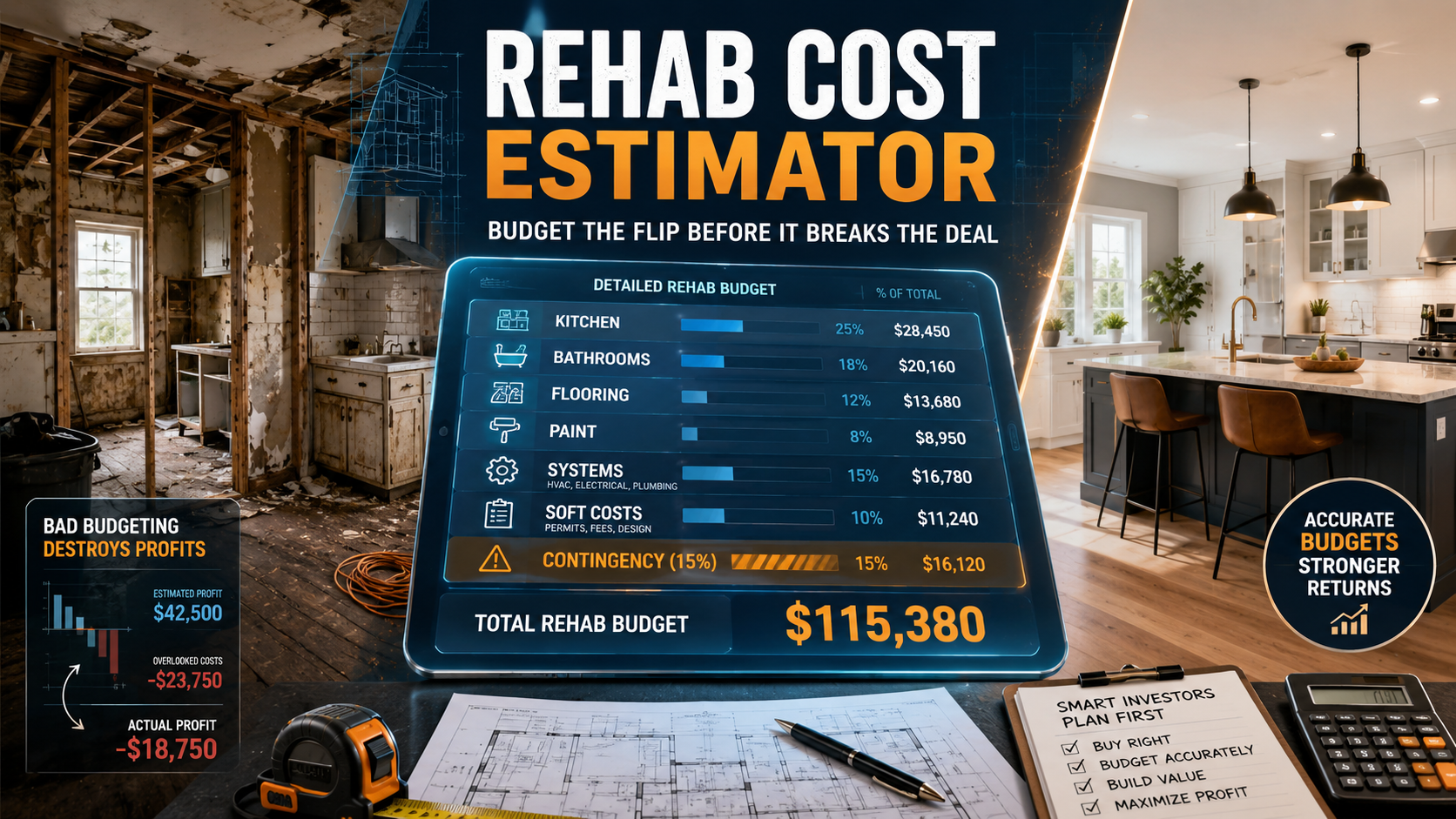
Rehab budgets break more flip deals than bad ARV estimates. I have watched experienced investors nail the after-repair value within 3% and still lose money because the renovation cost blew past their projections by 40%. The rehab cost estimator exists to prevent that specific problem.
The gap between a guess and a real estimate is usually $15,000 to $30,000 on a typical renovation. That is the difference between a profitable flip and a break-even headache.
Why Most Rehab Estimates Are Terribly Wrong
New investors estimate rehab by walking through a property and thinking “kitchen needs work, maybe $10K, bathroom another $5K, paint and flooring $3K.” Then they offer based on an $18K rehab budget and discover the real cost is $38K.
Three things cause this consistently.
First, people budget for materials but forget labor. In most markets, labor is 50-65% of total rehab cost. That $3,000 in flooring material becomes $7,000 installed. Every single line item roughly doubles when you add labor.
Second, hidden conditions. You cannot see what is behind walls until demo starts. Plumbing, electrical, structural issues, mold, termite damage, foundation cracks. A rehab cost estimator forces you to think about these categories before you discover them mid-project.
Third, soft costs. Permits, dumpsters, temporary utilities, project management, design, engineering. These add 10-20% to hard costs and most beginners skip them entirely.
How the Rehab Cost Estimator Works
The rehab cost estimator breaks renovation into categories instead of letting you guess a single lump sum. You enter costs for each scope area, add a contingency buffer, and get a total that accounts for things most spreadsheets miss.
| Category | What It Covers | Typical Range |
|---|---|---|
| Kitchen | Cabinets, counters, appliances, plumbing, electrical | $8K-$35K |
| Bathrooms | Vanity, tile, fixtures, plumbing, waterproofing | $5K-$20K each |
| Flooring | Demo, subfloor, material, installation | $3-$12/sqft installed |
| Paint | Interior, exterior, prep, primer, labor | $2-$5/sqft interior |
| Systems | HVAC, electrical panel, plumbing, water heater | $3K-$15K each |
| Structural | Foundation, framing, roof, load-bearing walls | $5K-$40K+ |
| Exterior | Siding, windows, doors, landscaping, driveway | $5K-$25K |
Ranges vary by market, property condition, and finish level. Use the rehab cost estimator with contractor bids when available. The estimator is a planning tool, not a replacement for on-site inspection.
How to Use the Rehab Cost Estimator
Step 1: Walk the property with categories in mind. Do not just think “this place needs work.” Go room by room and note what each category needs. Kitchen: cosmetic refresh or full gut? Bathrooms: new vanity or full re-tile? Flooring: refinish or replace? Systems: serviceable or end-of-life?
Step 2: Enter costs by category. The rehab cost estimator breaks each area into hard costs. Use contractor quotes when you have them. Use planning ranges when you do not, but note which numbers are verified and which are estimates.
Step 3: Add soft costs. Permits, dumpster rental, temporary utilities, design fees, project management. Most the calculator tools skip these. This one does not. Soft costs typically add 10-20% to your hard cost total.
Step 4: Set contingency. Add 10-15% for cosmetic rehabs. Add 15-20% for moderate rehabs. Add 20-25% for heavy or structural work. Do not skip this. The this tool includes contingency as a separate line item so you can see it clearly.
Step 5: Review total and connect to deal analysis. Take your total rehab budget and feed it into the 70% rule calculator for a quick flip screen, or the fix and flip calculator for full profit analysis.
Hard Costs vs Soft Costs: What Most People Miss
Hard costs are the things you can see and touch. Cabinets, tile, lumber, wiring, fixtures. This is where most people focus their the calculator inputs.
Soft costs are everything else. They are invisible until the invoice arrives.
- Permits: $500-$5,000 depending on scope and municipality
- Dumpsters: $400-$800 per haul, most projects need 2-4
- Temporary utilities: $200-$500/month during construction
- Design/engineering: $1,000-$5,000 for structural changes
- Project management: 10-15% of hard costs if you hire a GC
- Inspections: $300-$800 for pre-renovation and post-renovation
On a $40,000 hard cost rehab, soft costs typically add $6,000-$10,000. That is money most investors forget to budget. The this tool separates hard and soft costs so nothing falls through the cracks.
Rehab Cost by Scope Level
| Scope | What Is Involved | Typical Cost/SqFt |
|---|---|---|
| Cosmetic | Paint, flooring, fixtures, landscaping, cleaning | $10-$25/sqft |
| Moderate | Kitchen/bath remodel, new flooring, some systems | $25-$50/sqft |
| Heavy | Gut renovation, new systems, structural repairs | $50-$100/sqft |
| Full gut/addition | Down to studs, layout changes, additions | $100-$200+/sqft |
These ranges vary significantly by region. A moderate rehab in rural Ohio costs half what the same work costs in coastal Connecticut. Always use local contractor pricing when available and treat the calculator output as a planning starting point.
Why Contingency Is Not Optional
Every experienced flipper has a contingency horror story. Mine was a 1960s ranch where we discovered galvanized plumbing behind the walls during a bathroom demo. Replacing the entire supply line added $8,500 to a $35,000 rehab. Without contingency, that project would have gone negative.
Contingency is not padding. It is insurance against what you cannot see during the walkthrough. Older properties carry more risk. Properties with previous unpermitted work carry more risk. Properties with signs of water damage carry more risk.
The this tool lets you set contingency as a percentage. Use it. Set it based on the property age and condition, not based on what makes the deal look good on paper.
Worked Example: Moderate Rehab on a 1,400 SqFt Ranch
| Item | Cost |
|---|---|
| Kitchen remodel (mid-grade) | $18,000 |
| 2 bathroom refreshes | $9,000 |
| Flooring — LVP throughout (1,400 sqft) | $7,000 |
| Interior paint | $4,200 |
| New water heater | $2,500 |
| Exterior paint + landscaping | $5,500 |
| Fixtures + hardware | $2,800 |
| Hard Costs Subtotal | $49,000 |
| Permits + inspections | $1,800 |
| Dumpsters (3 hauls) | $1,500 |
| Temporary utilities | $600 |
| Soft Costs Subtotal | $3,900 |
| Contingency (15%) | $7,935 |
| TOTAL REHAB BUDGET | $60,835 |
An investor who eyeballed this property might have guessed $35K-$40K. The calculator with all categories filled out shows $61K. That $20K gap changes the MAO by $20K and can flip a deal from profitable to break-even.
Common Rehab Budgeting Mistakes
Guessing a lump sum. A single number with no breakdown is a wish, not a budget. The this tool forces you to think through each category. If you cannot fill in a category, you probably have not inspected closely enough.
Forgetting labor. Materials are 35-50% of installed cost. If you price cabinets at $4,000, installation adds another $2,000-$3,000. Every line item needs a labor component.
Skipping contingency. Properties built before 1980 almost always have surprises. Asbestos, lead paint, knob-and-tube wiring, cast iron drain lines, undersized electrical panels. Budget 15-20% contingency minimum on older properties.
Using national averages for local work. A bathroom remodel in Houston costs 30-40% less than the same work in Boston. Use local contractor quotes and adjust the calculator inputs for your market.
Not getting multiple bids. One contractor quote is an opinion. Three quotes are data. Get at least three bids for major scope items before locking your rehab budget.
How Rehab Cost Connects to Flip Profit
Your rehab budget feeds directly into every other calculation in a flip deal.
The 70% rule calculator subtracts rehab from 70% of ARV to get your maximum offer. A $10K rehab overrun means your MAO should have been $10K lower. Miss this and your profit shrinks dollar for dollar.
The fix and flip calculator uses rehab cost to calculate total capital deployed, holding period (bigger rehabs take longer), and financing costs (hard money on a larger loan). A longer timeline also means more holding costs, which compounds the damage from a rehab overrun.
For BRRRR investors, rehab cost affects how much capital you can recover through refinance. The BRRRR calculator shows whether your all-in cost (purchase plus rehab) stays below the refinance value enough to pull your capital back out. Overspending on rehab kills the BRRRR math.
The ARV calculator helps you set the target value that your rehab needs to achieve. If your ARV is $250K and your this tool shows $60K, you need $60K of work to produce $250K of value. If the scope does not support that value, either the ARV is wrong or the rehab plan needs adjustment.
Frequently Asked Questions
This tool provides planning ranges, not exact quotes. Accuracy depends on input quality. Using contractor bids for major items and realistic contingency produces estimates within 10-15% of actual cost. Guessing lump sums without category breakdown often misses by 30-50%.
10-15% for cosmetic work on newer properties. 15-20% for moderate rehabs. 20-25% for heavy or structural work, properties built before 1980, or properties with signs of water damage or deferred maintenance.
Soft costs include permits, dumpster rental, temporary utilities, design fees, engineering, project management, and inspections. They typically add 10-20% to hard construction costs and are the most commonly forgotten line items in rehab budgets.
A mid-grade kitchen remodel for a flip typically runs $12,000-$25,000 including cabinets, countertops, appliances, plumbing, electrical, and labor. Budget-grade cosmetic updates can be done for $5,000-$10,000. High-end renovations in expensive markets can exceed $40,000.
Both. Use it before bids to set a planning budget and determine your maximum offer price. Then update with actual contractor quotes to refine the number. If bids come in significantly higher than your estimate, re-evaluate the deal before committing.
The 70% rule formula is MAO = ARV times 70% minus rehab cost. Every dollar of rehab reduces your maximum allowable offer by one dollar. Underestimating rehab by $15,000 means you overpaid by $15,000 relative to the rule.
Disclaimer: This article and the rehab cost estimator are for educational planning purposes only. Rehab costs vary significantly by location, property condition, contractor availability, material prices, and scope of work. Always get multiple contractor bids and conduct a thorough property inspection before finalizing a rehab budget. Data from HomeAdvisor and local contractor associations may provide more current regional pricing.
Leave a Reply