Last updated: September 24, 2026 · Originally published: May 9, 2026 · By Alex Petrov
A 1031 exchange lets investors defer capital gains taxes by reinvesting sale proceeds into another investment property. Named after Section 1031 of the Internal Revenue Code, this strategy has helped investors build portfolios worth millions while paying zero capital gains tax along the way.
In 2026, with long-term capital gains rates up to 20% plus the 3.8% Net Investment Income Tax, a single property sale can trigger a six-figure tax bill. A properly structured 1031 exchange defers that entire amount — legally.
This guide covers every rule, deadline, and decision point you need. No theory padding. Just the mechanics, real numbers, and the mistakes that get investors audited or stuck with an unexpected tax bill.
Run your own scenarios with our 1031 Exchange Calculator as you read.
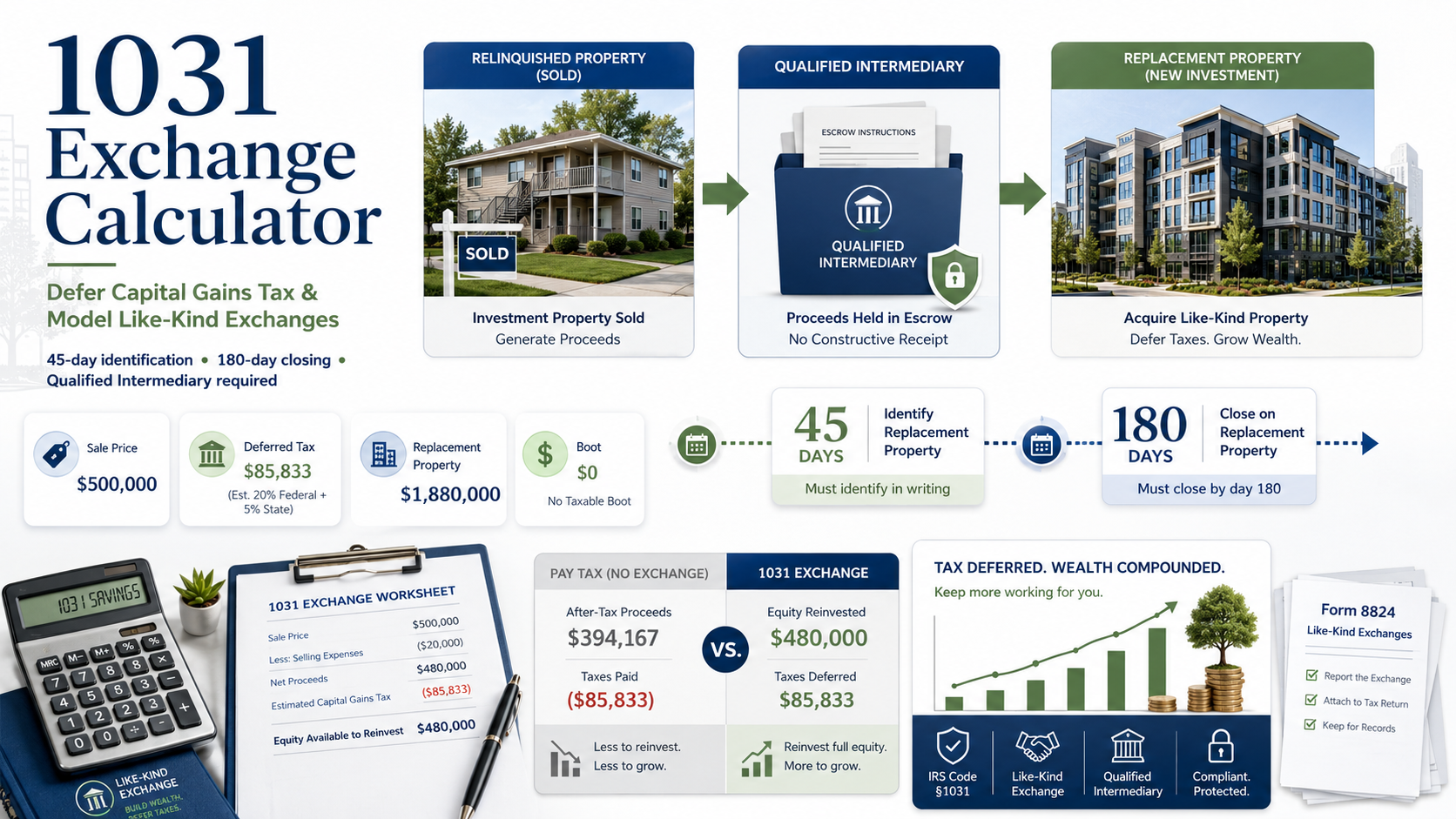
What Is a 1031 Exchange?
A 1031 exchange — also called a like-kind exchange or Starker exchange — is the most effective tax-deferral strategy in 1031 exchange investing, allowing you to sell an investment property and reinvest the proceeds into a new investment property without paying capital gains tax at the time of sale.
The key word is deferral, not elimination. Gains are postponed, not erased. Tax basis from the old property carries over to the new one. Eventually selling without another 1031 exchange makes the deferred gains taxable.
However, many investors chain 1031 exchanges for decades, deferring gains across multiple properties. And if they hold until death, their heirs receive a stepped-up basis — effectively eliminating the deferred gains entirely.
What qualifies:
- Rental properties (single-family, multifamily, commercial)
- Raw land held for investment
- Commercial buildings (office, retail, industrial)
- Triple-net lease properties
- DST (Delaware Statutory Trust) interests
What does NOT qualify:
- Your primary residence
- Property held primarily for resale (fix-and-flip inventory)
- Personal property (vehicles, equipment, artwork) — eliminated from 1031 eligibility after the Tax Cuts and Jobs Act of 2017
- Partnership interests
- Stocks, bonds, or other securities
How a 1031 Exchange Works: Step by Step
Step 1: Engage a Qualified Intermediary (QI) before closing. You must have an exchange agreement in place with a QI before you close on the sale of your relinquished property. A QI is a neutral third party who holds the sale proceeds. No touching, controlling, or accessing the funds at any point — otherwise the 1031 exchange is invalidated.
Step 2: Sell your relinquished property. At closing, the sale proceeds go directly from the title company to the QI. At this point the clock starts: 45 days to identify replacement properties and 180 days to close.
Step 3: Identify replacement properties within 45 days. Submit a written, signed identification notice to your QI listing the properties you intend to purchase. Investors can identify up to three properties regardless of value (the “3-Property Rule”), or more than three if their combined value does not exceed 200% of the relinquished property’s sale price (the “200% Rule”).
Step 4: Close on replacement property within 180 days. The QI transfers the exchange funds to the title company at the replacement property closing. Title transfers. Exchange complete.
Step 5: File IRS Form 8824. Report the exchange on your tax return for the year the relinquished property was sold.
1031 Exchange Rules & Requirements
Like-Kind Requirement
“Like-kind” is broader than most investors expect. Any real property held for investment or business use can be exchanged for any other real property held for investment or business use. A single-family rental can be exchanged for a commercial warehouse. Raw land can be exchanged for an apartment complex.
Qualified Intermediary (QI)
A QI is mandatory. Acting as your own intermediary is not allowed. Your agent, attorney, accountant, or anyone who has served as your employee or agent within the prior two years is also disqualified. QI fees typically range from $750 to $1,500 for a standard exchange. For reverse or improvement exchanges, expect $2,500 to $5,000+.
Equal or Greater Value
To fully defer all capital gains, the replacement property must meet two conditions:
- Equal or greater purchase price than the net sale price of the relinquished property
- Equal or greater debt — the mortgage on the replacement property must be at least as much as the mortgage paid off on the relinquished property
If you buy less, the difference is called “boot” and is taxable.
Identification Rules
- 3-Property Rule: Identify up to 3 properties of any value
- 200% Rule: Identify any number of properties as long as their total FMV does not exceed 200% of the relinquished property’s sale price
- 95% Rule: Identify any number of properties if you close on at least 95% of their total value (rarely used)
Holding Period
The IRS does not define a minimum holding period, but most tax advisors recommend holding both properties for at least 12 to 24 months to establish investment intent.
How to Choose a Qualified Intermediary
Your QI holds hundreds of thousands of dollars of your money with no federal bonding requirement. Choosing the wrong one can result in total loss of exchange funds. Here is what to look for:
Fidelity bond and E&O insurance. Minimum $5 million in fidelity coverage. Ask for proof — many QIs claim coverage they do not actually carry. Should the QI go bankrupt or an employee steal funds, the bond is your only protection.
Segregated accounts. Your exchange funds should be held in a separate, individual account — never commingled with other clients’ funds. Commingling was the primary reason investors lost money when several large QIs collapsed during the 2008 financial crisis.
Experience and volume. Ask how many exchanges the QI has handled in the past 12 months. A firm handling 500+ exchanges per year has seen every edge case and knows how to handle complications. Part-time QIs handling 10 exchanges per year are a risk.
Written exchange agreement. Review the agreement before signing. Look for clauses that limit the QI’s liability or allow them to invest your funds in risky instruments. Your funds should be in FDIC-insured accounts or short-term government securities only.
Typical QI fees for a standard delayed 1031 exchange range from $750 to $1,500. For this cost, you are deferring a five- or six-figure tax bill — it is one of the highest-ROI expenses in real estate investing.
Types of 1031 Exchanges
Not all 1031 exchanges work the same way. The IRS recognizes four main structures, and knowing which one fits your situation can save you from a costly misstep — consult a tax professional to confirm which type applies to your deal.
Delayed Exchange (Most Common)
This is the standard exchange most investors use. You sell your relinquished property first, a QI holds the proceeds, and you have 45 days to identify a replacement property and 180 days to close. The vast majority of 1031 exchanges are delayed exchanges because they give you the most flexibility in finding a suitable replacement.
Simultaneous Exchange
Both properties close on the same day — you hand over one property and receive the other in a single coordinated transaction. Simultaneous exchanges sound simple but are logistically difficult to pull off, since both closings must happen at exactly the same time with no gap in between.
Reverse Exchange
In a reverse exchange, you acquire the replacement property before selling the relinquished one. An Exchange Accommodation Titleholder (EAT) holds title to the new property while you sell the old one, and the same 45/180-day deadlines apply in reverse. Reverse exchanges are more expensive to structure and require all-cash or bridge financing.
Improvement (Build-to-Suit) Exchange
This lets you use exchange funds to build improvements on the replacement property before it’s transferred to you. All improvements must be completed and the property must be received within the 180-day window.
1031 Exchange Timeline
The two deadlines in a 1031 exchange are absolute — the IRS grants no extensions except in federally declared disasters. Missing either one by even a single day disqualifies the entire exchange.
| Day | Event | Notes |
|---|---|---|
| Day 0 | Relinquished property closes | QI receives proceeds — you cannot touch the funds |
| Day 1–45 | Identification window | Search, tour, analyze replacement properties |
| Day 45 | Identification deadline (HARD) | Submit written ID to QI — no extensions |
| Day 46–180 | Acquisition window | Close on identified replacement property |
| Day 180 | Exchange closing deadline (HARD) | Unspent proceeds become taxable boot |
Practical tip: Start identifying replacement properties before Day 0 if possible. Waiting until after closing to begin your search leaves you scrambling inside a 45-day window that includes weekends and holidays.
Tax Implications: What You’re Actually Deferring
The tax savings from a 1031 exchange can be substantial — but the exact amount depends on your depreciation history, income level, and state of residence. These numbers are illustrative examples only. Run your own numbers with our capital gains tax calculator and confirm with a tax professional.
Example Scenario
- Original purchase price: $300,000
- Depreciation claimed: $109,000
- Adjusted cost basis: $300,000 − $109,000 = $191,000
- Sale price: $500,000
- Total gain: $500,000 − $191,000 = $309,000
Estimated Tax WITHOUT Exchange
| Tax Type | Applies To | Rate | Amount |
|---|---|---|---|
| Depreciation recapture | $109,000 | 25% | ~$27,250 |
| Long-term capital gains | $200,000 | 20% | ~$40,000 |
| NIIT | $309,000 | 3.8% | ~$11,742 |
| State tax (example) | $309,000 | ~5% | ~$15,450 |
| Total estimated tax | ~$94,442 | ||
With a 1031 exchange: $0 due at closing — provided you reinvest all proceeds into a like-kind property of equal or greater value. Use our 1031 exchange calculator to estimate your specific deferral.
Common 1031 Exchange Mistakes
- Touching the proceeds. If the sale funds pass through your hands — even briefly — the exchange is disqualified. Funds must go directly to the QI.
- Missing the 45-day deadline. The clock starts at closing, not when you decide to exchange. No extensions, no exceptions.
- Buying down (boot). If the replacement costs less than net proceeds, the difference is taxable boot. Same applies if you take on less debt.
- Personal use property. A vacation home you use more than 14 days/year likely won’t qualify as investment property.
- Disqualified intermediary. Your attorney, CPA, or agent cannot serve as QI. Using one invalidates the exchange.
- Sloppy identification. Ambiguous property descriptions or identifying properties you can’t close on leaves you exposed at Day 180.
When a 1031 Exchange Doesn’t Make Sense
- Little or no gain. If your basis is close to sale price, the deferred tax is small and exchange costs may not be worth it.
- You need the cash. Exchange requires reinvesting all proceeds. If you need liquidity, pulling cash out triggers tax.
- Low tax bracket. If your LTCG rate is 0%, you may owe nothing anyway.
- Exiting real estate entirely. If you won’t reinvest in property, an exchange just delays the inevitable.
Frequently Asked Questions
No. A 1031 exchange applies only to investment and business property. If you sell your primary home, you may qualify for the Section 121 exclusion ($250K single / $500K married) instead. Consult a tax professional for mixed-use properties.
The deferred gain carries forward as long as you keep exchanging. If you hold until death, heirs may receive a stepped-up basis under current tax law, potentially eliminating the deferred gain. Tax laws can change — review with an estate planning attorney.
Yes. The 200% rule allows unlimited identifications if combined value doesn’t exceed 200% of the relinquished property. The 95% rule allows unlimited if you close on 95%+ of total value. The 3-property rule (any 3 regardless of value) is simplest and most commonly used.
Yes — residential rental for commercial, raw land for apartment building, retail for warehouse. “Like-kind” means real property held for investment, not same property type. Since 2017, only real property qualifies (not equipment, stocks, or collectibles).
Standard delayed exchange: $750–$1,500 in QI fees. Reverse exchanges: $5,000–$10,000+. Legal review: $500–$2,000. Compared to the five- or six-figure tax bill you’re deferring, these costs are minimal.
Disclaimer: This article is for educational purposes only and does not constitute financial, investment, legal, or tax advice. 1031 exchange rules are complex and subject to change. All numbers and projections are illustrative examples. Consult qualified tax and legal professionals before executing any 1031 exchange.
Leave a Reply