Last updated: November 3, 2026 · Originally published: October 23, 2026 · By Alex Petrov
I have closed three DSCR loans on South Carolina properties — two in Greenville and one in Columbia. Each deal qualified differently despite using the same lender and same credit profile. The reason: South Carolina’s 6% investment property tax assessment and wildly different insurance costs between inland and coastal markets shift the PITIA calculation enough to move DSCR by 0.10-0.20 points. A deal that qualifies easily in Columbia at 25% down may require 30% down in Charleston purely because of the insurance premium difference.
This South Carolina DSCR loan guide covers current rates, qualification requirements, how SC-specific costs affect your DSCR, and which markets qualify easiest. Check your property with the South Carolina DSCR calculator pre-loaded with SC tax and insurance data.
South Carolina DSCR Loan Rates (2026)
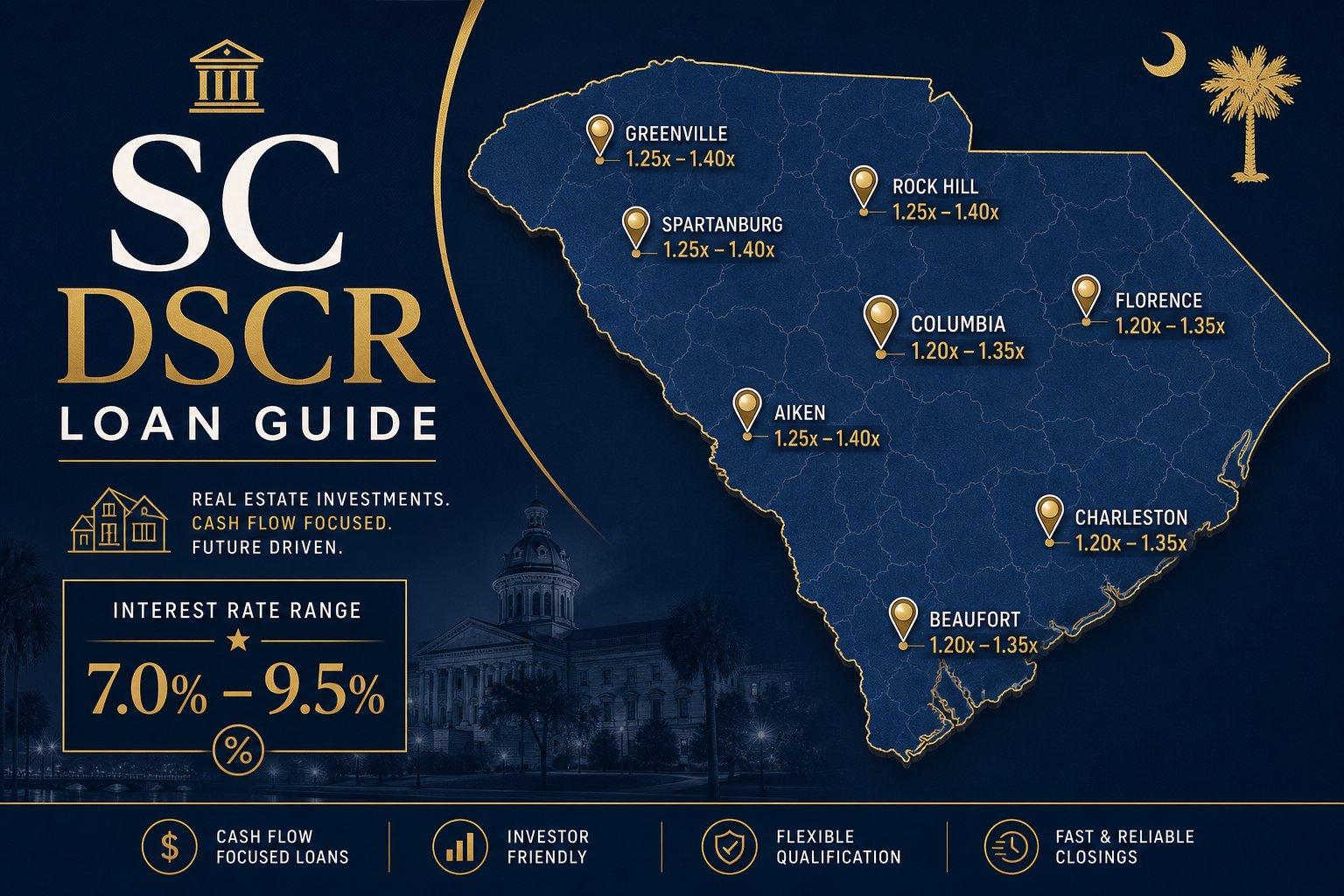
South Carolina DSCR loan rates in mid-2026 range from 7.00% to 9.50% depending on three factors: your LTV (down payment), credit score, and the property’s debt service coverage ratio.
| LTV | DSCR 1.25+ | DSCR 1.0-1.24 | DSCR 0.75-0.99 |
|---|---|---|---|
| 70% (30% down) | 7.00-7.25% | 7.25-7.75% | 8.00-8.50% |
| 75% (25% down) | 7.25-7.50% | 7.75-8.25% | 8.50-9.00% |
| 80% (20% down) | 7.75-8.25% | 8.25-8.75% | 9.00-9.50% |
According to CFPB guidance on debt service ratios, these rates are consistent with national DSCR pricing — SC does not have a state-specific premium or discount. The variance comes from how SC’s operating costs (tax and insurance) affect your DSCR ratio, which determines which rate tier you qualify for. Compare DSCR vs conventional in our DSCR vs conventional guide.
How DSCR Works: The SC-Specific Calculation
DSCR = Monthly Rent / Monthly PITIA. The lender divides your gross monthly rent by your total monthly payment (Principal + Interest + Taxes + Insurance + Association dues). If the result is 1.0 or higher, the property income covers the payment — and you qualify.
SC DSCR Example: $280,000 Greenville Rental
- Monthly rent: $1,400
- Loan: $210,000 (25% down) at 7.25%
- Monthly P&I: $1,432
- Monthly tax: $201 (0.86% investment rate on $280K / 12)
- Monthly insurance: $150 ($1,800/year inland)
- Monthly HOA: $0
- Total PITIA: $1,783
- DSCR: $1,400 / $1,783 = 0.79
At 0.79, this deal qualifies with some lenders but at a premium rate (8.50-9.00%). To improve it: put 30% down (reduces P&I to $1,338, DSCR rises to 0.83) or find a property with $1,600/month rent (DSCR jumps to 0.90). Run scenarios with the SC DSCR calculator.
SC Property Tax: The 6% Assessment Impact on DSCR
South Carolina’s dual assessment system is the #1 SC-specific factor affecting South Carolina DSCR loan qualification. Owner-occupied homes are assessed at 4% of market value. Investment property is assessed at 6% — a 50% higher rate.
On a $280,000 property:
- Owner-occupied tax: $280,000 × 4% × millage ≈ $1,600/year ($133/month)
- Investment tax: $280,000 × 6% × millage ≈ $2,408/year ($201/month)
- Difference: $68/month — drops DSCR by ~0.04 points
When a seller provides their tax bill, it reflects the 4% owner-occupied rate. Your lender will use the 6% investment rate. If you submit the seller’s tax amount on your DSCR application, the lender will correct it — and your DSCR will drop. Always use the 6% rate from the start. The SC DSCR calculator applies this automatically.
Insurance: Coastal vs Inland DSCR Impact
Insurance is the second major SC-specific variable. Inland markets (Greenville, Columbia, Spartanburg) average $1,500-$2,000/year. Coastal markets (Charleston, Myrtle Beach) average $3,000-$4,500/year because of hurricane and wind/hail exposure.
| Market | Insurance/yr | Insurance/mo | DSCR Impact vs $1,800 Baseline |
|---|---|---|---|
| Columbia | $1,600 | $133 | +0.01 (lower cost helps) |
| Greenville | $1,800 | $150 | Baseline |
| Spartanburg | $1,500 | $125 | +0.02 |
| Charleston | $3,200 | $267 | -0.07 |
| Myrtle Beach | $3,800 | $317 | -0.10 |
The Myrtle Beach-to-Spartanburg insurance spread is $2,300/year — $192/month. That $192 difference drops DSCR by 0.12 points. A deal that qualifies at 1.0 DSCR in Spartanburg may only hit 0.88 in Myrtle Beach on the same property type and rent level. Get real insurance quotes before submitting your South Carolina DSCR loan application — not statewide averages.
DSCR by South Carolina Market
| Market | Median Price | Median Rent | DSCR at 25% Down | DSCR at 30% Down |
|---|---|---|---|---|
| Columbia | $225,000 | $1,200 | 0.94 | 1.05 |
| Spartanburg | $210,000 | $1,100 | 0.92 | 1.03 |
| Greenville | $285,000 | $1,400 | 0.86 | 0.96 |
| Myrtle Beach | $310,000 | $1,500 | 0.82 | 0.92 |
| Charleston | $420,000 | $1,800 | 0.75 | 0.84 |
Only Columbia and Spartanburg break 1.0 DSCR at 30% down. Greenville is close at 0.96. Charleston and Myrtle Beach require either 35%+ down, above-market rent, or a significantly below-market purchase price to qualify. These numbers use SC investment tax (0.86%) and market-specific insurance — not generic estimates.
DSCR Loan Requirements for South Carolina
- Minimum DSCR: 1.0 for standard pricing. Some lenders accept 0.75 with higher down payment and rate premium.
- Credit score: 640+ minimum. 720+ for best pricing tier.
- Down payment: 20-25% typical. 15% available from some lenders with 1.25+ DSCR.
- Reserves: 6-18 months PITIA depending on LTV tier. At 80% LTV: 12-18 months. See our cash reserves guide.
- Property types: SFR, 2-4 unit, condo (warrantable), townhome.
- Seasoning: 3-6 months ownership for cash-out refinance based on appraised value.
- No income docs: No W-2, tax returns, or DTI calculation. Property income only.
- No property limit: Unlike conventional (capped at 4-10), DSCR has no limit on number of financed properties.
For a full comparison of all financing options, see our best loans for investment property guide. Check LTV impact on rate with the LTV calculator.
5 Ways to Improve Your SC DSCR
1. Increase Down Payment to 30%
Going from 25% to 30% down reduces your loan amount by ~7%, which drops monthly P&I by $90-$120 on a typical SC property. This improves DSCR by 0.06-0.10 points — often enough to cross a tier threshold. Bonus: the 75% LTV tier gets you 0.25% better rate, further reducing PITIA.
2. Buy Inland, Not Coastal
The insurance savings alone ($1,200-$2,300/year) improve DSCR by 0.07-0.12 points. Columbia and Spartanburg consistently produce the strongest South Carolina DSCR loan ratios because of low insurance plus affordable entry prices.
3. Find Above-Market Rent
A property that rents $100-$200 above area median improves DSCR by 0.05-0.10. Value-add properties with minor upgrades (new paint, updated fixtures, pet-friendly policy) often command $100-$150/month rent premiums. Factor this into your analysis with the SC rental property calculator.
4. Shop Rates Aggressively
A 0.25% rate difference on a $210,000 loan changes monthly P&I by ~$35. That moves DSCR by 0.02-0.03 points. Get quotes from 3-5 DSCR lenders — the spread between best and worst is typically 0.375-0.75%.
5. Consider ADU or Multi-Unit
Adding an accessory dwelling unit or buying a duplex instead of SFR can boost monthly rent by $600-$1,000 while only modestly increasing PITIA. A $285,000 Greenville duplex renting both units at $1,100 ($2,200 total) would show a DSCR of 1.23 at 25% down — dramatically better than the 0.86 DSCR on a single-unit.
DSCR vs Conventional for SC Investment Property
| Factor | Conventional | DSCR |
|---|---|---|
| Rate | 6.50-7.50% | 7.00-9.50% |
| Down payment | 20-25% | 15-25% |
| Income docs | W-2, tax returns, DTI | None — property income only |
| Property limit | 4-10 | Unlimited |
| Best for | W-2 earners, first 4 properties | Self-employed, 5+ properties, scaling |
Conventional saves 0.50-1.50% on rate but requires full income documentation. For SC investors scaling past 4-5 properties — or self-employed investors with complex tax returns — DSCR eliminates the documentation barrier. The rate premium is the cost of unlimited scalability. Full comparison in our DSCR vs conventional guide.
DSCR Loan Process Timeline in South Carolina
The South Carolina DSCR loan process from application to closing typically takes 21-30 days. Here is the step-by-step timeline:
- Days 1-2: Submit application with property address, estimated rent, and purchase price. No W-2s, tax returns, or pay stubs needed — just bank statements for reserves.
- Days 2-5: Lender orders appraisal and rent survey. The appraiser determines both property value and market rent — the rent survey is critical because it sets the DSCR numerator.
- Days 5-14: Underwriting reviews appraisal, rent survey, credit, and reserves. If the rent survey comes in lower than your assumed rent, DSCR drops and the lender may require more down payment or offer a higher rate.
- Days 14-21: Conditional approval, title search (by SC attorney), insurance verification.
- Days 21-30: Clear to close, attorney prepares documents, closing at attorney office.
Key SC-specific note: the attorney requirement adds 1-2 days to the closing process but does not significantly delay the overall timeline. Most SC real estate attorneys handle DSCR closings routinely.
What Can Delay Your SC DSCR Closing
Three common delays: (1) Appraisal comes in low — lender recalculates LTV and DSCR, may require more down payment. (2) Rent survey shows below-market rent — DSCR drops, may need rate adjustment. (3) Title issues found by SC attorney — liens, easements, or boundary disputes require resolution. Budget 35 days to be safe, even though 25 days is typical.
Closing a DSCR Loan in South Carolina
Per SC Bar Association requirements, SC is an attorney-close state — your DSCR closing requires a licensed attorney ($800-$1,500). This does not significantly slow the process: most DSCR loans close in 21-30 days in SC, similar to other states. Budget closing costs of 2.5-4.0% using the SC closing costs calculator.
State deed stamps (0.37% of purchase price) apply on purchase. On a $280,000 property: $1,036 in deed stamps. For BRRRR investors refinancing later, deed stamps do not apply on the refinance — only on the original purchase. This makes SC more BRRRR-friendly than states that charge transfer tax on refinances.
Planning a BRRRR deal in South Carolina? Our SC BRRRR strategy guide covers refinance math, worked examples, and the 5 mistakes that kill SC deals.
Frequently Asked Questions
What DSCR do lenders require in South Carolina?
Most South Carolina DSCR loan lenders require 1.0 minimum for standard pricing. Some accept 0.75 with 30%+ down and rate premium. For best rates, target 1.25+ DSCR — achievable in Columbia and Spartanburg at 30% down with inland insurance rates. Charleston typically requires 35%+ down due to high insurance inflating PITIA.
What are DSCR loan rates in South Carolina?
South Carolina DSCR loan rates range from 7.00% to 9.50% in mid-2026. At 75% LTV with 1.25+ DSCR and 720+ credit: 7.25-7.50%. At 80% LTV with sub-1.0 DSCR: 9.00-9.50%. Rates are nationally competitive — SC does not have a state-specific premium.
Which SC market is easiest for DSCR qualification?
Columbia (DSCR 0.94 at 25% down, 1.05 at 30%) and Spartanburg (0.92 / 1.03) qualify easiest thanks to low prices and affordable insurance. Greenville is borderline. Charleston and Myrtle Beach are hardest due to high prices and coastal insurance — most deals need 30-35% down.
How does SC property tax affect DSCR?
SC taxes investment property at 6% assessment (vs 4% owner-occupied). On $280,000: $2,408/year investment vs $1,600 owner-occupied. The $808 difference adds $67/month to PITIA, dropping DSCR by ~0.04. Always use the 6% rate — never the seller’s current bill which reflects the 4% owner-occupied rate.
Can I get a DSCR loan for a Charleston property?
Yes, but it is harder. Charleston’s $420,000 median price and $3,200/year coastal insurance produce a DSCR of ~0.75 at 25% down — the minimum most lenders accept. You need 30-35% down ($126,000-$147,000) or above-market rent to reach 1.0. Consider North Charleston or Summerville suburbs where prices are $100-150K lower with similar rents.
Run Your SC DSCR Before You Apply
The South Carolina DSCR loan market favors informed investors. Know your exact DSCR before approaching a lender: open the SC DSCR calculator, enter your property details with the correct 6% tax assessment and real insurance quotes, and see where you land. If you are below 1.0, use the five strategies above to improve — or look at a different market. Columbia and Spartanburg are the easiest SC markets for DSCR qualification. Charleston requires significantly more capital but rewards investors with 5-6% annual appreciation.
The South Carolina DSCR loan landscape rewards investors who understand the state-specific variables. The 6% investment tax assessment, coastal insurance premiums, and attorney closing requirement are not deal-breakers — they are inputs that change your numbers. Investors who account for these factors upfront negotiate better purchase prices, choose better markets, and close faster because their applications reflect reality rather than optimistic assumptions. The best SC DSCR deals are in Columbia and Spartanburg where low prices, affordable insurance, and stable government/university rental demand create the strongest qualification profiles in the state.
Compare your total financing options with the investment property mortgage calculator and budget your full capital requirement including reserves with the cash reserves guide.
For investors building a South Carolina portfolio, DSCR loans are the primary scaling tool after your first 4-5 conventional purchases. Each property qualifies independently on its own rental income — no cumulative DTI concerns, no W-2 documentation, no limit on property count. The rate premium over conventional (0.50-1.50%) is the cost of unlimited scalability. For most SC investors scaling past property #5, that premium pays for itself in time saved and deals closed.