Last updated: November 3, 2026 · Originally published: October 23, 2026 · By Alex Petrov
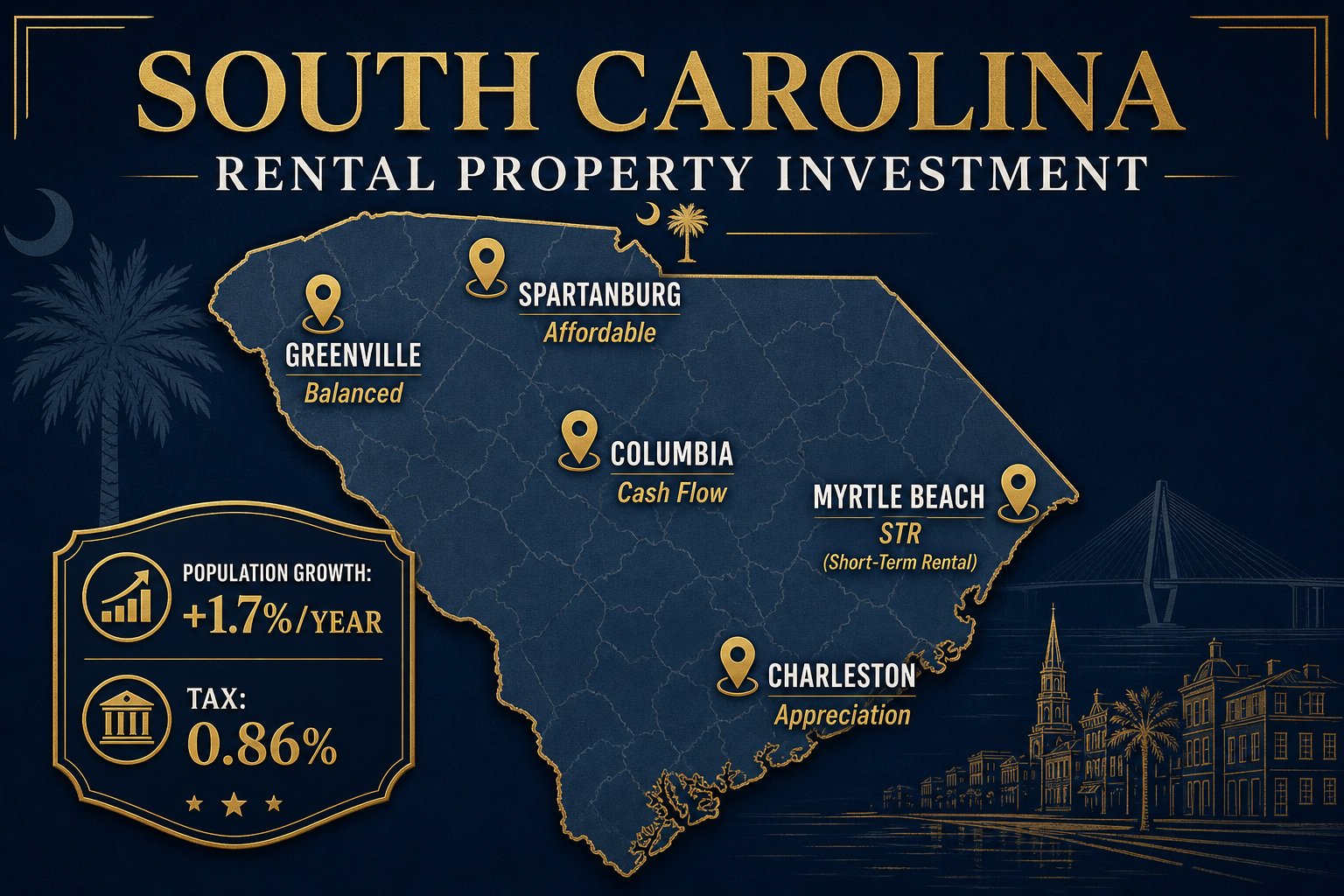
I analyzed rental deals in all five major South Carolina markets over the past year. The state’s numbers stand out in the Southeast: population growth of 1.7% annually (3.4x national average), investment property tax at 0.86% (lower than Ohio, Texas, or Michigan), no state estate tax, and landlord-friendly laws with no rent control. But the gap between SC’s best and worst markets is enormous — a deal that cash flows $150/month in Columbia loses $300/month in Charleston at the same down payment. Choosing the right city is as important as choosing the right property.
This South Carolina rental property investment guide covers all five major markets with the data investors actually need: property prices, rents, cap rates, insurance costs, vacancy rates, and cash flow projections. Run any SC deal through the South Carolina rental property calculator pre-loaded with local data.
Why South Carolina for Rental Property in 2026
South Carolina rental property investment attracts capital from across the country for five specific reasons that show up in the numbers:
| Factor | South Carolina | National Average | Advantage |
|---|---|---|---|
| Population growth | 1.7%/year | 0.5%/year | 3.4x faster — more renters |
| Property tax (investment) | 0.86% | 1.10% | $720/year savings on $300K |
| State income tax | 0-6.5% | Varies | Graduated — first $16K tax-free |
| Insurance (inland) | $1,500-$2,000 | $2,000 | Below average inland |
| Median home price | $280,000 | $350,000 | $70K lower entry |
| Rent control | Prohibited by state law | Varies | No rent caps ever |
The combination of fast population growth and low property taxes creates a rare environment where both appreciation and cash flow are realistic targets — depending on which city you choose. According to the Census Bureau population estimates, South Carolina’s growth is driven primarily by migration from high-cost Northeast and West Coast states.
The 5 South Carolina Markets Compared
| City | Median Price | Median Rent | Cap Rate | Vacancy | Insurance | Strategy |
|---|---|---|---|---|---|---|
| Charleston | $420,000 | $1,800 | 4.5-5.5% | 5.5% | $3,200 | Appreciation |
| Greenville | $285,000 | $1,400 | 5.5-6.5% | 5.8% | $1,800 | Balanced |
| Columbia | $225,000 | $1,200 | 6.0-8.5% | 7.2% | $1,600 | Cash flow |
| Myrtle Beach | $310,000 | $1,500 | 5.0-6.0% | 8.5% | $3,800 | STR/Tourism |
| Spartanburg | $210,000 | $1,100 | 6.0-7.0% | 7.0% | $1,500 | Affordable entry |
Greenville: Best Overall for Most Investors
Greenville is the sweet spot for South Carolina rental property investment. Population growth of 2.1% annually (fastest in SC) is driven by BMW’s manufacturing plant, Michelin’s North American headquarters, and a rapidly growing healthcare sector. These employers provide diversified rental demand — no single industry dominates.
At $285,000 median price and $1,400/month rent, Greenville delivers cap rates of 5.5-6.5% — meaningful cash flow without sacrificing appreciation (4.5% annually). Insurance at $1,800/year is half of Charleston’s $3,200 because Greenville sits 200+ miles inland from hurricane exposure. This insurance gap alone saves $1,400/year — $117/month directly to your cash flow.
Entry capital at 25% down: $71,250 + closing costs (~$9,400) + reserves (~$12,900) = approximately $93,550 total. Model your Greenville deal with the SC rental property calculator.
Columbia: Maximum Cash Flow
Columbia delivers the highest cap rates in South Carolina at 6.0-8.5%. Three recession-resistant demand drivers keep vacancy manageable despite the highest rate in SC (7.2%): state government employment (SC capital), University of South Carolina (35,000+ students), and Fort Jackson (largest Army basic training installation, 3,600 permanent personnel).
At $225,000 median price, Columbia offers the lowest entry point among SC’s major markets. A $1,200/month rental at 25% down produces positive cash flow at current interest rates — one of the few SC markets where this is consistently achievable. The tradeoff: appreciation averages 3-4% annually versus Greenville’s 4.5% and Charleston’s 5-6%.
For investors who prioritize monthly income over equity growth, Columbia is the clear choice. Check cash flow projections with the SC rental property calculator and financing options with the SC DSCR calculator.
Charleston: The Appreciation Play
Charleston is SC’s most expensive market ($420,000 median) and produces the lowest cap rates (4.5-5.5%). Investors accept thin-to-negative cash flow because they expect 5-6% annual appreciation — driven by tech sector expansion, tourism demand, and military presence (Joint Base Charleston).
The critical expense: insurance. Coastal Charleston averages $3,200/year — double Greenville’s $1,800. Properties within one mile of the coast may need separate windstorm coverage through the SC Wind and Hail Underwriting Association, adding $500-$1,500/year on top. This pushes total insurance to $3,700-$4,700/year — consuming 17-22% of gross annual rent on a $1,800/month property.
Charleston works for investors with $120,000+ capital who can absorb negative monthly cash flow for 5-7 years while building equity through appreciation. It does NOT work for investors who need current income to cover living expenses or portfolio growth. Compare Charleston vs Greenville numbers in the SC cap rate calculator.
Myrtle Beach and Spartanburg: Niche Strategies
Myrtle Beach: STR Potential, LTR Challenges
Myrtle Beach’s long-term rental numbers are mediocre: 5.0-6.0% cap rates with the highest vacancy (8.5%) and most expensive insurance ($3,800/year) in SC. But short-term rental income during peak season (May-September) can gross 2-3x the LTR rate. This is a specialized strategy for investors with Airbnb management experience. Model STR income with the Airbnb calculator.
Spartanburg: Lowest Entry Point
At $210,000 median and $1,100/month rent, Spartanburg requires only $52,500 down (25%). Cap rates of 6.0-7.0% are solid, and proximity to Greenville (30 minutes) means Spartanburg captures spillover growth. Manufacturing employers provide blue-collar rental demand. Risk: less economic diversification than Greenville, slower appreciation (3-3.5%).
SC Property Tax: The 4% vs 6% Assessment
Every South Carolina rental property investment analysis must account for the dual assessment system. Owner-occupied homes: 4% of market value. Investment property: 6% of market value. On a $280,000 property, your tax is $2,408/year — not the $1,600 the seller pays at 4%.
When buying a previously owner-occupied home, expect a 40-50% tax increase at the next reassessment cycle. Budget this increase from day one — it is not a surprise, it is a certainty. The SC rental property calculator uses the 6% investment rate automatically. See our SC closing costs guide for the full breakdown.
South Carolina Landlord-Tenant Laws
According to SC landlord-tenant law, SC is considered landlord-friendly — a significant advantage for South Carolina rental property investment:
- No rent control: State law prohibits local rent control ordinances. Set and raise rent as the market allows.
- Eviction timeline: 5-day notice for non-payment, then court filing. Typical eviction: 30-45 days from notice to possession — faster than most states.
- Security deposit: No state cap on deposit amount. Must return within 30 days of move-out with itemized deductions.
- Required disclosures: Lead paint (pre-1978 homes), property condition disclosure form. No additional SC-specific disclosures beyond federal requirements.
- Lease requirements: Written leases recommended but not legally required for terms under 1 year. Oral leases are valid but harder to enforce.
Screen tenants carefully regardless of landlord-friendly laws. Our tenant screening checklist covers the 7-point process that reduced my vacancy from 9.4% to 4.1%.
How to Start Investing in South Carolina
- Choose your market. Greenville for balanced returns. Columbia for cash flow. Charleston for appreciation. Match the city to your strategy and capital.
- Run the numbers. Use the SC rental property calculator with the 6% tax rate, real insurance quotes, and market-specific vacancy.
- Get financing. Check DSCR qualification with the SC DSCR calculator. SC rates: 7.0-9.5%. See our SC DSCR loan guide for requirements.
- Budget closing costs. SC requires an attorney at closing ($800-$1,500) plus 0.37% deed stamps. Total: 2.5-4.0%. Use the SC closing costs calculator.
- Hire local PM. 8-10% for long-term rentals. Non-negotiable for out-of-state investors. See our PM costs guide.
- Build reserves. 6 months PITIA per property. See our cash reserves guide.
If you prefer the BRRRR approach — buying distressed properties, renovating, renting, and refinancing — see our BRRRR strategy in South Carolina guide with worked examples for Columbia and Spartanburg.
Insurance: The Hidden Variable in SC Investing
Insurance is the single biggest cost variable in South Carolina rental property investment. The inland-to-coastal spread can swing your cash flow by $150-$250/month on the same property type:
- Spartanburg/Columbia: $1,500-$1,600/year ($125-$133/month) — among the lowest nationally
- Greenville: $1,800/year ($150/month) — moderate, below national average
- Charleston: $3,200/year ($267/month) — high, hurricane exposure
- Myrtle Beach: $3,800/year ($317/month) — highest in SC, may need separate windstorm policy
Coastal SC properties also require flood insurance if located in a FEMA-designated flood zone — an additional $800-$2,500/year depending on elevation and flood zone rating. Some lenders require windstorm riders separately from the standard landlord policy, adding another $400-$1,200/year. Always verify flood zone status on FEMA’s map before making an offer on any coastal SC property.
The Charleston-to-Spartanburg insurance gap is $2,300/year. On a 5-property portfolio, that is $11,500/year — enough to fund an entire additional acquisition’s down payment every 5-6 years. Inland SC markets give you an insurance advantage that compounds over time. Get three quotes before closing on any SC property and factor the actual premium — not the statewide average — into your NOI calculation.
For a complete state-by-state insurance comparison, see our landlord insurance guide and the insurance cost by state breakdown.
SC Cash Flow Projections by Market
| Market | Price | Rent | Est. Monthly Cash Flow | Cash-on-Cash |
|---|---|---|---|---|
| Columbia | $225,000 | $1,200 | +$85 | 1.8% |
| Spartanburg | $210,000 | $1,100 | +$55 | 1.3% |
| Greenville | $285,000 | $1,400 | -$65 | -1.1% |
| Myrtle Beach | $310,000 | $1,500 | -$120 | -1.9% |
| Charleston | $420,000 | $1,800 | -$310 | -3.5% |
Assumptions: 25% down, 7.25% rate, 30yr, SC investment tax 0.86%, market-specific insurance and vacancy, 9% PM, 5% maintenance.
Only Columbia and Spartanburg produce positive cash flow at 25% down with current rates. Greenville is borderline — some deals work, others do not. Charleston and Myrtle Beach are cash-flow negative for long-term hold strategies at current rates.
Frequently Asked Questions
Is South Carolina good for rental property investment?
Yes. South Carolina rental property investment benefits from 1.7% population growth (3.4x national average), low property taxes (0.86%), landlord-friendly laws (no rent control, fast eviction), and diverse markets. The main risks are coastal insurance costs (Charleston/Myrtle Beach) and the 6% investment tax assessment that catches first-time SC investors off guard. Inland markets (Greenville, Columbia, Spartanburg) offer the strongest fundamentals.
What is the best city in South Carolina for rental property?
Greenville for most investors — balanced cap rates (5.5-6.5%), fastest population growth (2.1%), affordable insurance ($1,800), and diversified employers. Columbia for pure cash flow (6.0-8.5% cap rates, lowest entry at $225K). Charleston for appreciation (5-6% annual, but cash-flow negative at current rates). Spartanburg for the lowest entry point ($210K).
How much does a rental property cost in South Carolina?
Median prices by market: Spartanburg $210,000, Columbia $225,000, Greenville $285,000, Myrtle Beach $310,000, Charleston $420,000. At 25% down, entry capital ranges from $52,500 (Spartanburg) to $105,000 (Charleston) plus closing costs (2.5-4%) and reserves (6 months PITIA).
What are property taxes on rental property in South Carolina?
SC assesses investment property at 6% of market value (versus 4% for owner-occupied). Effective tax rate: approximately 0.86%. On $280,000: ~$2,408/year. When buying an owner-occupied home as investment, expect 40-50% tax increase from the assessment ratio change. No state estate tax.
Do I need a property manager in South Carolina?
For out-of-state investing: yes, absolutely. SC property management runs 8-10% for LTR, 18-25% for STR. For local investors with under 8 units, self-management is viable. Budget PM into every deal analysis — even if you plan to self-manage — so the deal works on its own merits. See our PM costs guide for the break-even analysis.
Start Your SC Investment Analysis
The best South Carolina rental property investment starts with the right market for your strategy and capital. Greenville for balanced returns. Columbia for immediate cash flow. Charleston for long-term appreciation. Match the market to your goals, then run every deal through the SC rental property calculator with real numbers — not optimistic projections.
Check your financing with the SC DSCR calculator, budget closing costs with the SC closing costs calculator, and compare cap rates across cities with the SC cap rate calculator.
South Carolina rental property investment stands out in the Southeast for its rare combination of fast population growth and low operating costs. The 1.7% annual growth rate means demand for rental housing increases every year — landlords are not competing for a shrinking tenant pool. The 0.86% investment property tax keeps the expense ratio manageable even at current interest rates. And the landlord-friendly legal environment means you can manage your properties efficiently without regulatory obstacles that eat into your time and returns.
The key to SC success is market selection. Do not default to Charleston because it is the most well-known market. Evaluate each city against your specific strategy, capital position, and management capabilities. An investor with $60,000 in capital has no business in Charleston ($105,000+ entry) — but can buy a cash-flowing property in Columbia or Spartanburg and start building equity immediately.
The investors who build successful SC portfolios are the ones who let the numbers — not the marketing — guide every acquisition. Start your research today, run the numbers carefully, and make your first South Carolina rental property investment with confidence.