Published: October 15, 2026 · By Alex Petrov
I self-managed 22 rental units for six years before hiring a property manager. The day I switched, my effective vacancy rate dropped from 7.2% to 4.1% and my maintenance costs fell 15%. But my property management costs added $2,850 per month across the portfolio. Whether that tradeoff makes financial sense depends entirely on the fee structure — and most investors sign management agreements without understanding the full cost.
Total property management costs typically run 8-12% of collected rent for residential properties, but that percentage only tells part of the story. Leasing fees, maintenance markups, vacancy fees, lease renewal charges, and early termination penalties can add 3-5% on top of the base rate. This guide breaks down every fee you will encounter, shows you what is negotiable, and helps you calculate whether professional management actually improves or hurts your bottom line. Run your numbers alongside this article using the property management fee calculator.
Property Management Fee Structure: The Complete Breakdown
Understanding property management costs starts with knowing that every company charges differently, but the fee categories are universal. Here is what you will see on a typical management agreement, based on contracts I have reviewed from 14 different PM companies across six states. Industry benchmarks from the National Association of Realtors confirm these ranges.
| Fee Type | Typical Range | When Charged | Negotiable? |
|---|---|---|---|
| Monthly management fee | 8-12% of collected rent | Monthly | Yes — volume discounts |
| Leasing / tenant placement fee | 50-100% of first month’s rent | Per new tenant | Sometimes |
| Lease renewal fee | $150-$300 or 25% of one month | Per renewal | Yes |
| Maintenance markup | 10-20% on vendor invoices | Per repair | Rarely |
| Vacancy fee | $0-$50/month or reduced % | During vacancy | Yes — push for $0 |
| Setup / onboarding fee | $100-$500 per property | One-time | Yes |
| Eviction coordination fee | $200-$500 + legal costs | Per eviction | Sometimes |
| Early termination fee | $500-$1,000 or remaining contract | If you cancel early | Yes — avoid long contracts |
| Inspection fee | $75-$200 per inspection | Quarterly or annual | Should be included |
| Advertising / marketing fee | $100-$300 per listing | Per vacancy | Should be included in leasing fee |
Add these up and the true property management costs on a $1,500/month rental can easily reach $3,500-$4,500 per year — not the $1,800 you might expect from a simple “10% fee” calculation. Use the property management fee calculator to model the full cost structure for your property.
Monthly Management Fee: 8-12% of Collected Rent
The base monthly fee is the most visible property management cost component and property management cost and the one most investors focus on. Here is how rates vary by property type and market.
| Property Type | Typical Fee Range | Average |
|---|---|---|
| Single-family rental | 8-10% | 10% |
| Small multifamily (2-4 units) | 7-10% | 8-9% |
| Mid-size multifamily (5-20 units) | 5-8% | 6-7% |
| Large multifamily (20+ units) | 3-6% | 4-5% |
| Short-term rental / Airbnb | 15-25% | 20% |
Why Rates Vary
A single-family rental at $1,200/month generates $120/month for the PM at 10%. That barely covers the cost of one tenant phone call, a maintenance dispatch, and monthly accounting. This is why single-family rates are higher — the revenue per unit is too low for PM companies to operate profitably at lower percentages.
Multifamily properties generate more total revenue. A 20-unit building at $1,000/month average rent produces $20,000/month. At 5%, the PM earns $1,000/month — enough to justify dedicated staff time. This economies-of-scale effect is why investors with larger portfolios pay lower management rates.
Collected Rent vs Scheduled Rent
Read your management agreement carefully. Some PMs charge a percentage of collected rent (what tenants actually pay). Others charge on scheduled rent (what the lease says, regardless of whether the tenant paid). The difference matters: if a tenant does not pay for two months, a PM charging on scheduled rent still collects their fee. A PM charging on collected rent earns nothing on unpaid rent — which aligns their incentive with yours.
Always negotiate for “collected rent” billing. It ensures the PM has a financial motivation to collect rent aggressively and minimize delinquency.
Leasing Fee: The Biggest Hidden Cost
The leasing fee — also called tenant placement fee — is charged every time the PM fills a vacant unit with a new tenant. It typically ranges from 50% to 100% of the first month’s rent. On a $1,500/month unit, that is $750 to $1,500 per placement.
Why This Fee Matters More Than the Monthly Rate
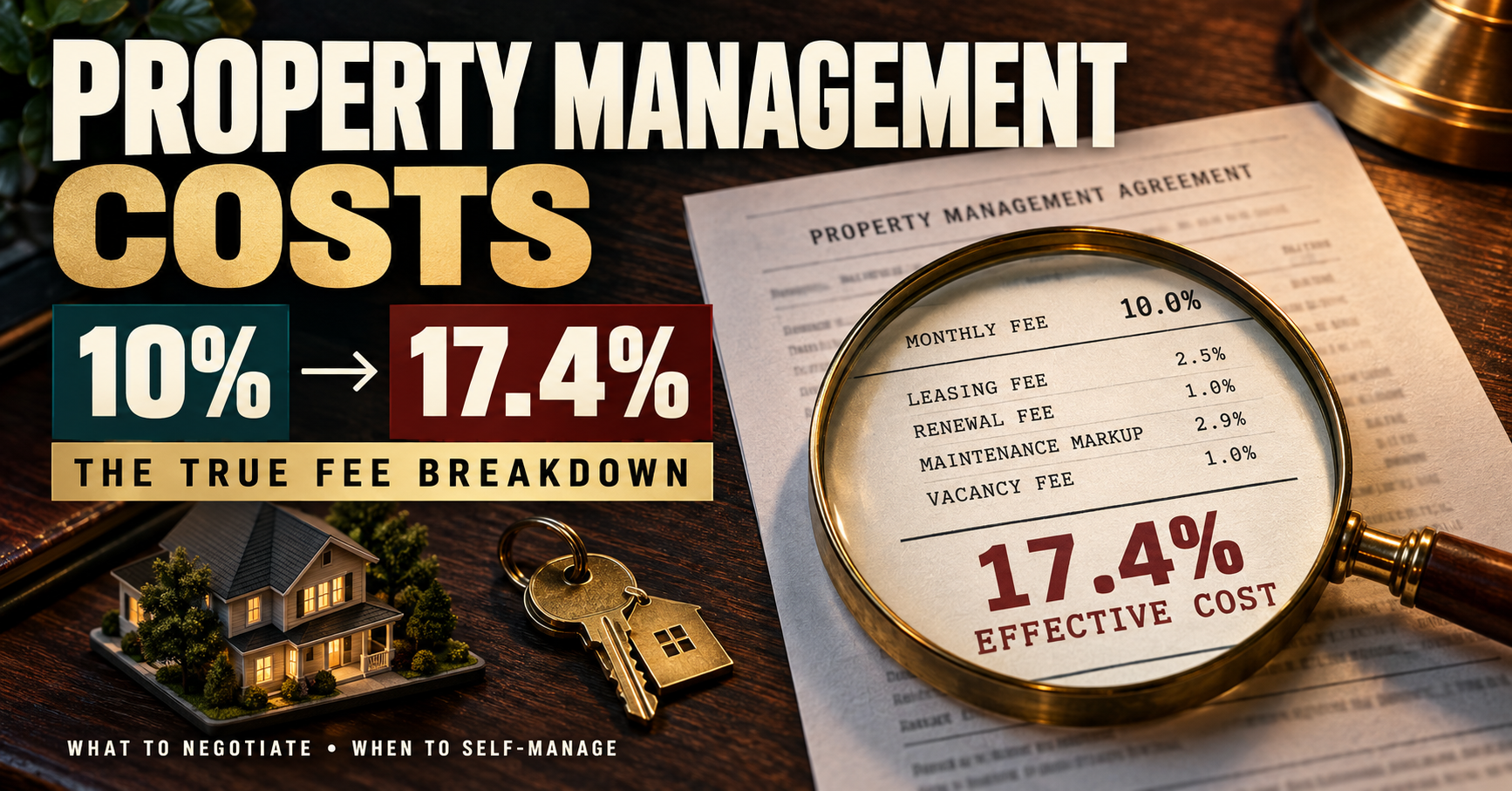
If your property turns over once per year (which is average for single-family rentals), the leasing fee adds 4-8% to your annual property management costs on top of the monthly percentage. Combined with the base 10% monthly fee, your effective annual rate is 14-18% of rent — not the 10% you thought you were paying.
Here is the math on a $1,500/month rental with one turnover per year:
- Monthly management at 10%: $1,500 × 10% × 12 = $1,800/year
- Leasing fee (75% of first month): $1,125
- Lease renewal fee: $200
- Total PM cost: $3,125/year
- Effective rate: $3,125 / $18,000 gross rent = 17.4%
That 17.4% effective rate is nearly double the advertised 10% monthly fee. Factor this into your rental property analysis before signing a management agreement.
Negotiating the Leasing Fee
Some PMs will reduce or waive the leasing fee if you sign a multi-year management contract or bring multiple properties. I negotiated my leasing fee from 100% to 50% of first month’s rent by committing three properties to the same PM company. That saved roughly $2,250 per year across the portfolio.
Maintenance Markup: 10-20% on Every Repair
Most property management companies add a markup to vendor invoices for repairs and maintenance. A plumber charges $350 to fix a water heater. The PM adds 15% ($52.50) and bills you $402.50. On a portfolio with $8,000-$12,000 in annual maintenance costs, that markup adds $800-$2,400 per year to your property management costs.
Is the Markup Worth It?
Sometimes, yes. Good PMs negotiate preferred vendor rates that are 10-20% below retail. If their vendor charges $350 where you would pay $425, the 15% markup on $350 ($402.50) still saves you $22.50 compared to hiring the plumber yourself. The question is whether your PM actually has preferred pricing or is simply marking up retail rates.
Ask your PM for a vendor rate card before signing. Compare their plumber, electrician, HVAC, and general contractor rates against quotes you can get independently. If their base rates are competitive, the markup is reasonable. If their rates are already at retail, you are paying a markup on top of market price.
Property Management Costs by Market
Property management costs vary significantly by location. Higher-cost markets tend to have lower percentage rates (because the dollar amount is already high), while lower-cost markets charge higher percentages to remain profitable.
| Market | Median Rent (SFR) | Typical PM Rate | Monthly PM Fee | Annual PM Cost (incl leasing) |
|---|---|---|---|---|
| Indianapolis, IN | $1,100 | 10% | $110 | $2,170 |
| Memphis, TN | $1,050 | 10% | $105 | $2,110 |
| Columbus, OH | $1,200 | 9% | $108 | $2,196 |
| Charlotte, NC | $1,450 | 8-10% | $130 | $2,685 |
| Austin, TX | $1,650 | 8-9% | $140 | $2,955 |
| Miami, FL | $2,400 | 8% | $192 | $3,504 |
| San Francisco, CA | $3,200 | 6-8% | $224 | $4,288 |
The annual cost column includes the monthly fee plus an estimated leasing fee (75% of one month’s rent per year). These numbers should go directly into your NOI calculation as an operating expense. Compare how PM costs affect your returns across markets using the cap rate calculator.
Self-Management vs Professional Management: The Real Math
The question is not whether total property management costs are expensive — they are. The question is whether professional management produces better financial outcomes than doing it yourself.
What Self-Management Actually Costs
Self-management is not free. Your time has value. Here is what I tracked during my six years of self-managing 22 units:
- Time spent: 15-20 hours per month on tenant communication, maintenance coordination, accounting, and showings
- Tenant placement: 8-12 hours per vacancy (listing, showings, screening, lease signing)
- Emergency calls: 2-3 per month, often evenings and weekends
- Vacancy rate: 7.2% (I was slower to fill units because I had a day job)
- Late rent collection: Average 3 days later than when the PM took over
If I value my time at $50/hour, self-management cost me roughly $1,000/month in time. My PM charges $2,850/month across 22 units, but my vacancy dropped by 3.1 percentage points (saving ~$8,200/year), maintenance costs dropped 15% (saving ~$4,500/year), and late payments nearly eliminated (saving ~$1,200/year in late fees and cash flow timing). Net cost of switching to professional management: $2,850/month minus savings of $1,158/month = $1,692/month, or $77/unit/month.
For $77/unit/month, I got my evenings and weekends back. Worth it — but only because I have enough units to get volume pricing. At 5 units or fewer, the math usually favors self-management. Model your specific situation in the property management fee calculator.
The Break-Even Point
Professional management typically becomes financially worthwhile at 8-10 units for a single market, or when you invest out of state (where self-management is impractical regardless of portfolio size). Below that threshold, the fees eat too large a share of your cash flow.
| Portfolio Size | Annual PM Cost (at 10%) | Self-Management Time | Recommendation |
|---|---|---|---|
| 1-3 units (local) | $2,000-$5,400 | 5-10 hrs/month | Self-manage |
| 4-7 units (local) | $5,400-$12,600 | 12-20 hrs/month | Borderline — depends on your hourly value |
| 8-15 units (local) | $12,600-$27,000 | 20-35 hrs/month | Hire PM — volume discounts kick in |
| Any units (out of state) | Varies | Impractical | Always hire PM |
How to Negotiate Property Management Fees
Reducing property management costs starts with negotiation. Everything in a management contract is negotiable. Here are the seven items I push back on in every PM agreement.
1. Get Volume Discounts in Writing
If you bring 3+ properties, ask for 8% instead of 10%. Most PMs will agree because the marginal cost of managing additional units from the same owner is low. I pay 8% across my portfolio because I negotiated at the point of bringing all 22 units to the company.
2. Cap the Leasing Fee at 50%
The industry standard leasing fee is 75-100% of first month’s rent. Push for 50%. Your leverage: the PM wants your monthly management fees, which are recurring. The leasing fee is a one-time charge. They will often reduce it to win the ongoing contract.
3. Eliminate the Vacancy Fee
Some PMs charge a reduced fee (25-50% of management rate) during vacancy — for managing an empty unit. This is indefensible. The PM should be motivated to fill the unit quickly, not incentivized to earn fees while it sits empty. Insist on zero fees during vacancy.
4. Remove the Lease Renewal Fee
A lease renewal takes the PM 30 minutes of work: a new document, a signature, maybe a rent increase conversation. Charging $200-$300 for this is excessive. Many PMs will waive it if you ask, especially if you have multiple units.
5. Require Approval on Repairs Over $300
Standard contracts often give the PM authority to approve repairs up to $500-$1,000 without your approval. Lower this threshold to $300. You want to know about significant expenses before they happen — and you want the ability to get competitive bids on larger jobs instead of defaulting to the PM’s preferred vendor.
6. Negotiate a 30-Day Termination Clause
Avoid contracts with 6-12 month terms and early termination penalties. Push for month-to-month or 30-day notice termination. If the PM is confident in their service quality, they should not need a long contract to retain you.
7. Ask for Transparent Vendor Pricing
Request that all vendor invoices be forwarded to you without markup, or with the markup clearly itemized. Some PMs will agree to a flat monthly fee instead of percentage-based markups on maintenance. A flat $100-$200/month maintenance coordination fee can save money compared to 15% markup on $8,000+ in annual repairs.
Red Flags in Property Management Contracts
In 14 years of reviewing PM agreements, these are the contract terms that should make you walk away or negotiate hard:
- Charge on gross scheduled rent, not collected rent. If you pay the PM when tenants do not pay you, the incentive alignment is broken.
- Early termination fee exceeding one month’s management fee. Anything higher suggests the PM profits from trapping clients, not from providing good service.
- No itemized maintenance invoices. If the PM will not show you what the vendor charged vs. what they billed you, they are hiding the markup margin.
- Required use of PM’s in-house maintenance team. This creates a conflict of interest — the PM profits from repair volume, which discourages preventive maintenance and cost-conscious repair decisions.
- PM keeps late fees and application fees. These should be split or go entirely to the property owner. Late fees compensate you for delayed cash flow, not the PM for collecting rent.
How Property Management Costs Affect Your Returns
Let me show you the impact of property management costs on a typical rental property deal.
Property: Single-family rental, $300,000 purchase, $1,800/month rent, 25% down ($75,000).
| Metric | Self-Managed | PM at 10% + Fees | Difference |
|---|---|---|---|
| Gross annual rent | $21,600 | $21,600 | $0 |
| Monthly management fee | $0 | $2,160/yr | -$2,160 |
| Leasing fee (1 turnover/yr) | $0 | $1,350 | -$1,350 |
| Lease renewal fee | $0 | $200 | -$200 |
| Maintenance markup (15%) | $0 | $600 | -$600 |
| Total PM cost | $0 | $4,310 | -$4,310 |
| NOI (after all expenses) | $12,400 | $8,090 | -$4,310 |
| Cash-on-cash return | 6.5% | 2.8% | -3.7% |
| Cap rate | 4.13% | 2.70% | -1.43% |
Professional management cuts cash-on-cash return by 3.7 percentage points on this deal. That is the trade — you pay for time freedom, scalability, and professional tenant management. Whether it is worth it depends on your situation. Check how PM fees affect your specific property’s returns in the rental property calculator and see the NOI impact in the NOI calculator.
Tax Treatment of Property Management Costs
All property management costs are fully tax-deductible as operating expenses on Schedule E. This includes the monthly management fee, leasing fees, maintenance markup, and any other PM-related charges. According to IRS Publication 527, property management fees paid to third parties are deductible in the year paid.
At a 24% marginal tax rate, $4,310 in annual PM costs produces a $1,034 tax deduction. Your net cost after tax benefit: $3,276. This does not eliminate the expense, but it reduces the effective cost by roughly 24%. Factor the tax benefit into your rental property tax deductions planning.
Frequently Asked Questions
How much do property managers charge for rental property?
Most property managers charge 8-12% of monthly collected rent as the base management fee. For a property renting at $1,500/month, that is $120-$180/month. However, total property management costs include additional fees: leasing fees (50-100% of first month’s rent per new tenant), lease renewal fees ($150-$300), maintenance markups (10-20% on vendor invoices), and sometimes vacancy fees. The true all-in cost is typically 14-20% of gross annual rent when you include all fees. Use the property management fee calculator to estimate your total cost.
Is 10% a good property management fee?
A 10% monthly management fee is standard for single-family rentals. For small multifamily (2-4 units), you should aim for 8-9%. For portfolios of 10+ units with the same PM company, negotiate for 7-8%. The monthly percentage alone does not tell the full story — check what the PM charges for leasing, renewals, maintenance markup, and vacancy. A PM charging 8% monthly with a 100% leasing fee can cost more annually than a PM charging 10% with a 50% leasing fee.
When should I hire a property manager?
Consider hiring a PM when you own 8+ local units (the volume makes fees more affordable), when you invest out of state (self-management is impractical remotely), when your portfolio generates enough income that your time is better spent acquiring new properties than managing existing ones, or when tenant management is causing you enough stress to affect other areas of your life. Below 5 local units, self-management usually makes more financial sense.
Are property management fees tax deductible?
Yes. All property management fees — monthly management, leasing, renewal, maintenance markup, and related costs — are fully tax-deductible as operating expenses on Schedule E of your federal tax return. According to IRS Publication 527, management fees paid to third parties reduce your taxable rental income dollar-for-dollar. At a 24% marginal rate, $4,000 in annual PM costs saves roughly $960 in taxes.
What is included in property management fees?
The base monthly fee (8-12%) typically covers rent collection, tenant communication, maintenance coordination (dispatching vendors), monthly financial reporting, and basic accounting. It does not usually include tenant placement (separate leasing fee), eviction proceedings (separate fee plus legal costs), major renovation oversight, or property inspections (some charge separately). Always request a complete fee schedule in writing before signing a management agreement.
Bottom Line: Know Your All-In Cost Before Signing
The monthly management percentage is marketing — it is the number PM companies put on their websites because it looks affordable. Your actual property management costs include every fee in the contract, and those fees add up to 40-60% more than the base rate.
Before signing with any PM company, do three things:
- Calculate your all-in annual cost. Add up the monthly fee, expected leasing fees (based on your historical turnover rate (Census Bureau vacancy data can help estimate this)), renewal fees, and estimated maintenance markup. Plug the total into the property management fee calculator.
- Compare against self-management. Estimate your time cost at a fair hourly rate and factor in the vacancy and maintenance differences between self-management and professional management. Use the rental property calculator to model both scenarios.
- Negotiate before you sign. Every fee in the contract is negotiable. Push for collected rent billing, 50% leasing fee, no vacancy fee, no renewal fee, and 30-day termination. The PMs who refuse all negotiation are usually the ones who profit from hidden fees rather than quality service.