Last updated: October 14, 2026 · Originally published: October 13, 2026 · By Alex Petrov
Understanding LTV investment property requirements changed how I structure every deal. I have closed deals with conventional financing at 75% LTV, DSCR loans at 80%, and hard money at 65%. Each loan type came with a different maximum LTV, a different rate, and a completely different set of documentation headaches. The difference between a 75% and an 80% LTV on a $400,000 rental property is $20,000 in cash you either keep in your pocket or wire to the title company at closing. That is not a rounding error — it is the difference between buying two properties this year or three.
LTV investment property requirements ranges from 65% to 85% depending on the loan program, your credit profile, and the property type. Conventional loans cap at 75-80%. DSCR loans go up to 80-85%. Hard money sits at 65-70% of purchase price but sometimes 80-85% of ARV. This article lays out the exact LTV requirements by loan type, shows you how your LTV ratio changes your interest rate, and walks through two worked examples so you can see the cash flow impact of even a 5% LTV swing. If you want to run your own numbers while you read, open the LTV calculator and plug in your deal.
What LTV Means for Investment Property (And Why Lenders Care)
The LTV investment property ratio is the loan amount divided by the property value. Borrow $300,000 on a $400,000 property and your LTV is 75%. The math is simple. What is not simple is understanding why lenders treat investment property LTV so differently from primary residence LTV.
On a primary residence, you can get an FHA loan at 96.5% LTV or a conventional loan at 95% LTV. On an investment property, those numbers drop by 15-30 percentage points. The reason is default risk. The CFPB explains that LTV measures the lender’s exposure — how much they stand to lose if you stop paying and they have to foreclose. Investment properties default at roughly 2-3x the rate of primary residences because borrowers under financial stress will always protect their own roof first.
That higher default rate is why every lender imposes stricter LTV limits on investment property. More equity in the deal means the lender can recover their principal even after foreclosure costs, realtor commissions, and months of vacancy. Use the LTV calculator to see exactly where your deal lands before you call a lender.
LTV Requirements by Loan Type — Complete Breakdown
I have borrowed through five different loan programs for investment property over the past seven years. Each one has different LTV limits, and those limits shift based on property type, unit count, and your credit score. Here is the full picture.
| Loan Type | Max LTV (SFR) | Max LTV (2-4 Unit) | Min Credit Score | Min Down Payment | Key Requirement |
|---|---|---|---|---|---|
| Conventional (Fannie/Freddie) | 80% | 75% | 620 (most lenders want 680+) | 20-25% | Full income docs, DTI under 45% |
| DSCR Loan | 80-85% | 75-80% | 640+ | 15-25% | Property DSCR 1.0+ (ideally 1.25+) |
| FHA House Hack (1-4 unit, owner-occupied) | 96.5% | 96.5% | 580+ | 3.5% | Must live in one unit 12+ months |
| Hard Money (purchase price basis) | 65-70% | 65-70% | None (most check anyway) | 30-35% | Experience, exit strategy |
| Hard Money (ARV basis) | 70-75% of ARV | 65-70% of ARV | None | Varies by deal | Rehab scope, comps supporting ARV |
| Commercial (5+ units / mixed-use) | 70-75% | 70-75% | 660+ | 25-30% | NOI, occupancy history, net worth |
| Portfolio / Community Bank | 70-80% | 70-80% | Flexible | 20-30% | Banking relationship, deposits |
Now let me walk through each loan type so you know exactly what you are dealing with.
Conventional Loans: 75-80% LTV
Fannie Mae’s eligibility matrix allows up to 85% LTV on a single-family investment property — but good luck finding a lender who will go that high. In practice, most conventional lenders cap LTV investment property limits at 80% for single-family and 75% for 2-4 unit properties. The reason is simple: lenders add their own overlays on top of Fannie/Freddie guidelines, and investment property is where they get most conservative.
At 75% LTV, you need 25% down on a $400,000 duplex — that is $100,000 plus closing costs. At 80% LTV on a single-family, you need $80,000 on the same purchase price. That $20,000 gap is real money, and it is why I always run the numbers through the investment property mortgage calculator before I decide which structure to pursue.
Conventional loans give you the lowest rates — typically 0.5-1.5% below DSCR loans. But the full income documentation requirement (W-2s, tax returns, DTI ratio under 45%) eliminates a lot of experienced investors who own multiple properties. If you have five or more financed properties, many conventional lenders will not talk to you at all. For a deeper comparison, see our guide on DSCR vs conventional loans.
DSCR Loans: 80-85% LTV
DSCR loans qualify you based on the property’s income, not yours. The lender calculates your debt service coverage ratio — monthly rent divided by PITIA (principal, interest, taxes, insurance, and association dues). If that number is 1.0 or higher, you qualify. No tax returns, no W-2s, no DTI calculation.
Most DSCR lenders offer up to 80% LTV investment property financing on single-family rentals. A handful will go to 85%, but at that tier you will pay a noticeably higher rate — often 1-1.5 points above the 75% LTV pricing. At 75% LTV and a DSCR of 1.25+, you can get competitive rates in the 7.0-7.75% range in mid-2026. Push to 85% LTV and expect 8.5-9.5%. Check out our full breakdown of current DSCR loan rates for state-by-state numbers.
One thing I have learned after eight DSCR closings: the LTV on the rate sheet and the LTV the underwriter approves are sometimes different numbers. Lenders advertise 85% LTV to get your application, then the appraisal comes in low and suddenly you are at 78% whether you planned for it or not. Always order comps before you commit to a purchase price.
FHA House Hack: 96.5% LTV (With a Catch)
FHA loans offer the highest LTV investment property financing at 96.5% — just 3.5% down — on 1-4 unit properties as long as you live in one unit for at least 12 months. This is the house hacking strategy, and it is the highest LTV you can get on a property that generates rental income.
Buy a $400,000 fourplex with 3.5% down ($14,000), live in one unit, rent the other three. After 12 months, you can move out and keep the property as a pure investment. The LTV ratio on day one is 96.5%. You will pay mortgage insurance (MIP) for the life of the loan, which adds about 0.85% annually to your effective rate. But the low entry cost lets you acquire rental units with a fraction of the capital required by other loan types.
The catch: you cannot use this strategy to scale beyond your first or second deal, and the property must pass FHA inspection standards. Distressed properties that need rehab usually do not qualify.
Hard Money Loans: 65-70% LTV (Purchase) or 70-75% ARV
Hard money lenders approach LTV investment property calculations differently. Some quote LTV based on purchase price. Others quote based on after-repair value (ARV). The distinction matters enormously. A $200,000 purchase price with a $300,000 ARV and a 70% ARV-based loan gives you $210,000 — more than the purchase price. A 65% purchase-price-based loan on the same deal gives you $130,000.
In both cases, the effective LTV at purchase is aggressive — you are putting less cash in, but paying higher rates (10-14%) and shorter terms (6-18 months). For the full cost breakdown, read our guide on hard money loan costs. Run your numbers through the hard money loan calculator to see total interest expense at different LTV levels.
Commercial Loans: 70-75% LTV
Once you cross into 5+ unit properties or mixed-use buildings, you are in commercial lending territory. Commercial LTV investment property loans typically cap at 70-75%, and the underwriting focuses on the property’s net operating income rather than your personal finances. Banks want to see a stabilized NOI that covers debt service by 1.20-1.35x.
The lower LTV means more cash at closing, but commercial loans also allow you to use the rental property calculator assumptions about rental income as part of the qualification. The 25-30% down payment requirement is steep, but these loans come with 20-25 year amortization and sometimes fixed rates for the first 5-10 years.
Portfolio / Community Bank Loans: 70-80% LTV
Portfolio lenders keep loans on their own books instead of selling to Fannie or Freddie. That means they set their own rules. I have gotten 80% LTV investment property financing from a community bank that no conventional lender would touch — a mixed-use building with a retail unit on the ground floor. The bank’s decision came down to relationship: I had $350,000 in deposits and a five-year borrowing history with them.
Portfolio lenders offer the most flexibility on LTV, but the tradeoff is usually adjustable rates, shorter fixed-rate periods (3-7 years), and sometimes personal guarantees or cross-collateralization requirements. If your deal does not fit a conventional or DSCR box, a portfolio lender might be your only path to 80% LTV on an unusual property type.
How LTV Affects Your Interest Rate
Your LTV investment property ratio is the single biggest rate lever you can pull on a rental property loan. Every lender prices risk based on LTV tiers — and the jumps between tiers are not small. Here is what I have seen across conventional and DSCR rate sheets in 2026.
| LTV Tier | Conventional Rate (SFR, 740+ FICO) | DSCR Rate (SFR, 1.25+ DSCR) | Rate Premium vs. 70% LTV |
|---|---|---|---|
| 65-70% | 6.50-6.75% | 7.00-7.25% | Baseline |
| 70-75% | 6.75-7.00% | 7.25-7.50% | +0.25% |
| 75-80% | 7.00-7.375% | 7.50-8.00% | +0.50-0.75% |
| 80-85% | N/A (most lenders cap at 80%) | 8.25-9.00% | +1.25-1.75% |
| 85-90% | N/A | 9.00-9.50% (very few lenders) | +2.00-2.25% |
Look at the 75% to 85% jump on DSCR loans: that is a full percentage point or more. On a $300,000 loan, 1% higher rate means $3,000 more in annual interest — $250 per month straight off your cash flow. Over a 30-year hold, you pay an extra $90,000 in total interest for the privilege of putting 15% down instead of 25%.
This is why I always model both scenarios in the LTV calculator before I commit to a loan structure. Sometimes putting more cash down is the mathematically worse decision because your cash-on-cash return drops. Other times, the rate savings at lower LTV more than compensate for the extra capital. The answer depends on your specific deal — and that is exactly what the calculator is built to show you.
LTV Investment Property Requirements: The Fine Print
The LTV investment property maximums in the table above are starting points. Lenders adjust them based on several factors that most borrowers do not discover until they are deep into underwriting. Here is what actually moves your maximum LTV.
Property Type Adjustments
Condos, non-warrantable condos, and 2-4 unit properties all have lower LTV caps than single-family homes. A conventional lender who offers 80% on an SFR might cap you at 75% on a condo and 70% on a non-warrantable condo. DSCR lenders follow the same pattern — the riskier the property type in the lender’s view, the more equity they demand.
Credit Score Impact
Your credit score does not just affect your rate — it affects your maximum LTV. Some DSCR lenders require 720+ credit for their 85% LTV tier. Drop below 700 and your max LTV might fall to 80%. Below 660 and you could be stuck at 75%, regardless of how strong the property’s rental income looks.
Cash Reserves
Most investment property lenders require 6-12 months of PITIA payments in liquid reserves after closing. At 80% LTV on a $400,000 property with a $2,800 monthly payment, that is $16,800-$33,600 sitting in a bank account. If your reserves fall short, lenders may reduce your maximum LTV by 5-10% to compensate for the added risk.
Number of Financed Properties
Fannie Mae allows up to 10 financed properties per borrower, but the LTV limits tighten after four. Properties 5-10 often come with a 75% LTV cap on single-family (versus 80% for properties 1-4) and higher reserve requirements. Read more about navigating these limits in our investment property mortgage rates guide.
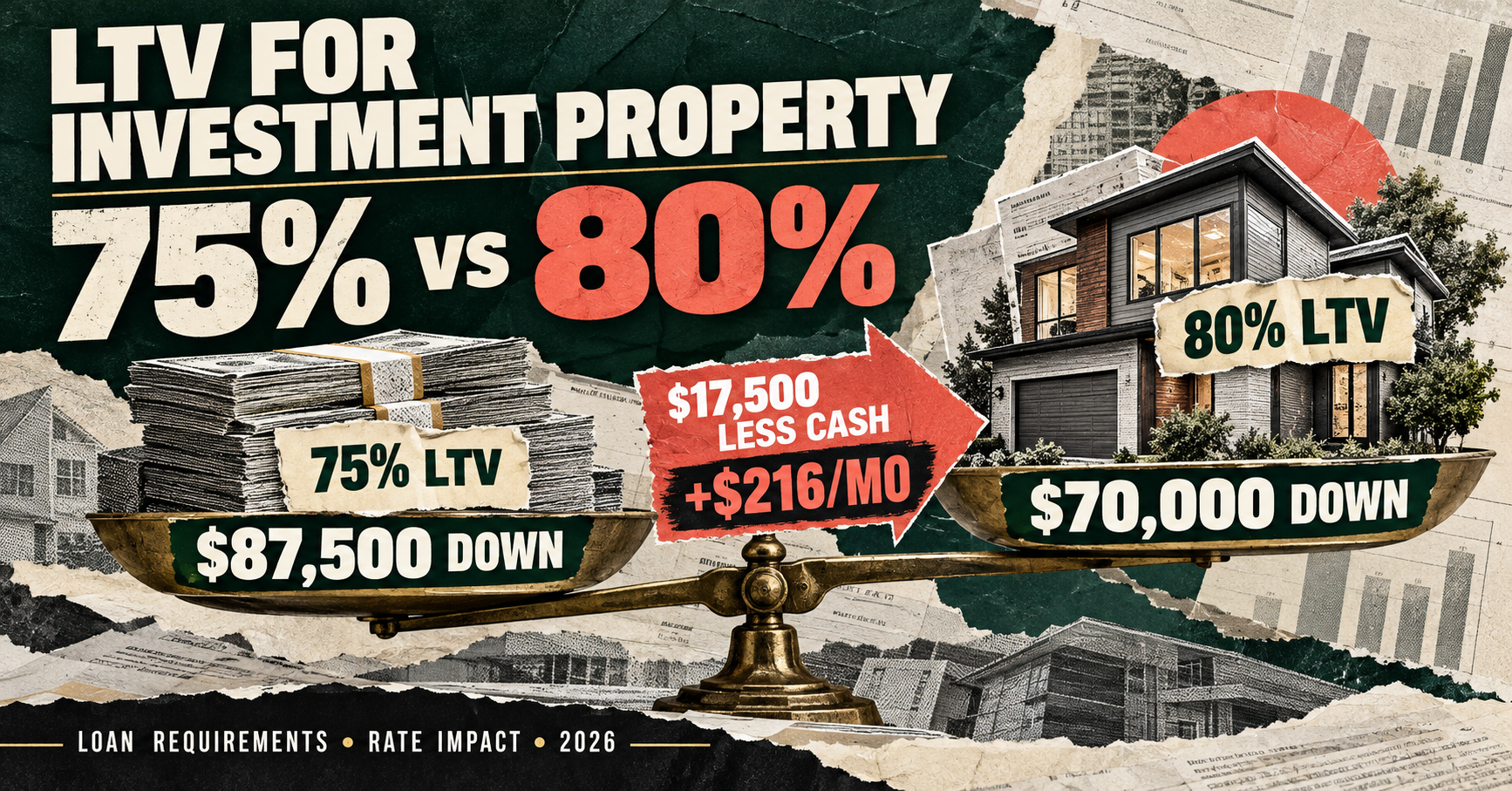
Worked Example 1: Same Property, 75% vs 80% LTV
Let me show you how LTV investment property differences of just 5% affect on an actual deal I analyzed last month. This is a single-family rental in a mid-sized Midwest market.
Property details: Purchase price $350,000. Market rent $2,600/month. Taxes $4,200/year. Insurance $1,800/year. Property management at 8%.
| Metric | Scenario A: 75% LTV | Scenario B: 80% LTV | Difference |
|---|---|---|---|
| Loan amount | $262,500 | $280,000 | +$17,500 |
| Down payment | $87,500 | $70,000 | -$17,500 |
| Interest rate (DSCR, 740 FICO) | 7.25% | 7.75% | +0.50% |
| Monthly P&I | $1,791 | $2,007 | +$216/mo |
| Monthly PITIA | $2,291 | $2,507 | +$216/mo |
| Gross monthly rent | $2,600 | $2,600 | $0 |
| Management (8%) | $208 | $208 | $0 |
| Monthly cash flow | $101 | -$115 | -$216/mo |
| Annual cash flow | $1,212 | -$1,380 | -$2,592/yr |
| Cash-on-cash return | 1.39% | -1.97% | -3.36% |
| DSCR | 1.05 | 0.95 | -0.10 |
At 75% LTV, this property barely cash flows — $101 per month after management fees. At 80% LTV, it goes negative. The higher loan amount ($17,500 more) combined with the 0.50% rate premium turns a thin positive cash flow into a monthly loss. And notice the DSCR drops below 1.0, which means some lenders will not approve the deal at 80% LTV at all.
But here is the counterargument: you kept $17,500 in your pocket by going with 80% LTV. If you can deploy that $17,500 into a second property or a rehab project earning 15%+ returns, the negative cash flow on this deal might be a worthwhile tradeoff. That is a portfolio strategy question, not just a single-property question. Model both scenarios in the rental property calculator to compare the full picture.
Worked Example 2: DSCR vs Hard Money LTV on a Value-Add Deal
This example compares two financing strategies for a value-add property — a single-family home purchased below market, light rehab, then held as a rental.
Property details: Purchase price $275,000. Rehab budget $40,000. After-repair value (ARV) $380,000. Stabilized rent $2,800/month.
| Metric | DSCR at 80% LTV (Purchase) | Hard Money at 75% ARV + DSCR Refi |
|---|---|---|
| Acquisition loan | $220,000 (80% of $275K) | $285,000 (75% of $380K ARV) |
| Cash at closing | $55,000 + $40,000 rehab = $95,000 | $0 down + rehab funded = $30,000 gap |
| Hard money rate / term | N/A | 11.5% / 12 months |
| Hard money interest cost | N/A | $16,388 (6-month hold) |
| Refi into DSCR at 75% of $380K | N/A | $285,000 loan at 7.25% |
| Total cash invested (after refi) | $95,000 | $62,388 ($30K gap + $16K interest + points) |
| Monthly P&I (long-term) | $1,501 | $1,944 |
| Monthly cash flow (stabilized) | $449 | $6 |
| Cash-on-cash return | 5.67% | 0.12% |
The hard money path requires less cash out of pocket ($62,388 vs $95,000), but the carrying costs during rehab and the higher refi loan balance crush your long-term cash flow. This is a classic LTV tradeoff: higher LTV at acquisition saves cash today but costs more every month going forward.
For the hard money path, run the acquisition through the hard money loan calculator, then model the refinance in the DSCR calculator. For the direct DSCR purchase, the LTV calculator gives you the debt-to-equity ratio instantly.
How to Improve Your LTV (And Get Better Loan Terms)
You have two ways to improve your LTV investment property ratio: reduce the loan amount (put more cash in) or increase the property value (so the same loan amount represents a smaller percentage). The first option is obvious. The second is where experienced investors find their edge.
1. Get a Higher Appraisal
The appraised value determines your LTV. If the appraisal comes in at $400,000 instead of $380,000, your $300,000 loan goes from 78.9% LTV to 75% LTV — and that might cross an LTV tier threshold that saves you 0.25-0.50% on your rate.
Prepare a comp package for the appraiser. Include 3-5 recent sales of similar properties within 0.5 miles, note any upgrades you have made, and list the renovations completed. Appraisers are not supposed to be influenced by your comp package, but they are human and they appreciate data. I have seen appraisals come in $10,000-$30,000 higher when the borrower prepared solid comps versus leaving the appraiser to find their own.
2. Make Strategic Improvements Before Refinancing
If you are planning a cash-out refinance or a rate-and-term refinance, spend $5,000-$15,000 on high-ROI improvements before the appraiser arrives. Kitchen countertops, fresh paint, updated fixtures, and landscaping can add $20,000-$50,000 in appraised value on a property in the $300,000-$500,000 range. That shifts your LTV by 3-8 percentage points, which often crosses a pricing tier.
3. Choose the Right Comp Approach
Some lenders use the lower of purchase price or appraised value for LTV calculation. Others use appraised value alone — especially on refinances after a seasoning period (typically 6-12 months). If you bought below market, a lender who uses appraised value gives you a lower LTV and better terms without putting additional cash in. Ask about the lender’s valuation methodology before you apply.
4. Increase Your Down Payment Strategically
Sometimes an extra $10,000-$15,000 in down payment crosses an LTV tier boundary and saves you more in rate reduction than it costs in opportunity. If you are at 81% LTV, getting to 80% might save 0.25-0.375% on rate. On a $300,000 loan, that is $750-$1,125 per year — an excellent return on the extra $3,000 in down payment needed to cross the threshold. See our complete guide on investment property down payment strategies.
5. Bring a Larger Reserve Account
Some lenders will extend higher LTV to borrowers with strong reserves. If you have 18-24 months of PITIA in liquid assets, a DSCR lender might approve 85% LTV where they would normally cap at 80%. The reserves act as a risk offset — the lender knows you can cover payments even if the property is vacant for several months.
6. Improve Your Credit Score Before Applying
As noted above, credit score directly affects your maximum LTV tier. Going from 699 to 720 can access a higher LTV tier at the same rate — or the same LTV at a lower rate. If your deal is not time-sensitive, spend 60-90 days paying down revolving balances and correcting any errors on your credit report.
LTV and Cash Reserves: The Numbers Lenders Actually Want
Lenders do not evaluate your LTV investment property ratio in isolation. They pair it with reserve requirements to create a risk profile. Here is how reserves and LTV interact across loan types.
| Loan Type | LTV 70% or Below | LTV 70-75% | LTV 75-80% | LTV 80%+ |
|---|---|---|---|---|
| Conventional (reserves in months PITIA) | 6 months | 6 months | 6-12 months | N/A |
| DSCR (reserves in months PITIA) | 3-6 months | 6 months | 6-12 months | 12-18 months |
| Commercial (reserves in months debt service) | 6 months | 9 months | 12 months | N/A |
Notice the pattern: higher LTV requires more reserves. At 80%+ LTV on a DSCR loan, you might need 12-18 months of PITIA in the bank — which on a $2,500/month payment means $30,000-$45,000 in liquid reserves in addition to your down payment and closing costs. That is a significant capital requirement that many investors underestimate.
Maximum LTV for Rental Property by State: Does Location Matter?
Does location affect your LTV investment property limits? The short answer: not for conventional or DSCR loans. Fannie Mae and Freddie Mac set uniform national guidelines, and most DSCR lenders operate nationwide with the same rate sheets. Hard money and portfolio lenders are different — a local community bank in Texas might offer 80% LTV on investment property while the same type of bank in California caps at 70% because property values are more volatile.
Where location matters more is in how LTV interacts with property values. An 80% LTV loan on a $500,000 property in Austin requires a $100,000 down payment. The same 80% LTV on a $180,000 property in Indianapolis requires $36,000 down. The LTV ratio is identical, but the cash requirement is dramatically different. This is why I always suggest investors in high-cost markets explore lower-cost markets where the same LTV gets them into a deal with less capital. Use the rental property calculator to compare cash flow across different markets and price points.
LTV vs LTC vs LTARV: Understanding the Ratios
When analyzing LTV investment property deals, lenders use three different value-based ratios, and confusing them leads to nasty surprises at closing.
LTV (Loan-to-Value): Loan amount divided by current appraised value or purchase price. This is the standard ratio for buy-and-hold rental property loans. Calculate yours with the LTV calculator.
LTC (Loan-to-Cost): Loan amount divided by total project cost (purchase price plus rehab). Hard money lenders and construction lenders use this. If you buy for $200,000 and spend $80,000 on rehab, your total cost is $280,000. A 90% LTC loan gives you $252,000 — but the lender may still cap total financing at 75% of ARV.
LTARV (Loan-to-After-Repair-Value): Loan amount divided by the projected value after renovations are complete. A fix-and-flip lender quoting “75% of ARV” is using this ratio. It is more generous than LTV or LTC because the denominator (ARV) is higher than the current value or total cost.
When a lender says “we go up to 80% LTV,” ask which value they are using: purchase price, current appraised value, or ARV. The answer changes how much cash you need at closing by tens of thousands of dollars.
When Higher LTV Makes Sense (And When It Doesn’t)
The conventional wisdom about LTV investment property strategy in real estate forums is “put as little down as possible and leverage everything.” I used to follow that advice. After eight DSCR loans and a few conventional deals, I have a more detailed view.
Higher LTV makes sense when:
- You are scaling quickly and need to preserve cash for multiple acquisitions
- The property’s rent comfortably covers the higher payment (DSCR 1.25+ even at the higher LTV)
- You have a reinvestment plan for the cash you save — leaving it in a savings account at 4% does not justify paying 8.5% interest on the extra loan amount
- You are house hacking with FHA financing where the LTV difference is 93% vs 96.5% and the rate is nearly identical
Lower LTV makes sense when:
- The rate drop at a lower LTV tier materially improves your cash flow (which it almost always does)
- You are buying in a market where rents are tight relative to prices and you need every basis point of rate savings
- You are refinancing into a long-term hold and want to lock in the lowest possible payment for 30 years
- You need to hit a DSCR threshold (1.0 or 1.25) to qualify, and lower LTV gets you there by reducing the payment
The right answer depends on your specific deal. I recommend running both scenarios — check the cash flow at 75% LTV and at 80% LTV using the investment property mortgage calculator, and let the numbers guide you instead of following generic advice from people who do not know your market or your portfolio.
How to Calculate LTV Investment Property Ratio
The LTV investment property formula is straightforward:
LTV = (Loan Amount / Property Value) x 100
But “property value” is where it gets complicated. Here are the three common scenarios:
Purchase scenario: Most lenders use the lower of purchase price or appraised value. If you are buying for $350,000 and the appraisal comes in at $370,000, your LTV is based on $350,000. A $280,000 loan gives you 80% LTV (280,000 / 350,000).
Refinance (rate-and-term): Lenders use the current appraised value. If you bought for $300,000 two years ago and the property now appraises at $360,000, a $270,000 refinance loan gives you 75% LTV (270,000 / 360,000).
Cash-out refinance: Same as rate-and-term — appraised value is the denominator. But many lenders cap cash-out refi LTV at 70-75%, which is 5% lower than their purchase LTV maximum. After seasoning requirements are met (typically 6-12 months of ownership), you can pull equity out up to the lender’s cash-out LTV limit.
Open the LTV calculator, enter your loan amount and property value, and see your ratio instantly. Then compare it to the LTV tiers in the rate table above to estimate where your interest rate will land.
LTV Trends in 2026: What’s Changed
The LTV investment property lending market has shifted since 2023. FRED data on 30-year mortgage rates shows rates stabilizing in the mid-6% range for conventional loans in 2026, down from the 7%+ peaks of 2023. DSCR rates have followed, dropping about 0.75-1.0% from their 2023 highs.
What has not changed — or has gotten stricter — is LTV limits. DSCR lenders who were offering 85% LTV freely in 2021 and 2022 pulled back to 75-80% during the rate spike. Some have reopened their 85% LTV tier, but with significantly higher rate premiums and reserve requirements. The market learned from 2008: loose LTV combined with declining property values is a recipe for losses.
For investors, the practical implication is clear: plan for 20-25% down on most investment property deals. The era of 10-15% down DSCR loans is not fully back, and betting on higher-LTV products returning is not a sound acquisition strategy.
Common LTV Mistakes Investors Make
I have watched investors — including myself in my early deals — make these LTV investment property errors that cost thousands.
Confusing LTV and LTC. A hard money lender offers “85% financing.” You assume that means 85% of the purchase price. They mean 85% of total project cost, capped at 70% of ARV. Your actual cash requirement might be very different from what you budgeted.
Ignoring the appraisal gap. You agree to buy at $400,000 with 80% LTV, expecting a $320,000 loan. The appraisal comes in at $380,000, and the lender calculates 80% of $380,000 = $304,000. You now need an extra $16,000 at closing that you did not plan for.
Not accounting for rate tiers. An investor puts 20% down (80% LTV) without realizing that 25% down (75% LTV) would have crossed a rate tier and saved 0.375% on their rate. Over 30 years, that is tens of thousands in interest saved — potentially worth far more than the extra $17,500 in down payment on a $350,000 property.
Maxing out LTV on every deal. Scaling a portfolio at 80-85% LTV on every property means minimal equity and maximum exposure. One market downturn that drops values 10-15% puts you underwater on multiple properties simultaneously. Varying your LTV across deals — some at 75%, some at 80% — builds a more resilient portfolio.
Forgetting reserves affect maximum LTV. You plan for 80% LTV and budget $80,000 on a $400,000 property. But the lender requires 12 months of PITIA reserves at that LTV tier — another $30,000+ in liquid assets. If you cannot show reserves, they drop your max LTV to 75%, and now you need $100,000 down plus closing costs. Always budget for reserves before committing to an LTV target.
Frequently Asked Questions
What is the maximum LTV for investment property?
The maximum LTV investment property limit depends on loan type. Conventional loans typically cap at 80% for single-family and 75% for 2-4 unit properties. DSCR loans go up to 80-85% on single-family rentals. Hard money lenders offer 65-70% of purchase price or 70-75% of after-repair value. FHA loans offer the highest LTV investment property financing at 96.5% if you owner-occupy one unit (house hacking). Portfolio and community bank lenders range from 70-80% depending on relationship and deal strength. Use the LTV calculator to see your exact ratio before shopping lenders.
How does LTV affect investment property mortgage rates?
LTV investment property ratios directly impact your interest rate through pricing tiers. Every 5% increase in LTV typically adds 0.25-0.50% to your rate on conventional loans and 0.25-0.75% on DSCR loans. For example, a 75% LTV DSCR loan in 2026 might price at 7.25% while the same loan at 85% LTV prices at 8.75% — a 1.50% difference. On a $300,000 loan, that 1.50% gap costs $4,500 per year in additional interest, or $375 per month off your cash flow. Check our investment property mortgage rates guide for current rate ranges by LTV tier.
Can I get 90% LTV on an investment property?
Not through standard LTV investment property loan products. The only path to 90%+ LTV on a property with rental income is FHA financing (96.5% LTV) or VA loans (100% LTV) — both require you to owner-occupy one unit for at least 12 months. For true non-owner-occupied investment property, 85% LTV is the practical maximum, and only a handful of DSCR lenders offer it with significant rate premiums and reserve requirements. Some hard money lenders will fund 90% of purchase price on flips if the ARV supports it, but that is short-term bridge financing, not a long-term hold loan. Read more in our house hacking guide if owner-occupancy is an option for you.
What is a good LTV ratio for rental property?
A “good” LTV for rental property ratio balances leverage with cash flow for LTV investment property decisions. For most buy-and-hold investors, 75% LTV hits the sweet spot — you get favorable rate pricing, manageable monthly payments, and 25% equity as a buffer against value declines. If you are scaling and need to preserve capital, 80% LTV is reasonable as long as the property’s DSCR stays above 1.0 at the higher payment. Going above 80% LTV rarely makes sense for long-term holds because the rate premium and reserve requirements usually outweigh the capital savings. Run your specific deal through the DSCR calculator at different LTV levels to find the breakpoint where cash flow turns negative.
How do I lower my LTV on an existing investment property?
You can lower your LTV investment property ratio two ways: pay down the loan balance or increase the property value. For active strategies, make strategic improvements (kitchen, bathrooms, landscaping) that boost appraised value, then refinance. A $15,000 renovation that adds $40,000 in value can drop your LTV by 5-8 percentage points. For passive improvement, principal paydown through regular mortgage payments reduces your loan balance over time — after 5 years of payments on a 30-year loan, you will have paid down roughly 5-7% of the original balance. You can also make extra principal payments to accelerate LTV improvement. See our investment property down payment guide for strategies on optimizing your equity position.
Bottom Line: Know Your LTV Tiers Before You Shop
Your LTV investment property ratio is not just a number on your loan application — it is the single biggest lever controlling your interest rate, monthly payment, and cash flow on every investment property you buy. A 5% difference in LTV can mean the difference between a cash-flowing rental and a monthly loss, as the worked examples above demonstrate.
Before you call a lender or submit an application, do three things:
- Calculate your LTV. Open the LTV calculator, plug in your purchase price and loan amount, and note which tier you fall into.
- Model both scenarios. Run your deal at two different LTV levels — typically 75% and 80% — in the investment property mortgage calculator and compare the cash flow.
- Check your DSCR. If you are using a DSCR loan, verify that the property’s income covers the payment at your target LTV using the DSCR calculator.
The investors who consistently close at favorable rates are not the ones who negotiate hardest — they are the ones who understand the LTV tiers, prepare their appraisal comps, and structure their deals to land on the right side of a pricing breakpoint.