{
“@context”: “https://schema.org”,
“@type”: “FAQPage”,
“mainEntity”: [
{
“@type”: “Question”,
“name”: “What are current investment property mortgage rates in 2026?”,
“acceptedAnswer”: {
“@type”: “Answer”,
“text”: “In 2026, investment property mortgage rates typically run 0.5–0.75% higher than primary residence rates. Conventional loans for investment properties average 7.0–7.5%, DSCR loans range from 7.25–9.0% depending on credit and property type, portfolio loans sit around 7.5–8.5%, and hard money loans run 11–13%. Rates change daily based on Fed policy, bond markets, and lender appetite.”
}
},
{
“@type”: “Question”,
“name”: “Why are investment property mortgage rates higher than primary home rates?”,
“acceptedAnswer”: {
“@type”: “Answer”,
“text”: “Lenders charge a premium on investment properties because borrowers statistically default on rental properties before their primary residence when finances tighten. Fannie Mae and Freddie Mac impose loan-level price adjustments (LLPAs) on investment property loans, which translate directly into higher rates. The premium typically ranges from 0.5% to 0.75% above comparable primary residence rates.”
}
},
{
“@type”: “Question”,
“name”: “How do I calculate my monthly payment on an investment property?”,
“acceptedAnswer”: {
“@type”: “Answer”,
“text”: “Use the PITI formula: Principal + Interest + Taxes + Insurance. For the P&I portion, use M = P[r(1+r)^n]/[(1+r)^n-1], where P is the loan amount, r is the monthly interest rate (annual rate ÷ 12), and n is the number of payments. On a $400,000 loan at 7.25% for 30 years, the P&I payment is approximately $2,729/month. Add property taxes (~$417/month on a $400K property) and landlord insurance (~$150/month) for total PITI of roughly $3,296/month.”
}
},
{
“@type”: “Question”,
“name”: “What credit score do I need for the best investment property mortgage rates?”,
“acceptedAnswer”: {
“@type”: “Answer”,
“text”: “For conventional investment property loans, you need a minimum 620 score, but rates improve significantly at 700, 720, and 740+. Borrowers with 740+ scores and 25–30% down typically qualify for the most competitive rates. DSCR lenders often set their own credit minimums, commonly 660–680, with better pricing above 720. Each 20-point credit score tier can affect your rate by 0.125–0.375%.”
}
},
{
“@type”: “Question”,
“name”: “What is a DSCR loan and how do rates compare to conventional?”,
“acceptedAnswer”: {
“@type”: “Answer”,
“text”: “A DSCR (Debt Service Coverage Ratio) loan qualifies you based on the rental income of the property rather than your personal income. The property’s annual rent must typically cover 1.0–1.25x the annual debt service. DSCR rates run 0.25–1.5% higher than conventional rates, ranging from 7.25–9.0% in 2026. The tradeoff is simpler qualification — no W-2s, tax returns, or debt-to-income ratio calculation required.”
}
},
{
“@type”: “Question”,
“name”: “Is a 15-year or 30-year mortgage better for investment property?”,
“acceptedAnswer”: {
“@type”: “Answer”,
“text”: “A 30-year mortgage maximizes monthly cash flow with lower payments, which is usually preferable for buy-and-hold rental investors. A 15-year mortgage builds equity faster and saves tens of thousands in interest, but the higher payment can turn a cash-flowing property negative. Most rental investors choose 30-year terms to protect cash flow, then pay extra principal when cash allows.”
}
},
{
“@type”: “Question”,
“name”: “Should I pay points to lower my investment property mortgage rate?”,
“acceptedAnswer”: {
“@type”: “Answer”,
“text”: “Paying points (prepaid interest, each point = 1% of loan amount) makes sense only if you plan to hold the property long enough to recoup the upfront cost. Divide the cost of the points by your monthly payment savings to find the break-even month. If you pay $4,000 to save $50/month, break-even is 80 months (6.7 years). If you plan to hold longer, points save money. If you might refinance or sell sooner, skip them.”
}
}
]
}
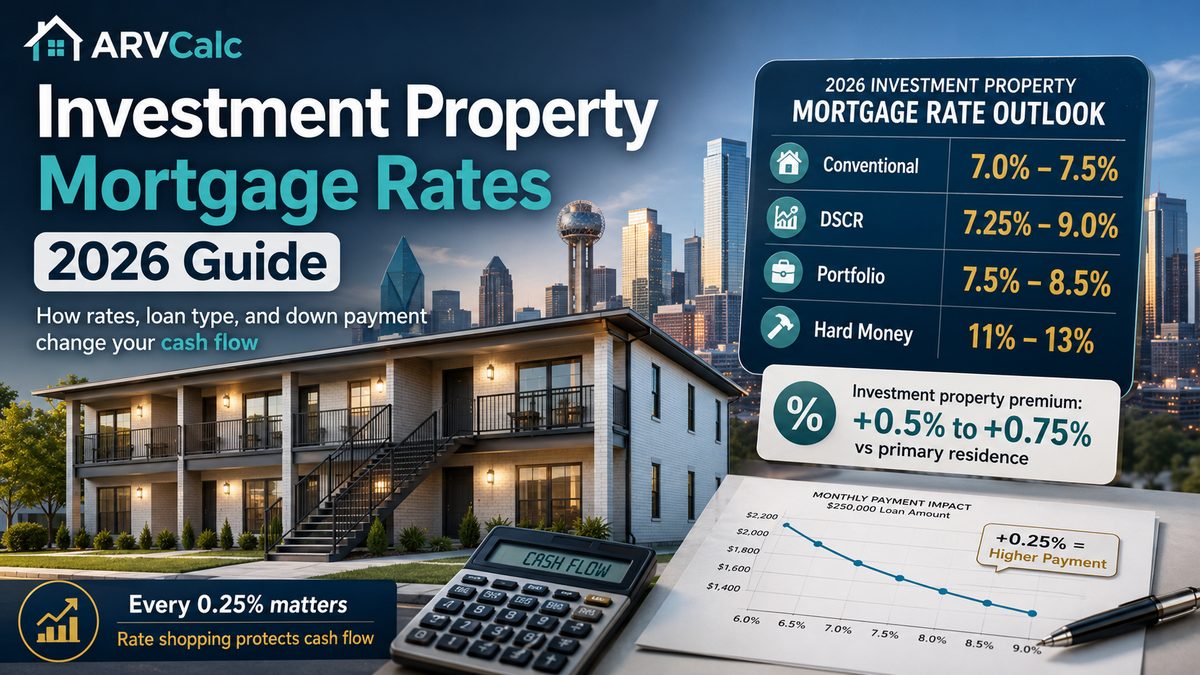
- Conventional (Fannie/Freddie): 7.0%–7.5% (25% down, 740+ credit)
- DSCR loans: 7.25%–9.0% (varies by DSCR ratio and credit)
- Portfolio loans: 7.5%–8.5% (lender-specific underwriting)
- Hard money: 11%–13% (asset-based, short-term)
- Investment property premium: 0.5%–0.75% above primary residence rates
Rates change daily. Run your numbers with our investment property mortgage calculator to see exact payments for your scenario.
Maria owns two rentals and is about to make an offer on a $500,000 four-unit in Dallas. Her lender quoted her two paths: a conventional loan at 7.25% with full income documentation, or a DSCR loan at 8.0% with no tax returns required. On a $400,000 loan (20% down on a $500K property isn’t enough — she needs 25%, so her loan is $375,000), the difference looks small on paper. But stretched over 30 years and measured against projected rental income, the right choice depends on knowing exactly how investment property mortgage rates work, what drives them higher than primary home rates, and how each extra quarter-point affects cash flow. This guide walks through every piece of that calculation with real numbers.
Current Investment Property Mortgage Rates (2026)
Rates fluctuate daily based on the 10-year Treasury yield, Federal Reserve policy, and lender-specific risk appetite. The figures below reflect mid-2026 market conditions. Always verify current pricing with at least three lenders — rate spreads between lenders on the same investment property loan routinely exceed 0.375%.
| Loan Type | Rate Range (2026) | Min Down Payment | Qualification Basis |
|---|---|---|---|
| Conventional (1 unit) | 7.0%–7.5% | 15% (20% for best rates) | Personal income / DTI |
| Conventional (2–4 unit) | 7.25%–7.75% | 25% | Personal income / DTI |
| DSCR Loan | 7.25%–9.0% | 20%–25% | Property cash flow (DSCR) |
| Portfolio Loan | 7.5%–8.5% | 20%–30% | Lender discretion |
| Hard Money | 11%–13% | 20%–35% (of ARV) | Asset value / exit strategy |
| Commercial (5+ units) | 6.75%–8.25% | 25%–30% | Property NOI / DSCR |
Source: Rate ranges compiled from Freddie Mac Primary Mortgage Market Survey, lender rate sheets, and Bankrate’s investment property rate tracker as of mid-2026. Individual rates vary by credit score, LTV, property type, and location.
For a side-by-side comparison of DSCR and conventional underwriting, see our guide: DSCR Loan vs. Conventional Mortgage: Which Is Right for Your Rental?
How Investment Property Mortgage Rates Differ From Primary Residence Rates
If you bought your primary home at 6.75% last year, expect to pay 7.25%–7.5% or more on the same loan amount for a rental property. That 0.5%–0.75% premium is not arbitrary — it is the direct result of how Fannie Mae’s Selling Guide treats investment properties versus owner-occupied homes.
Here is why the premium exists:
- Default risk hierarchy: When borrowers face financial hardship, they protect the roof over their head first. Rental properties get abandoned before primary residences. Lenders price that risk into the rate.
- Loan-Level Price Adjustments (LLPAs): Fannie Mae and Freddie Mac charge mandatory LLPAs on investment property loans. At 75% LTV and a 740 credit score, the LLPA is 1.625% of the loan amount — a cost that lenders roll into the rate rather than charge upfront by default.
- Stricter reserve requirements: Conventional guidelines require 6 months of PITI reserves for investment properties, compared to 2 months for primary residences. This doesn’t affect the rate directly, but it restricts which borrowers qualify.
- Income documentation complexity: Rental income is treated cautiously. Lenders typically use 75% of gross scheduled rent after applying a vacancy factor, making the effective qualifying income lower than actual rents.
According to NAR’s Investment & Vacation Home Buyers Survey, the majority of investment property purchases are financed — and the rate premium is the single biggest factor that separates profitable rentals from cash-flow-negative ones at today’s prices.
Use our rental property calculator to model how the rate premium affects your specific property’s returns.
Investment Property Mortgage Rates by Loan Type
Not all investment property financing works the same way. The loan type you choose affects not just your rate but your qualification process, flexibility, and long-term strategy.
Conventional Conforming Loans
Backed by Fannie Mae or Freddie Mac, these loans offer the lowest rates available for investment properties — but come with the strictest income documentation requirements. You need W-2s, two years of tax returns, and a debt-to-income ratio under 45% (sometimes 50% with compensating factors). Loan limits in most markets cap at $806,500 for single units in 2026.
Best for: Salaried investors buying their first or second rental with strong W-2 income and a credit score above 720.
DSCR Loans
DSCR loans qualify based on the property’s income, not yours. The lender calculates your Debt Service Coverage Ratio: annual gross rental income divided by annual debt service (P&I + taxes + insurance). Most lenders require a DSCR of 1.0–1.25. A ratio of 1.0 means the rent exactly covers the payment; 1.25 means rent covers 125% of the payment.
Use our DSCR calculator to check whether a property qualifies at current rates. We also have state-specific tools for Texas DSCR loans and Florida DSCR loans, where investor activity is highest.
Best for: Self-employed investors, those with complex tax returns showing low net income, or anyone building a large portfolio where DTI limits become a bottleneck.
Portfolio Loans
Portfolio lenders keep loans on their own books rather than selling to Fannie/Freddie. This gives them flexibility to lend to LLCs, accept mixed-use properties, or work with borrowers who don’t fit agency guidelines. Rates run higher to compensate for the lender’s capital being tied up, but terms can be more creative — interest-only periods, blanket loans across multiple properties, or non-standard amortization schedules.
Hard Money Loans
Hard money is asset-based, short-term, and expensive. At 11–13% in 2026, it is rarely used for buy-and-hold rentals. Its role is to fund fix-and-flip projects or bridge purchases where speed matters more than rate. Plan your exit strategy before taking hard money: either refinance into a DSCR or conventional loan once the property is stabilized, or sell within 12–18 months before the costs compound.
| Feature | Conventional | DSCR | Portfolio | Hard Money |
|---|---|---|---|---|
| Typical Rate (2026) | 7.0–7.5% | 7.25–9.0% | 7.5–8.5% | 11–13% |
| Income Docs Required | Full (W-2, tax returns) | None | Varies | None |
| LLC Allowed | No | Yes | Yes | Yes |
| Max Properties | 10 (Fannie) | Unlimited | Unlimited | Unlimited |
| Loan Term | 15 or 30 years | 30 years | Flexible | 6–24 months |
How to Calculate Your Monthly Payment on an Investment Property
Every rental analysis starts with knowing the exact monthly payment. The standard formula for Principal and Interest uses the annuity formula:
Where:
M = Monthly payment
P = Principal loan amount
r = Monthly interest rate (annual rate ÷ 12)
n = Total number of payments (years × 12)
But P&I is only part of what you pay. Investment property lenders require you to escrow taxes and insurance, and your cash-flow analysis must include them all. The full PITI formula:
For a $400,000 property in Texas with a $320,000 loan (20% down), annual taxes of $8,000, and landlord insurance of $1,800/year:
- Annual tax monthly: $8,000 ÷ 12 = $667
- Insurance monthly: $1,800 ÷ 12 = $150
- P&I depends on the rate — see worked examples below
Rather than doing this manually every time, use our investment property mortgage calculator to get PITI instantly for any loan amount, rate, and term.
Worked Example 1: Conventional Loan at 7.25%
Property: Single-family rental, purchase price $400,000
Down payment: 20% = $80,000
Loan amount: $320,000
Rate: 7.25% (conventional, 740+ credit score, 20% down)
Term: 30 years (360 payments)
Step 1 — Monthly interest rate:
r = 7.25% ÷ 12 = 0.604167% = 0.00604167
Step 2 — Calculate (1+r)^n:
(1.00604167)^360 = 8.6185 (approximately)
Step 3 — P&I payment:
M = 320,000 × [0.00604167 × 8.6185] / [8.6185 − 1]
M = 320,000 × [0.052072] / [7.6185]
M = 320,000 × 0.006836
M = $2,187/month
Step 4 — Add taxes and insurance:
| Component | Monthly Amount |
|---|---|
| Principal & Interest | $2,187 |
| Property Taxes ($8,000/yr) | $667 |
| Landlord Insurance ($1,800/yr) | $150 |
| Total PITI | $3,004/month |
With market rent at $2,800/month, this property would run a $204 monthly deficit before maintenance and vacancy — negative cash flow. At $3,200/month rent, it generates $196 positive cash flow, barely enough to build reserves. This is the math that makes rate shopping critical: every 0.25% matters.
Worked Example 2: DSCR Loan at 8.0% — Same Property, Higher Rate
Property: Same $400,000 single-family rental
Down payment: 25% = $100,000 (DSCR lenders commonly require 25%)
Loan amount: $300,000
Rate: 8.0% (DSCR loan, no income docs required)
Term: 30 years
Step 1 — Monthly rate:
r = 8.0% ÷ 12 = 0.6667% = 0.006667
Step 2 — (1+r)^360:
(1.006667)^360 = 10.9357
Step 3 — P&I:
M = 300,000 × [0.006667 × 10.9357] / [10.9357 − 1]
M = 300,000 × [0.072905] / [9.9357]
M = 300,000 × 0.007338
M = $2,201/month
| Component | Conventional (7.25%) | DSCR (8.0%) |
|---|---|---|
| Loan Amount | $320,000 | $300,000 |
| P&I Payment | $2,187 | $2,201 |
| Taxes + Insurance | $817 | $817 |
| Total PITI | $3,004 | $3,018 |
| Down Payment Required | $80,000 | $100,000 |
| Income Docs Required | Yes (W-2, taxes) | No |
| DSCR at $2,800/month rent | 0.93 (fails) | 0.93 (borderline) |
What matters here: the DSCR loan’s higher rate is nearly offset by the smaller loan amount from the larger down payment. The real difference is qualitative — no income documentation vs. full underwriting. For a self-employed investor, the DSCR path may be the only viable one. See our detailed investment property loan calculator guide for more scenarios.
How to Get the Best Investment Property Mortgage Rate
You have more control over your rate than you might think. These five strategies can move your rate down by 0.25%–0.75%, which on a $320,000 loan translates to $50–$150/month in payment savings — or $18,000–$54,000 over the life of the loan.
1. Optimize Your Credit Score Before Applying
For conventional investment property loans, the LLPA pricing tiers break at 660, 680, 700, 720, and 740. Getting from 719 to 721 could save 0.25–0.375% on your rate. Pull your credit reports, dispute errors, and reduce revolving utilization below 30% — ideally below 10% — before applying. Give yourself 60–90 days for score improvements to settle before rate shopping.
2. Put Down More Capital to Lower LTV
At 80% LTV (20% down), conventional investment property LLPAs are already high. At 75% LTV (25% down), you reduce the risk tier and can qualify for meaningfully better pricing. At 70% LTV (30% down), some lenders offer their best investment property rates. Run the break-even: if putting an extra $20,000 down saves you $60/month, you recover that cash in 27 months and then save for the remaining loan life.
3. Shop at Least Three to Five Lenders
According to Zillow research, borrowers who get five or more quotes save an average of 0.17% compared to those who accept the first offer. On investment properties, the spread is often larger because fewer lenders compete in this space and pricing is less standardized. Include community banks, credit unions, and non-QM specialty lenders — not just the big national banks.
4. Understand Rate Locks and When to Use Them
Rate locks on investment property loans typically run 30, 45, or 60 days. Extensions cost money — usually 0.125–0.25% of the loan amount per 15-day extension. Lock only when you have a signed purchase agreement and reasonable confidence the transaction will close within the lock period. If rates are rising and you are mid-process, a 45-day lock can protect you; if rates are falling, a float-down option (if offered) lets you capture improvements. Never lock without understanding the extension fee schedule — a delayed closing can cost more than you saved by locking early.
5. Consider Paying Points — But Do the Math First
One discount point costs 1% of the loan amount and typically reduces your rate by 0.25%. On a $320,000 loan, one point = $3,200 upfront to save roughly $50/month. Break-even: $3,200 ÷ $50 = 64 months (5.3 years). If you plan to hold the property and not refinance for at least 6–7 years, buying points can make sense. If you anticipate refinancing when rates drop, skip the points — you would not recoup them.
Model the full cost of your loan options with our investment property mortgage calculator, which includes a points break-even analysis.
Rate Impact on Cash Flow: The $400,000 Property Across Five Rate Scenarios
The most practical question is not “what is the rate?” but “what does this rate do to my cash flow?” The table below uses a $400,000 single-family rental with $320,000 in financing (20% down), $3,200/month market rent, $8,000/year taxes, $1,800/year insurance, 8% vacancy, and 10% of rent set aside for maintenance and management.
| Rate | P&I Payment | Total PITI | Effective Rent* | Monthly Cash Flow |
|---|---|---|---|---|
| 6.5% | $2,023 | $2,840 | $2,624 | −$216 |
| 7.0% | $2,129 | $2,946 | $2,624 | −$322 |
| 7.5% | $2,238 | $3,055 | $2,624 | −$431 |
| 8.0% | $2,348 | $3,165 | $2,624 | −$541 |
| 8.5% | $2,461 | $3,278 | $2,624 | −$654 |
*Effective rent = $3,200 gross rent − 8% vacancy ($256) − 10% for maintenance/management ($320) = $2,624/month
At $3,200/month rent, this property does not cash flow at any of these rates in 2026 — a common reality in many markets. That does not make it a bad investment. Appreciation, debt paydown, and tax benefits (depreciation, mortgage interest deduction) may make it worth holding despite negative monthly cash flow. But the table shows clearly: each half-point increase in rate costs roughly $110/month in cash flow.
Before committing, model the full picture including appreciation and equity with our rental property calculator.
30-Year vs 15-Year Mortgage for Investment Property
This is one of the most common questions from rental investors, and the answer almost always favors the 30-year term — but not for the obvious reason.
Consider the same $320,000 loan at 7.25% (30-year) versus 6.75% (15-year, which typically prices 0.4–0.5% lower):
| Factor | 30-Year at 7.25% | 15-Year at 6.75% |
|---|---|---|
| Monthly P&I | $2,187 | $2,830 |
| Monthly PITI | $3,004 | $3,647 |
| Cash flow vs. $3,200 gross rent | −$380 (before vacncy) | −$1,023 (before vacancy) |
| Total interest paid | $467,320 | $189,400 |
| Equity after 10 years | ~$55,000 | ~$165,000 |
The 15-year builds equity faster and saves $277,920 in total interest — but it increases your monthly payment by $643 and worsens cash flow dramatically. For investors who rely on rental income to cover costs, this extra payment burden can make the difference between weathering a vacancy and missing a mortgage payment.
The 30-year argument: lower payment protects cash flow, keeps your capital available for additional acquisitions, and you can voluntarily pay extra principal whenever your cash position allows — getting some of the 15-year benefit without the obligation. Read our investment property down payment guide for how down payment size interacts with the term decision.
Here is what this means: most buy-and-hold investors choose 30-year terms. The 15-year works best for investors close to retirement who want properties paid off by a specific date and who have strong cash flow from other properties covering the higher payment risk.
5 Mistakes Investors Make With Investment Property Mortgage Rates
Mistake 1: Not Rate Shopping Across Lender Types
Many investors call their primary home lender first and accept whatever rate they quote. Investment property lending is a specialty market. The bank where you have your checking account may not be competitive — or may not even offer DSCR or portfolio products at all. Always get quotes from at least one specialty non-QM lender, one community bank, and one credit union alongside your primary lender. The spread can exceed 0.5%.
Mistake 2: Choosing an ARM Without Understanding the Risk
Adjustable-rate mortgages (ARMs) offer lower initial rates — a 5/1 ARM might be 0.5–0.75% below a 30-year fixed. On an investment property, the risk is compounded: your rate cap is not just about your ability to pay, it affects the property’s cash flow and potentially its ability to refinance when the ARM adjusts. If you use an ARM, model the worst-case adjustment scenario against projected rents before committing.
Mistake 3: Locking Too Early (or Not Locking at All)
Rate locks create a false sense of security if not managed carefully. Locking before you have a signed purchase agreement means you may lock on a property you cannot buy — wasting the lock fee and potentially paying extension fees if timing shifts. On the other hand, floating the rate while rates are rising can cost you significantly. The rule: lock when you have a signed contract, a clear closing timeline, and evidence (from your lender) that the file can close within the lock period. Understand extension fees before you sign the lock agreement.
Mistake 4: Ignoring Points in Total Cost Comparison
Lender A quotes 7.25% with zero points. Lender B quotes 7.0% with 1.5 points ($4,800 on a $320,000 loan). If you compare only rates, Lender B looks better. But at $38/month savings, you need 127 months (10.5 years) to break even on the points. If you refinance in 5 years as rates drop, Lender B is more expensive in total. Always compare APR and total cost over your expected holding period, not just the rate.
Mistake 5: Treating Rate as the Only Variable
Rate matters, but it is not the only number. Origination fees, lender credits, prepayment penalties, whether the loan allows LLC ownership, recourse versus non-recourse terms, and prepayment flexibility all affect the true cost and suitability of a loan. A 7.25% loan with a 3-year prepayment penalty can cost more than a 7.5% loan with no restrictions if you refinance within that window. Read the loan estimate line by line, not just the rate box.
Use our investment property mortgage calculator to compare the total cost of any two loan offers side by side.
Frequently Asked Questions
What are current investment property mortgage rates in 2026?
In mid-2026, conventional investment property loans average 7.0–7.5% for borrowers with 740+ credit scores and 20–25% down. DSCR loans range from 7.25–9.0%, portfolio loans from 7.5–8.5%, and hard money from 11–13%. Rates vary by lender, credit, LTV, and property type. Check the Freddie Mac PMMS for weekly primary market benchmarks and add 0.5–0.75% for investment property premiums.
Why are investment property rates higher than primary home rates?
Investment property loans carry Fannie Mae and Freddie Mac loan-level price adjustments (LLPAs) that translate into higher rates. The statistical reason: borrowers default on rentals before primary residences during financial hardship. The premium typically runs 0.5–0.75% above comparable primary residence rates.
How much do I need to put down on an investment property?
Conventional loans require a minimum of 15% down for single-unit investment properties, but 20–25% is standard for better rates and to avoid private mortgage insurance (which is required by some lenders even on investment properties). DSCR lenders typically require 20–25%. Multi-unit (2–4 unit) conventional loans require 25% down. See our investment property down payment guide for a full breakdown.
Can I get an investment property loan through an LLC?
Conventional Fannie/Freddie loans must be in the borrower’s personal name — not an LLC. DSCR loans, portfolio loans, and hard money loans can typically be originated in LLC names, which is a key reason investors with asset protection concerns choose DSCR financing despite the higher rates.
What is a DSCR and how does it affect my rate?
DSCR stands for Debt Service Coverage Ratio: annual gross rental income ÷ annual debt service (PITI). A DSCR of 1.0 means rent exactly covers the payment; 1.25 means rent covers 125% of it. Higher DSCRs typically qualify for better rates. A property with a 1.3 DSCR may get a rate 0.25–0.5% lower than one with a 1.0 DSCR. Use our DSCR calculator to check your ratio before applying.
How do I lock an investment property mortgage rate safely?
Lock only after you have a signed purchase agreement and a lender-confirmed timeline showing the loan can close within the lock period. Standard locks run 30–45 days; extensions cost 0.125–0.25% of the loan amount per 15-day extension. Ask your lender about float-down options, which allow you to capture rate drops during the lock period for a small upfront fee. Never lock on a verbal acceptance — wait for a signed contract.
Is now a good time to buy an investment property given current rates?
At 7–8% rates, many markets do not pencil for immediate cash flow. However, appreciation, debt paydown, and depreciation tax benefits can make long-term holds profitable even when monthly cash flow is thin or slightly negative. The better question is whether the specific property’s numbers work — which depends on local rents, appreciation trajectory, your tax situation, and your hold period. Run the full analysis with our rental property calculator before deciding.
Related Calculators and Resources
Your rate is only one variable in the investment property equation. These tools help you model the full picture:
- Investment Property Mortgage Calculator — Calculate PITI for any loan amount, rate, and term, plus points break-even and total interest cost
- DSCR Calculator — Check whether a property’s rental income qualifies for a DSCR loan at current rates
- Rental Property Calculator — Full cash-on-cash return, cap rate, and 10-year projection including appreciation
- Texas DSCR Calculator — State-specific DSCR analysis for Texas investors
- Florida DSCR Calculator — State-specific DSCR analysis for Florida investors
Further reading:
- DSCR Loans: The Complete Guide for 2026
- DSCR Loan vs. Conventional Mortgage: Which Is Right for You?
- Investment Property Down Payment Requirements (All Loan Types)
- How to Use an Investment Property Loan Calculator
Understanding investment property mortgage rates is the foundation of every profitable rental decision. Whether you are evaluating a conventional loan at 7.25% or a DSCR loan at 8.0%, the analysis comes down to real numbers: your monthly payment, your property’s income, and your margin for error when a tenant misses rent or a furnace fails. Run your specific numbers with our investment property mortgage calculator — it takes 60 seconds and gives you a complete PITI breakdown, cash flow estimate, and amortization schedule for any scenario you are considering.
Leave a Reply