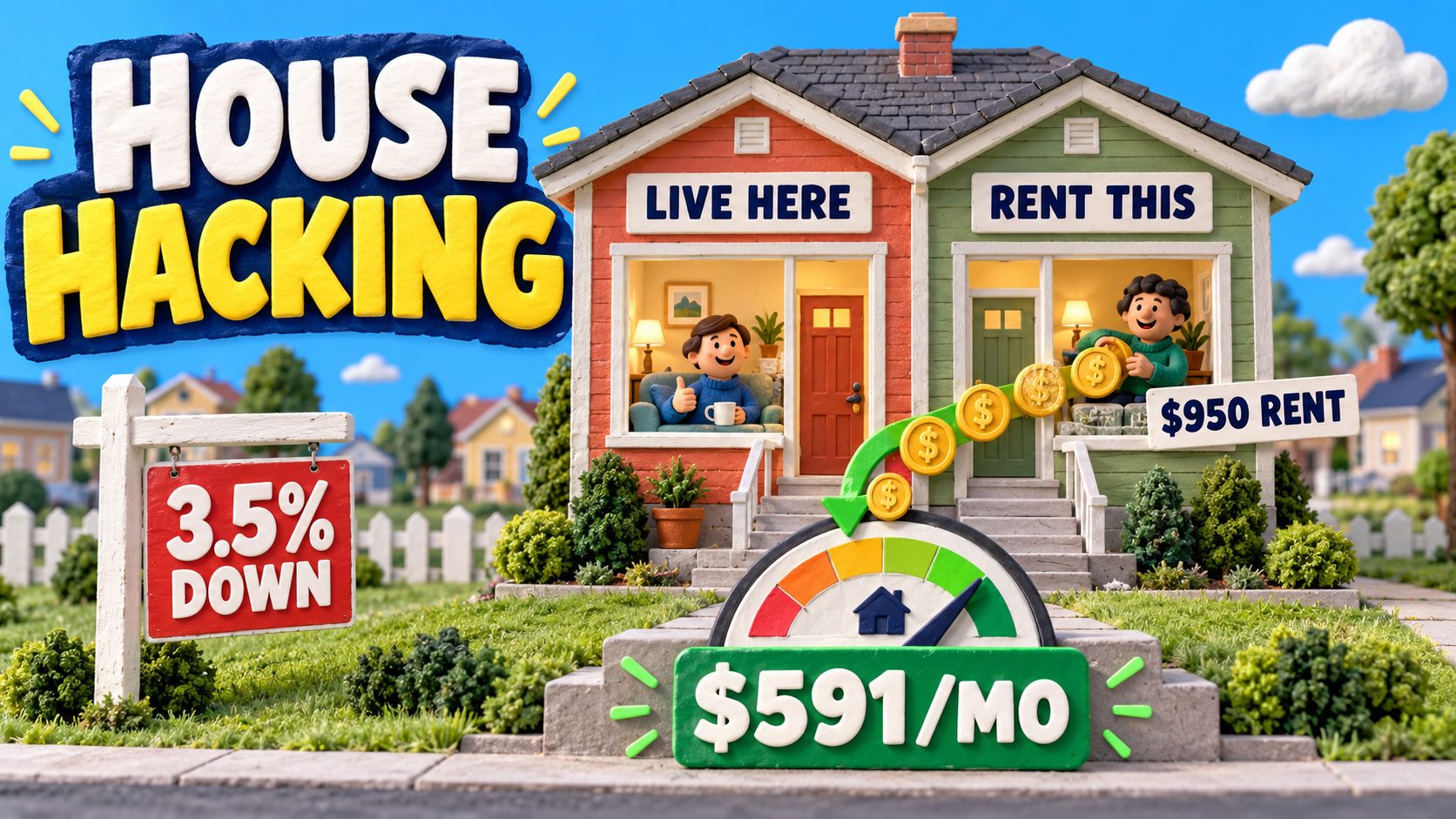
House hacking is the fastest path from renter to real estate investor — and you can start with as little as 3.5% down. The strategy is simple: buy a property, live in one unit (or one room), rent out the rest, and let tenant income cover your mortgage. The result: you live for free — or close to it — while building equity in an asset that appreciates. This guide covers how house hacking works in 2026, which property types work best, how to run the numbers, and the 5 mistakes that turn house hacks into money pits.
What Is House Hacking?
House hacking means buying a property with owner-occupied financing, living in part of it, and renting out the rest to offset your housing costs. The rental income reduces or eliminates your mortgage payment — and in many markets, it produces positive cash flow on top.
The concept is not new — people have rented out rooms and basement apartments for decades. What changed is the financing. Owner-occupied loans (FHA, VA, conventional) require 3.5–5% down vs. 20–25% for investment properties. This cuts your entry cost by 80% compared to buying a pure rental. Per HUD FHA loan guidelines, you must live in the property for at least 12 months to qualify.
After 12 months, you can move out, keep the property as a rental, and repeat the process with another house hack. This is how many investors build a portfolio of 3–5 properties in 5 years — each purchased with 3.5–5% down instead of 20–25%.
5 House Hacking Strategies That Work in 2026
1. Duplex, Triplex, or Fourplex (The Classic)
Buy a 2–4 unit property, live in one unit, rent the other 1–3. FHA loans allow up to 4 units with 3.5% down as long as you occupy one unit. This is the most profitable house hack because each additional unit generates income while your financing remains owner-occupied.
Example: Indianapolis duplex, $185,000. FHA 3.5% down = $6,475 + $5,500 closing costs = $11,975 total. Unit 1 (you live in it): $0 rent. Unit 2: $950/month. Monthly PITI: $1,320. Your effective housing cost: $1,320 − $950 = $370/month. Compare to renting a similar unit at $950/month — you save $580/month and build equity.
2. Rent by the Room
Buy a single-family home with 3–5 bedrooms. Live in the master. Rent each remaining bedroom for $500–$800/month. Total rental income often exceeds the mortgage. This works best near colleges, hospitals, and military bases where room rentals are in high demand.
Example: 4BR Cleveland home, $155,000. Mortgage: $1,050/month. Rent 3 rooms at $550/each = $1,650/month. Cash flow: +$600/month — you live for free AND pocket $600.
3. Basement or Accessory Dwelling Unit (ADU)
Buy a home with a finished basement or detached ADU (garage apartment, guest house). Live upstairs, rent the basement or ADU. Zoning must allow this — check local ordinances before purchasing. Many cities have relaxed ADU rules since 2020 to address housing shortages.
4. Short-Term Rental (STR) House Hack
Live in the main house and list a separate entrance unit (basement, ADU, guest suite) on Airbnb. STR rates are 2–3× long-term rents in tourist and business-travel markets. The downside: more management work, higher turnover costs, and HOA/city regulations may prohibit STRs.
Estimate your STR income in the Airbnb calculator.
5. Live-In Flip (House Hack + BRRRR)
Buy a fixer-upper with owner-occupied financing (FHA 203k or conventional renovation loan). Live in it while you renovate. After 12 months, refinance at the new (higher) appraised value, pull out your rehab costs, and either stay or move to the next one. This combines house hacking with the BRRRR strategy — you force equity through renovation while living rent-free (relative to renting elsewhere).
House Hacking Math: Worked Example — Indianapolis Duplex
Here is a full analysis of a house hack using real 2026 numbers.
PROPERTY:
  Indianapolis duplex, built 1985
  Purchase price: $185,000
  Condition: tenant-ready, no major rehab needed

FINANCING (FHA):
  Down payment (3.5%):        $6,475
  Closing costs (~3%):        $5,550
  Total cash needed:          $12,025
  Loan amount:                $178,525
  Interest rate:              6.75%
  Monthly PITI:               $1,320
  MIP (mortgage insurance):   included in PITI

INCOME:
  Unit 1 (you live here):     $0
  Unit 2 (tenant):            $950/month
  Gross rental income:        $950/month

EXPENSES:
  PITI:                       $1,320
  Vacancy (6%):               $57
  Repairs (8%):               $76
  CapEx (5%):                 $48
  Landlord insurance delta:   $40
  Total expenses:             $1,541

YOUR MONTHLY COST:
  Total expenses - Rental income = $1,541 - $950 = $591/month

COMPARISON:
  Renting similar unit:       $950/month
  House hacking:              $591/month
  Monthly savings:            $359/month = $4,308/year

EQUITY BUILD (YEAR 1):
  Principal paydown:          $2,840
  Appreciation (3%):          $5,550
  Total equity gained:        $8,390

EFFECTIVE RETURN:
  Cash saved: $4,308
  Equity gained: $8,390
  Total year 1 benefit: $12,698 on $12,025 invested
  Return: 105.6%
You live for $591/month instead of $950, save $4,308/year in housing costs, and gain $8,390 in equity — a 105.6% return on your $12,025 investment. No other real estate strategy lets you start with under $15K and generate six-figure returns in year one.
Run your own house hack numbers in the rental property calculator and check your monthly payment in the mortgage calculator.
House Hacking vs. Traditional Rental: Side-by-Side Comparison
| Factor | House Hacking (Duplex) | Traditional Rental (Duplex) |
|---|---|---|
| Down payment | 3.5% FHA ($6,475) | 20-25% ($37,000-$46,250) |
| Total cash to close | $12,025 | $42,550-$51,800 |
| Interest rate | 6.75% (owner-occupied) | 7.5-8.0% (investment) |
| Monthly PITI | $1,320 | $1,050 (more down = lower payment) |
| Rental income | $950 (1 unit) | $1,900 (both units) |
| Your housing cost | $591/month | $0 (you live elsewhere + pay rent) |
| Cash-on-cash return | 105.6% (including housing savings) | 3.2% (traditional CoC) |
| Occupancy requirement | 12 months minimum | None |
| Mortgage insurance | Yes (FHA MIP) | No (20%+ down) |
| Privacy | Tenant next door | Full privacy |
The trade-off is clear: house hacking requires 80% less cash and produces higher effective returns, but you sacrifice privacy by living next to your tenant for 12 months. For most investors under 40, this trade-off is overwhelmingly worth it.
Compare the numbers in the cash-on-cash calculator.
Financing Options for House Hacking
FHA Loan (3.5% Down)
The most common house hack loan. Minimum 580 credit score. Allows 1–4 unit properties. Downside: mortgage insurance premium (MIP) of 0.55% annually for the life of the loan. You can refinance into a conventional loan after 12 months to drop MIP if you have 20% equity.
VA Loan (0% Down)
For eligible veterans and active military. Zero down payment, no mortgage insurance, competitive rates. VA loans allow 1–4 unit owner-occupied properties. This is the most powerful house hack financing available — $0 down on a fourplex.
Conventional (5% Down)
Requires 620+ credit score. Private mortgage insurance (PMI) drops off at 20% equity (unlike FHA MIP). Slightly higher rates than FHA for low-down-payment borrowers, but no upfront funding fee.
FHA 203k (Renovation Loan)
Combines purchase and renovation into one loan. Buy a fixer-upper, include rehab costs in the mortgage. Live in it while renovating. Ideal for the live-in flip house hack strategy. Requires FHA-approved contractor and more paperwork.
Calculate your DSCR for any financing scenario in the DSCR calculator.
How to Find House Hack Properties
Not every property works as a house hack. Here is what to look for and where to find deals.
What to Look For
- 2–4 units in residential neighborhoods: FHA/VA/conventional all work. 5+ units = commercial financing (20%+ down)
- Separate entrances for each unit: Privacy matters for both you and tenants
- Unit sizes within 200 sqft of each other: If one unit is 1,200 sqft and the other is 500 sqft, the small unit limits your rental income or forces you into the bad unit
- Owner’s unit is the less desirable one: Live in the basement or the unit facing the street. Rent out the better unit for more money
- Low-crime, B/B+ neighborhoods: You are living here — safety matters more than with a pure rental
- Within 30 minutes of your job: The whole point is to reduce housing costs. A 90-minute commute defeats the purpose
Where to Find Deals
- MLS: Search for “multi-family” or “duplex” in your target ZIP codes. Filter for 2–4 units, price range you can FHA with 3.5% down
- Driving for dollars: Look for duplexes with one vacant unit, deferred maintenance, or tired landlords. These are often off-market and negotiable
- Wholesalers: Some wholesalers specialize in small multifamily. They find the deal, you close with FHA financing
- Local REIA meetings: Real Estate Investor Association meetings are the best place to find off-market 2–4 unit deals. Attend monthly
Best Cities for House Hacking in 2026
House hacking works best in markets where purchase prices are low enough for FHA financing AND rents are high enough to cover most of the mortgage. Here are the best and worst markets.
Best House Hacking Markets
| City | Median Duplex Price | Avg Rent (per unit) | FHA Down (3.5%) | Est. Monthly Cost After Rent |
|---|---|---|---|---|
| Indianapolis, IN | $185,000 | $950 | $6,475 | $370–$500 |
| Cleveland, OH | $145,000 | $825 | $5,075 | $200–$350 |
| Memphis, TN | $155,000 | $875 | $5,425 | $250–$400 |
| Fort Wayne, IN | $135,000 | $775 | $4,725 | $200–$350 |
| Kansas City, MO | $175,000 | $900 | $6,125 | $350–$500 |
| Birmingham, AL | $140,000 | $800 | $4,900 | $200–$350 |
In these markets, your out-of-pocket housing cost after rental income is $200–$500/month — less than renting a studio apartment. Cleveland and Fort Wayne are especially strong: low duplex prices ($135K–$145K) mean FHA down payments under $5,100.
Explore state-specific investment data: Ohio calculators, Indiana calculators, Tennessee calculators.
Worst Cities for House Hacking
Markets where purchase prices are too high for the rent-to-price ratio to work:
- San Francisco, CA: Median duplex $1.4M. FHA down: $49,000. Monthly PITI: $9,200. Rent per unit: $2,800. Your cost: $6,400/month. You are paying MORE than renting, not less
- New York City, NY: Median duplex $950K+ (outer boroughs). FHA limits cap at $1,149,825 for 2-unit. Even if you qualify, PITI exceeds $6,000/month against $2,200/unit rents
- Los Angeles, CA: Median duplex $800K+. Same problem — prices too high relative to rents. Rent-to-price ratio is 0.3% vs. the 0.6%+ needed for house hacking to work
- Seattle, WA: Median duplex $650K+. Rents strong ($1,800/unit) but not enough to offset $4,500+/month PITI
Rule of thumb: House hacking works when the rent-to-price ratio on each unit is at least 0.5%. Below that, the math does not close regardless of down payment. Check your market in the cap rate calculator.
House Hacking Exit Strategy: What Happens After 12 Months
The 12-month occupancy requirement is not a limitation — it is a launch pad. Here are four exit paths, each building on the house hack.
Exit 1: Move Out, Keep as Full Rental
The most common exit. After 12 months, move out and rent BOTH units. Your duplex now generates $1,900/month in rent (2 × $950) against $1,541 in total expenses = $359/month positive cash flow. You now own a cash-flowing rental that you bought with 3.5% down.
Check the full rental cash flow in the cash flow calculator.
Exit 2: Refinance into a Conventional Investment Loan
After 12+ months, refinance from FHA to conventional to drop the mortgage insurance premium (MIP). If the property has appreciated or you have built 20%+ equity through improvements and paydown, you eliminate MIP entirely — saving $100–$200/month. This also frees up your FHA loan for your next house hack (you can only have one FHA loan at a time).
Exit 3: BRRRR from Your House Hack
If you bought a fixer-upper with FHA 203k, your renovations may have forced $30K–$50K in equity. After 12 months, refinance at the new appraised value and pull out your rehab costs as cash. Use that cash as the down payment for your next house hack or investment property. This is the BRRRR strategy — and house hacking is the cheapest entry point into it.
Model the refinance in the BRRRR calculator.
Exit 4: Repeat — Buy Another House Hack
Move into a new property with owner-occupied financing. You now have two properties: one full rental (the first house hack) and one new house hack. Repeat every 12–18 months. Many investors build a portfolio of 4–5 properties in 5 years this way — each purchased with 3.5–5% down instead of 20–25%.
Portfolio example after 5 years:
Year 1: House hack duplex #1 ($185K, FHA 3.5% = $12K cash)
Year 2: Move out, rent both units. Buy duplex #2 ($195K, conventional 5% = $15K cash)
Year 3: Move out, rent both. Buy triplex #3 ($240K, FHA 3.5% = $14K cash)
Year 5: Move out, rent all.

Portfolio: 3 properties, 7 units, ~$620K total value
Total cash invested: ~$41K
Monthly cash flow (all rented): ~$1,200/month
Equity position: ~$95K (paydown + appreciation)
Annual return on $41K invested: 35%+
No other real estate strategy lets you control $620K in assets with $41K in cash.
Tax Considerations When Converting Primary to Rental
When you move out and convert your house hack to a full rental:
- Depreciation starts fully: Once 100% rental, you depreciate the entire building (previously only 50% for a duplex house hack). Depreciable basis = purchase price × building % × 100%. On a $185K duplex: $185K × 80% × 100% = $148K ÷ 27.5 = $5,382/year in depreciation deductions
- Section 121 exclusion timeline: If you lived there 2+ of the last 5 years and later sell, you can exclude up to $250K/$500K in capital gains from the primary-residence portion. This clock starts ticking when you move out — plan your sale within 3 years of moving to preserve the exclusion
- Passive activity rules apply: Rental income becomes passive. Losses up to $25K/year deductible against active income if AGI under $100K. See our rental property tax deductions guide
5 House Hacking Mistakes That Cost You Thousands
1. Not Running the Full Expense Stack
The #1 mistake: calculating “rent minus mortgage” and calling it cash flow. You must include vacancy (5–8%), repairs (8–10%), CapEx (5%), insurance, and property management (even if self-managing — your time has value). Run the full analysis in the rental property calculator before making an offer.
2. Ignoring the 12-Month Occupancy Rule
FHA and conventional owner-occupied loans require you to live in the property for 12 months. If you move out at month 6, the lender can call the loan — forcing immediate full repayment. Some investors have had their loans recalled. Do not risk it. Per 24 CFR 203.18, the borrower must certify intent to occupy.
3. Buying in a Bad Neighborhood to “Save Money”
House hacking means YOU live there. A C or D neighborhood might offer great cap rates on paper, but you will deal with higher crime, tenant quality issues, and property damage — all while living next door. Stick to B/B+ areas. The slightly lower returns are worth the quality of life. Check neighborhood-level vacancy rates in the vacancy rate calculator.
4. Not Screening Tenants Because “They’re Right Next Door”
Living next to your tenant makes screening MORE important, not less. A bad tenant in a pure rental is stressful. A bad tenant in the unit next to your bedroom is a nightmare. Run credit checks, verify employment, call previous landlords. No exceptions.
5. Forgetting About the Exit Strategy
After 12 months, you have three options: stay (keep house hacking), move out and rent both units (convert to full rental), or sell. The property must work as a rental if you plan to move out — calculate the cash flow with BOTH units rented and verify it covers all expenses. If the deal only works because you live there rent-free, it is not a house hack — it is a subsidized lifestyle.
House Hacking Tax Benefits
House hacking gives you investment property tax deductions on the rental portion — even though you live there.
- Depreciation: You can depreciate the rental portion of the property. On a duplex, that is 50% of the building value. $185K × 80% building × 50% rental = $74K depreciable basis = $2,691/year deduction. See our 15 rental property tax deductions guide
- Mortgage interest: The rental portion of mortgage interest is deductible on Schedule E
- Repairs on the rental unit: 100% deductible as an operating expense
- Property tax: The rental portion is deductible on Schedule E (not subject to the $10K SALT cap)
- Insurance: Rental portion deductible
Calculate your depreciation in the depreciation calculator and total tax impact in the cost segregation study guide.
Frequently Asked Questions
How much money do you need to start house hacking?
With an FHA loan, you need 3.5% down payment plus closing costs (2–3%). On a $185,000 duplex: $6,475 down + $5,550 closing = $12,025 total. With a VA loan (eligible veterans): $0 down + $3,700 closing = $3,700 total. This is 80% less cash than a traditional investment property purchase requiring 20–25% down ($37,000–$46,250).
Can you really live for free by house hacking?
How long do you have to live in a house hack property?
Is house hacking worth it in 2026 with high interest rates?
What is better: house hacking a duplex or renting rooms?
Related Calculators and Guides
- Rental Property Calculator — Full cash flow analysis for any property
- Mortgage Calculator — Monthly payment with PITI breakdown
- Cash-on-Cash Calculator — Return on your invested cash
- DSCR Calculator — Debt service coverage for loan qualification
- Cash Flow Calculator — Monthly cash flow after all expenses
- Vacancy Rate Calculator — ZIP-level vacancy data
- All 30+ Calculators
Related guides:
Leave a Reply