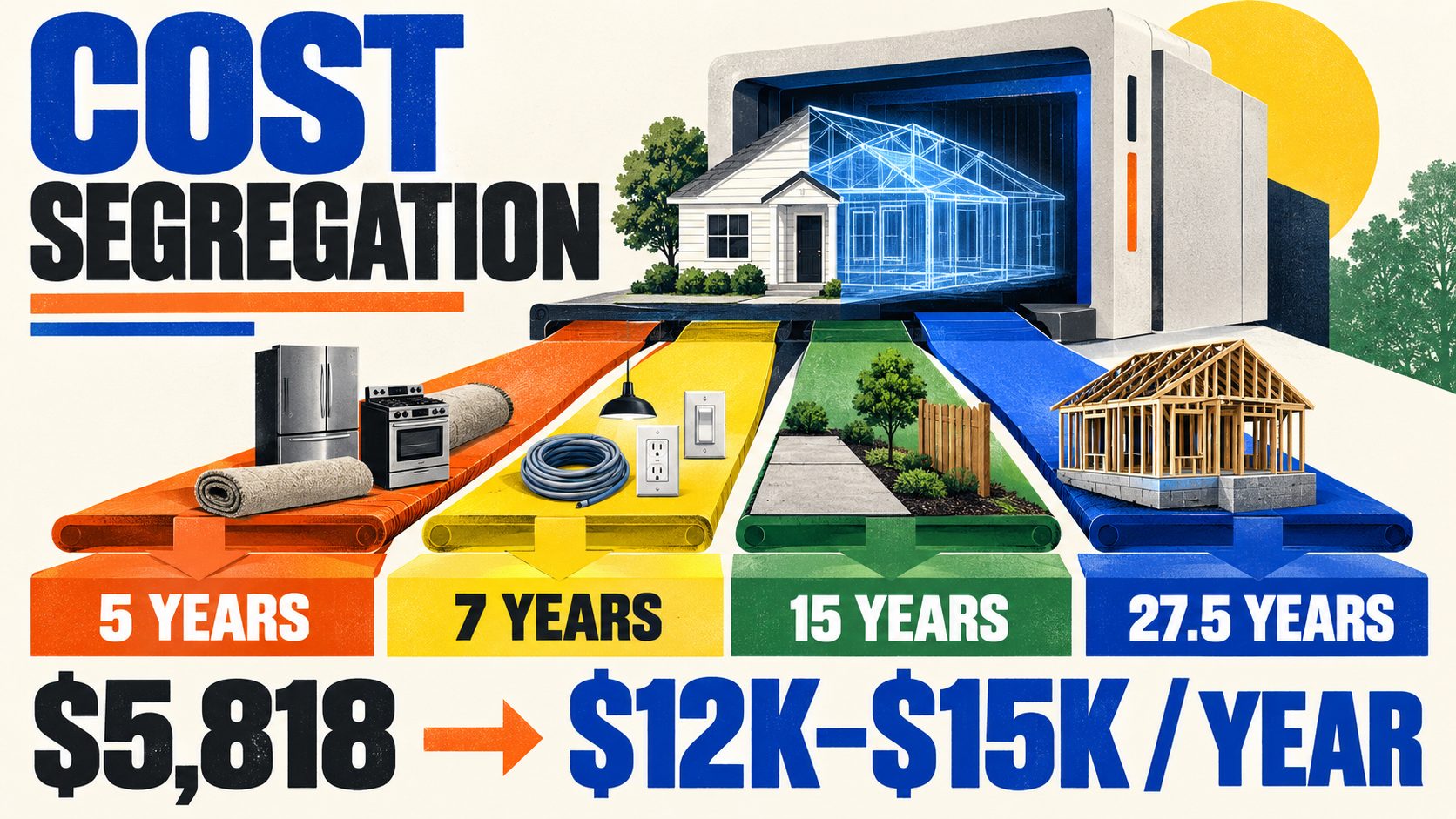
A cost segregation study can accelerate $40,000–$80,000 in depreciation deductions into the first 5 years of ownership — turning a $5,818/year write-off into $12,000–$15,000/year on a $200K rental property. But at $2,500–$7,500 per study, it is not free. This guide explains exactly how cost segregation works for rental properties, when it is worth the cost, and how to calculate whether your property qualifies — with worked examples and IRS rules you need to follow.
What Is a Cost Segregation Study for Rental Property?
A cost segregation study is an engineering-based analysis that reclassifies components of your rental property into shorter depreciation schedules. Instead of depreciating the entire building over 27.5 years (straight-line), a cost seg study identifies assets that qualify for 5-year, 7-year, or 15-year depreciation.
The IRS allows this because not every part of a building has a 27.5-year useful life. Carpet lasts 5–7 years. Appliances last 7–10 years. Landscaping and parking lots last 15 years. A cost segregation study documents which components fall into these shorter categories.
The result: you front-load depreciation deductions into the early years of ownership, significantly reducing your tax bill when you need the cash flow most — in the first 1–5 years.
How Standard Depreciation Works (Without Cost Segregation)
Under standard straight-line depreciation, a $200K rental property (80% building, 20% land) generates:
Depreciable basis: $200,000 × 80% = $160,000
Annual depreciation: $160,000 ÷ 27.5 = $5,818/year
Over 5 years: $5,818 × 5 = $29,091 total deductions
Every year is the same — $5,818. No acceleration. No front-loading. Calculate your standard depreciation in the depreciation calculator.
How Cost Segregation Changes the Math
A cost seg study on the same $200K property might reclassify 25–35% of the depreciable basis into shorter-lived assets:
Depreciable basis: $160,000

BEFORE cost seg (all 27.5-year):
 Year 1 depreciation: $5,818
 5-year total: $29,091

AFTER cost seg (30% reclassified):
 27.5-year property: $112,000 → $4,073/year
 5-year property: $32,000 → $6,400/year
 7-year property: $8,000 → $1,143/year
 15-year property: $8,000 → $533/year

 Year 1 depreciation: $12,149
 5-year total: $60,745

Additional deductions in first 5 years: $31,654
Tax savings at 24% bracket: $7,597
You deduct $60,745 in the first 5 years instead of $29,091 — more than double. The total depreciation over 27.5 years remains the same, but you receive the tax benefit sooner. This is the time value of money applied to tax deductions.
What Gets Reclassified in a Cost Segregation Study on Rental Property
A cost segregation study reclassifies building components into four IRS categories based on their useful life. Here is what falls into each category for a typical rental property.
5-Year Property (Section 1245)
- Carpet and vinyl flooring: $2,000–$5,000
- Appliances (refrigerator, range, dishwasher, washer/dryer): $3,000–$6,000
- Window treatments (blinds, curtains): $500–$1,500
- Decorative light fixtures: $500–$2,000
- Security systems and cameras: $500–$2,000
- Removable countertops and cabinetry: $2,000–$5,000
7-Year Property (Section 1245)
- Office furniture (if home office): $500–$2,000
- Certain fixtures and specialized equipment
- Communication wiring (cable, phone, data)
15-Year Property (Section 1250 — Land Improvement)
- Landscaping and grading: $2,000–$8,000
- Driveways and parking areas: $3,000–$10,000
- Sidewalks and patios: $1,000–$5,000
- Fencing: $1,000–$4,000
- Outdoor lighting: $500–$2,000
- Septic systems: $3,000–$8,000
- Retaining walls: $1,000–$5,000
27.5-Year Property (Section 1250 — Building)
- Foundation, framing, roof structure
- HVAC ductwork integrated into building
- Plumbing and electrical systems within walls
- Drywall, insulation, paint
- Permanent flooring (hardwood, tile)
- Windows, doors, built-in cabinetry
The key distinction: anything that can be removed without damaging the building structure is typically 5-year or 7-year property. Anything permanently integrated into the structure stays at 27.5 years.
Cost Segregation Study: Worked Example — $200K Cleveland SFR
Here is a real-world example of how a cost segregation study changes the tax picture on a typical rental property.
Property: Cleveland SFR, $200K purchase, $160K depreciable basis
Rent: $1,400/month ($16,800/year)
Tax bracket: 24%
Cost seg study cost: $3,500

COST SEG RECLASSIFICATION:
 Component Cost Basis Life Annual Depr.
 ───────────────────── ────────── ──── ────────────
 Carpet/vinyl $3,200 5yr $640
 Appliances $4,800 5yr $960
 Window treatments $1,200 5yr $240
 Light fixtures $1,600 5yr $320
 Cabinets (removable) $3,800 5yr $760
 Security system $800 5yr $160
 Landscaping $5,600 15yr $373
 Driveway/parking $6,400 15yr $427
 Fencing $2,400 15yr $160
 Patio/sidewalk $2,200 15yr $147
 ───────────────────── ────────── ────────────
 Reclassified total: $32,000 $4,187/year
 Remaining (27.5yr): $128,000 $4,655/year
 ───────────────────── ────────── ────────────
 TOTAL Year 1: $160,000 $8,842/year

COMPARISON:
 Without cost seg: $5,818/year depreciation
 With cost seg: $8,842/year depreciation
 Additional: $3,024/year × 24% = $726/year extra tax savings

OVER 5 YEARS:
 Without cost seg: $29,091 total depreciation
 With cost seg: $44,210 total depreciation
 Additional tax savings: ($44,210 - $29,091) × 24% = $3,629

 Cost seg study cost: $3,500
 Net benefit over 5 years: $3,629 - $3,500 = $129 (breakeven)
 Net benefit over 10 years: $7,258 - $3,500 = $3,758
Verdict on a $200K SFR: marginally worth it. The study pays for itself over 5 years but just barely. Cost segregation becomes significantly more valuable on properties above $300K or multifamily properties where the reclassifiable components are larger.
Cost Segregation Study: Quick Comparison Table
| Factor | Without Cost Segregation | With Cost Segregation Study |
|---|---|---|
| Depreciation schedule | 27.5 years (straight-line) | 5, 7, 15, and 27.5 years (accelerated) |
| Year 1 deduction ($200K SFR) | $5,818 | $8,842 – $12,149 |
| 5-year total deductions | $29,091 | $44,210 – $60,745 |
| Year 1 deduction ($450K duplex) | $13,091 | $27,880 |
| Study cost | $0 | $2,500 – $7,500 |
| Best for | Properties under $200K | Properties above $300K, multifamily, high tax bracket |
| Bonus depreciation (2026) | N/A | 20% of reclassified assets deducted Year 1 |
| Recapture impact at sale | Lower (less total depreciation) | Higher (more accelerated depreciation claimed) |
When a Cost Segregation Study Is Worth It for Rental Property
A cost segregation study for rental property is not always a good investment. The math depends on your property value, tax bracket, hold period, and the cost of the study itself.
Cost Segregation IS Worth It When:
- Property value is above $300K — the reclassifiable components scale with property value, but the study cost does not. A $500K property might reclassify $80K–$100K in components for the same $3,500–$5,000 study cost
- You are in the 32% or 37% tax bracket — every dollar of accelerated depreciation saves 32–37 cents instead of 22–24 cents. The same $15,000 in extra deductions saves $5,550 at 37% vs $3,600 at 24%
- You plan to hold for 7+ years — short holds do not allow enough time for the 5-year and 7-year assets to fully depreciate
- You have passive income to offset — or qualify for Real Estate Professional Status (REPS) so losses offset W-2 income
- It is a multifamily property — duplexes, triplexes, and apartment buildings have more appliances, carpet, fixtures, and land improvements per dollar of value
- Major renovation just completed — new components installed during rehab can be specifically identified and segregated
Cost Segregation Is NOT Worth It When:
- Property value is under $200K — the study cost ($2,500–$5,000) eats most or all of the tax benefit
- You are in the 10–12% tax bracket — accelerated deductions save very little at low tax rates
- You plan to sell within 3 years — accelerated depreciation triggers more depreciation recapture at sale (taxed at 25%), and you may not have enough years to benefit
- The property is land-heavy — if 40%+ of value is land (coastal, urban lots), the depreciable basis is small and the study yields less
- Your AGI is above $150K without REPS — passive loss limitations prevent you from using the extra deductions until you sell or generate passive income
Cost Segregation Study Worked Example #2 — $450K Rental Property Duplex
A cost segregation study for rental property shines on higher-value multifamily investments. Here is a duplex example that shows the ROI difference.
Property: Indianapolis duplex, $450K purchase, $360K depreciable basis
Rent: 2 units × $1,100/month = $26,400/year
Tax bracket: 32% (high W-2 earner with REPS status)
Cost seg study cost: $5,000

RECLASSIFICATION (35% of basis):
 5-year property: $72,000 → $14,400/year
 7-year property: $18,000 → $2,571/year
 15-year property: $36,000 → $2,400/year
 27.5-year: $234,000 → $8,509/year

 Total Year 1 depreciation: $27,880

WITHOUT COST SEG:
 $360,000 ÷ 27.5 = $13,091/year

ADDITIONAL YEAR 1 DEDUCTION: $27,880 - $13,091 = $14,789
TAX SAVINGS YEAR 1: $14,789 × 32% = $4,733

5-YEAR COMPARISON:
 Without cost seg: $65,455 total
 With cost seg: $139,400 total
 Additional deductions: $73,945
 Additional tax savings: $73,945 × 32% = $23,662

 Study cost: $5,000
 NET BENEFIT (5 years): $23,662 - $5,000 = $18,662
 ROI on the study: 373%
Verdict: The $5,000 study generates $18,662 in additional tax savings over 5 years — a 373% return. For high-bracket investors with REPS qualification, cost segregation on properties above $300K is almost always a clear winner.
Estimate your standard depreciation in the depreciation calculator and compare how cost segregation would change your numbers.
Bonus Depreciation and Cost Segregation Study Rules for Rental Property (2026)
The Tax Cuts and Jobs Act (TCJA) introduced 100% bonus depreciation for assets with a recovery period of 20 years or less. This means all 5-year, 7-year, and 15-year property identified in a cost seg study could be deducted in year 1 — not spread over their recovery period.
However, bonus depreciation has been phasing down:
2022: 100% bonus depreciation
2023: 80% bonus depreciation
2024: 60% bonus depreciation
2025: 40% bonus depreciation
2026: 20% bonus depreciation
2027: 0% (unless Congress extends)
In 2026, only 20% of the reclassified assets can be deducted immediately under bonus depreciation. The remaining 80% follows the standard 5, 7, or 15-year schedule. This reduces the first-year impact but does not eliminate the benefit of cost segregation — you still accelerate deductions from 27.5 years to 5–15 years.
Important: There is active discussion in Congress about extending or restoring higher bonus depreciation rates. Per the IRS TCJA depreciation rules, check current rates before commissioning a study. If bonus depreciation is restored to 100%, the first-year benefits of cost segregation increase dramatically.
How to Get a Cost Segregation Study for Your Rental Property
Types of Studies
There are three approaches to cost segregation, ranging in cost and accuracy:
- Full engineering-based study ($5,000–$15,000): A team physically inspects the property, measures components, and produces a detailed report. The gold standard for IRS defensibility. Required for properties above $1M or in high-audit-risk situations
- Desktop study ($2,500–$5,000): Uses property data, photos, and blueprints without a physical inspection. Acceptable for residential rental properties under $1M. Most cost-effective for individual landlords
- Software/automated study ($500–$2,000): Algorithm-based analysis using property characteristics. Faster and cheaper, but less detailed. Appropriate for simple residential properties (SFR, small multifamily). Newer providers like KBKG and Madison SPECS offer these at lower price points
What to Look for in a Provider
- Engineering credentials: The study should be performed or supervised by a licensed engineer or architect
- IRS audit support: The provider should guarantee they will defend the study if the IRS questions it
- Experience with residential rental: Many cost seg firms focus on commercial properties. Residential rental has different component ratios
- Flat fee, not contingency: Avoid providers who charge a percentage of the tax savings — this creates an incentive to over-classify. Per IRS Cost Segregation Audit Techniques Guide, the IRS specifically scrutinizes contingency-fee studies
Cost Segregation Study and Depreciation Recapture on Rental Property
A cost segregation study on a rental property has a trade-off: when you sell, all accelerated depreciation is subject to depreciation recapture at 25%.
If you accelerate $60,000 in depreciation over 5 years instead of claiming $29,000 under straight-line, you will owe recapture tax on the full $60,000 at sale — not just $29,000.
Scenario: Sell after 5 years

WITHOUT cost seg:
 Total depreciation claimed: $29,091
 Recapture tax (25%): $7,273

WITH cost seg:
 Total depreciation claimed: $44,210
 Recapture tax (25%): $11,053

 Additional recapture: $3,780
The net benefit is still positive: you saved $3,629 in taxes over 5 years (at 24%) by front-loading deductions, and pay $3,780 more in recapture (at 25%) — nearly a wash on a $200K property. But on higher-value properties in higher brackets, the spread is much more favorable because your ordinary income tax rate (32–37%) exceeds the 25% recapture rate.
Calculate your recapture exposure in the depreciation recapture calculator.
1031 Exchange: How to Avoid Recapture Entirely
If you use a 1031 exchange to defer capital gains at sale, you also defer the depreciation recapture — including the accelerated depreciation from cost segregation. This makes cost segregation even more powerful: you get the accelerated deductions during your hold period and defer the recapture tax indefinitely by exchanging into a replacement property.
Many sophisticated investors combine cost segregation with a 1031 exchange strategy: accelerate deductions on Property A, exchange into Property B, run a new cost seg study on Property B, and repeat. The depreciation recapture is deferred as long as you keep exchanging. Calculate the tax impact of a 1031 exchange in the 1031 exchange calculator.
Frequently Asked Questions
How much does a cost segregation study cost for a rental property?
A cost segregation study costs $500–$15,000 depending on the method and property size. Automated/software studies: $500–$2,000. Desktop studies: $2,500–$5,000. Full engineering-based studies: $5,000–$15,000. For most single-family rental properties ($200K–$500K), a desktop study at $2,500–$5,000 is the most cost-effective option. The study typically pays for itself in 1–3 years through additional tax savings.
Is a cost segregation study worth it on a $200K rental property?
Can I do a cost segregation study on a property I already own?
What is the difference between cost segregation and bonus depreciation?
Does cost segregation increase depreciation recapture when I sell?
Related Calculators and Guides
- Depreciation Calculator — Calculate standard 27.5-year depreciation
- Depreciation Recapture Calculator — Estimate recapture tax at sale
- Capital Gains Tax Calculator — Total tax on property sale
- ROI Calculator — Total return including tax benefits
- All 30+ Calculators
Related guides:
Leave a Reply