Last updated: September 24, 2026 · Originally published: August 27, 2026 · By Alex Petrov
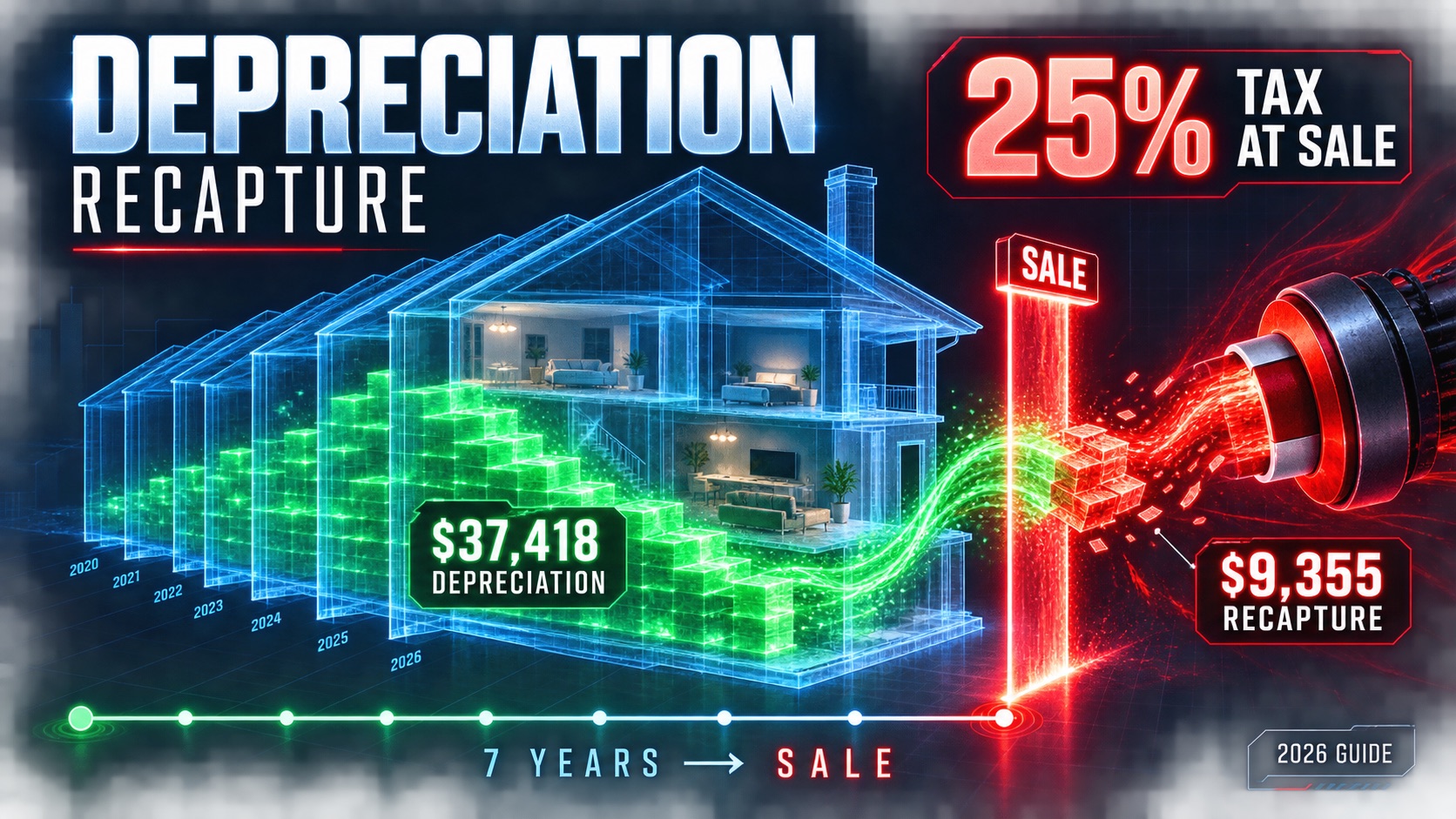
The depreciation recapture calculator estimates how much tax you owe when selling investment property — specifically the 25% recapture tax on depreciation you claimed during ownership. On a $200K rental held for 7 years, you took ~$37,400 in depreciation deductions. When you sell, the IRS taxes that amount at 25% ($9,355) on top of your capital gains tax. Most investors are shocked by this bill because they never modeled it before selling. Here is how to use the depreciation recapture calculator to estimate your total tax liability before you list — with two worked examples (Cleveland SFR and Indianapolis duplex) and three strategies to reduce or defer the tax.
What Is Depreciation Recapture?
Every year you own a rental property, the IRS lets you deduct a portion of the building’s value as depreciation — reducing your taxable rental income. Residential properties depreciate over 27.5 years using the straight-line method. On a $200K property with 20% land value, you deduct $5,818/year ($160K building ÷ 27.5).
The catch: when you sell, the IRS “recaptures” that depreciation. All the deductions you took (or could have taken, even if you didn’t claim them) are taxed at a maximum rate of 25% under Section 1250 of the Internal Revenue Code. This is separate from and in addition to capital gains tax on your profit.
The depreciation recapture calculator splits your gain into two parts automatically: the recapture portion (taxed at 25%) and the remaining capital gain (taxed at 0%, 15%, or 20% depending on your income). Without this split, you cannot accurately estimate what you will owe at closing.
How to Use the Depreciation Recapture Calculator
Step 1: Enter Purchase Price and Land Value
Enter the original purchase price of the property. Then enter the land value percentage — this is critical because land is not depreciable. Only the building portion generates depreciation and therefore recapture.
Typical land value ranges: 20–30% in suburban areas, 10–15% in rural areas, 40–60% in urban cores where land is expensive. Check your property tax assessment — most counties break out land vs improvement values. If you are unsure, use 20% as a conservative estimate.
The depreciation recapture calculator shows your depreciable basis immediately: Purchase Price − Land Value + Capital Improvements. Per IRS Topic 703, your basis includes the purchase price plus certain settlement costs and improvements.
Step 2: Enter Years Held
Enter the number of complete years you owned the property. The calculator computes annual depreciation (depreciable basis ÷ 27.5) and multiplies by years held to get total depreciation taken. This is the amount subject to 25% recapture.
More years = more depreciation = higher recapture tax but lower adjusted basis. After 27.5 years, depreciation is fully exhausted — selling at that point means maximum recapture. Use the sensitivity table in the calculator to see how holding 1–2 more years changes your tax picture.
Step 3: Enter Capital Improvements
Capital improvements are permanent additions that increase the property’s value: new roof, HVAC system, kitchen remodel, added square footage. Do NOT include routine maintenance (painting, fixing leaks, replacing appliances). Improvements increase both your depreciable basis and adjusted basis — they reduce your taxable gain but increase annual depreciation and eventual recapture.
Step 4: Enter Sale Price and Selling Costs
Enter your expected sale price and total selling costs (agent commission 5–6%, title insurance, transfer taxes, attorney fees). The calculator subtracts selling costs from the sale price to determine your net sale proceeds, then calculates total gain as Net Sale Price − Adjusted Basis.
Estimate selling costs in the closing costs calculator. Typical seller closing costs run 8–10% of sale price. For a $250K sale, expect $20,000–$25,000 in total closing costs including agent commission ($12,500–$15,000 at 5–6%), title insurance ($1,000–$2,000), transfer taxes (varies by state), and attorney fees. Every dollar of selling costs reduces your taxable gain and therefore your recapture tax.
Step 5: Enter Tax Rates
Three tax rates determine your total bill:
- Federal Capital Gains Rate — 0%, 15%, or 20% depending on your taxable income. Most investors fall in the 15% bracket ($47,026–$518,900 for single filers in 2026). The recapture portion is always taxed at 25% regardless of this setting.
- State Tax Rate — your state income tax rate on capital gains. Texas and Florida = 0%. California up to 13.3%. Ohio 2.75%. Enter your applicable rate.
- NIIT Rate — Net Investment Income Tax. Enter 3.8% if your modified adjusted gross income exceeds $200K (single) or $250K (married). Enter 0 if below threshold.
Step 6: Read the Results
The depreciation recapture calculator shows:
- Total Estimated Tax — sum of recapture tax + capital gains tax + state tax + NIIT
- Net Proceeds — what you keep after all taxes and selling costs
- Tax Breakdown — each component with percentage and dollar amount
- Effective Tax Rate — total tax ÷ total gain. Below 20% is good, 20–30% is average, above 30% is high
- Recapture as % of Total Tax — shows how much of your tax bill comes from recapture vs capital gains
- Sensitivity Table — tax at ±2 years of holding period
- Deal Context — actionable recommendation based on your numbers
Worked Example: Cleveland Rental, 7 Years
Scenario: You bought a Cleveland SFR for $180K (25% land), spent $12K on a new roof and HVAC, held for 7 years, and are selling for $250K with $15K in selling costs. You are in the 15% federal CG bracket, Ohio 2.75% state tax, and above the NIIT threshold (3.8%).
Depreciable Basis: $180,000 − $45,000 (land) + $12,000 (improvements) = $147,000
Annual Depreciation: $147,000 ÷ 27.5 = $5,345/year
Total Depreciation (7 years): $5,345 × 7 = $37,418
Adjusted Basis: $180,000 + $12,000 − $37,418 = $154,582

Net Sale Price: $250,000 − $15,000 = $235,000
Total Gain: $235,000 − $154,582 = $80,418

Tax Breakdown:
 Depreciation Recapture: $37,418 × 25% = $9,355
 Federal Capital Gains: $43,000 × 15% = $6,450
 State Tax (Ohio): $80,418 × 2.75% = $2,212
 NIIT: $80,418 × 3.8% = $3,056

Total Tax: $21,073
Net Proceeds: $213,927
Effective Tax Rate: 26.2%
Key insight: Depreciation recapture ($9,355) makes up 44% of your total tax bill. Without modeling this, you would estimate only $11,718 in taxes (capital gains + state + NIIT) — underestimating by $9,355. That is a $9,355 surprise at closing.
Run this exact scenario in the depreciation recapture calculator. Compare total returns including this tax hit in the ROI calculator.
Worked Example: Indianapolis Duplex, 12 Years
Scenario: Indianapolis duplex, $220K purchase (20% land), $25K improvements, held 12 years, selling for $340K, $20K selling costs. 15% federal CG, Indiana 3.05% state, NIIT 3.8%.
Depreciable Basis: $220,000 − $44,000 + $25,000 = $201,000
Annual Depreciation: $201,000 ÷ 27.5 = $7,309/year
Total Depreciation (12 years): $7,309 × 12 = $87,709
Adjusted Basis: $220,000 + $25,000 − $87,709 = $157,291

Total Gain: ($340,000 − $20,000) − $157,291 = $162,709

Tax Breakdown:
 Depreciation Recapture: $87,709 × 25% = $21,927
 Federal Capital Gains: $75,000 × 15% = $11,250
 State Tax (Indiana): $162,709 × 3.05% = $4,963
 NIIT: $162,709 × 3.8% = $6,183

Total Tax: $44,323
Effective Rate: 27.2%
$44,323 in taxes on a 12-year hold. Recapture alone is $21,927 — nearly half the total bill. This is why long-term holders with significant depreciation often use a 1031 exchange to defer both capital gains and recapture tax into a replacement property. See the 1031 exchange guide.
3 Ways to Reduce or Defer Depreciation Recapture
1. Use a 1031 Like-Kind Exchange
A 1031 exchange defers both capital gains AND depreciation recapture tax when you reinvest sale proceeds into another qualifying investment property. You must identify a replacement property within 45 days and close within 180 days. The deferred recapture transfers to the new property — you do not eliminate it, but you defer it indefinitely. Many investors use serial 1031 exchanges for decades and never pay recapture. Calculate deferral in the 1031 exchange calculator. See 1031 timeline guide for deadlines.
2. Hold Until Death (Stepped-Up Basis)
When an investor dies, heirs receive the property at its fair market value (stepped-up basis). All accumulated depreciation and unrealized gains are permanently eliminated — no recapture tax, no capital gains tax. This is the most effective tax strategy for investors who plan to hold properties long-term. Per IRS Publication 551, the heir’s basis becomes the fair market value at date of death.
3. Offset With Capital Losses
If you have capital losses from other investments (stocks, failed flips, other properties), those losses can offset your depreciation recapture gain dollar for dollar. A $30,000 stock loss offsets $30,000 of recapture, saving $7,500 in recapture tax. Time your sales strategically — sell losers in the same tax year you sell a property with large recapture. Track gains and losses in the capital gains tax calculator.
5 Mistakes When Estimating Depreciation Recapture
1. Thinking You Can Avoid Recapture by Not Claiming Depreciation
The IRS taxes depreciation “allowed or allowable.” If you could have claimed depreciation but chose not to, you still owe recapture tax on the amount you should have claimed. There is no benefit to skipping depreciation deductions — you lose the annual tax benefit AND still pay recapture at sale.
2. Forgetting Capital Improvements Add to Depreciable Basis
A $15,000 new roof adds to your depreciable basis. If you held the property for 10 more years after the roof, that is $15,000 ÷ 27.5 × 10 = $5,455 in additional depreciation — and $5,455 more in recapture. But it also increases your adjusted basis, reducing your capital gains portion. Always include improvements in the calculator.
3. Using Wrong Land Value Percentage
Land value directly determines depreciable basis. Using 10% land value instead of 30% increases your depreciation by 29% — and your recapture by the same amount. Use your property tax assessment or a qualified appraisal to determine the accurate land-to-improvement ratio.
4. Ignoring State Tax on Recapture
Most states tax depreciation recapture as ordinary income or capital gains. California taxes recapture at up to 13.3%. Ohio at 2.75%. Texas and Florida at 0%. Forgetting state tax on a $40,000 recapture in Georgia (4.99%) costs you an unexpected $1,996 at closing.
5. Not Modeling the 1031 Exchange Alternative
Before paying $20,000+ in recapture tax, model whether a 1031 exchange makes sense. Exchange costs run $2,000–$5,000, but they defer the entire $20,000+ tax bill. If you plan to remain in real estate, the exchange almost always wins financially. Compare in the 1031 exchange calculator.
Frequently Asked Questions
What is the depreciation recapture tax rate?
The maximum federal depreciation recapture tax rate on real estate is 25% under Section 1250. This applies to the portion of your gain attributable to depreciation taken during ownership. The remaining gain above the depreciation amount is taxed at your long-term capital gains rate (0%, 15%, or 20%). If your ordinary income tax rate is below 25%, recapture is taxed at your ordinary rate instead. State taxes and NIIT (3.8%) may apply on top. Use the depreciation recapture calculator to model your exact liability.
Can I avoid depreciation recapture when selling rental property?
How do I calculate depreciation on rental property?
Does depreciation recapture apply to a 1031 exchange?
What happens if I sell rental property at a loss?
Related Calculators and Guides
- Depreciation Recapture Calculator — Estimate Section 1250 tax at sale
- Depreciation Calculator — Annual depreciation deduction
- Capital Gains Tax Calculator — Full tax on investment property sale
- 1031 Exchange Calculator — Tax deferral modeling
- ROI Calculator — Total return including tax impact
- Closing Costs Calculator — Seller closing costs estimate
- Fix and Flip Calculator — Flip profit after costs
- All 30+ Calculators
Blog guides:
Leave a Reply