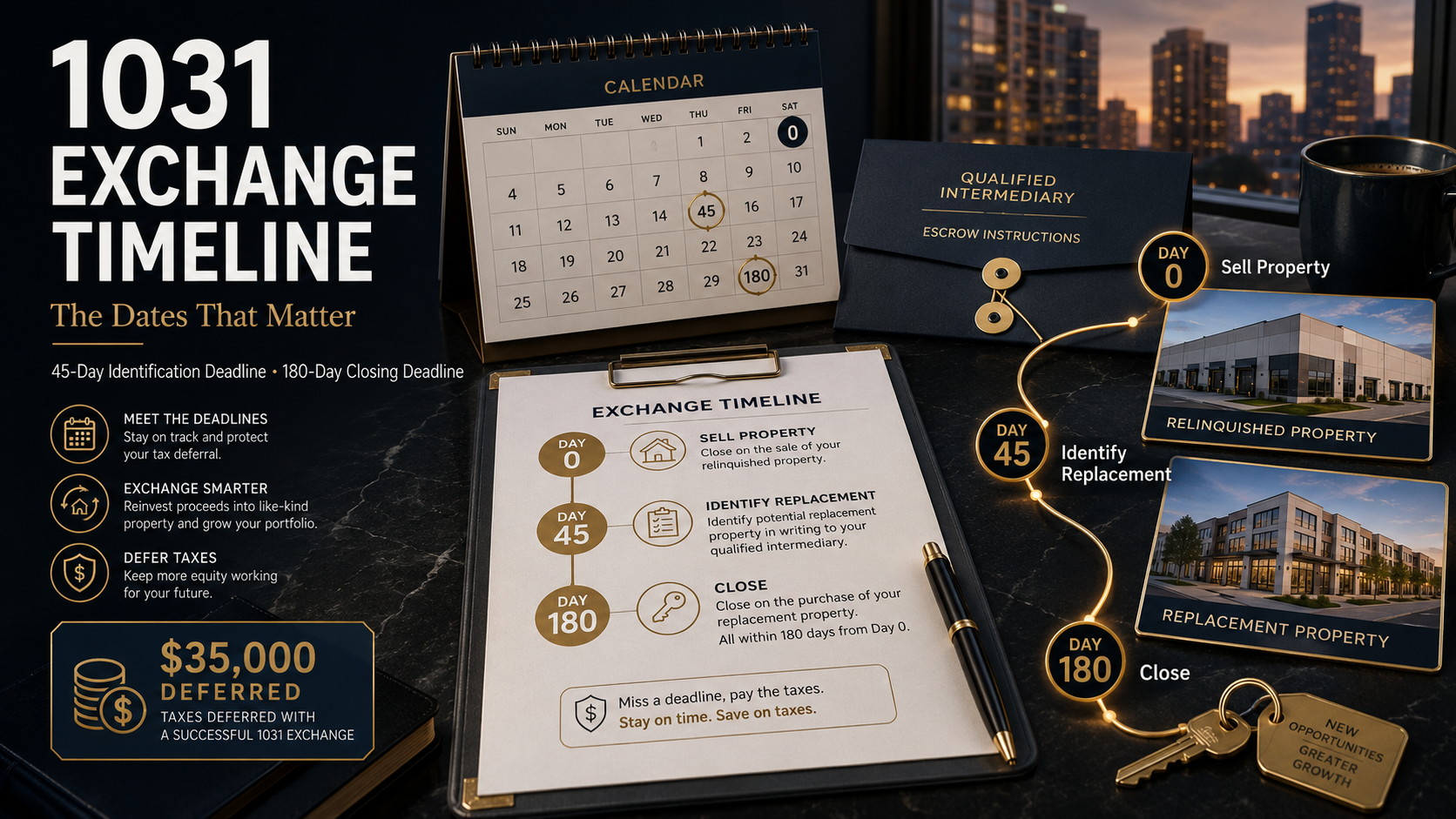
1031 Exchange Timeline: The Dates That Matter
The 1031 exchange timeline has two deadlines that cannot be extended, negotiated, or forgiven. Miss either one and you owe capital gains tax on the entire sale. No exceptions, no grace period, no “I didn’t know.”
This guide covers every critical date in the 1031 exchange timeline, what happens at each stage, and how to avoid the mistakes that trigger a taxable event. Use the free 1031 Exchange Calculator to model your tax deferral, and read the complete 1031 exchange guide for rules and requirements.
The Two Deadlines You Cannot Miss
| Deadline | Days After Sale | What Must Happen | Can It Be Extended? |
|---|---|---|---|
| Identification Period | 45 days | Identify up to 3 replacement properties in writing | No — not even by 1 day |
| Exchange Period | 180 days | Close on the replacement property | No — not even by 1 day |
Both deadlines in the 1031 exchange timeline are calendar days, not business days. Weekends and holidays count. If day 45 falls on a Sunday, the identification is due Sunday — not Monday.
According to IRS Publication 544, these deadlines are statutory and the IRS has no authority to grant extensions except in cases of federally declared disasters.
Complete 1031 Exchange Timeline: Day by Day
Here is every step from listing to closing, with the dates that matter:
Before Day 0: Preparation
Hire a Qualified Intermediary (QI) before listing. The QI must be in place before you close the sale. They hold the proceeds — if you touch the money, the exchange fails. QI fees run $750 to $1,500 for a standard exchange.
Do not sign a purchase agreement on the replacement property yet. You can research and tour properties, but do not enter into a binding contract before selling. The exchange starts when the relinquished property closes.
Day 0: Sale of Relinquished Property Closes
The 1031 exchange timeline clock starts when title transfers on the property you are selling. The QI receives the proceeds directly — they never pass through your hands or bank account.
Key point: If your closing is delayed by a week, your 45-day and 180-day clocks shift by a week. The deadlines are tied to the actual closing date, not the listing date or contract date.
Day 1–45: Identification Period
You have 45 calendar days to identify replacement properties in writing to your QI. This is the most stressful phase of the 1031 exchange timeline for most exchangers because the timeline is tight and the consequences of failure are severe.
Three identification rules (choose one):
| Rule | What It Allows | Best For |
|---|---|---|
| 3-Property Rule | Identify up to 3 properties of any value | Most exchangers — simple and safe |
| 200% Rule | Identify any number, total value cannot exceed 200% of sold property | Exchangers considering many small properties |
| 95% Rule | Identify any number of any value, but must close on 95% of total identified value | Almost never used — too risky |
Most investors use the 3-Property Rule. Identify your top choice plus two backups. If your first choice falls through, you have alternatives without restarting the process.
The identification must be in writing — signed, dated, and delivered to your QI by 11:59 PM on day 45. An email to your QI counts. A verbal mention to your agent does not.
Day 45–180: Acquisition Period
After identifying properties, you have until day 180 to close on one (or more) of the identified replacements. You cannot buy a property that was not on your identification list.
Common timeline within this phase:
| Task | Typical Timeline |
|---|---|
| Enter contract on replacement property | Day 30–60 |
| Inspection and due diligence | Day 45–90 |
| Loan underwriting (if financing) | Day 60–150 |
| Appraisal | Day 90–140 |
| Close on replacement property | Day 120–180 |
Most investors completing a 1031 exchange timeline close between day 120 and day 170. Waiting until day 178 is risky — one title issue or lender delay and you blow the deadline.
Day 180: Exchange Complete
The QI transfers the held proceeds to the closing agent for the replacement property purchase. If everything closes on time, the capital gains tax is deferred. You owe nothing to the IRS on the sale — until you eventually sell the replacement property without doing another exchange.
Worked Example: Austin to Memphis Exchange
Sarah sells a duplex in Austin for $420,000. Original purchase price: $280,000. Capital gains: $140,000. At a combined 25% federal + state rate, she would owe $35,000 in taxes without a 1031 exchange.
| Date | Day | Event |
|---|---|---|
| March 15 | Day 0 | Austin duplex closes. QI receives $420,000. |
| March 20 | Day 5 | Sarah begins touring properties in Memphis. |
| April 15 | Day 31 | Makes offer on a Memphis fourplex ($380,000). |
| April 29 | Day 45 | Submits written identification: Memphis fourplex + 2 backup properties. |
| May 10 | Day 56 | Inspection complete. Negotiates $8,000 repair credit. |
| June 20 | Day 97 | DSCR loan approved. Appraisal at $395,000. |
| July 25 | Day 132 | Closes on Memphis fourplex. QI transfers funds. |
| — | — | $35,000 in capital gains tax deferred. |
Sarah closed on day 132 — 48 days before the 180-day deadline. She used a DSCR loan (no income verification needed) and the DSCR Calculator confirmed the fourplex at 1.35 DSCR. Tax saved: $35,000. Use the 1031 Exchange Calculator to estimate your tax deferral.
What Triggers a Failed Exchange
Missing the 45-day identification deadline. Even by one day. There is no appeals process. If you do not deliver a signed identification letter to your QI by day 45, the exchange fails and the QI sends you the proceeds as taxable income.
Touching the money. If sale proceeds pass through your bank account at any point — even briefly — the exchange is disqualified. The QI must hold and transfer all funds.
Buying a property not on your identification list. You found a better deal on day 90? Too bad — if it was not identified by day 45, it does not qualify.
Using a disqualified intermediary. Your attorney, CPA, real estate agent, or anyone who has acted as your agent in the past 2 years cannot serve as QI. Use an independent, Federation of Exchange Accommodators member.
Receiving “boot.” If the replacement property costs less than the sold property, the difference (“boot”) is taxable. To defer 100% of gains, the replacement must be equal or greater in value. Use the Capital Gains Tax Calculator to model partial vs full deferral.
How to Build a Buffer Into Your Timeline
To protect your 1031 exchange timeline, experienced exchangers follow these rules to avoid deadline disasters:
- Start property shopping before listing. Know your target market, price range, and property type before day 0. You do not have time to “figure it out” during the 45-day window.
- Identify 3 properties by day 30. Give yourself a 15-day buffer. Markets move fast and you may need to pivot.
- Target closing by day 150. A 30-day buffer protects against lender delays, title issues, and inspection surprises.
- Use a DSCR loan for faster closing. Conventional loans require income documentation and take 45-60 days. DSCR loans close in 21-35 days because they qualify the property, not you. See the DSCR Loans Guide.
- Have backup financing ready. If your primary lender falls through on day 160, a backup hard money lender can close in 7-10 days — expensive, but cheaper than $35,000 in taxes.
1031 Exchange Costs
| Cost | Typical Range | Notes |
|---|---|---|
| Qualified Intermediary fee | $750–$1,500 | Required — non-negotiable |
| Legal review | $500–$2,000 | Recommended for complex exchanges |
| Closing costs (buy side) | 2%–4% of purchase | Standard buyer costs |
| Inspection + appraisal | $500–$1,000 | Standard |
| Total exchange costs | $2,000–$5,000 | Still far less than capital gains tax |
On Sarah’s $140,000 gain, the exchange cost $3,200 total. The alternative was $35,000 in taxes. The exchange saved $31,800. Use the Closing Costs Calculator to estimate buy-side costs on your replacement property.
Disclaimer
This article is for educational purposes only and does not constitute tax, legal, or financial advice. 1031 exchange rules are complex and vary by situation. The IRS may update regulations at any time. Consult a qualified tax advisor, real estate attorney, and qualified intermediary before attempting a 1031 exchange. ArvCalc is not a tax advisor, attorney, or qualified intermediary.
The 45-day rule in the 1031 exchange timeline requires you to identify replacement properties in writing within 45 calendar days of selling your relinquished property. The identification must be signed, dated, and delivered to your qualified intermediary. Missing this deadline by even one day disqualifies the exchange and triggers capital gains tax on the entire sale.
The 180-day rule in the 1031 exchange timeline requires you to close on a replacement property within 180 calendar days of selling your relinquished property. The replacement must be one of the properties identified during the 45-day identification period. Both the 45-day and 180-day deadlines run concurrently from the sale closing date.
No. The 1031 exchange timeline deadlines (45-day and 180-day) cannot be extended under normal circumstances. The IRS has granted extensions only for federally declared disasters affecting specific geographic areas. Weekends, holidays, personal emergencies, lender delays, and market conditions do not qualify for extensions.
Under the 3-Property Rule (most common), you can identify up to 3 replacement properties of any value. Under the 200% Rule, you can identify any number of properties as long as their total value does not exceed 200% of the sold property’s value. The 95% Rule allows unlimited identifications but requires closing on at least 95% of total identified value.
If you miss either the 45-day identification deadline or the 180-day exchange deadline, the exchange fails completely. The qualified intermediary releases the sale proceeds to you as taxable income. You owe capital gains tax on the full gain from the sale, plus any applicable state taxes and the 3.8% Net Investment Income Tax if your income exceeds the threshold.
A standard 1031 exchange costs $2,000 to $5,000 total, including the qualified intermediary fee ($750 to $1,500), legal review ($500 to $2,000), and standard closing costs on the replacement property (2% to 4%). These costs are almost always far less than the capital gains tax you defer. On a $140,000 gain at 25% combined rate, the exchange saves approximately $30,000 net after fees.
Yes. DSCR loans are popular for 1031 exchange replacement properties because they close faster (21 to 35 days vs 45 to 60 for conventional) and qualify based on property income rather than personal tax returns. This is especially helpful when the 180-day deadline is approaching and speed matters. Most DSCR lenders are familiar with 1031 exchange transactions.
Leave a Reply