Last updated: October 3, 2026 · Originally published: June 12, 2026 · By Alex Petrov
I screen between 15 and 20 deals every week. Most of them die at step three. A few survive to step eight. Maybe one a month makes it through all twelve steps and gets an offer letter.
After running this process on over 200 properties across Cleveland, Memphis, Indianapolis, and Birmingham, I can tell you that the speed of your screening matters almost as much as the accuracy. The investors who win in 2026 are not the ones spending four hours modeling every listing on the MLS. They are the ones who kill bad deals fast and spend their time on the 5% worth pursuing.
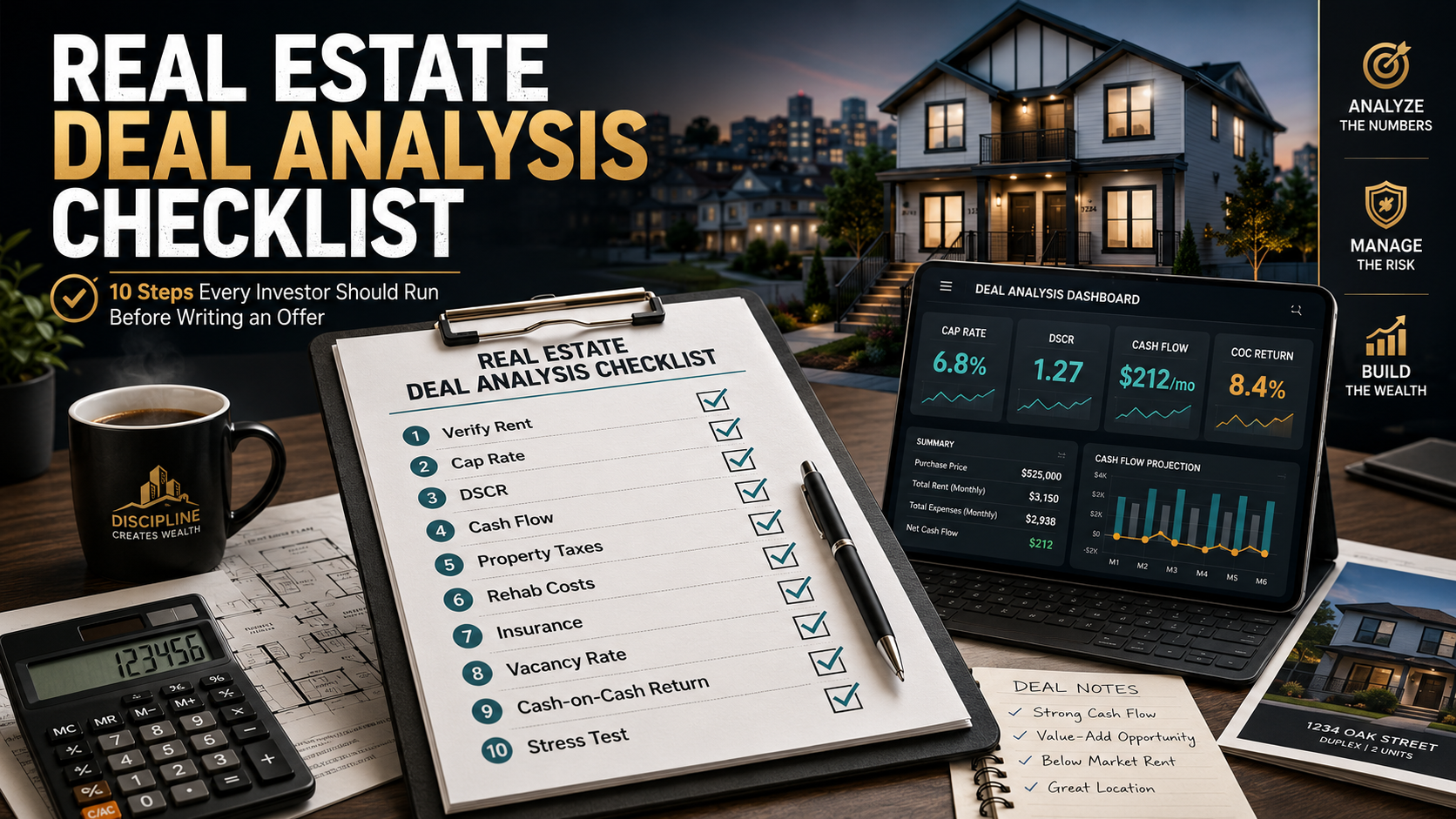
This property deal analysis checklist is the exact 12-step sequence I use. Each step has a clear pass/fail threshold. If a deal fails any step, I stop and move to the next property. No emotional attachment, no “let me tweak the numbers to make it work.”
Grab a pen, pull up a listing you are considering, and follow along. I will walk a real Cleveland duplex through every step so you see exactly how the math works.
Why You Need a Standardized Property Deal Analysis Checklist
Most beginner investors evaluate deals by gut feeling. They see a low price, assume the rent looks decent, and start imagining passive income. Then six months later they are covering a $400/month cash-flow deficit out of pocket because they skipped the vacancy math or forgot about capital expenditure reserves.
A written checklist fixes three problems at once:
Speed. You stop wasting afternoons on properties that fail basic math. My target is under 30 minutes per deal for the first pass. If a property cannot survive 30 minutes of scrutiny, it will not survive 30 years of ownership.
Consistency. Your Thursday-night analysis uses the same standards as your Saturday-morning analysis. No “I was tired and forgot to check insurance quotes” situations.
Documentation. When a partner, lender, or spouse asks “why this property?” you hand them the completed checklist. Every number is sourced. Every assumption is written down.
The 12 steps below move from simple (verify seller numbers) to complex (stress testing). This order is intentional. The early steps filter out 80% of deals with almost zero effort, saving the heavy analysis for the small number of properties that actually deserve it.
The 12-Step Property Deal Analysis Checklist
Step 1: Verify the Seller’s Numbers
Before you do any math yourself, check whether the seller or listing agent is lying to you. I do not mean they are committing fraud (though that happens). I mean they are cherry-picking the best month of rental income, ignoring a unit that has been vacant for six months, or quoting gross rent without mentioning the $200/month water bill they cover.
Request the trailing 12 months of actual bank deposits or rent rolls. Not pro forma. Not “projected.” Actual collected rent, month by month. If the seller will not provide T-12 data, that tells you something.
Cross-reference the stated rent against market comps. Pull three to five comparable rentals within a half-mile on Zillow, Rentometer, or your local MLS. If the seller claims $1,200/unit but comps show $950, you are dealing with inflated numbers.
Check the property tax amount on the county assessor website. Sellers often quote last year’s taxes, but a sale can trigger a reassessment that jumps taxes 20-40% in states like Ohio or Indiana.
Pass/fail: Verified income within 5% of stated. Tax data confirmed. If numbers are off by more than 10%, rework every calculation below using your verified figures, not the seller’s.
Step 2: Calculate Cap Rate
Cap rate gives you a quick snapshot of the property’s return before financing. It strips out your mortgage terms and tells you: if I paid all cash, what annual return would this property generate?
The formula: Cap Rate = Net Operating Income / Purchase Price
At this stage, you are using a rough NOI (gross rent minus taxes, insurance, and a management fee estimate). You will refine it in later steps. The goal here is a quick filter.
For 2026, here are the cap rate ranges I am seeing across my target markets:
| Market | Class B Cap Rate | Class C Cap Rate | My Minimum |
|---|---|---|---|
| Cleveland, OH | 7.5% – 9.0% | 9.0% – 12.0% | 8.0% |
| Memphis, TN | 7.0% – 8.5% | 8.5% – 11.0% | 7.5% |
| Indianapolis, IN | 6.5% – 8.0% | 8.0% – 10.5% | 7.0% |
| Birmingham, AL | 7.0% – 8.5% | 8.5% – 11.5% | 7.5% |
Run your numbers through the cap rate calculator to see where your deal lands. If it falls below the minimum for your market, the deal is unlikely to cash-flow after financing.
Pass/fail: Cap rate meets or exceeds your market minimum. Below that line, stop here unless you are targeting appreciation in a high-growth metro (a different strategy with different risk).
Step 3: Build the Full NOI
Now break down the Net Operating Income properly. This is where most analysis worksheets fall apart because investors forget line items or underestimate expenses.
Your NOI calculation must include every recurring operating cost:
| Income / Expense Line | Source | Notes |
|---|---|---|
| Gross Scheduled Rent | Verified T-12 or market comps | Use the lower of the two |
| Other Income (laundry, parking, pet fees) | T-12 actuals | Do not project income that does not exist yet |
| − Vacancy Loss | Step 6 below | Minimum 5%, often 8-10% |
| = Effective Gross Income | Calculated | |
| − Property Taxes | County assessor (post-sale estimate) | Factor in reassessment risk |
| − Insurance | Quote from agent or landlord policy marketplace | Get a real quote, do not guess |
| − Property Management | 8-10% of collected rent | Include even if self-managing |
| − Maintenance & Repairs | Budget 5-10% of gross rent | Higher for older properties |
| − CapEx Reserves | See Step 8 | Roof, HVAC, water heater fund |
| − Utilities (if owner-paid) | Utility company 12-month average | Common in older multifamily |
| = Net Operating Income | Calculated | This drives everything else |
Plug these numbers into the NOI calculator to get a clean figure. The difference between a sloppy NOI and an accurate one can swing your projected return by 3-5 percentage points.
I always include property management at 8-10% even if I plan to self-manage. Why? Because the day you want to scale or move to a different city, you will need a manager. If the deal only works because you are doing free labor, it is a job disguised as an investment.
Pass/fail: NOI is positive after accounting for all expenses listed above. If NOI is negative or barely positive, the deal cannot support any debt and should be rejected unless you are buying a value-add project with a clear path to higher rents (in which case, jump ahead to Step 8 for the rehab analysis first).
Step 4: Run Cash-on-Cash Return
Cap rate ignores financing. Cash-on-cash tells you the actual return on the money you put in. This is the metric that matters most to investors using leverage.
Cash-on-Cash Return = Annual Pre-Tax Cash Flow / Total Cash Invested
Total cash invested includes: down payment + closing costs + any immediate rehab needed before renting. Do not forget closing costs — they add 2-4% of the purchase price in most states. Use the cash-on-cash calculator to model different down payment scenarios.
For buy-and-hold rental properties in 2026, I target a minimum 8% cash-on-cash return. Below 8%, the risk-adjusted return does not justify the illiquidity compared to simply buying an index fund yielding 5% with zero landlord headaches.
Some investors accept 6% cash-on-cash in appreciating markets like Raleigh or Nashville. That is a valid strategy, but you are betting on price growth that may or may not appear. In Midwest cash-flow markets, there is no reason to accept less than 8%.
For a full rental property cash-flow breakdown, run the rental property calculator, which accounts for mortgage amortization, tax benefits, and long-term equity build.
Pass/fail: Cash-on-cash return at or above 8% (adjust for your market and strategy). Below your threshold, the deal dies here.
Step 5: Check DSCR (Debt Service Coverage Ratio)
DSCR answers one question: can this property’s income cover its mortgage payments? Lenders care about this number, and so should you.
DSCR = Net Operating Income / Annual Debt Service
A DSCR of 1.0 means the property exactly breaks even on its mortgage. Anything below 1.0 means you are writing a check every month to cover the shortfall. Most DSCR loan programs require a minimum of 1.20-1.25, meaning the property generates 20-25% more income than the mortgage payment.
I set my personal minimum at 1.25. Here is why: a DSCR of 1.10 feels safe on paper, but one bad month (an eviction, a furnace replacement, a two-month vacancy) wipes out that thin margin for the entire year.
As of Q3 2026, DSCR loan rates for investment properties range from 7.0% to 8.5% depending on your credit score, LTV, and the property type. Check current rate sheets from lenders like Kiavi, Lima One, or New Western. The CFPB rate explorer also provides a useful benchmark for conventional investment property rates.
Pass/fail: DSCR at or above 1.25 using current market rates. If the deal only hits 1.25 with a below-market rate assumption, you are fooling yourself.
Step 6: Set Your Vacancy Assumption
Vacancy is where optimistic investors lose the most money. Putting 0% vacancy in your spreadsheet is not analysis — it is fiction.
Check actual vacancy rates for your submarket. The U.S. Census Bureau’s housing vacancy data gives you a starting point at the county level. Then adjust based on local knowledge.
The vacancy rate calculator lets you model different scenarios. Here is what I use as a baseline:
Single-family rental: 5-8% vacancy (roughly one month every 12-24 months for turnover).
Small multifamily (2-4 units): 8-10%. More units means more turnover events per year.
Larger multifamily (5+ units): 5-7% in stabilized properties with professional management. Higher in value-add or transitional properties.
Do not forget that vacancy is not just “the unit is empty.” It also covers collection loss (tenant stops paying and you spend two months on eviction), concessions (one month free rent to attract a tenant in a soft market), and turnover costs (painting, cleaning, minor repairs between tenants).
For multifamily analysis including vacancy modeling, the multifamily property calculator handles multiple units with different rent levels and vacancy assumptions per unit.
Pass/fail: Your pro forma uses a vacancy rate backed by local data, not a made-up number. If using 5% or less, you better have strong evidence (waiting list, zero turnover in the last two years, supply-constrained submarket).
Step 7: Calculate the Break-Even Occupancy Ratio
This metric tells you how full the property needs to be just to cover all expenses and debt service. It answers: at what point do I start losing money?
Break-Even Ratio = (Operating Expenses + Debt Service) / Gross Potential Income
A break-even ratio of 85% means you need 85% of your units producing rent just to cover costs. If you own a 4-unit building, that means you cannot afford to have more than one unit vacant at any given time.
I want this number below 80% on any multifamily property. Below 75% is strong. Above 85% is too tight — one eviction or extended vacancy and you are burning cash. For more detail on this metric, read the break-even ratio guide which walks through three real scenarios.
For single-family rentals, this metric is binary — you are either 100% occupied or 0%. That is why the DSCR and cash-on-cash hurdles matter even more on single-family deals. There is no partial occupancy cushion.
Pass/fail: Break-even ratio below 80% for multifamily. For single-family, confirm that DSCR and cash reserves can cover at least 3 months of vacancy without pulling from personal funds.
Step 8: Estimate Rehab and CapEx
This step separates investors from speculators. Skipping the property inspection and rehab estimate is the single most expensive mistake I see new investors make.
Split your costs into two buckets:
Immediate rehab: Work needed before the property can be rented or before rent can be raised to market rate. Roof replacement, electrical panel upgrade, kitchen renovation, bathroom remodel, flooring, paint. Walk the property with a contractor and get a written scope of work with line-item pricing. Read the full rehab cost guide for current 2026 pricing benchmarks by project type.
CapEx reserves: The ongoing fund for major components that will wear out over time. Every roof, furnace, water heater, and appliance has a finite life. You need to be saving monthly for the day each one fails.
Here is my rule of thumb for CapEx reserves on a typical 1960s-1980s Midwest rental:
Roof (25-year life, $8,000-$12,000 replacement): budget $30-$40/month per unit.
HVAC (15-20 year life, $5,000-$8,000 replacement): budget $25-$35/month per unit.
Water heater (10-12 year life, $1,200-$2,000 replacement): budget $10-$15/month per unit.
Appliances, flooring, and miscellaneous: budget $30-$50/month per unit.
Total CapEx reserve: $95-$140/month per unit. If your cash-flow model does not include a CapEx line item of at least $100/unit/month, your profits are illusory.
For fix-and-flip deals, use the fix and flip calculator to model rehab costs, holding costs, and projected profit. The 70% rule calculator gives you a fast maximum purchase price based on ARV and estimated repairs.
Pass/fail: Rehab estimate from a contractor (not a guess). CapEx reserves included in your monthly expense model. If adding real rehab costs kills the return, the deal is not as good as it looked.
Step 9: Apply the 70% Rule or Run a Stress Test
The 70% rule is a quick filter for flip and BRRRR deals: Maximum Purchase Price = (ARV x 0.70) – Repair Costs. It bakes in a margin of safety for holding costs, selling costs, and profit.
For buy-and-hold deals, I replace the 70% rule with a stress test. I take my cash-flow model and answer three questions:
What happens if rates rise 1.5 points at refinance? If you are using a bridge loan or ARM, model the higher payment. Does the deal still cash-flow at a 9% rate instead of 7.5%? Run this through the hard money loan calculator if you are using short-term financing.
What happens if rent drops 10%? Markets soften. Look at what happened in 2020 in many urban cores. If your deal dies with a 10% rent decline, the margin of safety is too thin.
What happens if vacancy doubles? If you modeled 8% vacancy and it jumps to 16%, are you still above breakeven? Two tenants deciding not to renew in the same quarter is not a black swan — it happens regularly.
If the deal survives all three stress scenarios with positive cash flow (even if the return drops), you have a property with real downside protection. If any scenario pushes you into negative territory, you need a bigger margin of safety (lower purchase price or higher initial equity).
Pass/fail: For flips, the 70% rule holds. For buy-and-hold, the deal survives all three stress scenarios without going cash-flow negative.
Step 10: Run ARV and Pull Comps
ARV — After Repair Value — matters for every deal, not just flips. Even on a buy-and-hold, you need to know what the property will be worth after your planned improvements, because that number affects your refinance options, your equity position, and your exit strategy.
Pull three to five closed comparable sales within a half-mile, sold in the last 90 days, with similar square footage (within 20%), same bedroom/bathroom count, and similar condition (post-renovation if you are comparing to your expected after-repair state).
Adjust for differences: $3,000-$5,000 per bedroom, $2,000-$3,000 per bathroom, $20-$40 per square foot depending on the market, and $5,000-$15,000 for garage vs. no garage. The ARV calculator helps you systematize this adjustment process. For a deeper walkthrough on pulling and adjusting comps, read the ARV comp guide.
Do not rely on Zillow’s Zestimate or Redfin’s estimate for your ARV. Those algorithms are designed for owner-occupied homes and struggle with investor-grade properties, distressed sales, and renovation value-adds. Use actual closed sales, sourced from the MLS or your county recorder.
Also check the LTV calculator to confirm that your projected ARV supports the refinance or purchase loan you need. If your ARV gives you an 85% LTV but your lender caps at 75%, you will need more cash at closing than planned.
Pass/fail: ARV supported by at least three closed comps within 90 days and a half-mile. If you cannot find comps, the market is too thin or your ARV assumption is speculative.
Step 11: Lock Down Financing Terms
By now you know the property works on paper. Step 11 confirms that the financing exists to make it work in reality.
Get a written rate quote — not a verbal “we could probably do around 7%” from a loan officer at a cocktail party. A written pre-qualification or rate lock with terms, fees, and conditions.
Key terms to nail down:
Interest rate and type (fixed vs. ARM). Fixed rates remove refinance risk but cost more. ARMs save money initially but expose you to rate increases. As of September 2026, the Fannie Mae Economic Forecast projects 30-year conventional rates holding in the 6.3-6.7% range through Q1 2027, with investment property spreads adding 0.5-1.0% on top.
Down payment requirement. Conventional investment property loans typically require 20-25% down. DSCR loans may allow 15-20% with a strong property DSCR. Hard money for flips ranges from 10-20% of purchase price plus 100% of rehab in many cases.
Closing costs. Budget 2-4% of loan amount for origination fees, appraisal, title insurance, attorney fees, and recording. These add to your total cash invested and reduce your cash-on-cash return. The Bureau of Labor Statistics tracks the consumer price index including housing costs, which affects appraisal and title insurance pricing trends.
Prepayment penalty. Many DSCR and portfolio loans carry a 3-5 year prepayment penalty. If you plan to refinance in 12-18 months (BRRRR strategy), make sure the loan allows it without a penalty or that the penalty is priced into your return model.
Pass/fail: Written rate quote in hand. Re-run cash-on-cash and DSCR with actual terms (not assumed terms). If the real financing kills the return, renegotiate or walk.
Step 12: Make the Go/No-Go Decision
You have now passed through eleven filters. The property has verified income, acceptable cap rate, solid NOI, strong cash-on-cash, adequate DSCR, realistic vacancy, safe break-even ratio, funded rehab and CapEx, stress-test resilience, comp-supported ARV, and confirmed financing.
The go/no-go decision comes down to one question: does this deal meet or exceed every threshold on your checklist, simultaneously?
Not “does it meet most of them.” Not “it’s close on DSCR but the neighborhood is up-and-coming.” Every single step. If a property scores 11 out of 12, it fails. Because that one weak spot is exactly where Murphy’s Law will hit.
If the answer is yes across the board, you write the offer. Structure it with contingencies for inspection, appraisal, and financing. Set a due diligence period of 10-14 days and use that time to get boots on the ground — visit the property, walk the neighborhood, talk to the neighbors, verify the contractor’s scope of work.
If the answer is no, file the analysis, note the specific step where it failed, and move on. Deals are like buses: another one is coming in 15 minutes. The worst thing you can do is force a marginal deal because you have been looking for three months and want to “get started.”
Pass/fail: All 12 steps passed simultaneously. One failure = no offer.
Worked Example: Cleveland Duplex Through All 12 Steps
Let me walk a real deal through every step. This is based on a duplex I analyzed in the Tremont neighborhood of Cleveland, OH in August 2026. I have changed the address but the numbers are real.
The listing: 2-unit side-by-side duplex, built 1952, 1,800 sq ft total. Listed at $135,000. Each unit is 2-bed/1-bath. Seller claims both units rented at $950/month each ($1,900/month gross).
Step 1: Verify Numbers
I requested the T-12 rent roll. Turns out Unit A has been rented at $950 consistently. Unit B had a two-month vacancy in Q1 2026 and currently rents at $875, not $950. Actual collected rent over the trailing 12 months: $20,750, not $22,800.
Cuyahoga County auditor shows property taxes at $2,840/year. Post-sale reassessment estimate: $3,100/year based on the $135,000 purchase price.
Verdict: Income is 9% lower than stated. I will use my verified numbers going forward. Pass with corrected figures.
Step 2: Cap Rate
Quick NOI estimate: $20,750 gross rent – $3,100 taxes – $1,600 insurance – $1,660 management (8%) = $14,390 rough NOI.
Cap Rate = $14,390 / $135,000 = 10.66%
My Cleveland minimum is 8.0%. This clears it easily. The cap rate calculator confirms. Pass.
Step 3: Full NOI
Now I build the detailed NOI with all expense lines:
| Line Item | Annual Amount | Notes |
|---|---|---|
| Gross Scheduled Rent | $21,900 | $950 + $875 x 12 |
| Other Income | $0 | No laundry or parking fees |
| − Vacancy (8%) | −$1,752 | Duplex in B/C neighborhood |
| = Effective Gross Income | $20,148 | |
| − Property Taxes | −$3,100 | Post-reassessment estimate |
| − Insurance | −$1,600 | Landlord policy quote from Erie |
| − Property Management (8%) | −$1,612 | 8% of effective gross income |
| − Maintenance (7%) | −$1,410 | 1952 construction, higher rate |
| − CapEx Reserves | −$2,400 | $100/unit/month |
| − Utilities (owner-paid water) | −$960 | $80/month, older duplex |
| = Net Operating Income | $9,066 |
That is a significantly lower NOI than the Step 2 quick estimate because I have added CapEx, maintenance, and utilities. This is exactly why Step 3 exists. The NOI calculator confirms $9,066 annual NOI. Pass — NOI is positive.
Step 4: Cash-on-Cash
Financing: DSCR loan at 7.5% interest, 25-year amortization, 25% down ($33,750). Closing costs: $3,800. No immediate rehab needed (cosmetic updates only, covered by maintenance budget).
Total cash invested: $33,750 + $3,800 = $37,550.
Annual debt service on a $101,250 loan at 7.5% / 25 years: $8,982/year ($748.50/month).
Annual pre-tax cash flow: $9,066 NOI – $8,982 debt service = $84/year.
Cash-on-Cash Return: $84 / $37,550 = 0.22%
That is terrible. My minimum is 8%. The numbers using the cash-on-cash calculator confirm this deal does not generate cash flow after debt service. Fail.
Wait — Should I Stop Here?
According to my own rules, yes. Step 4 is a hard fail. But let me continue through all 12 steps for educational purposes so you see the full process.
Step 5: DSCR
DSCR = $9,066 / $8,982 = 1.01
My minimum is 1.25. This property barely covers its mortgage. One vacancy month and I am cash-flow negative. The DSCR calculator confirms. Fail.
Step 6: Vacancy
I used 8% based on Cuyahoga County rental vacancy data from Census Bureau tables. The Tremont submarket actually has lower vacancy (around 5-6%) due to gentrification, but I stick with 8% for the margin of safety. Pass — assumption is conservative and data-backed.
Step 7: Break-Even Ratio
Break-Even Ratio = ($11,082 operating expenses + $8,982 debt service) / $21,900 gross rent = 91.5%
My maximum is 80%. At 91.5%, this duplex needs both units occupied and paying full rent almost every month just to break even. One vacancy month creates a loss. Fail.
Step 8: Rehab and CapEx
Property inspection revealed: roof has 10 years of life remaining, furnaces are 8 years old (functional), water heaters are 5 years old, cosmetic condition is fair. No immediate major rehab needed. CapEx reserves of $200/month ($100/unit) are already included in the NOI. Pass.
Step 9: Stress Test
Rate increase to 9%: Monthly payment jumps to $849. Annual cash flow goes to -$1,122. Fail.
Rent drops 10%: NOI drops to roughly $6,876. Cash flow: -$2,106/year. Fail.
Vacancy doubles to 16%: NOI drops to roughly $7,314. Cash flow: -$1,668/year. Fail.
All three stress scenarios produce negative cash flow. Fail across the board.
Step 10: ARV/Comps
Pulled five comps in Tremont for renovated duplexes. Sales in last 90 days ranged from $140,000 to $165,000. Median: $152,000. The listed property at $135,000 is below market, which makes sense — the seller knows the rents are below market and the property needs cosmetic work. Checked with the ARV calculator. Pass — purchase price is at or below market value.
Step 11: Financing
Rate quote received from Lima One: 7.5% fixed for 5 years, then adjustable, 25-year amortization, 3-year prepayment penalty. Terms are confirmed and match my model. Pass.
Step 12: Go/No-Go
Scorecard: 7 passed, 5 failed (cash-on-cash, DSCR, break-even ratio, and all three stress tests).
Decision: NO-GO at $135,000.
To make this deal work at my minimums, I would need the purchase price closer to $105,000-$110,000 (which pushes the cap rate above 8.5%, improves DSCR to 1.25+, and generates actual cash flow). I submitted an offer at $108,000. The seller countered at $125,000. I walked.
Three weeks later, the property sold to another investor at $130,000. I suspect that investor did not run a full 12-step analysis.
How to Save This Checklist as a Repeatable System
Running these 12 steps manually on every deal gets tedious. Here is how I speed it up:
Batch the calculator steps. Open the rental property calculator and input all your numbers once. It will spit out cash-on-cash, cap rate, NOI, and monthly cash flow in a single pass. Then cross-check the individual metrics using the cap rate calculator, DSCR calculator, and vacancy rate calculator for any deals that pass the initial screen.
Create a deal analysis spreadsheet. One row per property. Columns for each of the 12 steps with pass/fail. Sort by total passes. Only deep-dive properties that score 10+ on the initial screen.
Set your thresholds in writing before you start looking. Write down your minimums for cap rate, cash-on-cash, DSCR, and vacancy. Tape them to your monitor. When you are excited about a property at 11pm and “the numbers are close,” the written thresholds keep you honest.
Red Flags — Walk Away If…
Some deals fail for reasons that go beyond the math. These are the red flags I watch for that kill a deal before I even open a calculator:
Seller refuses to provide T-12 financials. If they will not show you actual income and expense records, they are hiding something. Every time. I have never once had a “legitimate reason” turn out to be legitimate.
Property taxes are under appeal. This means the current tax bill is artificially low and will likely jump once the appeal resolves or after a sale triggers reassessment. Budget for the higher number.
Deferred maintenance is structural. Cosmetic rehab (paint, flooring, fixtures) has predictable costs. Structural issues (foundation cracks, sagging roof trusses, horizontal cracks in basement walls, active water intrusion) have unpredictable costs that can turn a $15,000 rehab into a $60,000 rehab. Unless you are a contractor yourself, structural problems are deal-killers.
The neighborhood has declining population. Check Census data for the specific zip code, not just the metro. A city might be growing while specific neighborhoods lose 2-3% population per year. Declining population means declining rental demand, which means rising vacancy and falling rents over your hold period.
Rent is already at or above market rate. If the seller achieved above-market rents by filling units with tenants who will not pass your screening criteria, you will face a rent correction the moment those tenants leave. This turns a “cash-flowing property” into a value-subtract situation.
Environmental red flags. Underground storage tanks, asbestos, lead paint in pre-1978 construction (common in Cleveland, Detroit, and Pittsburgh properties), former industrial use on or adjacent to the property. Environmental remediation costs can exceed the value of the property.
The deal only works with “projected” rents that do not exist yet. “This property COULD rent for $1,400 with a renovation.” Could is doing a lot of heavy lifting in that sentence. If you are buying based on future performance, make sure your stress test (Step 9) uses current rents, not projected rents.
Seller financing with a balloon payment. If the seller offers attractive terms with a 3-5 year balloon, ask yourself: what happens if rates are 9% and your credit score dropped when that balloon comes due? If you cannot answer that question confidently, the deal has a hidden time bomb.
Customizing the Checklist for Different Deal Types
The 12 steps above are calibrated for a standard buy-and-hold rental purchase. But you can adapt them for other strategies:
Fix-and-Flip Adjustments
Remove Steps 5 (DSCR is irrelevant for a 6-month hold), 6 (vacancy during rehab is 100% by definition), and 7 (break-even does not apply). Replace them with:
Holding cost calculation: Monthly mortgage + taxes + insurance + utilities during the rehab period. Every month you hold the property, your profit shrinks. The fix and flip calculator handles this automatically.
70% rule gate: Maximum purchase price = ARV x 0.70 – repair costs. If the asking price exceeds this, walk away or negotiate harder. The 70% rule calculator gives you this number instantly.
Profit margin check: Target a minimum 15% net profit margin after all costs (purchase, rehab, holding, selling costs including 5-6% agent commissions). Below 15%, the risk-adjusted return is not worth the effort and capital tie-up.
BRRRR Adjustments
Keep all 12 steps but run them twice: once using the initial purchase financing (usually hard money or bridge), and once using the projected refinance terms. The deal must work under both scenarios.
Add a Step 10.5: confirm that the ARV supports a 75% LTV refinance that pays off 100% of the initial purchase + rehab loan. If you leave cash in the deal after refinance, that is not a BRRRR — it is a regular purchase with extra steps and higher costs. Use the LTV calculator to verify the refinance math.
Multifamily (5+ Units) Adjustments
For larger properties, add two extra steps:
Expense ratio check: Total operating expenses should be 40-50% of effective gross income for well-run small apartments. Above 55% usually indicates deferred maintenance, poor management, or over-assessment. The multifamily property calculator breaks this down by expense category.
Rent roll audit: Check not just the amounts but the lease terms. Month-to-month leases are risky (tenants can leave anytime). Leases expiring within 60 days of your close date mean you are inheriting turnover costs. Below-market leases are an opportunity if you can raise rents to market; above-market leases are a trap.
FAQ: Property Deal Analysis Checklist
How long does the full 12-step property deal analysis checklist take?
The first pass takes 20-30 minutes per property once you have done it a few times. Steps 1-4 take about 10 minutes and kill 80% of deals. If the deal passes those initial filters, the remaining steps take another 15-20 minutes. The time investment is front-loaded in gathering T-12 data and getting contractor estimates for rehab (Step 8), which may take a few days. The calculator-heavy steps go fast — plug in the numbers, read the output, compare to your thresholds.
What cash-on-cash return should I target in 2026?
I target 8% minimum in Midwest cash-flow markets (Cleveland, Memphis, Indianapolis, Kansas City). In higher-priced markets like Charlotte, Atlanta, or parts of Texas, 6-7% is more realistic because purchase prices are higher relative to rents. Below 6%, you are paying a premium for appreciation potential rather than cash flow — a valid strategy, but recognize it as a bet on price growth. Use the cash-on-cash calculator to model your specific deal. Keep in mind that your actual return also includes principal paydown, tax benefits, and appreciation, but cash-on-cash measures only the annual cash profit on your invested dollars.
Should I include property management fees even if I self-manage?
Yes. Always. I cannot stress this enough. If you skip the management fee, you are overstating your return by 8-10%. The day you add a second property, get a demanding day job, move to another state, or simply burn out on tenant calls, you will need a manager. If the deal does not work with an 8% management fee built in, it does not work — you are just subsidizing it with your free labor. Calculate your returns with management included, and treat the savings from self-managing as a bonus, not a requirement for the deal to function.
How do I stress test a deal if I am using a fixed-rate loan?
Fixed-rate loans remove interest rate risk during the loan term, but you should still run the other two stress tests (10% rent decline and doubled vacancy). Also consider: what happens at the end of the fixed period if it is a 5/1 ARM disguised as “fixed”? What happens if property taxes increase 15% after reassessment? What if insurance premiums spike (common in Florida, Louisiana, and coastal markets after hurricane seasons)? Stress testing is about imagining the reasonable worst case, not just the interest rate scenario.
Can I skip steps if I am buying in a market I know well?
You can move faster through certain steps, but I would not skip any of them entirely. Market familiarity helps with Steps 1 (you already know market rents), 6 (you know local vacancy rates), and 10 (you already track comp sales). But I have seen experienced investors in their own backyard get burned by skipping Step 8 (assuming the roof was fine without an inspection) or Step 11 (assuming financing would come together without a written commitment). The checklist exists precisely because deal excitement clouds judgment. The more familiar you are with a market, the more likely you are to talk yourself into a marginal deal. The checklist keeps you objective.
Putting It All Together
The property deal analysis checklist is a filter, not a formula. It will not find you deals — that requires sourcing, networking, and market knowledge. What it will do is protect you from the deals that look good on the surface but fall apart under scrutiny.
The investors I know who have been doing this for 10+ years all say the same thing: the money in real estate is made by the deals you do not do. Every bad deal you avoid saves you $20,000-$50,000 in losses, headaches, and opportunity cost. A disciplined checklist is the cheapest insurance you will ever buy.
Start with the free calculators on this site to run your numbers. The rental property calculator handles Steps 2-5 in a single analysis. The cap rate calculator and NOI calculator let you drill into individual metrics. The vacancy rate calculator and DSCR calculator cover the risk metrics. And for rehab-heavy deals, the fix and flip calculator, 70% rule calculator, and hard money loan calculator handle the flip-specific math.
Print this checklist. Use it on your next deal. Cross out any property that fails a single step. The right deal will pass all twelve.
Leave a Reply