Last updated: July 3, 2026 · Originally published: June 11, 2026 · By Alex Petrov
How Much Can You Make on Airbnb?
Airbnb income depends on three numbers: your nightly rate, your occupancy rate, and your operating expenses. A property that looks profitable at $200/night falls apart if occupancy drops to 50% or cleaning costs eat 25% of revenue.
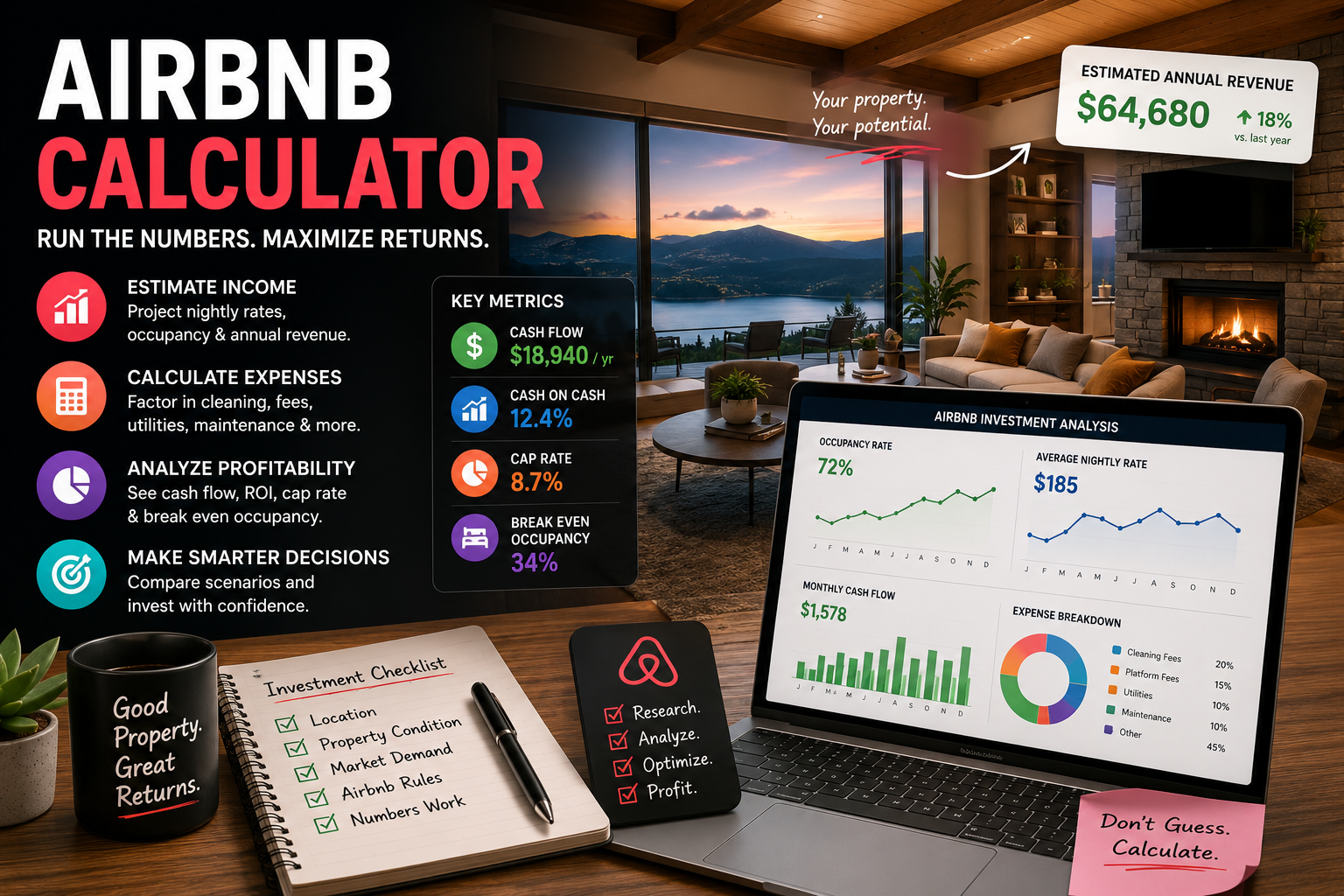
The typical Airbnb host in the US earns $2,000 to $5,000 per month gross revenue. After expenses — cleaning, supplies, utilities, management software, insurance, and platform fees — net income is 40% to 60% of gross. That means actual profit is $800 to $3,000/month for most properties.
This guide shows how to estimate Airbnb income for any property, what expenses to budget, and how to tell whether short-term rental beats long-term rental for your deal. Use the free Airbnb STR Calculator to run the numbers.
How Much Can You Make on Airbnb: The Formula
Airbnb income is not rent × 12. It is a function of nightly rate, occupancy, and seasonality:
| Variable | Formula |
|---|---|
| Gross Revenue | Average Nightly Rate × Occupied Nights per Year |
| Occupied Nights | 365 × Occupancy Rate |
| Net Revenue | Gross Revenue − Airbnb Platform Fee (3%) |
| Net Operating Income | Net Revenue − All Operating Expenses |
| Airbnb Profit | NOI − Mortgage Payment |
Worked Example: Nashville 2BR Condo
A 2-bedroom condo near downtown Nashville. Purchase price $285,000. Comparable Airbnb listings charge $165/night with 68% average occupancy.
| Item | Monthly | Annual |
|---|---|---|
| Average Nightly Rate | — | $165 |
| Occupied Nights (68%) | — | 248 |
| Gross Revenue | $3,412 | $40,920 |
| Airbnb Fee (3%) | −$102 | −$1,228 |
| Net Revenue | $3,310 | $39,692 |
| Cleaning ($120 × 5.2 turns/mo) | −$624 | −$7,488 |
| Supplies & Consumables | −$150 | −$1,800 |
| Utilities (electric, water, internet, cable) | −$350 | −$4,200 |
| Property Management (20%) | −$662 | −$7,938 |
| Insurance (STR policy) | −$200 | −$2,400 |
| Property Taxes | −$238 | −$2,850 |
| Maintenance & Repairs (5%) | −$171 | −$2,046 |
| Furnishing Reserve (3%) | −$102 | −$1,228 |
| NOI | $813 | $9,742 |
| Mortgage ($228K @ 7%, 30yr) | −$1,517 | −$18,204 |
| Cash Flow | −$704 | −$8,462 |
This example shows how much can you make on Airbnb in Nashville. This property has negative cash flow of $704/month despite $3,412 in gross revenue. The combination of high purchase price, 20% property management, and STR-specific expenses (cleaning, supplies, furnishing) eats all the income.
Compare this to a long-term rental at $1,800/month: lower revenue but far fewer expenses. The Airbnb Calculator lets you compare STR vs LTR side by side.
How Much Can You Make on Airbnb by Market
Short-term rental income varies dramatically by location. Vacation destinations outperform urban markets on nightly rate but often have seasonal occupancy drops.
| Market | Avg Nightly Rate | Avg Occupancy | Gross Monthly Revenue |
|---|---|---|---|
| Smoky Mountains, TN | $180–$280 | 55%–70% | $3,000–$6,000 |
| Nashville, TN | $150–$220 | 65%–75% | $3,000–$5,000 |
| Scottsdale, AZ | $200–$350 | 60%–75% | $3,600–$8,000 |
| Gulf Shores, AL | $160–$250 | 50%–65% | $2,400–$5,000 |
| Joshua Tree, CA | $180–$300 | 55%–70% | $3,000–$6,400 |
| Cleveland, OH | $80–$130 | 45%–60% | $1,100–$2,400 |
| Indianapolis, IN | $90–$140 | 50%–65% | $1,350–$2,800 |
Data from AirDNA and AllTheRooms Analytics. Check your specific market before making assumptions.
STR Expenses Most Hosts Underestimate
Cleaning costs. At $120–$180 per turnover and 4–6 turnovers per month, cleaning alone costs $480–$1,080/month. This is the single largest STR-specific expense and does not exist for long-term rentals.
Furnishing and replacement. Guests wear out furniture, linens, and kitchen items faster than tenants. Budget 3%–5% of gross revenue for ongoing replacement. Initial furnishing for a 2-bedroom costs $8,000–$15,000 — money you spend before earning a dollar.
Utilities. Long-term tenants usually pay their own utilities. Airbnb hosts pay everything: electricity, water, gas, internet, cable, streaming subscriptions. Budget $300–$500/month depending on property size and climate.
STR insurance. Standard landlord insurance does not cover short-term rentals. An STR-specific policy costs $2,000–$4,000/year — two to three times more than a standard rental policy.
Property management. Self-managing saves 20%–25% of revenue but requires responding to guest messages at midnight, coordinating cleaners, handling lockouts, and managing reviews. Professional STR management charges 20%–30% of gross revenue — significantly more than the 8%–10% for long-term rental management.
Airbnb vs Long-Term Rental: When Does STR Win?
Understanding how much can you make on Airbnb vs long-term rental is key. Short-term rental does not always beat long-term. Here is when each strategy works:
| Factor | Airbnb Wins When | Long-Term Wins When |
|---|---|---|
| Revenue | STR gross is 2x+ long-term rent | STR gross is less than 1.5x LTR |
| Occupancy | Consistent 65%+ year-round | Seasonal market with 40% winter occupancy |
| Expenses | Self-managed, low cleaning costs | High cleaning costs, professional PM at 25% |
| Regulations | STR-friendly market, permit available | Strict STR bans or expensive permits |
| Location | Vacation destination or event city | Suburban residential neighborhood |
| Investor time | Available to manage actively | Wants passive income |
When asking how much can you make on Airbnb vs renting, the break-even point is typically when STR gross revenue exceeds 1.8x the long-term rent. Below that, the extra expenses and effort of STR do not justify the premium. Calculate your specific break-even with the Airbnb STR Calculator.
How to Estimate Airbnb Income Before Buying
- Research comparable listings. Search Airbnb for properties with similar bedroom count, location, and amenities. Note nightly rates and check calendar availability to estimate occupancy. Use AirDNA for market-level data.
- Be conservative on occupancy. New listings typically achieve 40%–55% occupancy in the first 3–6 months while building reviews. Established listings with 50+ reviews can sustain 65%–80%. Do not underwrite at 75% if you have zero reviews.
- Budget all STR-specific expenses. Cleaning, supplies, utilities, furnishing, STR insurance, platform fees, and higher management costs. These add 35%–50% on top of standard rental expenses.
- Check local regulations. Many cities require STR permits ($500–$5,000/year), limit the number of days you can rent, or ban STR entirely. Verify before buying. Host Compliance tracks STR regulations by city.
- Run both scenarios. Calculate cash flow as both Airbnb and long-term rental. If the property only works as an STR, you have no fallback if regulations change or occupancy drops. The Rental Property Calculator handles the long-term comparison. See our cash flow calculation guide for the full long-term rental formula.
DSCR Loans for Airbnb Properties
Most DSCR lenders calculate DSCR using long-term rental comps, not actual Airbnb income. This means your property might generate $4,000/month on Airbnb, but the lender uses $2,000 long-term rent for qualification.
Some lenders now offer STR DSCR programs that use actual booking income (12-month history required). These typically require 25%+ down and DSCR above 1.0 based on documented STR revenue. See the DSCR Loans Guide for lender requirements. And check how much down payment you need for different loan types.
Use the DSCR Calculator with both the long-term rent (for qualification) and actual Airbnb income (for cash flow analysis) to understand the full picture.
Common Airbnb Income Mistakes
Overestimating how much can you make on Airbnb by projecting at peak-season rates year-round. A cabin that books $300/night in summer may average $120/night in winter. Annual income is the blended average, not the peak.
Ignoring platform fees. Airbnb charges hosts 3% per booking. VRBO charges 5%–8%. On $40,000 gross revenue, that is $1,200–$3,200 you never see.
Not budgeting for vacancy between guests. Even at 70% occupancy, gaps between bookings are rarely back-to-back. One-night gaps between 3-day bookings add up to 15%–20% of lost nights that do not show up in occupancy math.
Forgetting initial furnishing cost. A 2BR Airbnb needs $8,000–$15,000 in furniture, linens, kitchenware, decor, and supplies before the first guest arrives. This is capital invested that reduces your first-year return.
Disclaimer
This article is for educational purposes only. Airbnb income estimates are based on general market data and may not reflect your specific property, location, or market conditions. Short-term rental regulations, tax requirements, and platform policies vary by jurisdiction and change frequently. Consult a licensed real estate professional, tax advisor, and local attorney before investing in short-term rental property. ArvCalc is not a broker, property manager, or financial advisor.
So how much can you make on Airbnb? Most hosts earn $2,000 to $5,000 per month in gross revenue. After all expenses (cleaning, utilities, supplies, insurance, management, platform fees), net profit is typically 40% to 60% of gross — meaning $800 to $3,000/month. Properties in top vacation markets like Smoky Mountains or Scottsdale can earn significantly more, while urban properties in competitive markets may barely break even.
How much can you make on Airbnb as a new host? New listings with zero reviews typically achieve 40% to 55% occupancy in the first 3 to 6 months. Established listings with strong reviews can sustain 65% to 80% in popular markets. Seasonal markets (beach, ski) may see 80%+ in peak season but drop to 30% to 40% in off-season. Budget at 60% occupancy for conservative underwriting.
How much can you make on Airbnb compared to LTR? Airbnb can generate 1.5x to 3x the revenue of a long-term rental, but STR expenses are 40% to 60% higher (cleaning, utilities, furnishing, management, insurance). The break-even point is typically when Airbnb gross exceeds 1.8x the long-term rent. Below that threshold, long-term rental usually produces better net cash flow with less effort and risk.
Startup costs for Airbnb include initial furnishing ($8,000 to $15,000 for a 2-bedroom), professional photography ($200 to $500), smart locks and keypad ($150 to $300), initial supplies ($300 to $500), and STR permits ($0 to $5,000 depending on city). Total startup cost beyond the property purchase is typically $10,000 to $20,000.
Yes, but most DSCR lenders calculate the ratio using long-term rental comps rather than actual Airbnb income. Some lenders now offer STR-specific DSCR programs that accept 12 months of documented booking history. These typically require 25% or more down and a DSCR above 1.0 based on STR revenue. Always confirm the lender’s STR policy before applying.
The largest Airbnb-specific expenses are cleaning ($120 to $180 per turnover, 4 to 6 times per month), property management (20% to 30% of gross), utilities ($300 to $500/month), and STR insurance ($2,000 to $4,000/year). Combined with standard property expenses (mortgage, taxes, maintenance), total operating costs consume 50% to 70% of gross revenue for most Airbnb properties.
Search Airbnb for comparable listings in the same area with similar bedroom count and amenities. Check their calendars to estimate occupancy. Use data tools like AirDNA or AllTheRooms for market-level averages. Price your projections at 85% to 90% of top-performing comps since new listings without reviews typically earn less until they build a track record.
Related: For market-by-market income data and a full worked example with seasonal breakdown, see our Airbnb Income Potential Guide.
Leave a Reply