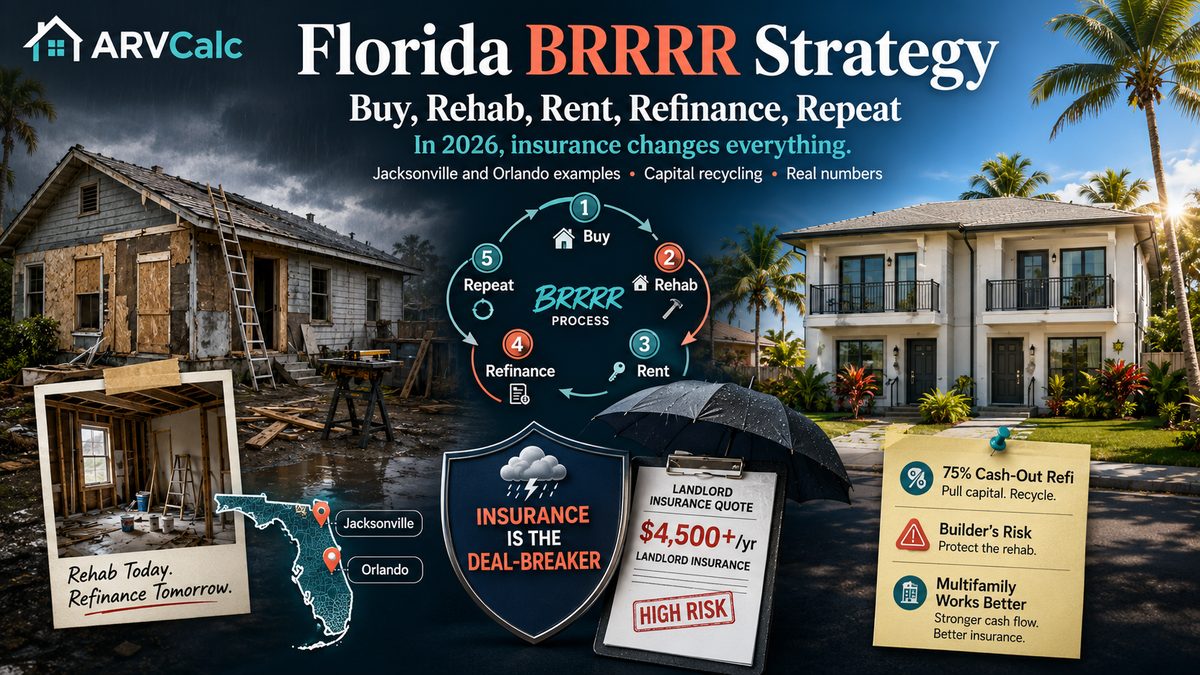
The BRRRR Florida strategy works in 2026 — but insurance is the variable that breaks most deals. This guide shows real Jacksonville and Orlando examples with a free BRRRR Florida calculator.
{
“@context”: “https://schema.org”,
“@type”: “FAQPage”,
“mainEntity”: [
{
“@type”: “Question”,
“name”: “Does the BRRRR strategy work in Florida in 2026?”,
“acceptedAnswer”: {
“@type”: “Answer”,
“text”: “Yes, but Florida’s high insurance costs — often $4,500–$6,000/year on a single-family rental — compress cash flow significantly compared to other states. The strategy works best in lower-cost metros like Jacksonville and in multi-unit properties where insurance is spread across multiple rent streams.”
}
},
{
“@type”: “Question”,
“name”: “What is a realistic ARV-to-purchase ratio for BRRRR Florida?”,
“acceptedAnswer”: {
“@type”: “Answer”,
“text”: “Most Florida investors target an all-in cost (purchase + rehab) of 75–80% of ARV. At a 75% cash-out refinance, this structure allows you to pull out most or all of your equity. In practice, distressed properties in Jacksonville and parts of Orlando can still hit these numbers in 2026.”
}
},
{
“@type”: “Question”,
“name”: “How much does insurance cost during a BRRRR rehab in Florida?”,
“acceptedAnswer”: {
“@type”: “Answer”,
“text”: “Builder’s risk insurance during the rehab phase typically runs $3,000–$5,000 in Florida, depending on property size and location. Once the property is stabilized and refinanced, you’ll switch to a landlord policy averaging $4,500/year statewide — one of the highest in the nation.”
}
},
{
“@type”: “Question”,
“name”: “What is the seasoning requirement for a Florida BRRRR refinance?”,
“acceptedAnswer”: {
“@type”: “Answer”,
“text”: “Most conventional lenders require 6–12 months of seasoning before a cash-out refinance on a non-owner-occupied property in Florida. DSCR lenders may offer refinances after 3–6 months of seasoning, making them popular with Florida BRRRR investors.”
}
},
{
“@type”: “Question”,
“name”: “Are there documentary stamp taxes on BRRRR refinances in Florida?”,
“acceptedAnswer”: {
“@type”: “Answer”,
“text”: “Yes. Florida charges documentary stamp tax (doc stamps) on new mortgages at $0.35 per $100 of the loan amount, plus an intangible tax of $0.002 per dollar. On a $225,000 refinance, that’s roughly $787.50 in doc stamps plus $450 in intangible tax — costs many out-of-state investors overlook.”
}
},
{
“@type”: “Question”,
“name”: “Which Florida city is best for the BRRRR strategy?”,
“acceptedAnswer”: {
“@type”: “Answer”,
“text”: “Jacksonville offers the most favorable conditions in 2026 — lower purchase prices, meaningful inventory of distressed properties, strong rent growth, and lower flood risk than coastal markets. Orlando ranks second, especially for small multifamily. Tampa is viable but competitive. Miami is extremely difficult due to land costs and insurance exposure.”
}
},
{
“@type”: “Question”,
“name”: “What DSCR is required to refinance a BRRRR property in Florida?”,
“acceptedAnswer”: {
“@type”: “Answer”,
“text”: “Most DSCR lenders in Florida require a minimum DSCR of 1.0–1.25. Given high insurance costs, many Florida rentals that look profitable on paper fall below 1.0 DSCR when insurance, property taxes, and management fees are fully counted. Use a DSCR calculator to verify your numbers before committing to a purchase.”
}
}
]
}
The BRRRR Florida strategy works in 2026 — but insurance changes everything. Imagine you’re a Jacksonville investor who closed on a distressed three-bedroom in 2025 for $200,000, put $40,000 into the rehab, and walked out with an ARV of $300,000 — a textbook BRRRR strategy Florida setup. You refi at 75%, pull out $225,000, leave only $15,000 in the deal, and feel like a genius. Then the first insurance bill arrives: $4,800 for the landlord policy. Add $375 a month in carrying costs the spreadsheet didn’t emphasize, and suddenly the deal cash-flows a lot less than you expected. That story plays out across Florida every week. This guide walks through the real numbers, two full worked examples, a metro-by-metro comparison, and the five mistakes that kill Florida BRRRR deals before the refinance closes.
What Is the BRRRR Strategy and Why Florida Presents a Unique Challenge
BRRRR stands for Buy, Rehab, Rent, Refinance, Repeat. The core mechanic is straightforward: acquire a distressed property below market, renovate it to force appreciation, place a tenant, refinance at the new appraised value to extract your invested capital, then redeploy that capital into the next deal. Done well, a single pool of capital can cycle through multiple properties over several years.
Florida adds layers of complexity that investors from Ohio, Texas, or the Midwest rarely anticipate:
- Insurance costs are among the highest in the nation. According to data from the Florida Office of Insurance Regulation, the average homeowners insurance premium in Florida now exceeds $4,500 per year — roughly three times the national average. For rental properties, landlord policies typically cost more than standard homeowners coverage.
- Builder’s risk insurance during rehab is mandatory and expensive. While a property sits vacant during renovation, most lenders and prudent investors carry builder’s risk coverage, which runs $3,000–$5,000 in Florida depending on replacement cost.
- Flood zone exposure is widespread. FEMA National Flood Insurance Program (NFIP) policies average $700–$2,500/year in Florida but can exceed $5,000 in higher-risk zones. Properties in AE and VE zones require flood insurance, which is non-negotiable for most lenders.
- Documentary stamp taxes apply on every new mortgage. Unlike most states, Florida charges doc stamps at $0.35 per $100 on new mortgage originations plus a $0.002 intangible tax — costs that compound when you’re refinancing multiple properties.
- Seasoning requirements. Conventional cash-out refinances typically require 6–12 months of ownership seasoning, tying up capital longer than many investors budget for.
None of these factors make BRRRR impossible in Florida. They do mean the margin for error is thinner than in lower-cost states, and your underwriting has to be precise. Use the Florida BRRRR Calculator to stress-test every assumption before you make an offer.
BRRRR Florida: Why Insurance Makes It Harder Than You Think
Florida’s insurance market has been in turmoil since 2020. Multiple private carriers have exited the state, and those that remain have raised rates sharply. The Florida Citizens Property Insurance Corporation, the state-backed insurer of last resort, has also implemented significant rate increases. FRED economic data tracks homeowners insurance costs as a component of the Consumer Price Index for shelter, and Florida’s trajectory has been substantially steeper than national trends.
Here is how insurance costs stack through a typical Florida BRRRR timeline:
| Phase | Coverage Type | Typical FL Cost | Duration |
|---|---|---|---|
| Rehab / Vacant | Builder’s Risk | $3,000–$5,000 | 3–6 months |
| Stabilized / Rented | Landlord Policy | $4,500–$6,000/yr | Ongoing |
| Flood Zone (if applicable) | NFIP / Private Flood | $700–$5,000+/yr | Ongoing |
| Wind-Exposed Coastal | Separate Wind Policy | $2,000–$8,000+/yr | Ongoing |
The total insurance drag on a coastal SFR can exceed $10,000/year. Even a conservative inland SFR in Jacksonville should budget $4,500–$5,500/year when combining landlord policy and basic flood where applicable. For your DSCR underwriting, input these real numbers into the Florida DSCR Calculator — not a percentage estimate — before deciding to proceed.
Savvy Florida BRRRR investors combat insurance drag in two ways: they target multifamily properties (where insurance cost is divided across multiple rent streams) and they focus on inland, non-flood-zone markets like Jacksonville’s suburban neighborhoods and Orlando’s growth corridors.
Worked Example 1: Jacksonville Single-Family BRRRR
Jacksonville is the most investor-friendly major market in Florida for the BRRRR strategy. Home prices remain relatively affordable compared to Tampa or Miami, there is meaningful inventory of 1950s–1980s-era homes that need work, and rent growth has been solid. Redfin’s Jacksonville market data shows median sale prices running $100,000–$150,000 below Tampa as of 2026.
Here is a real-numbers Jacksonville SFR deal:
| Item | Amount |
|---|---|
| Purchase Price | $200,000 |
| Rehab Cost | $40,000 |
| Closing Costs (purchase) | $5,000 |
| All-In Cost | $245,000 |
| After-Repair Value (ARV) | $300,000 |
| Cash-Out Refi (75% of ARV) | $225,000 |
| Doc Stamps + Intangible Tax on Refi | ~$1,237 |
| Capital Left in Deal | ~$21,237 |
| Monthly Rent | $1,700 |
Monthly cash flow analysis after refinance:
| Expense | Monthly |
|---|---|
| PITI (7.25% DSCR loan, 30yr, $225K) | $1,534 |
| Landlord Insurance ($4,500/yr) | $375 |
| Property Management (10%) | $170 |
| CapEx Reserve (5%) | $85 |
| Vacancy Reserve (5%) | $85 |
| Total Monthly Expenses | $2,249 |
| Net Monthly Cash Flow | -$549 |
This deal is cash-flow negative at a 75% LTV refinance. The equity creation is real — you captured $55,000 in equity and left about $21,000 in the deal. But the monthly bleed of roughly $549 means this only makes sense if you believe in Jacksonville appreciation, or if you can push the rent above $2,300/month (requiring a higher-rent neighborhood or a better product). At $2,200/month, the deal nearly breaks even. At $2,400/month, it generates modest positive cash flow.
The takeaway: a 70% LTV refinance (pulling $210,000 instead of $225,000) reduces your mortgage payment and dramatically improves cash flow, at the cost of leaving more capital in the deal. Model both scenarios using the Florida BRRRR Calculator before deciding which refi structure to pursue. Also verify your closing cost estimates with the Florida Closing Costs Calculator.
Worked Example 2: Orlando Duplex BRRRR — How Multifamily Fixes the Insurance Problem
The second example illustrates why experienced Florida BRRRR investors often prefer small multifamily. An Orlando duplex spreading insurance costs across two units changes the math substantially.
| Item | Amount |
|---|---|
| Purchase Price | $260,000 |
| Rehab Cost | $50,000 |
| Closing Costs (purchase) | $6,000 |
| All-In Cost | $316,000 |
| After-Repair Value (ARV) | $380,000 |
| Cash-Out Refi (75% of ARV) | $285,000 |
| Doc Stamps + Intangible Tax on Refi | ~$1,568 |
| Capital Left in Deal | ~$32,568 |
| Total Monthly Rent (2 units × $1,600) | $3,200 |
Monthly cash flow analysis after refinance:
| Expense | Monthly |
|---|---|
| PITI (7.25% DSCR loan, 30yr, $285K) | $1,943 |
| Landlord Insurance ($5,400/yr duplex) | $450 |
| Property Management (10%) | $320 |
| CapEx Reserve (5%) | $160 |
| Vacancy Reserve (5%) | $160 |
| Total Monthly Expenses | $3,033 |
| Net Monthly Cash Flow | +$167 |
The duplex deal achieves modest positive cash flow at 75% LTV — roughly $167/month or $2,004/year. That is not a home run, but it is a sustainable position. The key difference: the $450/month insurance cost is spread across $3,200 in rents (14% of gross rents) versus $375/month against $1,700 in rents (22% of gross rents) in the SFR example. Two rent streams also provide vacancy cushion — if one unit is empty, the other still covers most of the fixed costs.
Orlando’s tourism-driven economy sustains strong rental demand, particularly in the Dr. Phillips, Windermere, and Winter Garden corridors. Check current rent trends on Zillow Research before finalizing your rent assumptions. Also run the cap rate math through the Florida Cap Rate Calculator to verify the deal pencils against comparable properties.
Florida BRRRR Metro Comparison: Where the Numbers Work in 2026
| Metro | BRRRR Viability | Avg SFR Price | Avg Insurance/yr | Key Challenge |
|---|---|---|---|---|
| Jacksonville | Best | $270K–$320K | $3,800–$4,800 | Cash flow tight on SFR at 75% LTV; multifamily preferred |
| Orlando | Good | $340K–$420K | $4,200–$5,500 | Higher entry prices require strong forced appreciation |
| Tampa | Possible | $380K–$480K | $4,800–$7,500 | Competition is fierce; flood/wind exposure costly near coast |
| Miami | Very Hard | $550K–$900K+ | $6,000–$15,000+ | Land prices eliminate forced-appreciation upside; insurance is extreme |
Jacksonville’s advantage stems from its large geographic footprint (it is the largest city by area in the contiguous U.S.), which creates pockets of distressed inventory in established neighborhoods. Areas like Riverside, Avondale, and Springfield have undergone significant gentrification, creating pre-gentrification buying opportunities in adjacent zip codes. The complete Florida rental property investment guide covers each of these markets in greater depth.
5 BRRRR Florida Mistakes That Kill Deals
Each of the following mistakes has derailed real deals in Florida. Understanding them before you close is far less expensive than learning them after the fact.
Mistake 1: Not Buying Insurance Before Closing on the Rehab Property
Many investors assume they can get a standard landlord policy on a vacant, distressed property. They cannot. Vacant property in disrepair requires builder’s risk or a vacant property policy — and in Florida, this runs $3,000–$5,000 for the rehab period. Investors who skip this coverage are one electrical fire or slip-and-fall away from a catastrophic loss with no insurance backstop. Budget for builder’s risk from day one. See the full breakdown in our Florida DSCR loan guide.
Mistake 2: Ignoring Flood Zone Before Making an Offer
Florida has more flood-zone properties than any other state. FEMA’s NFIP rates are based on Risk Rating 2.0, which went into effect in 2021 and dramatically increased premiums for many Florida properties that were previously cheap to insure. Always look up the FEMA Flood Map before making an offer. A property in an AE zone with a $3,000/year flood policy can easily swing a marginal deal from profitable to losing. This is especially critical in Tampa Bay, South Florida, and coastal Jacksonville areas.
Mistake 3: Using National Contractor Cost Estimates
Florida has a shortage of licensed contractors in many markets, which means pricing is Improved compared to Midwest or Southeast averages. Roofing, HVAC, and electrical work — all disproportionately expensive in Florida — are frequently needed on distressed properties. A rehab budget built on national averages will typically run 20–35% over in Florida markets. Always get three local bids before finalizing your rehab estimate, and add a 15% contingency on top. Understating rehab cost is the fastest way to destroy your ARV-to-cost ratio.
Mistake 4: Forgetting Documentary Stamp Taxes on the Refinance
Most out-of-state BRRRR investors are accustomed to refinance costs being primarily lender fees and title insurance. Florida adds documentary stamp tax ($0.35 per $100) and intangible tax ($0.002 per dollar) on every new mortgage. On a $225,000 refinance, that adds roughly $1,237 in mandatory state taxes on top of normal closing costs. These are not negotiable and not waivable. Budget them into your refi closing costs, and use the Florida Closing Costs Calculator to see a full breakdown. More detail on this is in our Florida closing costs for investment property article.
Mistake 5: Underestimating Seasoning Requirements and Holding Costs
Seasoning requirements mean your capital is locked in the deal for longer than you planned. A conventional lender requiring 12 months of seasoning on an investment property means 12 months of carrying costs — insurance, property taxes, any debt service on a hard money loan — before you can pull your equity out. At $500–$800/month in carrying costs, a 12-month seasoning period costs $6,000–$9,600 that many investors didn’t model. DSCR lenders often offer shorter seasoning periods (sometimes 3–6 months), making them popular for Florida BRRRR recycling. See the Florida DSCR loan guide and run your debt service numbers through the Florida DSCR Calculator.
How to Run the Florida BRRRR Numbers: Step-by-Step Framework
Whether you’re evaluating Jacksonville or Orlando, the underwriting framework is the same. What changes are the inputs — particularly insurance, local property taxes (which vary significantly by county in Florida), and achievable rents.
Step 1: Establish your maximum purchase price. Start with the ARV and work backward. If your lender will refi at 75% LTV, and you want to leave less than $20,000 in the deal, your all-in cost (purchase + rehab + closing costs + builder’s risk) must be under 75% of ARV minus $20,000. For a $300,000 ARV, that’s a maximum all-in of $205,000.
Step 2: Get real insurance quotes before making an offer. Do not use estimates. Call two or three Florida landlord insurance brokers with the property address and get actual quotes. This is the number that will make or break your cash flow analysis, and it varies significantly by property age, construction type, proximity to coast, and flood zone.
Step 3: Model the full expense stack. Use the Florida Rental Property Calculator to input mortgage payment, insurance, property taxes, management, vacancy, maintenance/CapEx, and flood insurance if applicable. If the numbers work at these real expenses, proceed. If not, either renegotiate the purchase price or move on.
Step 4: Verify DSCR for your lender. Most DSCR lenders in Florida calculate DSCR as gross rents divided by full PITI plus insurance. Run this with the actual insurance figure. A deal that shows 1.15 DSCR with a $250/month insurance estimate might fail DSCR underwriting at $450/month actual. Use the Florida DSCR Calculator with real numbers.
Step 5: Model the repeat cycle. The entire point of BRRRR is recycling capital. How much capital will you actually have to reinvest after the refinance? What is the projected cash flow on the stabilized asset? Run scenario analysis through the Florida BRRRR Calculator to project your equity position, monthly cash flow, and available capital for the next deal.
Financing Florida BRRRR Deals: Hard Money to DSCR
Most Florida BRRRR investors use a two-loan structure: a short-term hard money or bridge loan for the acquisition and rehab, followed by a DSCR refinance once the property is stabilized and tenant-occupied. Understanding both legs of this structure is critical.
Hard money / bridge loans in Florida typically offer 70–75% of ARV (loan-to-after-repair-value), interest-only payments, 6–18 month terms, and rates ranging from 10–13% in the current rate environment. The key variable is the lender’s scope of work approval process — many Florida hard money lenders have tightened draw schedules and inspection requirements after contractor fraud issues in South Florida markets.
DSCR refinances are the refinance mechanism of choice for most Florida investors because they underwrite to the property’s rental income rather than the investor’s personal income — making them accessible to self-employed investors and those with multiple investment properties. Rates on 30-year DSCR loans in Florida currently run approximately 7.0–7.75% depending on LTV, DSCR ratio, and borrower profile. The full breakdown of how these loans work, including Florida-specific requirements, is covered in the Florida DSCR loan guide.
One Florida-specific nuance: because doc stamps apply to every new mortgage, some investors explore assumption structures or subject-to acquisitions as an alternative to traditional cash-out refi. These strategies carry their own legal complexities and are beyond the scope of this article, but they are worth researching if you are building a portfolio and the doc stamp costs are adding up.
Is the BRRRR Strategy Still Worth It in Florida in 2026?
The short answer is yes — with discipline. Florida’s insurance crisis has unquestionably made the strategy harder than it was in 2019 or 2020. Single-family BRRRR deals that cash-flowed comfortably at 75% LTV four years ago often barely break even today. But the fundamentals that make Florida attractive — population growth, strong rental demand driven by in-migration, a no-state-income-tax environment that attracts high earners, and the absence of rent control in most markets — remain intact.
The investors who are succeeding with Florida BRRRR in 2026 share a few traits: they buy in inland markets with manageable insurance costs, they prefer multifamily over SFR, they build real insurance quotes into their underwriting rather than estimates, and they are comfortable accepting break-even or slightly negative cash flow in exchange for equity creation and appreciation. They also use the right tools — particularly the Florida BRRRR Calculator — to stress-test their deals against realistic downside scenarios before committing capital.
The investors who are struggling are those who brought a national BRRRR playbook to Florida without adjusting for the local insurance environment, or who chased deals in coastal markets where the insurance math simply does not work at any LTV.
For a broader look at the rental market context underlying these deals, the Florida rental property investment guide covers statewide trends in vacancy rates, rent growth by metro, and property tax assessments. The complete BRRRR strategy guide covers the national framework that applies across all states.
Frequently Asked Questions: BRRRR Florida
Does the BRRRR strategy work in Florida in 2026?
Yes, but insurance costs averaging $4,500/year change the math. Jacksonville and inland Orlando offer the best spreads. Coastal markets and Miami are very difficult due to insurance premiums that can exceed $7,000/year. Multi-unit properties perform better because rent scales faster than insurance.
How does Florida insurance affect BRRRR holding costs?
During rehab you need builder’s risk insurance ($3,000-$5,000 for 6 months). After refinance, landlord policy runs $375/month ($4,500/year). In flood zones add $150-$300/month. Total insurance can reach $500-$700/month — often the largest single expense after the mortgage payment.
Which Florida city is best for BRRRR in 2026?
Jacksonville offers the lowest entry prices ($180K-$250K), lowest insurance costs (inland), and strongest rent-to-price ratios in the state. Orlando works for multi-unit. Tampa is possible but tight. Miami is very difficult — entry prices too high and insurance extreme.
Do I pay documentary stamp tax on a BRRRR refinance in Florida?
Yes. Florida charges $0.35 per $100 on the new mortgage plus 0.2% intangible tax. On a $225,000 refinance loan, that adds $787 in doc stamps and $450 in intangible tax — $1,237 in transfer costs that reduce your capital recovery.
What seasoning period do Florida lenders require for BRRRR?
Most conventional lenders require 6 months of ownership before a cash-out refinance. Some DSCR and portfolio lenders allow refinance after 3 months with a new appraisal. Budget 6 months of holding costs (mortgage, insurance, taxes, utilities) into your BRRRR analysis.
Can I BRRRR a condo in Florida?
Technically yes, but SB 4-D reserve requirements (effective 2025) mean many Florida condo associations have special assessments of $10,000-$50,000+. HOA fees are rising 20-40%. Most experienced BRRRR investors avoid Florida condos and focus on single-family and small multifamily.
What DSCR do I need to refinance a Florida BRRRR property?
Most DSCR lenders want 1.0 minimum for refinance, with better rates at 1.25+. In Florida, insurance at $375-$500/month makes hitting 1.0 harder than in low-insurance states. Multi-unit properties produce better DSCR because rent scales while insurance stays roughly the same per building.
Leave a Reply