{
“@context”: “https://schema.org”,
“@type”: “FAQPage”,
“mainEntity”: [
{
“@type”: “Question”,
“name”: “What is a Florida DSCR loan?”,
“acceptedAnswer”: {
“@type”: “Answer”,
“text”: “A Florida DSCR loan (Debt Service Coverage Ratio loan) is a non-QM mortgage that qualifies investors based on a rental property’s income rather than personal income or tax returns. Lenders divide the property’s gross monthly rent by the full PITIA payment (principal, interest, taxes, insurance, and HOA) — if that ratio hits 1.0 or higher, the loan can be approved without W-2s or pay stubs.”
}
},
{
“@type”: “Question”,
“name”: “What DSCR ratio do Florida lenders require?”,
“acceptedAnswer”: {
“@type”: “Answer”,
“text”: “Most Florida DSCR lenders require a minimum ratio of 1.0, meaning rent exactly covers PITIA. Premium pricing (lowest rates) kicks in at 1.25+. A ratio below 1.0 — called a No-Ratio or sub-1 DSCR loan — is available from some lenders but carries higher rates and larger down payment requirements, often 30–35%.”
}
},
{
“@type”: “Question”,
“name”: “Why does Florida insurance make DSCR loans harder to qualify for?”,
“acceptedAnswer”: {
“@type”: “Answer”,
“text”: “Florida has the highest homeowner insurance rates in the nation. The average landlord policy runs $4,500–$6,000 per year on a single-family rental, and coastal or flood-zone properties add $1,500–$3,000 more in flood insurance. That $500–$750/month in insurance alone raises your PITIA dramatically and can push an otherwise qualifying property below the 1.0 DSCR threshold.”
}
},
{
“@type”: “Question”,
“name”: “What are current Florida DSCR loan rates in 2026?”,
“acceptedAnswer”: {
“@type”: “Answer”,
“text”: “As of mid-2026, Florida DSCR loan rates range from approximately 7.00% to 8.50% for 30-year fixed on a 1.0+ DSCR with 25% down. A DSCR above 1.25 and 30% down can bring rates closer to 6.875%–7.25%. Rates shift with the 10-year Treasury — check the FRED database for current benchmark rates and add a typical 2.5–3.5% spread for DSCR non-QM pricing.”
}
},
{
“@type”: “Question”,
“name”: “Can I use short-term rental income for a Florida DSCR loan?”,
“acceptedAnswer”: {
“@type”: “Answer”,
“text”: “Yes. Most DSCR lenders accept Airbnb or VRBO income using a 12-month average from platform statements or a market rent appraisal (Form 1007/1025). Some lenders haircut STR income by 25–30% to account for vacancy. Orlando and Miami markets see strong STR income but many neighborhoods now have HOA or municipal restrictions — confirm before underwriting.”
}
},
{
“@type”: “Question”,
“name”: “What credit score do I need for a Florida DSCR loan?”,
“acceptedAnswer”: {
“@type”: “Answer”,
“text”: “Minimum credit score for a Florida DSCR loan is typically 620–640, though 680+ gets you meaningfully better pricing. Below 660, expect rate add-ons of 0.50–1.00% and possible LTV restrictions (max 70–75% LTV). The best DSCR rates in Florida go to borrowers with 720+ scores, 30%+ down, and a DSCR above 1.25.”
}
},
{
“@type”: “Question”,
“name”: “How do Florida property taxes affect DSCR calculations?”,
“acceptedAnswer”: {
“@type”: “Answer”,
“text”: “Florida property taxes average 0.83% of assessed value statewide, but investment properties do not qualify for the Homestead Exemption, so expect full millage rates. In Miami-Dade, effective rates can reach 1.1–1.3% on non-homesteaded rentals. On a $350,000 property, that’s $3,640–$4,550 per year ($303–$379/month) added to your PITIA before insurance is even factored in.”
}
}
]
}
Picture this: a real estate investor under contract on a Tampa single-family rental, thirty days from closing, finds out her Florida DSCR loan has been denied — not because rents were low or her credit was poor, but because the insurance quote came in at $512 per month. That one line item pushed her debt service coverage ratio from 1.08 down to 0.91, and the lender walked. This scenario plays out hundreds of times a month across Florida, and it is entirely avoidable if you understand how PITIA math works in this state before you go under contract.
This guide covers everything that makes Florida DSCR lending different from every other state: the insurance crisis, metro-by-metro market conditions, current rate ranges, and two fully worked examples showing exactly where deals pass and where they fail. Use our Florida DSCR calculator alongside this article to stress-test any deal you’re evaluating.
What Is a Florida DSCR Loan and How Does It Work?
A DSCR loan — Debt Service Coverage Ratio loan — is a non-QM (non-qualified mortgage) product designed for real estate investors. Unlike conventional financing, it does not require W-2s, pay stubs, or personal income verification. Instead, the lender looks at one number: the ratio of the property’s gross monthly rent to its total monthly PITIA obligation.
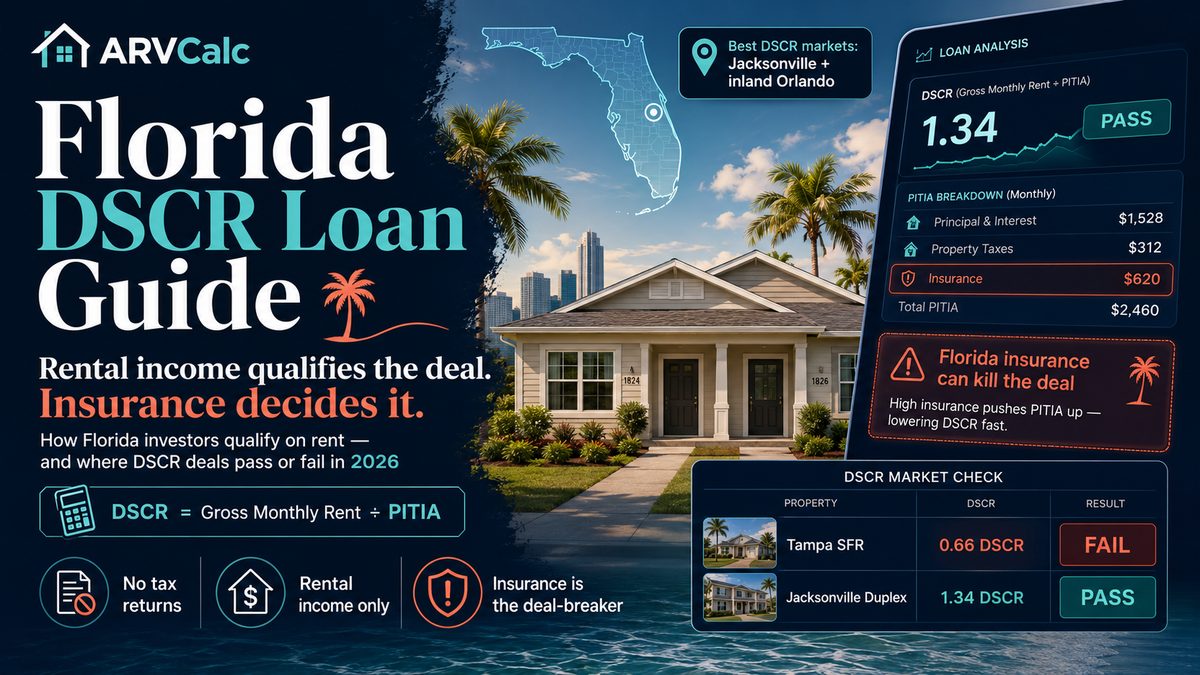
DSCR = Gross Monthly Rent ÷ Monthly PITIA
PITIA stands for:
- Principal + Interest — your loan payment
- Taxes — monthly escrow for property taxes
- Insurance — hazard insurance, flood insurance if required, and wind insurance if required
- Association dues — HOA or condo fees
Hit 1.0 and the property pays for itself. Hit 1.25 and most lenders give you their best pricing tier. Drop below 1.0 and you are in sub-1 DSCR territory — still fundable with some lenders, but at a rate premium of 0.50–1.00% and with stricter LTV limits.
What makes Florida uniquely challenging is that the “I” in PITIA is not just big here — it is enormous and unpredictable. The Florida Office of Insurance Regulation has documented statewide average homeowner premium increases of 42% between 2020 and 2025, and several major carriers have exited the market entirely. That cost falls directly on your DSCR ratio.
For a deeper dive on DSCR fundamentals that apply nationally, read our complete DSCR loans guide for 2026.
How Florida Insurance Crushes DSCR Ratios
Here is the math that catches investors off guard. Take a hypothetical $350,000 inland Florida rental. Insurance costs that might run $1,400/year in the Midwest or $1,800/year in Texas look like this in Florida in 2026:
- Base landlord policy (DP-3 equivalent): $4,500/year ($375/month)
- Required flood insurance (FEMA NFIP or private): $2,000/year ($167/month)
- Wind mitigation rider (many coastal zip codes): $0–$1,200/year
- Total: $6,500/year = $542/month
Compare that to an inland Texas property of the same value at roughly $2,400/year ($200/month). The Florida investor is paying an extra $342/month purely in insurance — enough to sink most deals.
Factors that drive Florida insurance costs even higher:
- Roof age: Roofs over 15 years old face surcharges or outright rejection. Many insurers in 2026 require roofs under 10 years old for binding coverage.
- FEMA flood zone designation: AE and VE zones mandate flood insurance if the property has any federally backed financing. Private flood markets now offer competitive alternatives to NFIP.
- Wind exposure: Properties within 1 mile of a coastline pay wind mitigation surcharges regardless of construction quality.
- Citizens Insurance assignment: The state insurer of last resort has raised rates aggressively since 2022, and policies can be taken out (assumed) by private carriers during policy renewal.
- Litigation history: Florida has historically had more property insurance litigation than the other 49 states combined, driving up loss costs for every carrier.
According to the Florida Office of Insurance Regulation, average landlord premiums in coastal counties (Miami-Dade, Broward, Palm Beach, Pinellas, Hillsborough) run 35–60% above the state average. If you are buying in those markets, your insurance line in the DSCR calc needs to reflect that reality, not a wishful estimate.
Use our Florida rental property calculator to model insurance costs alongside all other operating expenses before committing to a price.
Florida DSCR Loan Requirements in 2026
DSCR lending is not regulated like conventional mortgages — each lender sets its own overlays. That said, the market has converged on a fairly consistent set of requirements for Florida investment properties:
Credit Score
- Minimum: 620 (some lenders 640)
- Best pricing: 720+
- Sub-660: expect rate add-ons of 0.50–1.00% and LTV restrictions
Down Payment / LTV
- SFR (1–4 units): 20–25% minimum down (75–80% LTV)
- 5–8 unit commercial DSCR: 25–30% down
- Sub-1.0 DSCR loans: 30–35% down required by most lenders
- Cash-out refinance: typically max 70–75% LTV
DSCR Thresholds
- 1.25+: best rates, most lender options
- 1.0–1.24: standard approval, slight rate add-ons
- 0.75–0.99: sub-1 DSCR program, higher rates, limited lenders
- Below 0.75: very few lenders, hard money territory
Property Requirements
- Must be non-owner-occupied investment property
- 1–4 units for residential DSCR; 5+ for commercial DSCR
- Warrantable and non-warrantable condos accepted by many DSCR lenders
- Short-term rental (Airbnb/VRBO) properties accepted with market rent appraisal
- Rural properties (outside metro areas) may face LTV restrictions
Reserves
Most lenders require 3–6 months of PITIA in liquid reserves after closing. For Florida properties, some lenders add a 1–2 month insurance reserve given the volatility of the market.
Current Florida DSCR Loan Rates (Mid-2026)
DSCR rates price off the 10-year Treasury plus a spread that reflects non-QM risk. The FRED 10-year Treasury data is the best free benchmark for tracking where rates are headed. As of mid-2026, here is the realistic range for Florida DSCR loans:
| DSCR Tier | LTV | Credit Score | Rate Range (30yr Fixed) |
|---|---|---|---|
| 1.25+ | 70% (30% down) | 720+ | 6.875% – 7.25% |
| 1.25+ | 75% (25% down) | 700+ | 7.125% – 7.50% |
| 1.0 – 1.24 | 75% | 680+ | 7.375% – 7.875% |
| 1.0 – 1.24 | 75% | 640–679 | 7.75% – 8.375% |
| Sub-1.0 DSCR | 65–70% | 680+ | 8.25% – 9.00% |
Florida-specific pricing adjustments that differ from national DSCR quotes:
- Coastal zip code add-on: 0.125–0.375% on properties in FEMA high-risk flood zones
- Condo add-on: 0.25–0.50% for non-warrantable condos
- Short-term rental add-on: 0.125–0.25% for documented Airbnb/VRBO properties
Interest rates matter, but so does knowing your cap rate going in. Use our Florida cap rate calculator to benchmark returns before locking a rate.
Worked Example 1: Tampa SFR — Deal That Fails
An investor is buying a 3/2 single-family home in Tampa’s New Tampa neighborhood. The numbers look attractive on the surface:
- Purchase price: $350,000
- Down payment: 25% = $87,500
- Loan amount: $262,500
- Rate: 7.50% (30-year fixed DSCR)
- Monthly P&I: $1,836
- Property taxes: $4,200/year = $350/month (non-homesteaded)
- Landlord insurance (DP-3): $4,500/year = $375/month
- Flood insurance (AE zone): $2,000/year = $167/month
- HOA: $0
- Total PITIA: $2,728/month
The gross market rent per appraisal: $1,800/month
DSCR = $1,800 ÷ $2,728 = 0.66
This loan does not close. Not at any standard DSCR program. The property would need to rent for $3,410/month to hit 1.25 DSCR, or $2,728/month just to break even at 1.0. The rent-to-price ratio in this Tampa neighborhood simply does not support DSCR financing at these insurance levels.
What could save this deal? Options include: increasing the down payment to 40%+ to reduce P&I, finding a property outside the AE flood zone (eliminating $167/month), negotiating a lower purchase price, or targeting a property type that commands higher rents relative to value (a duplex, for instance). If the investor insists on this property, a conventional investment loan requiring income documentation may ironically be the better path.
This is exactly why you need to run your DSCR numbers in Florida with accurate insurance quotes — not back-of-envelope estimates — before going hard on earnest money.
Worked Example 2: Jacksonville Duplex — Deal That Passes
Now consider a duplex in Jacksonville’s Riverside/Avondale neighborhood, a market with better rent-to-price ratios and lower insurance exposure than coastal Florida:
- Purchase price: $290,000
- Down payment: 25% = $72,500
- Loan amount: $217,500
- Rate: 7.375% (30-year fixed, 1.25+ DSCR expected)
- Monthly P&I: $1,502
- Property taxes: $2,900/year = $242/month (Duval County, inland)
- Landlord insurance: $3,200/year = $267/month (inland, no flood zone)
- Flood insurance: Not required (X flood zone)
- HOA: $0
- Total PITIA: $2,011/month
Combined gross market rent (both units): $2,700/month (Unit A: $1,400 + Unit B: $1,300)
DSCR = $2,700 ÷ $2,011 = 1.34
This deal passes. At 1.34 DSCR, the investor qualifies for the 1.25+ pricing tier — and with a 720 credit score, could hit rates near 7.125–7.25%. The duplex structure helps: two income streams, each lower in absolute terms, combine to push rents well past PITIA. The property being in an X flood zone eliminates one of Florida’s biggest PITIA inflators.
This deal would also benefit from a home inspection focused on the roof age and HVAC systems, since insurance quote variances in Florida often hinge on roof condition. A 14-year-old roof here could push the insurance quote from $3,200 to $4,800 and shave the DSCR down to approximately 1.21 — still passing, but out of the best pricing tier.
Florida vs. Texas DSCR Comparison
Investors often compare Florida and Texas since both are no-income-tax states with landlord-friendly laws and high population growth. But their DSCR math looks very different:
| Factor | Florida | Texas |
|---|---|---|
| State income tax | None | None |
| Avg. effective property tax (investment) | 0.83% – 1.3% (coastal) | 1.6% – 2.3% |
| Avg. landlord insurance (SFR, $300K) | $3,500 – $6,000/yr | $1,800 – $2,800/yr |
| Flood insurance prevalence | High (many AE/VE zones) | Moderate (bayou areas) |
| Combined insurance + tax PITIA burden | Higher overall in coastal markets | Higher overall in DFW/Austin |
| DSCR-friendly metros | Jacksonville, inland Orlando | San Antonio, El Paso, Lubbock |
| Hardest DSCR markets | Miami Beach, coastal Tampa | Austin, Highland Park (Dallas) |
| DSCR lender availability | High — many lenders active | High — competitive market |
The takeaway: Florida’s lower property taxes partially offset its higher insurance burden, but in most Florida coastal markets, the insurance differential is so large that Texas wins on total PITIA. Inland Florida (Jacksonville, Ocala, Gainesville) is a different story — those markets can look very similar to Texas on a DSCR basis.
For Florida-specific tax impact on investment properties, the Tax Foundation’s Florida profile is a solid baseline for understanding the full tax picture beyond just property taxes.
Always factor closing costs into your entry math. Use our Florida closing costs calculator to model your full acquisition cost before comparing deals across states.
Florida Metro DSCR Guide: Market-by-Market Breakdown
Florida is not one market — it is a collection of very different markets with wildly different DSCR dynamics. Here is how the major metros stack up:
| Metro | DSCR Difficulty | Typical DSCR (SFR) | Key Driver |
|---|---|---|---|
| Miami / South Florida | Hardest | 0.55 – 0.80 | Extreme prices + coastal insurance + condo fees |
| Tampa Bay Area | Hard | 0.70 – 0.95 | Rising prices post-Ian + flood zone exposure |
| Orlando / Central FL | Possible | 0.90 – 1.15 | STR income helps; non-coastal insurance rates |
| Jacksonville | Best | 1.10 – 1.40 | Better rent ratios, lower insurance, lower prices |
Miami / South Florida
The hardest DSCR market in Florida, and one of the hardest in the nation. Median SFR prices in Miami-Dade and Broward routinely exceed $550,000–$700,000 for anything rentable. Coastal exposure means both hazard and flood insurance are mandatory and expensive. High-rise condo HOA fees of $800–$2,000/month are common. Most SFR DSCR deals in Miami simply do not pencil — investors here typically rely on appreciation plays financed conventionally, or they seek multifamily properties where income density offsets the PITIA burden. If you are pursuing a Florida DSCR loan in Miami, you need properties with exceptional rent-to-value ratios, often in transitional neighborhoods or workforce housing.
Tampa Bay
Tampa and St. Petersburg saw significant price run-ups from 2020–2023 and then a further insurance shock following Hurricane Ian’s landfall in nearby Southwest Florida. Many Pinellas County properties are in FEMA AE or VE flood zones, and insurance carriers have made some zip codes nearly uninsurable except through Citizens. DSCR deals are possible in inland Hillsborough County (Brandon, Riverview, Wesley Chapel) where prices are lower and flood zone exposure is reduced. Our Worked Example 1 above illustrates exactly why coastal Tampa deals struggle.
Orlando / Central Florida
Orlando is the most detailed Florida market for DSCR. The theme park corridor generates massive short-term rental demand, and DSCR lenders that accept STR income (using 12-month gross averages) can find deals that pencil near or above 1.0. However, many communities near Disney have HOA rules prohibiting short-term rentals, and municipal ordinances in unincorporated Osceola County continue to evolve. Long-term rental markets in suburban Orange and Seminole counties are more straightforward — DSCR ratios in the 0.95–1.15 range are achievable on well-priced SFRs, and duplexes can push above 1.20.
For a complete look at investment dynamics in this market, read our article on Florida rental property investment.
Jacksonville
The most DSCR-friendly major market in Florida. Jacksonville offers lower property values relative to rent, lower insurance costs due to its inland orientation (the coastline is accessible but the metro core is not coastal), and a diversified economy anchored by logistics, healthcare, and financial services. The Riverside, Springfield, and San Marco neighborhoods offer urban-feel properties at prices where DSCR math works. Our Worked Example 2 above shows a realistic Jacksonville duplex clearing 1.34 DSCR — the kind of deal that is structurally difficult to find in Miami or Tampa.
5 Common Florida DSCR Loan Mistakes Investors Make
After seeing hundreds of Florida DSCR loan applications, the same errors appear repeatedly. Here are the five that most often kill deals or cost investors money:
Mistake 1: Using Agent or Lender Insurance Estimates
Real estate agents often quote $1,500–$2,000/year in insurance when modeling cash flows. Lenders sometimes use national averages for initial pre-approval letters. Neither reflects what bindable Florida insurance actually costs. Get real quotes from real carriers before you are contractually committed. This single mistake accounts for more Florida DSCR denials than any other factor.
Mistake 2: Ignoring Flood Zone Designation
FEMA’s Flood Map Service Center shows whether a property is in an AE, VE, X, or other flood zone. AE and VE zones require flood insurance if there is any lender involvement. Many investors discover at closing — not before — that the property requires flood insurance that was never in their pro forma. The premium can be $1,500–$4,000/year depending on structure elevation and zone. Check the FEMA map before making any offer on a Florida property.
Mistake 3: Buying in HOA-Restricted Short-Term Rental Communities
In markets like Kissimmee and Davenport, many communities are marketed as STR-friendly, but HOA documents tell a different story. If you underwrite a deal on $3,200/month in Airbnb income and the HOA prohibits rentals under 30 days, your DSCR just dropped to whatever the long-term rent is — often $400–$600/month less. Always read the complete HOA documents, not just the seller’s assurance.
Mistake 4: Skipping the Cap Rate Analysis
DSCR approval is not the same as a good investment. A property can just barely clear 1.0 DSCR and still deliver a 4% cap rate that makes no economic sense given the risk. Always run the cap rate alongside the DSCR. Our Florida cap rate calculator and this deep to Florida cap rates by market give you the full picture. A 1.0 DSCR with a 5% cap rate in Jacksonville is a very different risk profile than a 1.0 DSCR with a 4.2% cap rate in Miami.
Mistake 5: Not Shopping Multiple DSCR Lenders
Non-QM DSCR lending is not commoditized the way conventional lending is. Rate spreads between lenders on identical Florida DSCR scenarios can range from 0.50% to 1.25% — on a $300,000 loan, that difference is $85–$210/month in payment. Lender overlays also vary significantly: one lender might accept a 0.90 sub-DSCR on a Jacksonville duplex, while another declines it entirely. Work with a broker who has access to 8–12+ DSCR lender relationships, not just one or two.
Before closing, understand your full entry cost with our Florida investment property closing costs calculator. See also our broader article on Florida closing costs for investment properties for what to expect at the settlement table.
Florida DSCR Loan Qualifying Checklist
Use this pre-application checklist to assess whether your Florida property is likely to qualify:
- Get bindable insurance quotes — minimum three carriers; include flood if AE/VE zone
- Pull FEMA flood map — know your flood zone before going under contract
- Verify non-homesteaded tax rate — investment properties pay full millage, no homestead exemption
- Check HOA documents — confirm rental and short-term rental permissions
- Get market rent appraisal (Form 1007) — do not rely on Zillow rent estimates for underwriting
- Run DSCR with actual PITIA — use the Florida DSCR calculator with your real numbers
- Check credit score — pull all three bureaus; know your exact middle score
- Verify reserves — 3–6 months PITIA liquid after down payment and closing costs
- Confirm property condition — roof age, HVAC age, electrical type (aluminum wiring affects insurability)
- Shop 3+ DSCR lenders — compare rates, fees, and program overlays before locking
Florida DSCR Loan: FAQs Answered
Can I finance a vacation rental with a Florida DSCR loan?
Yes, most DSCR lenders accept short-term rental properties. Income documentation comes from 12-month platform statements (Airbnb, VRBO) or a market rent appraisal — lenders will use the lower of the two. Kissimmee and Davenport are the most active STR markets for DSCR lending in Florida, but Orlando area condo/HOA restrictions require careful verification. Lenders typically haircut STR income by 10–25% for vacancy in their DSCR calculation.
How does Fannie Mae’s treatment of investment properties affect DSCR lending?
DSCR loans are non-QM products — they are not sold to Fannie Mae or Freddie Mac. However, Fannie Mae’s research on the housing insurance crisis is directly relevant because it documents the same insurance cost trends that drive DSCR math in Florida. DSCR lenders price their loans to sell into private label securities, not agency pools, so their risk models are more flexible but their capital costs are higher — hence the rate premium over conventional investment loans.
Is it possible to refinance into a DSCR loan from a hard money loan?
Yes, this is one of the most common uses of Florida DSCR loans. Investors who buy distressed properties with hard money, then renovate and lease them, use DSCR refinances to pull out equity and move to permanent financing. The property needs to be stabilized (lease in place or demonstrable market rent) before most DSCR lenders will appraise and approve the refinance. Seasoning requirements vary: some lenders accept refinances after 3 months of ownership, others require 6–12 months.
Do Florida DSCR loans have prepayment penalties?
Most do, yes. Standard DSCR prepayment penalty structures are step-down: 5/4/3/2/1 (prepay penalties of 5% in year 1, 4% in year 2, etc.) or 3/2/1. Some lenders offer no-prepayment options at higher rates. If you plan to flip or refinance within 3–5 years, model the prepayment penalty into your exit math — it can be $10,000–$20,000 or more on a $300,000+ loan balance.
Making Your Florida DSCR Deal Work: Strategic Takeaways
Florida DSCR lending is absolutely viable in 2026, but it requires more discipline than DSCR investing in states with lower insurance costs. The investors who succeed here share a few common traits: they run real numbers with real insurance quotes before going under contract, they target markets with genuine rent-to-price ratios (Jacksonville, inland Orlando, certain Tampa suburbs), they understand that coastal Florida is primarily an appreciation play not a cash-flow play, and they shop multiple lenders rather than accepting the first quote they get.
The insurance crisis is not going away quickly. Florida’s state-backed Citizens Insurance program has been under pressure to raise rates to actuarially sound levels, and the private market is still in the process of repricing after years of catastrophic losses. Build insurance cost increases of 5–10% annually into your long-term pro formas.
That said, Jacksonville continues to offer some of the most attractive DSCR economics in the Southeast. Well-located duplexes and small multifamily properties in Duval County routinely hit 1.25–1.40 DSCR ratios — the kind of numbers that would be exceptional in Miami or nearly impossible in coastal Pinellas County.
Your first step before making any offer: plug your real numbers into our Florida DSCR calculator. Use actual insurance quotes, the correct non-homesteaded tax rate, and the market rent from a local property manager or formal 1007 appraisal. If the number comes up below 1.0, the deal either needs renegotiation or a different financing structure. If it clears 1.25, you are in the market’s best pricing tier and Florida DSCR lending starts to look very attractive.
For the complete investment picture beyond the DSCR ratio, start with our Florida rental property investment guide and our Florida cap rate analysis — both give you the market context needed to make confident acquisition decisions in 2026.
Leave a Reply