
Published: November 10, 2026 · By Alex Petrov
Opportunity zone investing can leave you with a tax bill while your money stays inside a real estate fund. If you already hold a qualifying investment, December 31, 2026 may end the deferral on your original gain. If you are considering a new investment, the date your capital enters the fund can change the rules. Treating those situations as one deadline can produce an expensive planning error.
Federal rules checked November 11, 2026. Educational analysis, not individual tax or investment advice. Consult a CPA or tax attorney before making an election or moving money.
Opportunity zone investing has two separate tax clocks
The original gain is the eligible gain you realized before investing in a Qualified Opportunity Fund, or QOF. Investment appreciation is the increase in value that may occur after you acquire the qualifying fund interest. The rules can treat those amounts differently. A potential exclusion for appreciation does not erase the tax obligation attached to the original gain.
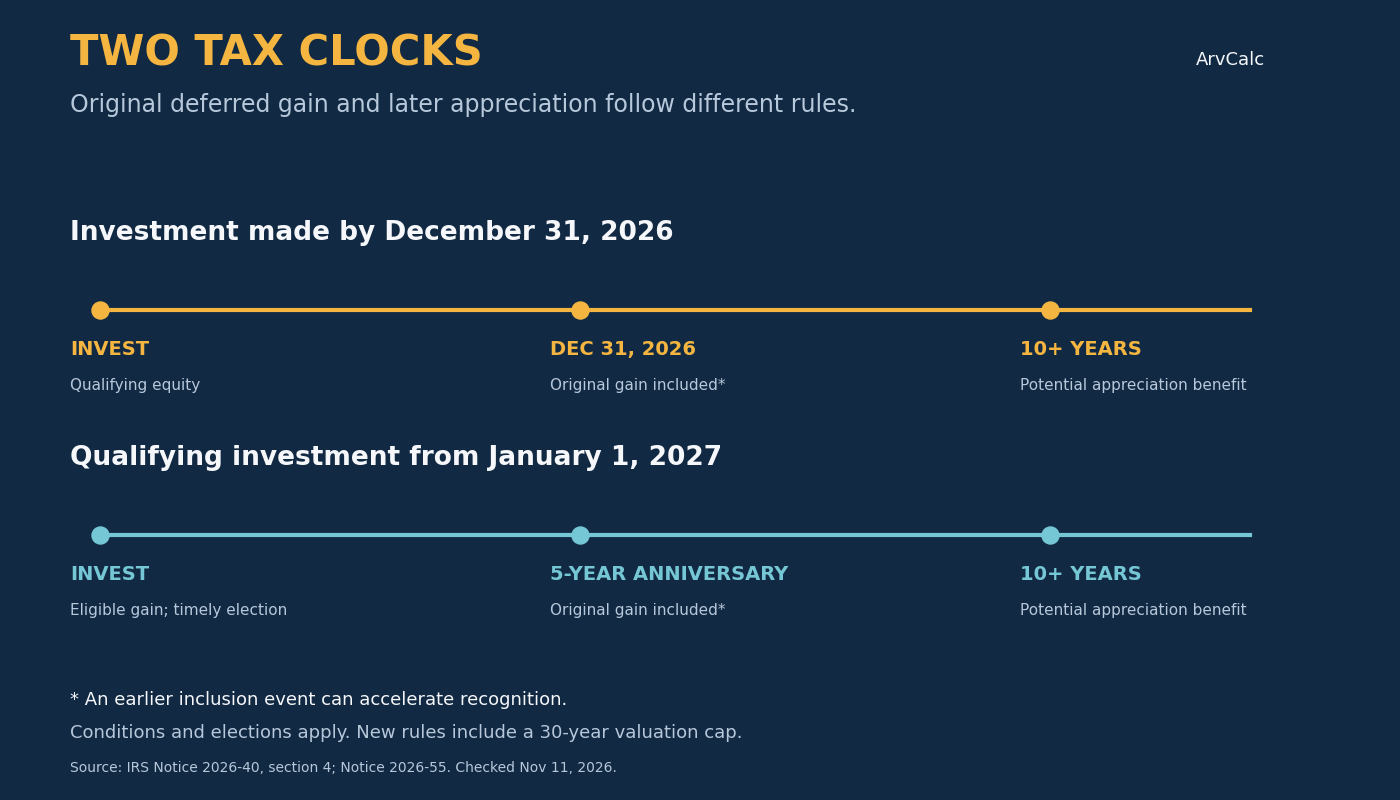
Under the original framework, a qualifying investment could defer eligible gain until an earlier inclusion event or December 31, 2026. Earlier investors may have earned basis increases after five or seven years. A person making a new investment late in 2026 cannot complete those holding periods before that year-end inclusion date.
The ten-year holding rule serves a separate purpose. With the required election and continued compliance, a qualifying investment may receive a basis adjustment that excludes qualifying appreciation on disposition. Recognizing the original deferred gain in 2026 does not, by itself, force you to sell the fund interest or cancel that potential later benefit.
The IRS explains this distinction in Notice 2026-40, section 4. It also addresses the transition between investment dates. The notice describes rules Treasury and the IRS intend to include in regulations; it should be read with the statute and any later guidance.
For a wider comparison of tax planning approaches, see our investment property capital gains guide. This article focuses on the Opportunity Zone transition and the cash needed to carry an investment through it.
Opportunity zone investing: 2026 versus 2027 rules
The 2025 legislation made the incentive permanent and changed the treatment of amounts invested after December 31, 2026. “Permanent” describes the program. Individual investments still have deadlines and compliance requirements. A sale, exchange, or another inclusion event can end an investor’s deferral earlier than the scheduled date.
| Question | Qualifying investment made by December 31, 2026 | Qualifying investment made from January 1, 2027 |
|---|---|---|
| When does original gain become includible? | Generally the earlier inclusion event or December 31, 2026. | Generally the earlier inclusion event or five years after investment. |
| What is the five-year basis increase? | 10% for investors who satisfy the holding period before the fixed inclusion date. | 10% of deferred gain; 30% for a qualifying rural fund investment. |
| Does the old seven-year increase continue? | An additional 5% may apply to eligible older investments. | The new framework does not retain that additional seven-year increase. |
| What happens after at least ten years? | A qualifying election may exclude appreciation, subject to the original rules. | A qualifying basis election remains available; the new framework adds a 30-year valuation cap. |
| Must the fund distribute cash for your tax bill? | Do not assume a distribution is available. | Do not assume a distribution is available. |
The post-2026 changes are summarized in IRS Notice 2026-55. For new investments, the ten-year basis election uses fair market value at sale or exchange, capped at the value on the investment’s thirtieth anniversary. That is not a thirty-year deferral of the original gain.
These are federal rules. Your state may treat the investment differently. Ask your adviser to separate federal capital gains tax, any applicable net investment income tax, and state tax instead of applying a single nationwide “OZ savings” percentage.
Can a late-2026 gain use the 2027 rules?
Potentially, yes. Notice 2026-40, section 4.02, addresses eligible gains realized on, before, or after December 31, 2026 that are timely invested in a QOF on or after January 1, 2027. The date of realization alone does not decide which investment framework applies.
Consider a hypothetical investor who realizes an eligible gain on November 10, 2026 and subscribes to a qualifying fund on January 15, 2027. Those dates are within the ordinary 180-day window. If the taxpayer and investment meet the requirements, the new investment can fall under the rolling five-year framework. With no earlier inclusion event, the fifth anniversary would be January 15, 2032.
This example does not establish your deadline. Partnership gains, installment transactions, and other situations can have different timing rules. Before delaying a subscription, obtain a written calculation of the applicable investment window and confirm when the fund actually accepts your capital as equity.
The IRS investor guidance explains the general 180-day requirement and the need for an equity interest. A loan to a fund is not the same qualifying investment.
There is also a limit on recycling old deferred gain. Notice 2026-40 says deemed included gain recognized at December 31, 2026 cannot simply receive another deferral election while the original qualifying investment remains in place. A genuine disposition can raise different questions. Do not build a plan around automatically rolling the year-end inclusion into a new five-year clock.
Worked example: a 2026 tax bill without a cash distribution
Assume a hypothetical U.S. investor contributed $200,000 of eligible gain to a qualifying fund on November 1, 2020. The investment remains compliant and is worth at least $200,000 on December 31, 2026. Assume the only basis adjustment is the earned five-year increase. The investor has not completed seven years.
For this teaching example, use an assumed combined federal tax rate of 23.8%. This is an input, not a statement that every investor owes that rate. Ignore state tax and other adjustments.
| Step | Calculation | Amount |
|---|---|---|
| Five-year basis increase | $200,000 × 10% | $20,000 |
| Original gain included | $200,000 − $20,000 | $180,000 |
| Illustrative tax provision | $180,000 × 23.8% | $42,840 |
| Cash already reserved | Assumed available cash | $12,000 |
| Unfunded tax provision | $42,840 − $12,000 | $30,840 |
The fund does not have to sell a building for the inclusion date to arrive. The investor can face a $30,840 reserve gap while continuing to own the interest. A property-level refinance may be possible, but refinancing proceeds, lender approval, and distribution permissions are separate assumptions.
What happens if the fund distributes nothing? The tax funding plan needs an answer before year-end. Start with a dedicated reserve, compare it with the projected liability, and ask the adviser when payments are required. December 31 is the inclusion date, not a universal payment deadline. Estimated-tax rules and filing circumstances still matter.
Our rental cash reserve guide covers operating liquidity. Keep this investor tax reserve separate from the money a property needs for vacancies, repairs, and debt service.
Worked example: a standard fund versus a qualified rural fund
Now assume a new, fully qualifying $200,000 gain investment on January 15, 2027. It stays invested for five years without an earlier inclusion event, retains sufficient value, and has no other basis adjustments. Hold the example’s assumed tax rate at 23.8% to isolate the basis effect. Actual 2032 tax treatment and rates require review then.
| Hypothetical five-year result | Standard QOF | Qualified rural opportunity fund |
|---|---|---|
| Eligible gain invested | $200,000 | $200,000 |
| Basis increase | 10% = $20,000 | 30% = $60,000 |
| Original gain included | $180,000 | $140,000 |
| Tax at assumed 23.8% | $42,840 | $33,320 |
The difference in this simplified tax provision is $9,520. That amount does not tell you which investment is better. Differences in fees, leasing, financing, or exit value can exceed it. Compare the same holding period and include every investor cash payment in both models.
A rural property address alone does not establish eligibility for the 30% increase. The investment must meet the qualified rural opportunity fund requirements. A separate rule also reduces the substantial-improvement threshold for qualifying property in an Opportunity Zone comprised entirely of a rural area. The IRS rural incentives explanation distinguishes these changes.
Have the sponsor document which provision applies to the fund and which applies to the property. Treat a promised rural benefit as an item to verify in the documents, rather than a reason to skip the operating analysis.
Include the tax payment when comparing investment returns
A return model can look attractive because it leaves out a cash payment that the investor must make outside the fund. For opportunity zone investing, the original-gain tax can be that missing payment. Put it on the timeline even when the sponsor’s projection does not show it.
Use another hypothetical U.S. fund example: $200,000 invested at time zero, $10,000 annual investor cash distributions for ten years, and $300,000 net exit proceeds in year ten. The exit amount includes returned capital. Assume the distributions are after their associated investor taxes and fees, and the exit amount reflects the qualifying appreciation treatment. These are modeling assumptions, not a forecast.
With annual end-of-year timing, the model produces an IRR of approximately 8.39% if it omits tax on the original gain. Add the $42,840 payment at the end of year five, and the modeled IRR falls to about 6.53%. Year-five net cash becomes negative $32,840 after the $10,000 distribution.
In a downside case, reduce annual distributions to $6,000 and net exit proceeds to $240,000. Keep the same tax provision solely for comparison. The annual model returns approximately 2.61%. A real decline in value could change the tax calculation as well, so rerun both parts when assumptions change.
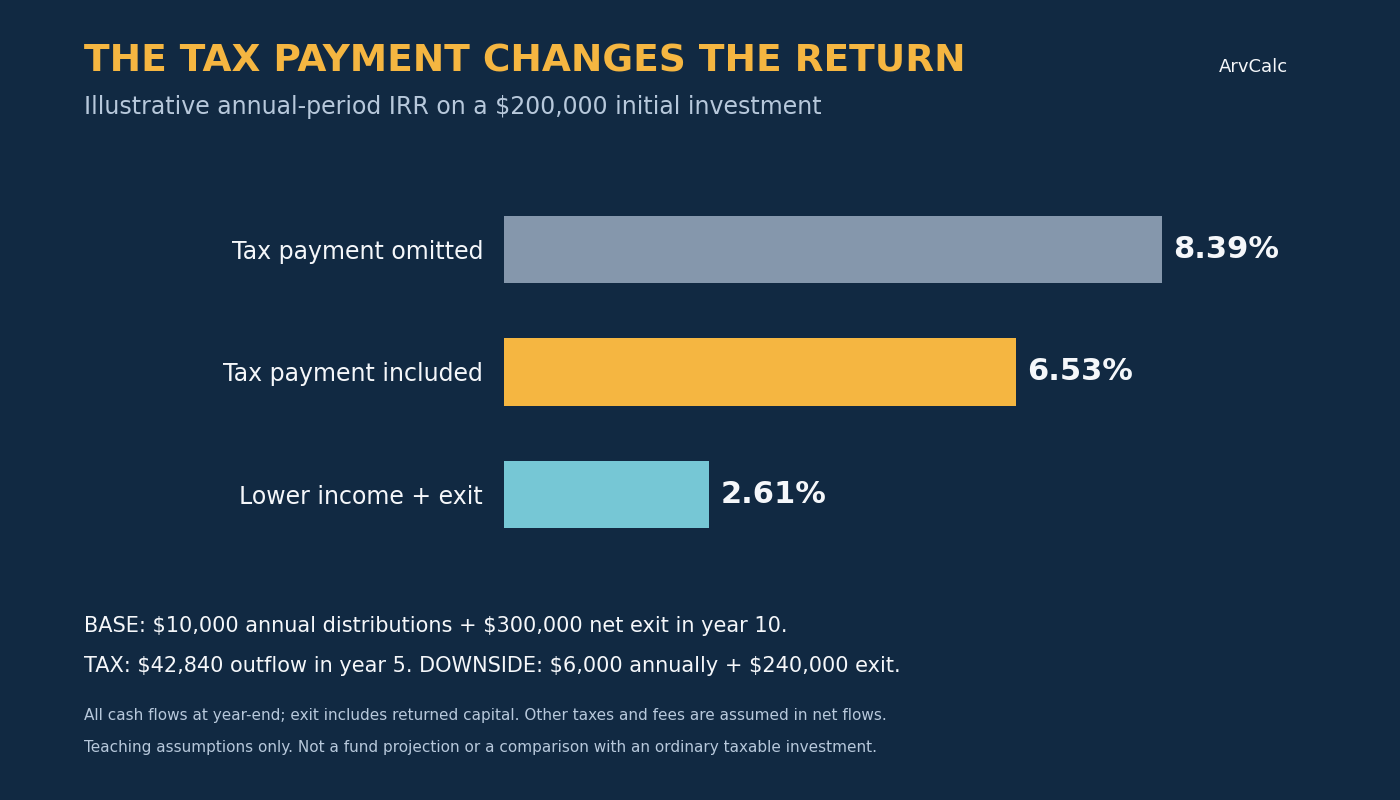
Run the same cash-flow assumptions in the real estate IRR calculator. Keep the original-gain tax separate from sale tax so it appears once, in the correct period. Exact dates matter for a real transaction; use a dated cash-flow calculation when annual periods are too coarse.
Verify the 2027 zone designation for the actual property
On November 5, 2026, Treasury and the IRS announced 6,576 designated census tracts for the new cycle, including 2,594 rural tracts. The designations take effect January 1, 2027. The official announcement links to the full list and map.
Match the property’s tract to the applicable list and effective date. A marketing brochure showing an older Opportunity Zone map is insufficient evidence for a new acquisition. Existing projects also have transition provisions, so a tract’s status cannot be assessed from a single headline about the new map.
Zone designation does not establish that a specific fund interest qualifies or that a building will lease successfully. Ask for the property acquisition date, the applicable tract identifier, and an explanation of the fund’s compliance approach. A tax adviser should review transition provisions where a project spans the two systems.
Then check the property as an investment: rents supported by comparable leases, documented expenses, and a financing plan that works without an optimistic refinance. Our investment property due diligence checklist can organize those operating questions.
Questions to resolve before you subscribe
Request a cash-flow schedule that distinguishes property operations from investor distributions. A building can report positive net operating income while debt service, construction spending, or fund expenses leave little distributable cash. The NOI calculator helps check the operating layer, but does not determine the cash a limited partner receives.
- Eligibility: Which gain is being invested, who makes the election, and what is the documented deadline?
- Fund status: How is QOF compliance monitored, and what supports any claimed rural-fund status?
- Liquidity: Are tax distributions required, discretionary, or absent? What happens if refinancing fails?
- Economics: Which fees apply before and after the investment, and how does the distribution waterfall work?
- Exit: What happens if assets sell before your ten-year holding period is complete?
Read the answers against the operating agreement and offering documents. An anticipated refinancing is not cash already available to pay tax. Compare lender restrictions with the sponsor’s distribution schedule, and examine a scenario with no distribution in the inclusion year.
For an individual rental project’s operating assumptions, the rental property calculator can help stress-test rent and expenses. A pooled fund still needs a separate investor model for fees, capital calls, and the distribution waterfall.
Five common opportunity zone investing mistakes
- Calling 2026 the end of the program. It is a fixed inclusion date under the original investment rules. The new framework begins in 2027.
- Expecting a new 2026 investment to earn an old five-year benefit. A few weeks cannot satisfy a five-year holding requirement before December 31.
- Assuming every sale profit qualifies. Confirm the character of the gain. Ordinary dealer income and depreciation recapture should not be treated automatically as eligible capital gain.
- Treating the ten-year benefit as a blanket exemption. Original gain, annual operating income, and qualifying appreciation have different treatment.
- Leaving the inclusion-year tax out of the model. The obligation can arise even when the fund makes no distribution.
The IRS identifies eligible capital gains and qualified section 1231 gains in its investor guidance. For a property sale, a CPA should separate the gain components before you choose an investment amount. Our capital gains calculation guide explains the baseline inputs, including adjusted basis and accumulated depreciation.
A calculator workflow with clear limits
Begin with the sale outside the fund. Use the capital gains tax calculator to estimate the baseline under your entered assumptions. It is not an Opportunity Zone eligibility engine and does not automatically apply the investment-date rules, rural-fund basis increase, or investor elections.
Next, obtain an adviser-reviewed original-gain tax estimate for the relevant inclusion year. Put that estimate into the investor cash-flow schedule. In ArvCalc’s IRR tool, a year-specific additional contribution can represent the cash outflow for modeling purposes; label it clearly in your working notes. Its economic use in the model does not mean the payment legally becomes fund capital.
Finally, compare the expected case with lower distributions, a smaller exit, and an earlier sale. Check whether the assumed tax treatment survives each scenario. A spreadsheet with exact dates is preferable when the annual model puts an investment anniversary and payment date into different periods.
Opportunity zone investing starts with three numbers you can use: the eligible gain, the tax cash required in the inclusion year, and the return after that payment. Make those numbers explicit before comparing fund marketing projections.
Frequently asked questions
Does opportunity zone investing end in 2026?
No. The original framework generally brings deferred gains into income by December 31, 2026. The program continues with a new framework for qualifying amounts invested from January 1, 2027, including a rolling five-year deferral subject to earlier inclusion events.
Can I invest a 2026 capital gain in a QOF during 2027?
Potentially. IRS Notice 2026-40 addresses eligible gains realized before 2027 that are timely invested on or after January 1, 2027. You must meet the applicable investment window and all other requirements. Confirm the deadline for your specific gain with a tax adviser.
Do I have to sell my existing fund investment in December 2026?
The gain-inclusion date does not itself require a sale. You may still qualify for a later appreciation benefit if you meet the holding period, election, and other requirements. You nevertheless need a source of cash for the original-gain tax obligation.
Does holding an Opportunity Zone investment for ten years eliminate all taxes?
No. A qualifying election can affect appreciation on the investment. It does not automatically eliminate tax on the original deferred gain, annual operating income, or every state tax obligation. The post-2026 rules also limit the valuation used for the basis adjustment after thirty years.
Does buying a rental house in an Opportunity Zone qualify automatically?
No. Location alone is insufficient. The investor must meet the QOF investment requirements, and the fund and its property or business must satisfy the applicable rules. Ordinary ownership of a house in a designated tract does not automatically create the investor benefit.
How much cash should I reserve for the 2026 inclusion?
Use an adviser-reviewed estimate based on the remaining deferred gain, investment value, adjusted basis, and applicable taxes. Subtract cash already reserved and only count distributions you can reasonably support. The worked example has a $42,840 tax provision and a $30,840 funding gap.
Can the ArvCalc calculators apply all Opportunity Zone rules?
No. Use the capital gains tool for a baseline and the IRR tool to model cash-flow timing. Supply an independently reviewed tax amount. The calculators do not certify a QOF, decide gain eligibility, verify a zone designation, or make tax elections.