
Last updated: November 23, 2026 · Originally published: November 12, 2026 · By Alex Petrov
The tax bill on a Michigan listing can be the least reliable number in the whole deal. A seller who has lived in a house since 2009 may pay under $2,000 a year, and the investor who buys it can owe three times that amount the following year. This guide turns that jump into a Michigan property tax calculator you can run on paper before you make an offer, and shows what it does to cash flow and DSCR. To see how Michigan compares with the rest of the country, check our property tax rates by state ranking.
Rules checked November 12, 2026, against Michigan statutes, Treasury guidance and the 2026 State Tax Commission multiplier. Educational analysis, not tax or legal advice. Confirm values and millage with the local assessor and treasurer.
Why the seller’s Michigan property tax bill misleads investors
Michigan taxes property on taxable value, and taxable value usually grows more slowly than the market. Proposal A, approved by voters in 1994, limits the yearly increase for an existing owner to the lesser of 5% or the inflation rate multiplier. For 2026 the State Tax Commission set that multiplier at 1.027, which means a 2.7% cap. Over fifteen years of rising prices, a gap opens between what a house is worth and what its owner is taxed on.
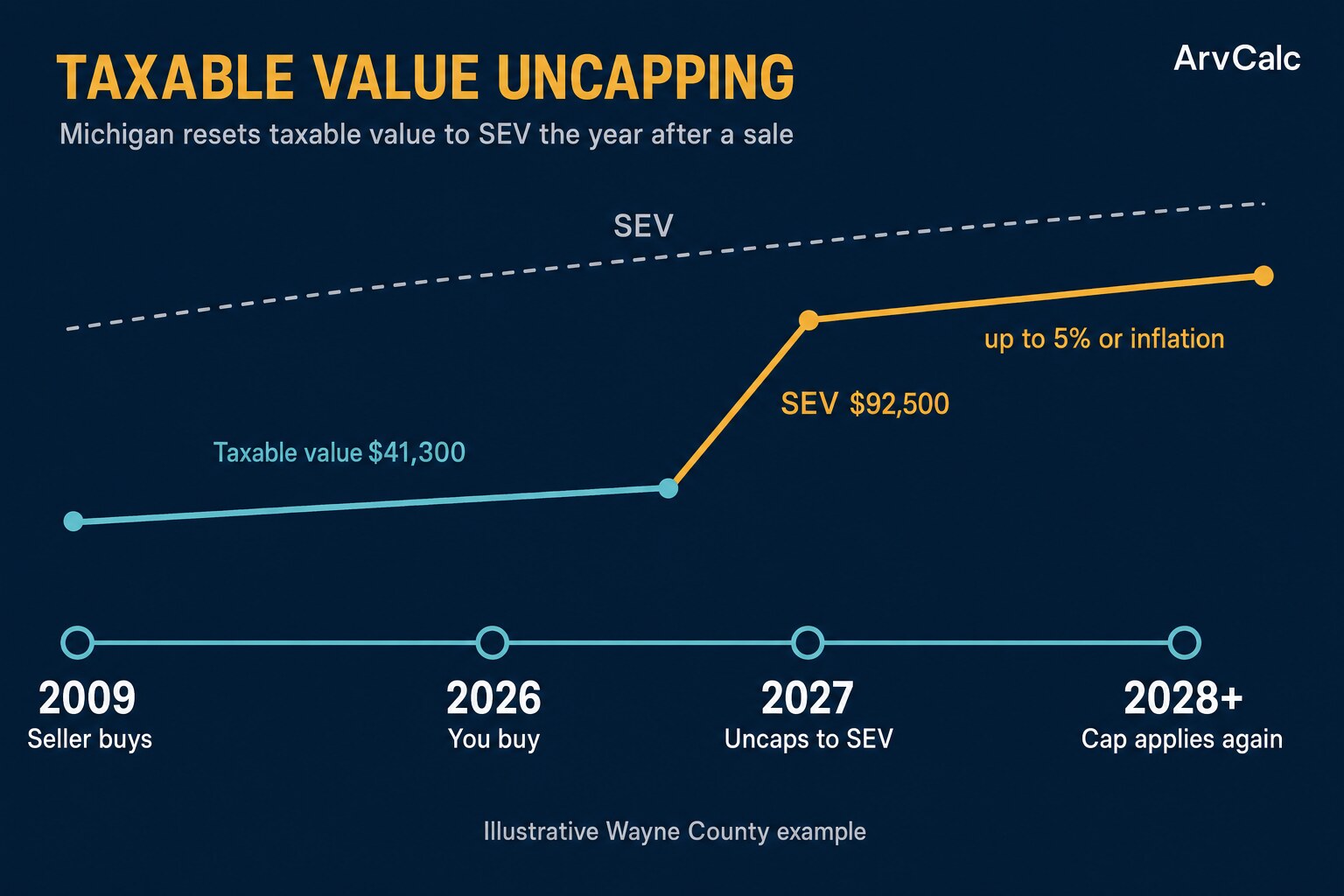
The cap belongs to the owner, not to the house. When ownership transfers, the law “uncaps” taxable value in the year after the transfer and sets it equal to SEV. You can read the rule in MCL 211.27a and in the Michigan Treasury’s Transfer of Ownership Guidelines. A sale by deed counts, and so does a land contract.
The second change is about who lives in the home. An owner-occupied principal residence is exempt from up to 18 mills of local school operating tax under the Principal Residence Exemption (PRE). A rental does not qualify. So a long-time owner-occupant’s bill is low for two reasons at once, and you lose both of them when you buy the property as an investment.
Listing sites rarely explain any of this. They show last year’s bill, which reflects the seller’s capped value and, often, the seller’s exemption. If you plug that number into a rental property calculator, every result downstream is too optimistic: NOI, cap rate, DSCR and cash-on-cash return.
Three numbers on every Michigan tax record
Most Michigan assessors publish parcel data online, often through a BS&A or county portal. Any Michigan property tax calculator is only as good as these inputs. You need three figures from that record, plus the millage rate from the tax bill or the local treasurer.
| Term | What it means | How investors use it |
|---|---|---|
| True cash value | The assessor’s estimate of market value | Compare it with your purchase price; assessors work from sales studies, so it can lag the market |
| Assessed value / SEV | Generally 50% of true cash value, after county and state equalization | Your best estimate of taxable value in the year after you buy |
| Taxable value | The capped value that the bill is calculated on | Shows how far below SEV the seller’s value sits today |
| Millage | Tax per $1,000 of taxable value, summed across city, county, schools and other units | Use the non-homestead (non-PRE) rate for a rental |
A mill is $1 of tax for every $1,000 of taxable value. Sixty mills therefore equals 6% of taxable value, which is about 3% of market value, because taxable value starts near half of market value. Look at the gap between SEV and taxable value on the record. A large gap tells you the next owner will pay much more.
Some local units also add a property tax administration fee of up to 1% to the bill. Check the treasurer’s page so you do not miss it.
Michigan property tax calculator: four steps for a rental
This is the calculation the assessor will make for you the year after closing. Run it before you sign.
- Estimate next year’s SEV. Start with the current SEV on the record. If you are paying well above the assessor’s true cash value, expect the assessor to move toward recent sales over time. A cautious figure is 50% of your purchase price.
- Find the non-homestead millage. Take the total from the summer and winter bills for that parcel’s school district and city or township. If the seller had a PRE, add back the school operating millage (up to 18 mills) to reach the rental rate.
- Calculate the uncapped tax. Annual tax = estimated SEV × non-homestead mills ÷ 1,000. Add any administration fee.
- Replace the listing figure. Enter the new tax in the Michigan rental property calculator, then check the result in the DSCR calculator if you plan to use a DSCR loan.
Here is the formula in one line, using an illustrative 63 mills: a $185,000 purchase gives an estimated SEV of $92,500, and $92,500 × 63 ÷ 1,000 = $5,828 a year. Your parcel’s millage will differ, so treat 63 mills as a placeholder, never as a statewide rate.
Why use SEV rather than half the price straight away? Assessors set SEV from sales studies across the neighborhood, and a single purchase price does not overwrite it. If you paid a premium for a renovated house, SEV may trail your price for a year or two before it catches up.
Worked example: a long-held house in Wayne County
Picture an investor named Maria looking at a three-bedroom single-family house in a Wayne County suburb in late 2026. The asking price is $185,000. The listing shows annual taxes of $1,859, and the seller has owned and lived in the house since 2009.
The parcel record tells a different story. Taxable value is $41,300, while the assessor’s true cash value is in line with the price. Maria assumes a 2027 SEV of $92,500 and a total rate of 63 mills for non-homestead property, or 45 mills with the PRE. Those millage figures are illustrative assumptions for this example.
| Line | Seller’s bill used in the listing | Maria’s bill after uncapping |
|---|---|---|
| Taxable value | $41,300 | $92,500 |
| Millage | 45 mills (PRE) | 63 mills (non-homestead) |
| Annual property tax | $1,859 | $5,828 |
| Difference | +$3,969 a year, or about $331 a month | |
Now run the deal. Rent is $1,650 a month, or $19,800 a year. After a 6% vacancy allowance, effective gross income is $18,612. Other operating costs are insurance of $1,500, maintenance and capital reserves at 8% of rent ($1,584) and management at 9% of collected rent ($1,675). Together they total $4,759. Maria plans a 25% down payment, so the loan is $138,750 at 7.0% over 30 years, with annual payments of $11,077.
| Metric | With the seller’s tax | With the uncapped tax |
|---|---|---|
| Net operating income | $11,994 | $8,025 |
| Cap rate on $185,000 | 6.48% | 4.34% |
| DSCR | 1.08 | 0.72 |
| Annual cash flow after debt service | +$917 (about $76 a month) | −$3,052 (about −$254 a month) |
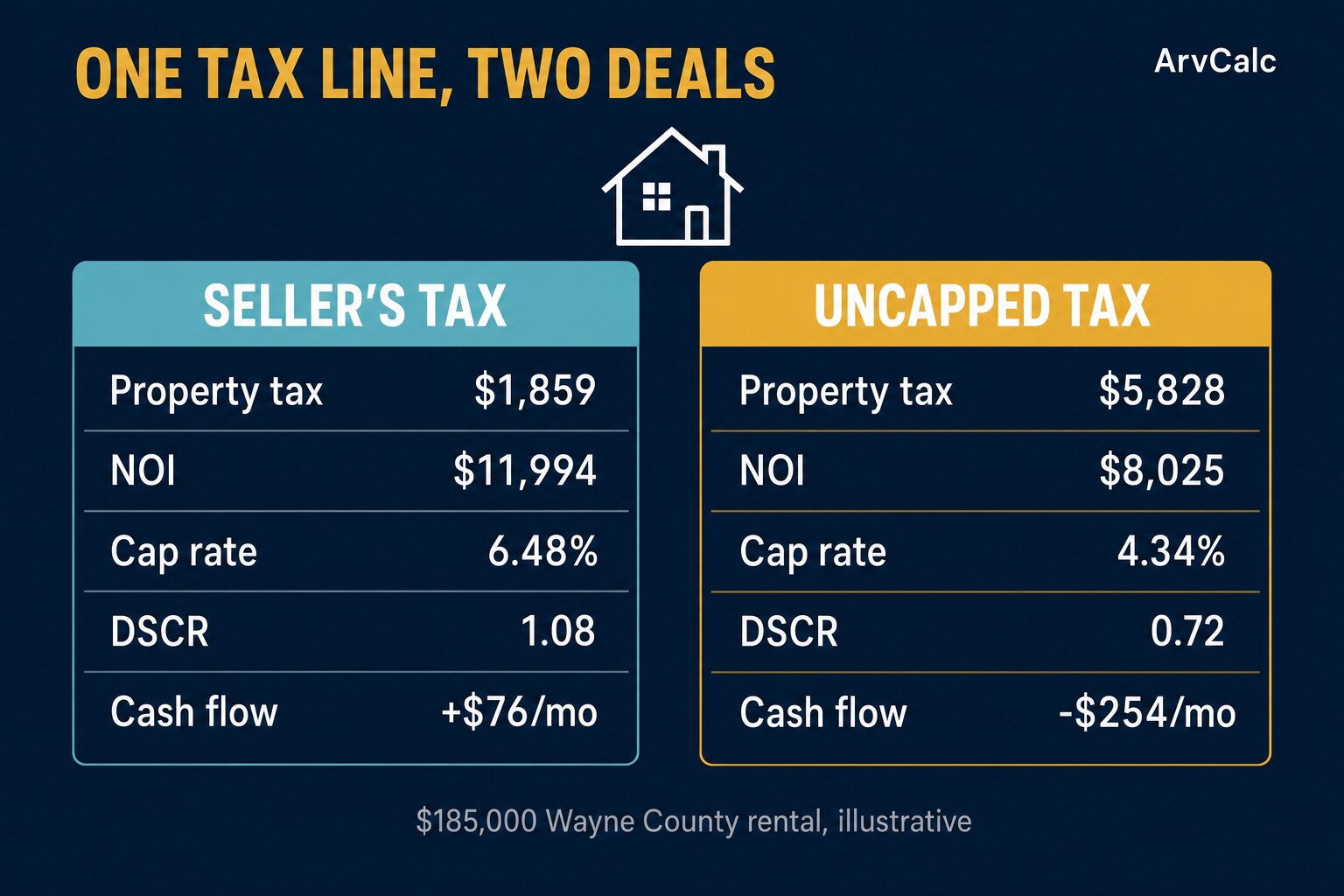
The deal turns from thin to negative because of one line. Most DSCR lenders look for a ratio of at least 1.0 to 1.25, so the uncapped version may not qualify at all. If Maria wanted the property at the 6.48% cap rate the listing implied, the uncapped NOI supports a price of roughly $124,000, not $185,000.
She has three honest options: negotiate with the parcel record in hand, find more rent, or walk away. Paying the asking price and hoping the assessor will not notice is not one of them, because every sale is reported to the assessor.
Worked example: a house bought from a flipper
Uncapping does not always hurt this much. Suppose the same $185,000 house was bought by a flipper in 2025 for $150,000. The flipper never lived there, so there was no PRE. Taxable value uncapped to an SEV of $75,000 for 2026, and the 2026 bill at 63 mills is $4,725.
When Maria buys it, taxable value uncaps again for 2027. With an SEV of $92,500, her bill becomes $5,828, which is $1,103 more than the listing figure. That is still worth modeling, yet the shock is about a quarter of the first example. A recent sale, a non-homestead history and a small gap between SEV and taxable value all point to a smaller surprise.
The lesson for screening is simple. Before you analyze rent, check the sale history and the PRE status on the parcel. Those two facts tell you whether the listed tax is close to reality or far below it.
What happens to Michigan property tax after the first uncapped year
Once your taxable value has been reset, the cap starts working for you, and the Michigan property tax calculator math gets easier to project. From then on, taxable value can rise by no more than the lesser of 5% or the inflation multiplier each year, plus the value of additions such as a new garage or finished basement. If SEV ever falls below that capped figure, taxable value follows SEV down.
Here is how that plays out for Maria. If the market rose 6% after 2027, her SEV would go to about $98,050, but her taxable value would be limited by the multiplier. At a 2.7% increase it would be about $94,998, giving a bill of roughly $5,985 at the same 63 mills. The multiplier for each year is published by the State Tax Commission; the 2026 figure of 1.027 is summarized in the Michigan Municipal League’s 2026 Headlee and inflation rate fact sheet.
Millage can also change. Voters approve new levies and renewals, and the Headlee rollback can reduce rates when values rise quickly. Build a small annual increase into long-term projections and revisit it when the winter bill arrives. For a full list of costs to model, see our rental property expenses guide.
Deadlines, forms and appeals for Michigan rental owners
A few dates matter more to investors than to homeowners:
- Property Transfer Affidavit (Form 2766, L-4260). The buyer files it with the local assessor within 45 days of the transfer. For residential property, the late penalty is $5 a day, up to $200. Filing late does not avoid uncapping; it only delays it, and the assessor can bill the missed taxes later.
- PRE status. If you will not live in the property, do not claim the exemption. If you convert your own home to a rental, the owner must rescind the PRE, and the school operating millage applies from the following year. A wrongly kept exemption can be denied for prior years, with tax and interest.
- Owner-occupied duplex. If you live in one unit, the exemption can apply to the part you occupy. The assessor sets the percentage, so ask before you underwrite.
- Appeals. Assessment disputes usually start at the local March Board of Review. Notices of uncapping or added taxes under MCL 211.27b can be appealed to the Michigan Tax Tribunal within 35 days of the notice.
Transfer tax is a separate, one-time cost at closing. The state charges $3.75 per $500 of value and most counties add $0.55 per $500, a combined $8.60 per $1,000. By custom the seller pays it, although it can be negotiated. On a $185,000 sale it comes to about $1,591. Our Michigan closing costs guide covers the other fees.
Five mistakes that break Michigan rental underwriting
- Using the listing’s tax figure. It reflects the seller’s capped value and, possibly, the seller’s exemption. Replace it with your own SEV-based estimate.
- Using the homestead millage. Rentals pay the school operating levy. A rate taken from an owner-occupied bill can be 18 mills too low.
- Ignoring the tax proration at closing. Proration splits the current year’s bills, which are still based on the seller’s numbers. A small credit in 2026 says nothing about your 2027 cost.
- Forgetting the escrow reset. If your lender escrows taxes, the payment will rise after the first uncapped bill. Plan for a shortage notice and a higher monthly payment.
- Valuing the deal on the wrong NOI. A buyer who applies a market cap rate to an NOI built on the seller’s tax can overpay by tens of thousands of dollars, as the Wayne County example shows.
If you are investing from out of state, add these checks to your due diligence checklist and keep extra money for the first bill in your cash reserves.
What the ArvCalc calculators can and cannot do
The Michigan investment calculators start with a statewide average tax rate as a default, so you should replace it with your parcel’s estimate. Once you enter the uncapped tax, the tools show its effect on cash flow, cap rate, DSCR and returns.
The calculators do not look up a parcel, predict an assessor’s SEV, read a millage schedule or decide whether you qualify for an exemption. Those facts come from the assessor, the treasurer and your closing documents. Treat the output as a test of the deal under clear assumptions, and rerun it when the real figures arrive.
Related tools and guides for Michigan investors:
- Michigan rental property calculator
- Michigan cap rate calculator
- Michigan DSCR calculator
- Property cash flow calculator
- Michigan rental property investment guide
- Michigan cap rates by city
The short version: price a Michigan rental on the bill you will pay, not the bill the seller paid. A two-minute Michigan property tax calculator check on the parcel record can be the difference between a deal that pays you and one that you pay for every month.
Frequently asked questions
How do I calculate property tax on a Michigan rental?
Multiply the estimated taxable value by the total non-homestead millage and divide by 1,000. After a purchase, taxable value resets to SEV in the following year, so use the current SEV or about half of a market-level price as your estimate.
When does taxable value uncap after I buy?
In the tax year after the transfer. A purchase that closes in 2026 normally produces an uncapped taxable value on the 2027 assessment, which then drives the 2027 summer and winter bills.
Do rental properties get the Principal Residence Exemption?
No. The PRE is for an owner’s principal residence. A rental, vacation home or vacant property pays the local school operating millage of up to 18 mills. An owner who lives in one unit of a duplex may receive a partial exemption for that unit.
How much can taxable value increase each year?
For a continuing owner, the increase is limited to the lesser of 5% or the inflation rate multiplier, plus additions. The State Tax Commission set the 2026 multiplier at 1.027, a 2.7% cap. The limit no longer protects the property once it transfers.
What happens if I file the Property Transfer Affidavit late?
The residential late penalty is $5 a day after 45 days, up to $200. The taxable value still uncaps, and the assessor can bill the taxes that should have been levied in earlier years, together with interest and penalties.
Who pays Michigan transfer tax on a rental purchase?
By custom the seller pays it, though the parties can agree otherwise. The combined state and county rate is $8.60 per $1,000 of value in most counties. It is a closing cost, separate from the annual property tax.
Can I appeal a higher assessment after uncapping?
Uncapping itself follows the statute, but you can challenge the assessor’s value. Assessment appeals usually go to the March Board of Review first. Notices of uncapping or added taxes can be appealed to the Michigan Tax Tribunal within 35 days.
Leave a Reply