
Last updated: November 24, 2026 · Originally published: November 22, 2026 · By Alex Petrov
Rent increase laws by state decide three things every landlord needs to know before sending a renewal letter: how much the rent can go up, how many days of written notice the tenant must get, and how often a rent increase is allowed. In 2026 only three states cap the rent increase on most private rentals statewide: California, Oregon and Washington. New York adds strict notice tiers and a “reasonable increase” test where its Good Cause Eviction law applies, and states such as Colorado limit you to one rent increase a year. Most other states, including Texas, Florida, Arizona and North Carolina, ban local rent control, but that does not mean anything goes. This guide compares the rules in nine key states, shows the 2026 caps in dollars, and walks through the costly mistakes that turn a routine rent increase into a refund, a penalty or a vacant unit.
Laws checked November 21, 2026 against the state statutes and agency pages listed in the Sources section. Dollar examples are calculations on a hypothetical $2,000 monthly rent. Cities and counties can add their own rules where state law allows it, and exemptions depend on the facts of each property. Educational analysis, not legal advice.
How rent increase laws by state work
Every state’s rules can be read as answers to four questions. If you check all four before each renewal, you will catch nearly every problem that shows up in landlord-tenant court.
- Is there a cap? A cap limits the percentage a landlord can raise the rent over a 12-month period. California, Oregon and Washington have statewide caps. In New York, Good Cause Eviction uses a “local rent standard” as a test of whether an increase is reasonable in covered areas. Elsewhere, any cap comes from local rent control, and most states forbid it.
- How much notice? Notice rules set the minimum number of days between the written notice and the date the higher rent takes effect. They range from 30 to 90 days in the states below and often grow with the size of the rent increase or the length of the tenancy.
- How often? Some states allow only one rent increase in any 12 months (Oregon, Colorado), and some prohibit any increase in the first year (Oregon, Washington). California allows no more than two increments within 12 months.
- When can it take effect? A fixed-term lease generally locks the rent until the term ends unless the lease itself provides for a change. Washington writes this directly into its statute: an increase may not take effect before the rental agreement term is complete.
One more rule matters for investors: in the capped states, the cap applies to the sitting tenant. When a tenant moves out and a new tenancy begins, California, Oregon and Washington all let the landlord set the new rent at market, with one important Oregon exception covered below. To see what market rent looks like in each state, check our average rent by state ranking.
Rent increase laws by state: 2026 comparison table
The table covers the states with statewide caps plus the large investor markets where the state has expressly preempted local rent control. “Notice” is the statutory minimum for a typical residential tenancy; some leases require more.
| State | Statewide cap | Notice of rent increase | Frequency limits | Local rent control |
|---|---|---|---|---|
| California | 5% + regional CPI, max 10% in 12 months (Civil Code 1947.12, through 2029) | 30 days if 10% or less in 12 months; 90 days if more than 10% (Civil Code 827) | No more than 2 increments in 12 months | Allowed (stricter local laws apply) |
| Oregon | 7% + CPI, max 10%; 9.5% for 2026, 10% for 2027 (ORS 90.323, 90.324) | 90 days’ written notice; 7 days for week-to-week | None in first year; once per 12 months | State law sets the cap |
| Washington | 7% + Seattle-area CPI, max 10%; 9.683% for 2026, 10% for 2027 (RCW 59.18.700) | 90 days’ written notice (RCW 59.18.140) | None in first 12 months; cap applies per 12 months | State law sets the cap |
| New York | No general cap; Good Cause areas presume an increase above CPI + 5% (max 10%) unreasonable | 30, 60 or 90 days for increases of 5% or more (RPL 226-c) | Tied to renewal | NYC and opt-in localities (Good Cause); rent stabilization separate |
| Colorado | None | 60 days’ written notice if no written lease (CRS 38-12-701) | Once per 12 months of occupancy (CRS 38-12-702) | Prohibited (CRS 38-12-301) |
| Florida | None | No rent-specific statute; month-to-month ends on 30 days’ notice (Fla. Stat. 83.57) | None in statute | Prohibited (Fla. Stat. 125.0103) |
| Texas | None | No rent-specific statute; month-to-month ends on one month’s notice unless agreed otherwise (Prop. Code 91.001) | None in statute | Only in a disaster housing emergency with governor approval (Local Gov’t Code 214.902) |
| Arizona | None | No rent-specific statute; month-to-month ends on 30 days’ notice (ARS 33-1375) | None in statute | Prohibited (ARS 33-1329) |
| North Carolina | None | Set by the lease | None in statute | Prohibited (G.S. 42-14.1) |
The pattern is clear: rent increase laws by state split into a small group of capped West Coast states, a New York model built on notice and reasonableness, and a large group of states that block local rent control and leave the amount to the market. Even in that last group, the timing rules still bite.
States with a statewide rent increase cap

California: 5% plus CPI, never more than 10%
California’s Tenant Protection Act (Civil Code 1947.12) limits a rent increase over any 12-month period to 5% plus the percentage change in the regional Consumer Price Index, or 10%, whichever is lower. The base is the lowest gross rent charged at any time in the prior 12 months, so a temporary discount counts against you unless it is listed separately in the lease as a concession. The rent can rise in no more than two increments in 12 months.
On a $2,000 rent, a 3.0% CPI change produces an 8% cap, or $2,160. A 2.5% CPI change gives 7.5%, or $2,150. Even if inflation hits 6%, the 10% ceiling holds the rent at $2,200. The cap does not apply to housing with a certificate of occupancy issued within the previous 15 years, to qualifying affordable housing, or to a single-family home or condo that is not owned by a REIT, a corporation or an LLC with a corporate member, provided the tenant received the exact written exemption notice the statute prescribes. Skipping that notice is one of the most costly mistakes a small California landlord can make, because without it the exemption is lost. The statute is set to remain in effect until January 1, 2030.
Notice is separate. Under Civil Code 827, a month-to-month rent increase of 10% or less within 12 months needs at least 30 days’ written notice; above 10% it needs 90 days (possible only for exempt units). Serving by mail adds extra days under the Code of Civil Procedure. Many California cities, including Los Angeles and San Francisco, have stricter local rent control, and where it is stricter, the local rule wins.
Oregon: 9.5% for 2026, 10% for 2027
Oregon was the first state to adopt statewide rent stabilization. ORS 90.323 bars any rent increase during the first year of a tenancy, requires at least 90 days’ written notice after that, allows only one rent increase in any 12-month period, and limits the amount to the percentage the Department of Administrative Services publishes each September: 7% plus CPI, but never more than 10%. The published limit is 9.5% for 2026 and 10% for 2027. On a $2,000 rent, that is $2,190 in 2026 and $2,200 in 2027.
The notice must state the amount of the increase, the new rent and the effective date. Units whose first certificate of occupancy is less than 15 years old are exempt from the percentage cap, but not from the first-year ban, the 90-day notice or the once-a-year rule. The penalty for exceeding the cap is three months’ rent plus actual damages, or $6,000 plus damages on a $2,000 unit. Oregon also closes a loophole: if a landlord ends a tenancy without cause during the first year, the next tenant’s rent cannot exceed what the cap would have allowed for the old tenant.
Washington: 9.683% for 2026, 10% for 2027
Washington’s 2025 law (RCW 59.18.700, in effect since May 7, 2025) caps any rent increase at 7% plus the June Seattle-area CPI, or 10%, whichever is less, and bans increases during the first 12 months of a tenancy. The Department of Commerce sets the number each year: 9.683% for 2026 and 10% for 2027. On a $2,000 rent, the 2026 maximum is $2,193.66. RCW 59.18.140 requires at least 90 days’ prior written notice, and the increase cannot take effect before the lease term ends.
The exemptions are narrower than many landlords assume. New construction is exempt only for 12 years after the first certificate of occupancy. Owner-occupied homes that rent no more than two units or bedrooms, and owner-occupied duplexes through fourplexes, are exempt only if the owner is not a REIT, a corporation or an LLC with a corporate member. If you claim an exemption, the notice must state the facts that support it. Washington also requires parity between lease types: a month-to-month rent cannot be more than 5% higher than a 12-month lease rent for the same unit.
New York: notice tiers and the Good Cause test
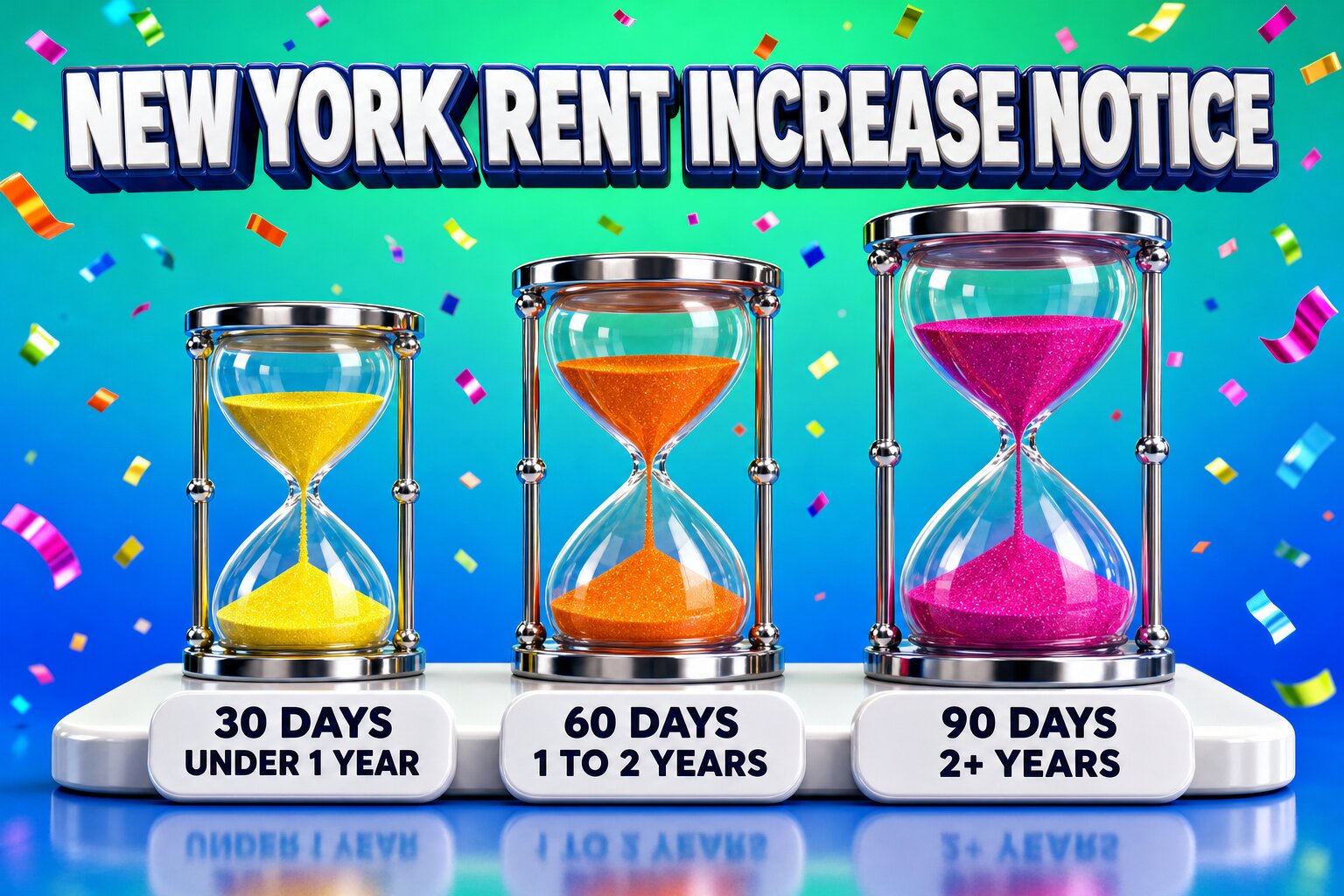
New York Real Property Law 226-c applies statewide. If a landlord plans to renew with a rent increase of 5% or more, or not to renew at all, written notice is required:
- 30 days if the tenant has lived there less than one year and does not have a lease of at least one year;
- 60 days if the tenant has lived there one to two years or has a lease of one to two years;
- 90 days if the tenant has lived there more than two years or has a lease of at least two years.
The period is based on the total time in the unit or the lease term, whichever is longer. Late notice does not void the increase, but the tenancy continues on the old terms until the full notice period has run, so a late letter costs you rent for every day you are short.
Good Cause Eviction (Real Property Law article 6-A) applies in New York City and in localities that opt in, with exemptions. It is not a hard cap. Instead, in a nonpayment case, a rent increase above the “local rent standard” (CPI plus 5%, or 10%, whichever is lower) is presumed unreasonable. The landlord can rebut that by showing rising costs such as property tax, insurance, utilities and significant repairs. Rent-stabilized apartments follow their own separate rules. For a landlord with a market-rate unit in a covered area, the practical limit on a rent increase is the local rent standard unless you can document higher costs.
States that ban rent control: Colorado, Florida, Texas, Arizona and North Carolina
Rent increase laws by state look the most relaxed here. Most popular investor states have a preemption statute that stops cities and counties from capping rent. That makes the amount of a rent increase a market decision, but the procedure still matters.
- Colorado: CRS 38-12-301 bars local rent control. But CRS 38-12-702 allows only one rent increase in any 12 months of consecutive occupancy, whatever the lease type, and CRS 38-12-701 requires 60 days’ written notice when there is no written lease. In a tenancy without a written lease, a landlord also may not serve a notice to quit mainly to push through a rent increase that sidesteps the notice rule.
- Florida: Fla. Stat. 125.0103 provides that a county or city may not adopt or maintain any measure that would control rents. No statute sets a rent-increase notice period, but either side can end a month-to-month tenancy with 30 days’ notice before the end of a monthly period (Fla. Stat. 83.57), so 30 days is the practical minimum lead time for a month-to-month rent increase.
- Texas: Local Government Code 214.902 allows city rent control only when a disaster creates a housing emergency and the governor approves the ordinance. A month-to-month tenancy ends one month after notice unless the parties signed a different notice period (Property Code 91.001).
- Arizona: ARS 33-1329 preempts rent control by cities and towns, except for housing owned, financed or subsidized by government. Month-to-month tenancies end on 30 days’ written notice (ARS 33-1375).
- North Carolina: G.S. 42-14.1 forbids counties and cities from regulating the amount of rent on privately owned residential or commercial rental property. The lease controls timing.
In these states the most common legal problem is not the size of the rent increase. It is timing: raising rent in the middle of a fixed-term lease that does not allow it, giving less notice than the lease requires, or treating a non-renewal as a pretext. A rent increase that looks like retaliation after a tenant complains about repairs can also create liability under the retaliation statutes many states have, so keep your reasons and comparables on file.
What an illegal rent increase costs
Penalties are what turn rent increase laws by state from paperwork into a real financial risk:
- Oregon: three months’ rent plus actual damages for exceeding the cap or for overcharging the next tenant after a first-year no-cause termination.
- Washington: refund of the excess rent and fees, up to three months of the unlawful rent, and the tenant’s attorneys’ fees. The Attorney General can add civil penalties of up to $7,500 per violation. If an increase exceeds the cap without a valid exemption, the tenant can also end the lease on 20 days’ notice before it takes effect, and the landlord may not report the unlawful portion to a tenant screening service.
- New York: a late 226-c notice keeps the old rent in place until the notice period runs, and in Good Cause areas an unreasonable increase can defeat a nonpayment eviction.
On a $2,000 rent, Oregon’s three-month penalty alone is $6,000, more than three years of the extra income from a 4% rent increase ($80 a month, or $960 a year).
How much should a landlord raise the rent? The numbers
The legal maximum is a ceiling, not a target. Here is how the decision looks on a $2,000 rental property where comparable units rent for $2,150. These are illustrative assumptions, so plug in your own figures in the vacancy rate calculator and the property cash flow calculator.
- Going straight to market (+7.5%) adds $150 a month, or $1,800 a year, if the tenant stays.
- Turnover if the tenant leaves: one month vacant ($2,150), $1,200 of make-ready work and a half-month leasing fee ($1,075) total $4,425. That is 2.46 years of the extra rent.
- A moderate 4% rent increase adds $80 a month, or $960 a year, and keeps a good tenant more likely to renew. At a 7% cap rate, $960 of extra net operating income adds about $13,714 of value.
The opposite mistake is freezing the rent for years. Five annual 3% raises take $2,000 to $2,318.55. A landlord who skips them and then tries to catch up needs a 15.9% jump, which is illegal for most units in California, Oregon and Washington, where the 10% ceiling means catching up takes two years. Over the first five years, raising rent 3% a year from year two collects $127,419 versus $120,000 with a freeze, a difference of $7,419. Small, regular, well-documented increases are both safer under rent increase laws by state and better for long-term cash flow. Our guides on increasing NOI and reducing vacancy show other ways to grow income without pushing a tenant out.
7 costly rent increase mistakes landlords make
- Raising rent mid-lease. A fixed-term lease generally sets the rent until the term ends unless it contains an escalation clause. Washington states it outright.
- Counting days wrong. Notice periods run to the effective date, and mailing can add days. Serve early and keep proof of delivery.
- Using the wrong base in California. The cap is measured from the lowest rent in the prior 12 months, including discounted months, unless concessions are listed separately.
- Assuming an exemption. California’s single-family exemption requires a specific written notice; Washington’s owner-occupied exemptions disappear if a corporation is involved; Oregon’s new-construction exemption does not waive the first-year ban.
- Two increases in a year. Oregon and Colorado allow one per 12 months, and California allows two increments that together stay within the cap.
- Raising the rent in year one in Oregon or Washington. Both states ban it outright, even if the lease is only six months long.
- Ignoring local law. State caps are floors for tenant protection. Cities in California and localities in New York can be stricter, so check the city before every rent increase.
The same discipline helps with the other money rules in your lease. See our state guides to rent late fee laws and security deposit laws, which follow the same state-by-state format.
Rent increase checklist for landlords
Use this sequence for every renewal. It works under all the rent increase laws by state covered above, because it checks the strictest rule first.
- Confirm the state rule: cap, notice days, first-year ban and once-a-year limit.
- Check the city or county for stricter local rent control.
- Read the lease: term end date, escalation clause and any longer notice requirement.
- Pull rent comps and set the new rent with the rent projection guide or our article on how much you can rent your house for.
- Calculate the maximum allowed rent in dollars, and if you claim an exemption, write down the facts.
- Send written notice with the current rent, the new rent, the increase and the effective date, served the way the state requires.
- Update your rental property calculator and NOI calculator so the new rent shows up in your returns.
Rent increase laws by state: FAQ
Which states have rent control in 2026?
California, Oregon and Washington cap annual rent increases statewide for most private rentals. New York has rent stabilization and, in New York City and opt-in localities, a Good Cause test that presumes an increase above CPI plus 5% (maximum 10%) is unreasonable. Many states, including Texas, Florida, Arizona, Colorado and North Carolina, prohibit local rent control.
How much can a landlord raise rent in 2026?
In states without a cap, the law does not set a maximum; the lease and the market do. In Oregon the 2026 limit is 9.5%, in Washington 9.683%, and in California 5% plus regional CPI, never more than 10% in 12 months. New construction and some owner-occupied units are exempt.
How much notice is required for a rent increase?
It depends on the state: 90 days in Oregon and Washington; 30 or 90 days in California depending on whether the increase is above 10%; 30, 60 or 90 days in New York for increases of 5% or more; 60 days in Colorado when there is no written lease. Where no statute addresses rent increases, the lease and the month-to-month termination notice set the timing.
Can a landlord raise rent during a lease?
Usually not, unless the lease contains a clause that allows it. A fixed-term lease generally sets the rent for the full term. Washington’s statute says an increase cannot take effect before the term ends.
Can a landlord raise rent twice in one year?
Not in Oregon or Colorado, which allow one rent increase per 12 months. California allows up to two increments in 12 months as long as the total stays within the cap. Other states generally leave it to the lease.
Does the cap apply when a new tenant moves in?
No, in California, Oregon and Washington the landlord can generally set a new rent between tenancies. Oregon’s exception: after a no-cause termination in the first year, the next rent cannot exceed what the cap allowed for the prior tenant.
Sources
- California Civil Code 1947.12: 5% plus CPI or 10% cap, two increments, exemptions, in effect until January 1, 2030.
- California Civil Code 827: 30-day and 90-day rent increase notice.
- Oregon ORS 90.323 and 90.324: first-year ban, 90-day notice, once per 12 months, 7% plus CPI capped at 10%, three months’ rent penalty.
- Oregon Office of Economic Analysis, Rent Stabilization: 9.5% for 2026, 10% for 2027.
- Washington RCW 59.18.700, 59.18.710 and 59.18.140: cap, exemptions, penalties, 90-day notice.
- Washington Department of Commerce: 9.683% cap for 2026; 10% for 2027 on the HB 1217 landlord resource center.
- New York Real Property Law 226-c, 211 and 216: notice tiers, local rent standard, Good Cause presumption.
- Colorado Revised Statutes title 38: 38-12-301 (rent control preemption), 38-12-701 (60-day notice), 38-12-702 (once per 12 months).
- Florida Statutes 125.0103 and 83.57: rent control preemption and month-to-month notice.
- Texas Local Government Code 214.902 and Property Code 91.001.
- Arizona ARS 33-1329 and 33-1375.
- North Carolina G.S. 42-14.1: preemption of local rent regulation.
Leave a Reply