Why You Should Increase NOI on Rental Property Before Buying More
Every dollar you add to Net Operating Income increases your property value by $12 to $20 — depending on the cap rate in your market. At a 7% cap rate, a $1,000 NOI increase adds $14,286 to the property value. At 5%, it adds $20,000.
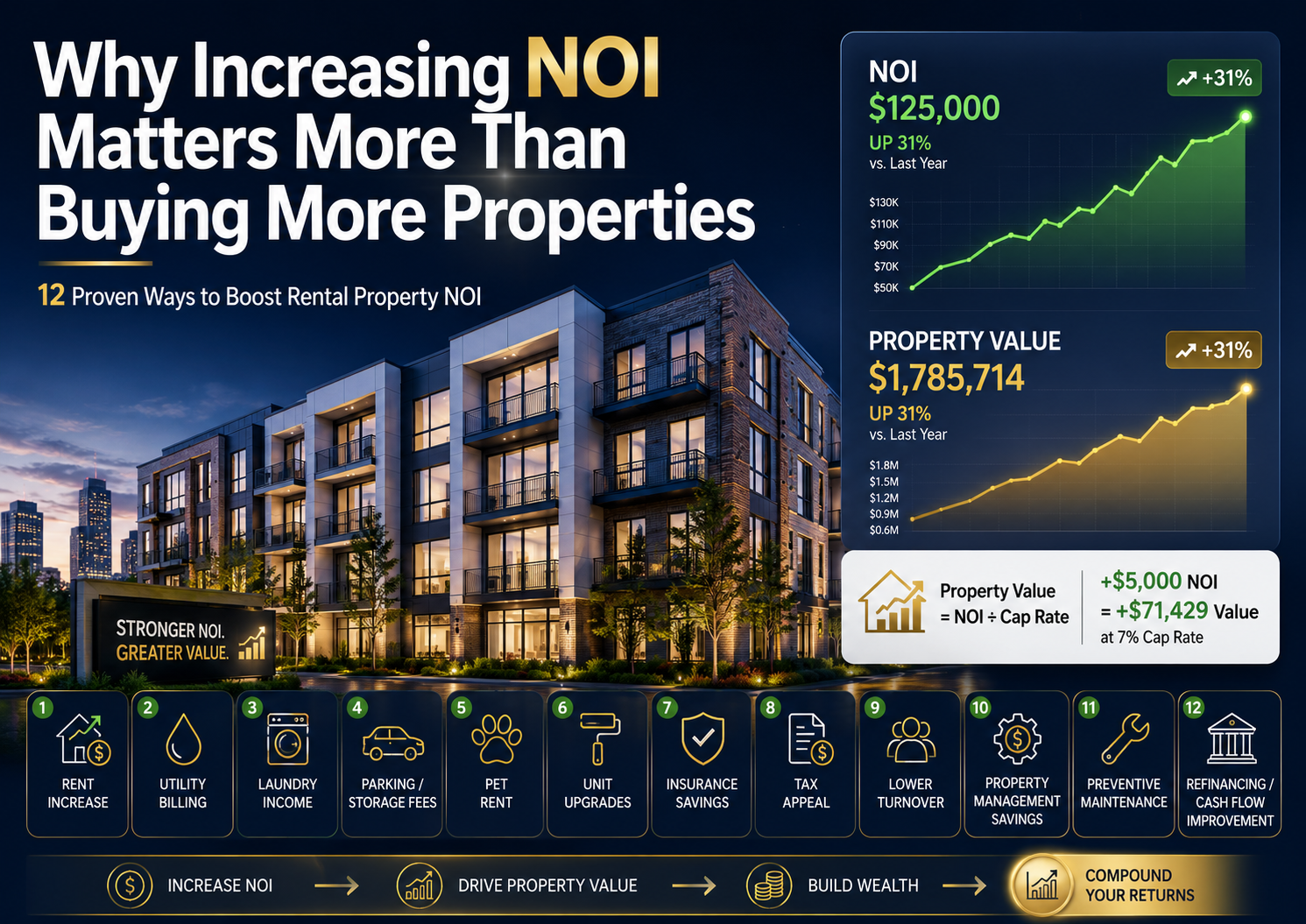
Most investors focus on buying the next property. Smart investors increase NOI on rental property they already own first — it costs less, carries less risk, and creates equity without a new mortgage. This guide covers 12 proven ways to increase NOI on rental property, with real numbers for each strategy.
Calculate your current NOI with the free NOI Calculator, then model improvements to see the impact.
How to Increase NOI on Rental Property and Boost Value
Commercial and multifamily properties are valued based on income, not comparable sales. The formula:
Property Value = NOI ÷ Cap Rate
| NOI Increase | Value Added at 5% Cap | Value Added at 7% Cap | Value Added at 10% Cap |
|---|---|---|---|
| $1,000/year | $20,000 | $14,286 | $10,000 |
| $3,000/year | $60,000 | $42,857 | $30,000 |
| $5,000/year | $100,000 | $71,429 | $50,000 |
| $10,000/year | $200,000 | $142,857 | $100,000 |
A $5,000 NOI increase on a property in a 7% cap rate market adds $71,429 in value. That is forced appreciation — equity you create through management, not market luck. Use the Cap Rate Calculator to see how NOI changes affect your property’s implied value.
12 Proven Ways to Increase NOI on Rental Property
Revenue Increases
1. Raise Rent to Market Rate
The simplest way to increase NOI on rental property. If comparable units in your area rent for $1,500 and you charge $1,350, you are leaving $1,800/year on the table per unit. Many landlords underprice rent to avoid turnover — but a 5-10% increase rarely causes good tenants to leave.
Impact: $150/month increase = $1,800/year NOI per unit. On a 4-unit building at 7% cap rate, that is $102,857 in added value.
2. Add Utility Billing (RUBS)
If you pay water, sewer, trash, or gas for tenants, implement a Ratio Utility Billing System (RUBS). Tenants pay their proportional share of utilities based on unit size or occupant count.
Impact: $75-150/month savings per unit = $900-1,800/year NOI per unit. Water and sewer alone average $80/month per unit in many markets.
3. Add Laundry Income
Coin-operated or card-operated laundry generates $15-50/month per unit with minimal management. On a 10-unit building, that is $1,800-6,000/year in pure revenue.
Cost: $2,000-5,000 for washer/dryer pair. Payback period: 6-18 months.
4. Add Storage or Parking Fees
Charge for garage parking ($50-150/month), storage units ($25-75/month), or covered parking ($25-50/month). These amenities cost almost nothing to maintain once built.
Impact: 5 parking spots at $75/month = $4,500/year NOI.
5. Pet Rent and Pet Deposits
Allow pets with a monthly pet rent of $25-50 per pet plus a $200-500 pet deposit. In most markets, 60-70% of renters have pets — excluding them shrinks your tenant pool and increases vacancy.
Impact: 6 units with pets at $35/month = $2,520/year NOI.
6. Upgrade Units and Raise Rent
A $3,000-5,000 unit upgrade (new countertops, fixtures, LVP flooring, fresh paint) can justify a $100-200/month rent increase. The investment pays for itself in 18-36 months, then produces pure NOI for the remaining hold period.
Impact: $150/month increase on a $4,000 upgrade = 2.2-year payback, then $1,800/year NOI forever. Use the Rehab Cost Estimator to budget unit upgrades.
Expense Reductions
7. Shop Insurance Annually
Insurance premiums increase 5-15% per year if you auto-renew. Get 3 quotes every year. Switching carriers can save $500-2,000/year on a 4-unit building, sometimes more.
8. Appeal Property Tax Assessment
If your property is assessed above market value, file a tax appeal. According to the National Association of Realtors, success rates vary by county but are typically 30-50%. A successful appeal can reduce your annual tax bill by $500-3,000.
Cost: $0 if you appeal yourself, $200-500 if you hire a tax appeal service. The savings are permanent until the next reassessment.
9. Reduce Turnover
Every tenant turnover costs $2,000-5,000 in lost rent (2-4 weeks vacant), make-ready repairs ($500-1,500), marketing, and leasing time. Reducing turnover from 40% to 20% on a 10-unit building saves $10,000-25,000/year.
How: Respond to maintenance requests within 24 hours. Offer lease renewals 90 days early with a small rent increase (3-5% vs market rate). Fix problems before tenants complain.
10. Self-Manage (or Negotiate PM Fees)
Property management fees of 8-10% eat $1,920-2,400/year on a $2,000/month rental. Self-managing eliminates this entirely. If you keep a PM, negotiate the rate — managers who handle multiple properties for you will often drop to 6-7%.
Impact: Cutting PM from 10% to 7% on $24,000 gross rent = $720/year NOI increase. Eliminating PM entirely = $2,400/year. See the PM Fee Calculator for the real cost analysis.
11. Preventive Maintenance Over Reactive
A $150 annual HVAC tune-up prevents a $5,000 emergency replacement. Fixing a $20 leak prevents $3,000 in water damage. According to Bureau of Labor Statistics data, proactive maintenance costs 30-50% less than reactive over a 5-year period.
12. Refinance to Lower Rate
Refinancing does not technically change NOI (debt service is below the NOI line), but it improves cash flow — which is what lands in your pocket. A 1% rate reduction on a $200,000 loan saves $1,200-1,500/year. Use the Mortgage Calculator to compare rates, and the DSCR Calculator to check if the new payment improves your ratio.
Worked Example: 8-Unit Building in Memphis
Current: 8 units at $850/month average. NOI: $48,960/year. Value at 8% cap rate: $612,000.
| Strategy | Annual NOI Impact |
|---|---|
| Raise rent $75/unit (to market) | +$7,200 |
| RUBS water/sewer ($60/unit) | +$5,760 |
| Pet rent ($35 × 5 pets) | +$2,100 |
| Shop insurance (save 15%) | +$900 |
| Appeal tax assessment | +$1,200 |
| Reduce PM from 10% to 7% | +$2,448 |
| Total NOI increase | +$19,608 |
New NOI: $48,960 + $19,608 = $68,568. New value at 8% cap rate: $857,100.
Value created: $245,100 — without buying a single new property. That is forced appreciation through operations, and it cost approximately $2,000 in implementation (insurance shopping, tax appeal, lease amendments).
Run your own scenario: NOI Calculator
Disclaimer
This article is for educational purposes only. NOI improvement results depend on local market conditions, property type, tenant demographics, and regulatory requirements. Some strategies (rent increases, utility billing, pet policies) may be restricted by local rent control ordinances or lease terms. Consult a licensed property manager, real estate attorney, and tax advisor before implementing changes. ArvCalc is not a property manager, attorney, or financial advisor.
Raising rent to market rate is the fastest way to increase NOI on rental property because it requires no capital investment — just a lease amendment at renewal. A $100/month rent increase across 4 units adds $4,800/year to NOI instantly. The second fastest is implementing utility billing (RUBS), which shifts $75-150/month per unit from your expenses to the tenant.
Every dollar of NOI increase multiplies through the cap rate to create value. At a 7% cap rate, $1,000 in additional NOI adds $14,286 to property value. At 5%, it adds $20,000. A $10,000 NOI increase on an 8-unit building in a 7% cap market adds $142,857 in equity — far more than the cost of implementation.
Both approaches increase NOI on rental property, but prioritize revenue first. Rent increases have no cost to implement and the full amount flows to NOI. Expense reductions often require time or capital (shopping insurance, appealing taxes, upgrading to prevent maintenance). A balanced approach — raising rent to market while reducing the top 2-3 expenses — produces the largest NOI improvement with the least effort.
Target 3-5% annual increases for existing tenants, or raise to market rate if you are significantly below. Check comparable listings within a half-mile to determine market rent. Increases above 5% per year risk tenant turnover, which costs $2,000-5,000 per unit in vacancy and make-ready. In rent-controlled areas, check local ordinances for maximum allowable increases.
RUBS (Ratio Utility Billing System) allocates utility costs to tenants based on unit size, occupant count, or a combination. Instead of the landlord paying $80/month per unit for water and sewer, tenants pay their share. On a 10-unit building, RUBS can shift $800/month ($9,600/year) from expenses to tenant-paid, directly increasing NOI by the same amount.
Yes, if your property is assessed above its current market value. Success rates for tax appeals are 30-50% depending on the county. The cost is $0 if you appeal yourself or $200-500 for a professional service. The savings are permanent until the next reassessment cycle (typically 3-5 years). Even a 10% reduction on a $5,000 annual tax bill saves $500/year — a $2,500 total over 5 years for a few hours of work.
Leave a Reply