What Are Closing Costs on Investment Property?
Closing costs on investment property are the fees and expenses you pay when you buy or sell a property — on top of the purchase price and down payment. On an investment property, closing costs typically run 2% to 5% of the purchase price for buyers and 6% to 10% for sellers (including agent commission).
On a $250,000 rental property purchase, that means $5,000 to $12,500 in closing costs that many investors forget to budget. This guide breaks down every fee you will see on the closing disclosure, explains which costs are negotiable, and shows how to estimate your total cash to close before making an offer.
Use the free Closing Costs Calculator to estimate your fees on any deal.
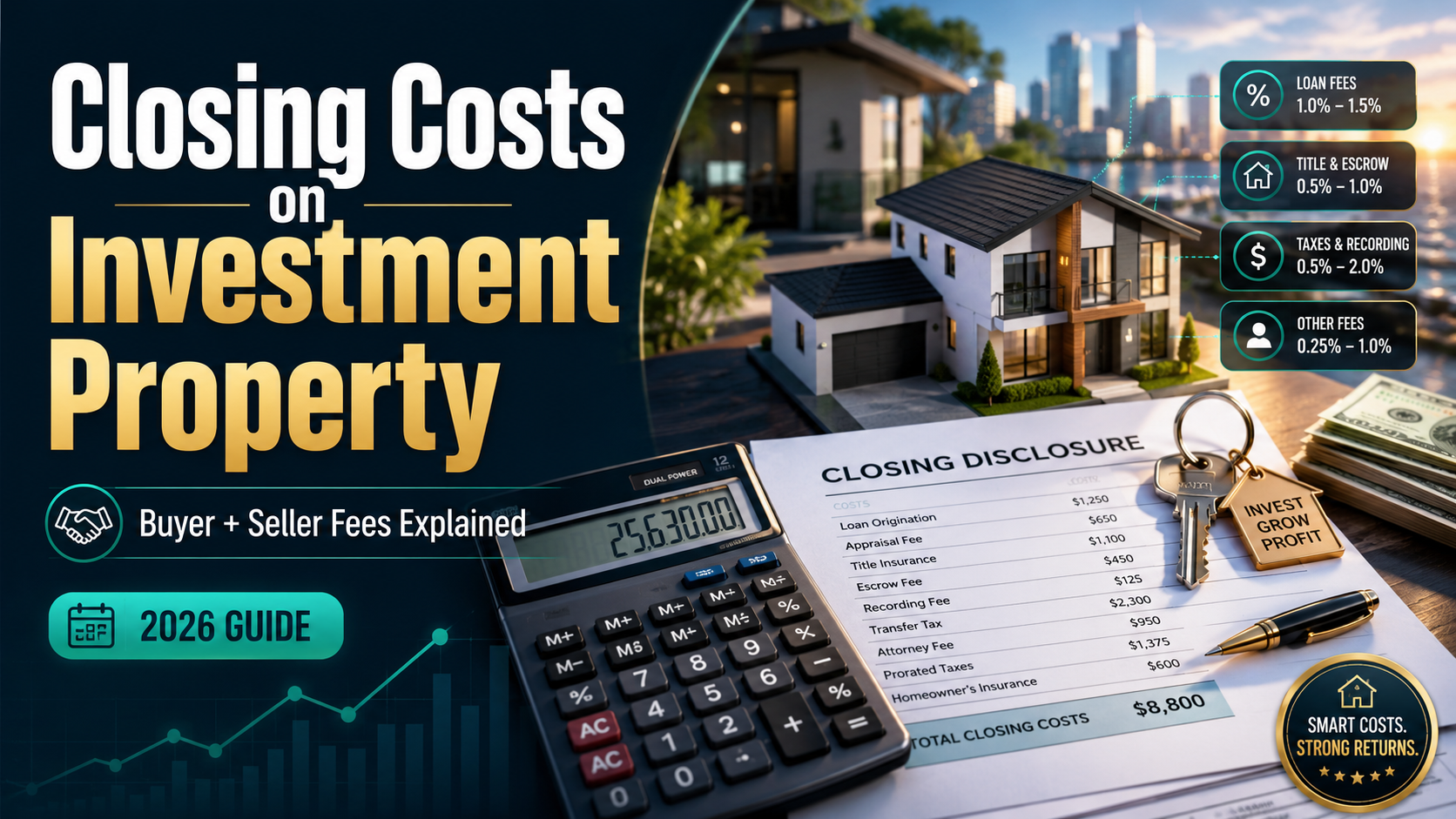
Buyer Closing Costs on Investment Property: Complete Breakdown
As the buyer of an investment property, you will pay most of the closing costs. Here is every fee you should expect:
Loan-Related Costs
| Fee | Typical Cost | On a $250K Purchase | Negotiable? |
|---|---|---|---|
| Loan origination fee | 0.5%–1.0% of loan | $1,000–$2,000 | Yes — shop lenders |
| Discount points | 0%–2% of loan (optional) | $0–$4,000 | Yes — your choice |
| Appraisal | $400–$600 | $500 | No |
| Credit report | $25–$50 | $35 | No |
| Underwriting fee | $300–$900 | $500 | Sometimes |
| Flood certification | $15–$25 | $20 | No |
DSCR loans vs conventional: DSCR loans typically charge 1–2 points plus a higher origination fee than conventional. But they skip income verification, which means faster closing and no tax return headaches. See the DSCR Loans Guide for a full comparison. For hard money (fix-and-flip), expect 2–4 points plus 12–14% interest — use the Hard Money Loan Calculator to model the total cost.
Title and Escrow Costs
| Fee | Typical Cost | On a $250K Purchase | Negotiable? |
|---|---|---|---|
| Title search | $200–$400 | $300 | No |
| Title insurance (lender’s policy) | $500–$1,500 | $800 | Shop providers |
| Title insurance (owner’s policy) | $500–$1,500 | $800 | Optional but recommended |
| Settlement/closing fee | $300–$800 | $500 | Shop title companies |
| Recording fees | $50–$250 | $125 | No — set by county |
| Attorney fee (required in some states) | $500–$1,500 | $750 | Shop attorneys |
Title costs vary significantly by state. Attorney states (New York, New Jersey, Massachusetts, Connecticut) require a lawyer at closing, adding $500–$1,500. Non-attorney states use title companies, which are typically cheaper.
Prepaid Items and Escrow
| Fee | Typical Cost | On a $250K Purchase | Notes |
|---|---|---|---|
| Prepaid interest | Per diem × days until month-end | $200–$800 | Close at end of month to minimize |
| Property tax escrow | 2–6 months of tax | $500–$1,500 | Varies by close date and tax schedule |
| Insurance escrow | 12–14 months premium | $1,200–$1,800 | Full year upfront + 2 months buffer |
| HOA transfer fee | $0–$500 | $250 | Only if HOA exists |
Pro tip: Close at the end of the month to minimize prepaid interest. Closing on June 28 means 2 days of prepaid interest. Closing on June 1 means 29 days. On a $200,000 loan at 7%, that difference is $1,100.
Inspection and Due Diligence
| Fee | Typical Cost | Required? |
|---|---|---|
| Home inspection | $300–$500 | Highly recommended |
| Pest/termite inspection | $75–$150 | Required by some lenders |
| Sewer scope | $100–$250 | Recommended for older properties |
| Survey | $300–$600 | Required by some lenders |
Inspections are paid before closing (usually at the time of inspection), but they are part of your total acquisition cost. Budget $500–$1,000 for a thorough due diligence package. See the deal analysis checklist for the full pre-purchase workflow.
Total Buyer Closing Costs: Worked Example
$250,000 investment property purchase with 20% down ($50,000) and a conventional loan at 7%.
| Category | Amount |
|---|---|
| Loan origination (0.75%) | $1,500 |
| Appraisal | $500 |
| Credit report + underwriting | $535 |
| Title search + insurance | $1,600 |
| Settlement fee | $500 |
| Recording fees | $125 |
| Prepaid interest (15 days) | $575 |
| Tax escrow (3 months) | $625 |
| Insurance (14 months) | $1,750 |
| Home inspection | $400 |
| Total closing costs | $8,110 |
| Total cash to close | $58,110 (down + closing) |
The investor who budgeted only $50,000 for the down payment is $8,110 short at closing. This is why the down payment guide recommends budgeting 25–32% of purchase price for total cash to close.
Seller Closing Costs on Investment Property
If you are selling an investment property, your closing costs are significantly higher because of the agent commission:
| Fee | Typical Cost | On a $300K Sale |
|---|---|---|
| Agent commission | 5%–6% | $15,000–$18,000 |
| Title insurance (owner’s policy) | $500–$1,500 | $1,000 |
| Transfer tax | 0.1%–2% (varies by state) | $300–$6,000 |
| Attorney/settlement fee | $300–$1,000 | $500 |
| Recording fees | $50–$200 | $100 |
| Prorated taxes | Varies | $0–$1,500 |
| HOA payoff | $0–$500 | $0 |
| Total seller costs | 6%–10% | $17,000–$27,000 |
Agent commission is the elephant in the room. On a $300,000 sale, 6% commission is $18,000. This is why the 70% rule for flippers builds in 5–6% for commission — without it, your profit margin collapses.
Seller closing costs also include capital gains tax — not paid at closing but owed at tax time. Use the Capital Gains Tax Calculator to estimate your liability.
How to Reduce Closing Costs on Investment Property
1. Shop Multiple Lenders
Origination fees, underwriting fees, and discount points vary by 0.5%–1.5% between lenders. On a $200,000 loan, that is $1,000–$3,000 in savings. Get at least 3 loan estimates (required within 3 business days of application under CFPB rules) and compare the “Loan Costs” section on page 2.
2. Negotiate Seller Concessions
Ask the seller to pay 2%–6% of the purchase price toward your closing costs. On a $250,000 purchase, a 3% seller concession covers $7,500 of your $8,110 in closing costs. The seller net is the same if you increase the purchase price slightly — but your cash out of pocket drops dramatically.
Limits: Conventional investment property loans cap seller concessions at 2% of purchase price. DSCR lenders may allow up to 6%. Check with your specific lender.
3. Close at End of Month
Prepaid interest is charged from your closing date through the end of the month. Close on the 28th instead of the 1st and save 25+ days of per diem interest. On a $200,000 loan at 7%, that is about $960 saved.
4. Skip the Owner’s Title Policy (With Caution)
The lender’s title insurance policy is required. The owner’s policy ($500–$1,500) protects you if a title defect is discovered after closing. On investment properties, some experienced investors skip it to save money — but this is risky on properties with complex title history (foreclosures, probate, multiple previous owners).
5. Use a No-Closing-Cost Loan
Some lenders offer loans with no upfront closing costs in exchange for a higher interest rate (typically 0.25%–0.50% higher). This preserves cash at closing but costs more over time. On a $200,000 loan, a 0.25% rate increase costs about $30/month — $10,800 over 30 years. Worth it if you plan to refinance or sell within 5 years.
Closing Costs by State: What You Need to Know
Closing costs vary significantly by state due to transfer taxes, attorney requirements, and title insurance rates:
| State | Avg Closing Cost (% of price) | Key Factor |
|---|---|---|
| Texas | 1.5%–2.5% | No state income tax, low transfer tax |
| Florida | 2.0%–3.0% | Doc stamps + intangible tax on mortgage |
| Ohio | 1.5%–2.5% | Transfer tax varies by county |
| Tennessee | 2.0%–3.0% | Transfer tax + recording fees |
| New York | 3.0%–5.0% | Attorney required + mansion tax above $1M |
| California | 2.0%–3.5% | Transfer tax varies by city |
| New Jersey | 2.5%–4.0% | Attorney required + realty transfer fee |
| Georgia | 1.5%–2.5% | Relatively low, no attorney requirement |
Data from Bankrate and CFPB. Always get a Loan Estimate specific to your state and county.
Closing Costs for BRRRR and Fix-and-Flip
BRRRR and flip investors pay closing costs twice — once when buying and once when refinancing (BRRRR) or selling (flip). This double hit is one of the most underestimated costs in real estate investing.
| Strategy | Purchase Closing | Exit Closing | Total |
|---|---|---|---|
| Buy-and-hold | $5,000–$10,000 | N/A (holding) | $5,000–$10,000 |
| BRRRR | $3,000–$6,000 (hard money) | $4,000–$8,000 (refi) | $7,000–$14,000 |
| Fix-and-flip | $3,000–$6,000 (hard money) | $15,000–$25,000 (sale + commission) | $18,000–$31,000 |
A flipper buying at $150,000 and selling at $250,000 pays $18,000–$31,000 in total closing costs across both transactions. That is 12–20% of the sale price consumed by closing costs alone — before rehab, holding costs, or profit. The Fix-and-Flip Calculator models both sets of closing costs.
For BRRRR, the refinance closing costs reduce your cash recovery. A $4,000 refi closing cost means $4,000 less capital returned to you. Model this with the BRRRR Refinance Calculator.
Disclaimer
This article is for educational purposes only. Closing costs vary by state, county, lender, and transaction type. The estimates provided are based on national averages and may not reflect your specific situation. Always review your Loan Estimate and Closing Disclosure carefully before signing. Consult a licensed real estate attorney, title company, and mortgage professional for advice specific to your transaction. ArvCalc is not a lender, title company, or attorney.
Closing costs on investment property for buyers typically run 2% to 5% of the purchase price, or $5,000 to $12,500 on a $250,000 property. This includes loan origination, appraisal, title insurance, escrow deposits, and recording fees. Seller closing costs are higher at 6% to 10% because they include agent commission (5-6% of sale price).
Loan origination fees, discount points, and underwriting fees are negotiable between lenders — always get at least 3 quotes. Title insurance and settlement fees can be reduced by shopping title companies. Seller concessions (2-6% of purchase price) can cover a large portion of buyer closing costs. Recording fees and transfer taxes are set by the government and cannot be negotiated.
Yes. Closing costs on investment property are slightly higher because loans typically have higher origination fees (0.5-1% more), higher interest rates (0.5-0.75% more), and some lenders charge additional risk-based fees. Title insurance and escrow costs are similar. The biggest difference is that seller concession limits are lower for investment properties — 2% for conventional versus 3-6% for primary residence loans.
Yes. You pay closing costs when you purchase (typically with a hard money loan) and again when you refinance into a permanent loan. Total closing costs across both transactions are $7,000 to $14,000. The refinance closing costs reduce the amount of capital you recover. Budget for both sets of costs when analyzing whether a BRRRR deal returns all your capital.
Use 3% of purchase price as a quick estimate for closing costs on investment property with a conventional loan, or 4% for DSCR and hard money loans. For a more precise estimate, request a Loan Estimate from your lender (required within 3 business days of application) and get a title fee quote from a local title company. Online closing cost calculators provide rough estimates based on purchase price and location.
Closing costs are fees for services rendered during the transaction (origination, title, appraisal). Prepaids are advance payments for ongoing expenses (property tax escrow, insurance premium, prepaid interest). Both are paid at closing, but prepaids would be owed regardless of the transaction — you are just paying them upfront. On your Closing Disclosure, they are listed in separate sections.
Only if you plan to hold the property long enough to break even on the upfront cost. One point (1% of loan amount) typically reduces the rate by 0.25%. On a $200,000 loan, one point costs $2,000 and saves about $30/month. Break-even: 67 months (5.6 years). If you plan to sell or refinance within 5 years, skip the points. If holding 10+ years, points can save significant money over the loan life.
Leave a Reply