Last updated: October 21, 2026 · Originally published: May 22, 2026 · By Alex Petrov
Closing Costs Calculator: The Investor’s Guide (2026 Benchmarks & Strategy)
Overview: Why Every Investor Needs a Closing Costs Calculator Tool
If you’ve ever been blindsided by a $12,000 closing bill on a $200,000 property, you know the pain. The closing costs calculator on arvcalc.com is built for investors who need to underwrite with surgical accuracy. Unlike generic consumer calculators, this one accounts for transfer taxes, title insurance tiers, recording fees, and even local surcharges that vary by county.
I’ve been investing since 2012, and I’ve seen too many deals fall apart because someone forgot to factor in the 1.5% transfer tax in Pennsylvania or the $750 attorney fee in New York. This tool eliminates those surprises. It’s not just a calculator; it’s a deal validation engine.
How to Use the Closing Costs Calculator
Using the closing costs calculator is straightforward, but the magic is in the details. Here’s the step-by-step workflow I use when analyzing a potential acquisition:
- Step 1: Enter the purchase price (e.g., $285,000).
- Step 2: Select your property type: residential, commercial, or multi-family. This changes the title insurance and tax assumptions.
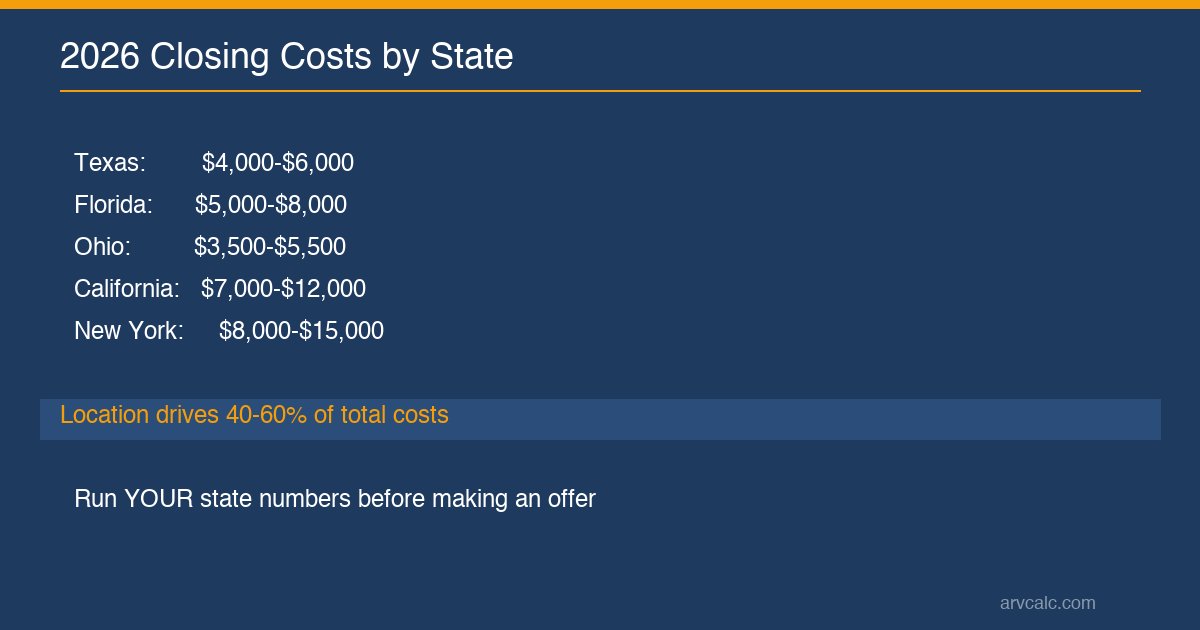
- Step 3: Choose your state or county — because closing costs are hyper-local. A buyer in Ohio pays different fees than one in Texas.
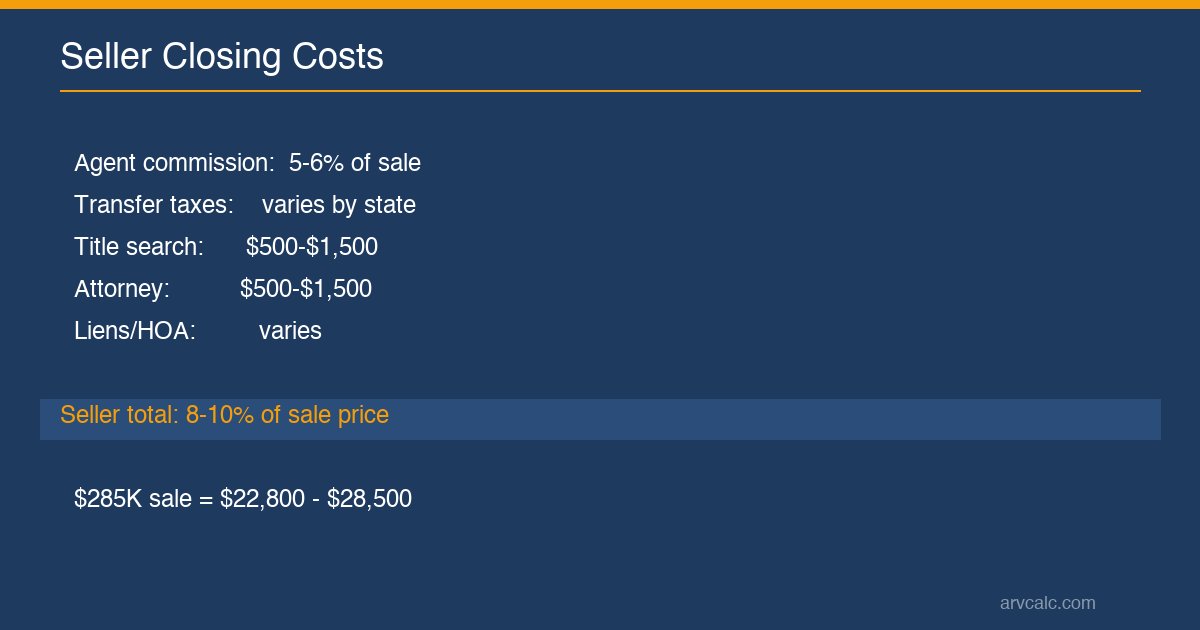
- Step 4: Toggle between “buyer” and “seller” side. For buy-and-hold investors, buyer costs are your focus; flippers often look at both.
- Step 5: Hit calculate. The tool instantly breaks down every line item: loan origination, appraisal, credit report, title search, lender’s title insurance, owner’s title insurance, recording fees, transfer taxes, and prepaids.
The output also shows a high/low range, so you can stress-test your cash-to-close.
Inputs & Outputs: What Goes In and What Comes Out
| Input Field | Explanation |
|---|---|
| Purchase Price | Total acquisition price of the property. |
| Loan Amount / Down Payment | If financing, the loan size drives origination fees (typically 0.5%–1%). |
| Property Location (state/county) | Determines transfer tax rates, recording fees, and local surcharges. |
| Property Type | Residential vs. commercial affects title insurance rates and tax treatment. |
| Buyer/Seller Side | Switches between typical buyer-paid and seller-paid costs. |
| Output Field | What It Shows |
|---|---|
| Total Estimated Closing Costs | Sum of all fees, taxes, and prepaids. |
| Breakdown by Category | Lender fees, third-party fees, government recording/transfer, prepaids. |
| Cash to Close | Total amount you need at closing (down payment + closing costs). |
| Cost per $1,000 Financed | Useful for comparing loan offers. |
The Formula Behind the Closing Costs Calculator
Under the hood, the calculator aggregates up to 15 line items. The core formula for buyer closing costs is:
Worked Example: $285,000 Property in Cleveland, Ohio
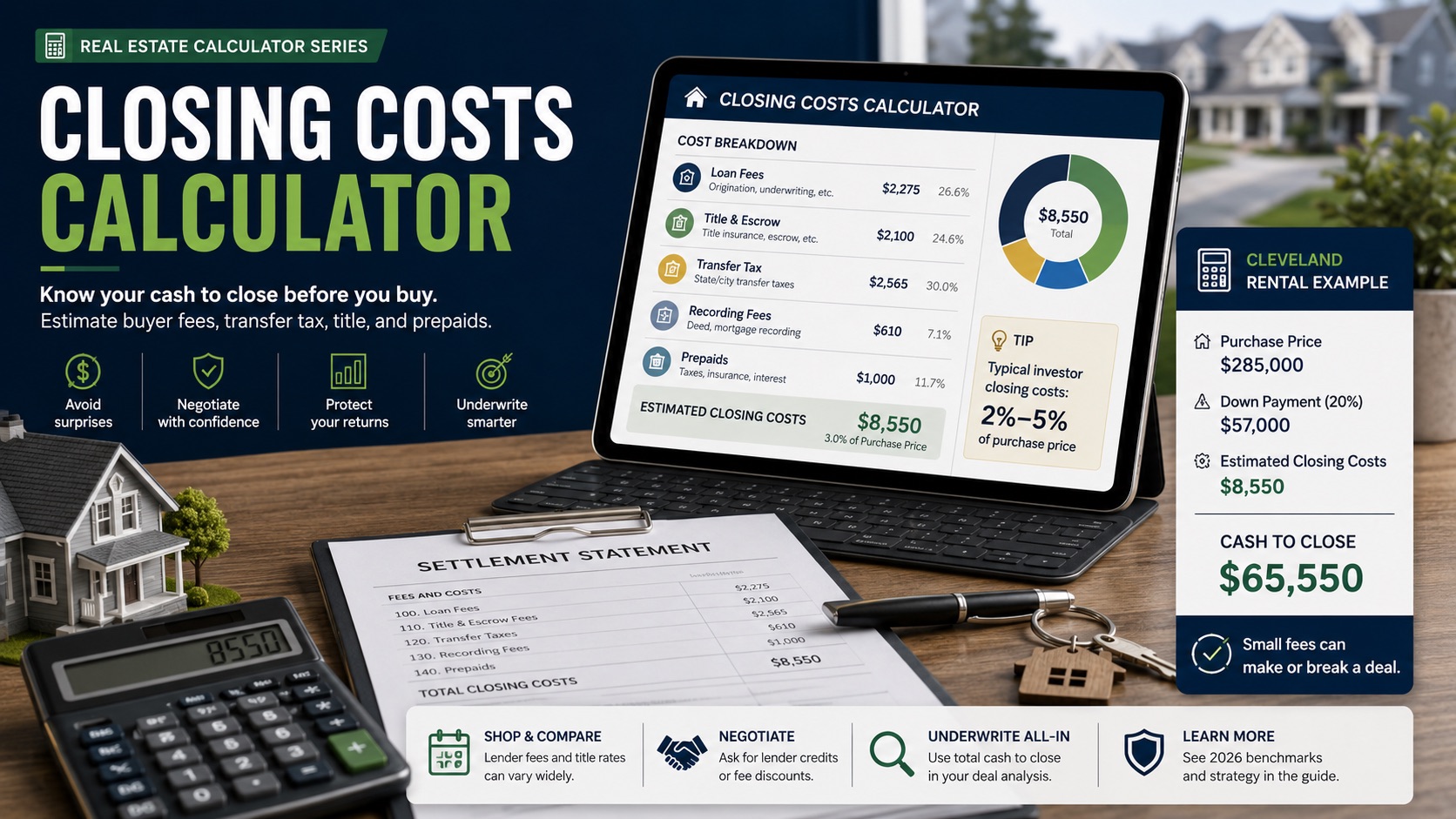
Let’s run a real-world scenario. You’re buying a 3-bedroom rental in Cleveland, OH 44113. Purchase price: $285,000. You’re putting 20% down ($57,000), financing $228,000. Using the closing costs calculator (with Ohio-specific settings):
- Loan origination (1%): $2,280
- Appraisal: $550
- Credit report: $45
- Title search & lender’s title insurance: $950
- Owner’s title insurance (optional but recommended): $725
- Recording fees (Cuyahoga County): $210
- Ohio transfer tax (buyer side, $0.40 per $100): $1,140
- Prepaids (interest, property taxes, hazard insurance escrow): ~$1,650
Total estimated buyer closing costs: ~$8,550 (3% of purchase price). That $8,550 is added to your $57,000 down payment, so your total cash to close is roughly $65,550. Without the calculator, many investors would guess 2% or 5% — the tool nails it.
What Are Closing Costs? (The Investor’s Definition)
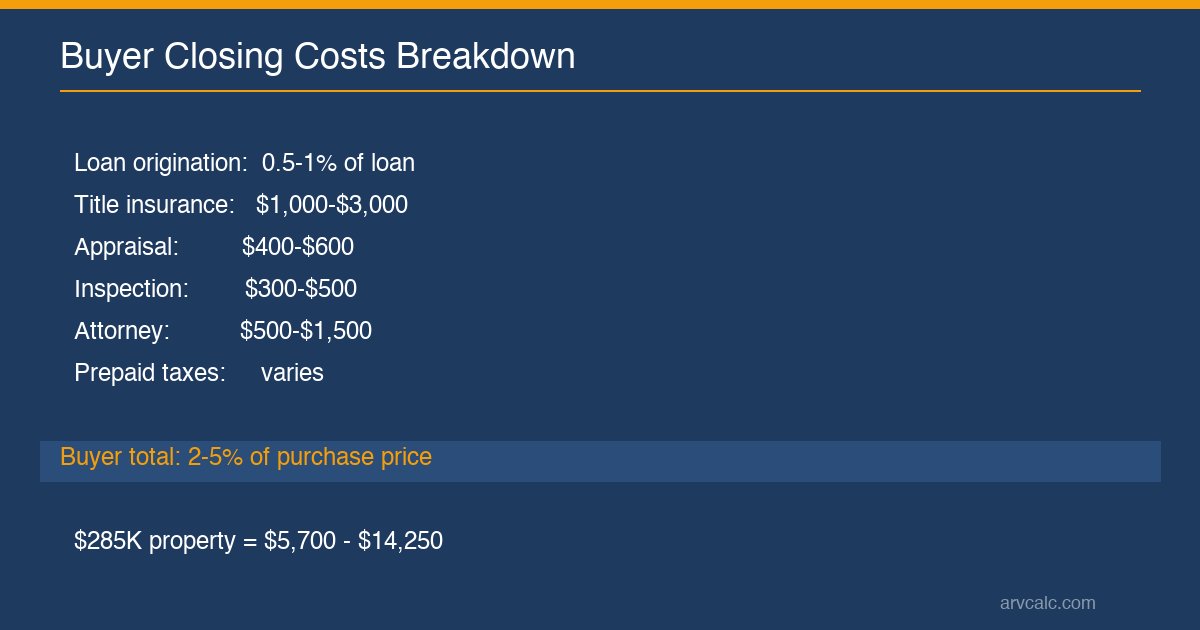
Closing costs are the fees and expenses you pay to finalize a real estate transaction, over and above the purchase price. For investors, these are not just “friction” — they are part of your basis for depreciation and cost basis calculations. Typical categories include:
- Lender fees: origination, underwriting, processing
- Third-party fees: appraisal, title search, escrow, survey
- Government fees: recording, transfer taxes, revenue stamps
- Prepaids: property taxes, homeowners insurance, mortgage interest
Knowing these line items inside out helps you negotiate with sellers and lenders. A closing costs calculator gives you advantage — you can say, “I see the title insurance is $1,400; I’d like to shop for a better rate.”
Reading Results: How to Interpret Your Closing Cost Estimate
When you run the closing costs calculator, you’ll see a detailed table. Here’s how to read it like a pro:
- Total estimate vs. range: The tool gives a low, medium, and high range. If your actual quote falls outside the range, investigate.
- Percentage of purchase price: National average is 2–5%. In Ohio, 3% is typical. If you see 6%, you might be overpaying for title or lender fees.
- Prepaid vs. non-recurring: Prepaids (taxes, insurance) are not “lost” — they sit in escrow. Focus on non-recurring fees like origination and title.
I always compare the calculator’s output to the Loan Estimate (LE) from my lender. If there’s a discrepancy, I ask questions.
2026 Benchmarks: What Investors Should Expect
| Cost Category | 2025–2026 Typical Range | Notes |
|---|---|---|
| Loan Origination | 0.5% – 1.0% of loan amount | Rising slightly due to regulatory costs |
| Title Insurance (lender) | $500 – $1,200 | Varies by state; some states have regulated rates |
| Transfer Tax (buyer side) | 0.1% – 2.0% of price | Highest in PA, MD, NY; lowest in CO, WY |
| Recording Fees | $75 – $350 | County-specific; digital recording is cheaper |
| Appraisal | $450 – $700 | Higher for multi-family/commercial |
| Attorney Fees | $500 – $2,500 | Required in some states (NY, NJ, CT) |
These benchmarks are built into the closing costs calculator so you always have a reality check.
Strategy Guide: How to Lower Your Closing Costs
As an investor, every dollar counts. Here are five strategies I use to reduce closing costs:
- Shop for title insurance: Rates vary by up to 40% between providers. Use the calculator to see the average, then negotiate.
- Ask the seller to pay: In a buyer’s market, you can negotiate up to 3% seller concessions toward closing costs.
- Use a local lender: Big banks often charge higher origination. A local credit union might save you $1,000.
- Waive owner’s title insurance (with caution): If you’re paying cash or have a low LTV, you might skip it, but consult an attorney.
- Close at the end of the month: Reduces prepaid interest — the calculator shows how much.
Run every scenario through the closing costs calculator before you sign anything.
Use Cases: When to Run the Closing Costs Calculator
- Buy-and-hold rental: Factor costs into your cash-on-cash return. The calculator integrates with our rental property calculator.
- Fix-and-flip: Know your exit costs. Use the seller-side mode to estimate what you’ll pay when you sell, then combine with the fix & flip calculator.
- Refinance: Even if you’re not buying, refinancing has closing costs. The tool works for refis too.
- 1031 Exchange: Closing costs reduce the net proceeds, affecting your exchange math.
Industry Conventions: What’s Standard vs. Negotiable
In the real estate world, some fees are set by law (recording fees, transfer taxes), while others are negotiable (origination, processing, title insurance). A good closing costs calculator separates these so you know where to push back. For example, lender fees are often waived if you pay a higher rate (yield spread premium). But be careful — higher rate means higher monthly payment. The calculator helps you compare.
Also note: in some states (Texas, Iowa), title insurance rates are set by the state — no negotiation. But in Ohio, Florida, and California, you can shop around. Always check local conventions.
Limitations of the Closing Costs Calculator
No calculator is perfect. The closing costs calculator on arvcalc.com is highly accurate, but you should be aware of these limitations:
- Local quirks: Some counties have specific surcharges (e.g., Mello-Roos in CA, or transfer tax in NYC). The tool includes many but not all.
- Lender-specific fees: Some lenders charge “junk fees” like document preparation or courier fees. The calculator uses averages.
- Prepaids are estimates: Property tax prorations depend on the closing date and local tax calendar.
Always verify with a Loan Estimate from your lender. The calculator is a starting point, not a final invoice.
Common Mistakes Investors Make (And How to Avoid Them)
- Ignoring transfer taxes: In high-tax states, this can be 2%+ of the price. Always use a closing costs calculator that includes state-specific rates.
- Forgetting prepaids: Many new investors only count lender fees. Prepaids can add $2,000–$5,000.
- Not shopping title insurance: I’ve seen title insurance quotes vary by $800 on the same property.
- Assuming seller pays all closing costs: In many markets, buyer pays their own costs plus transfer tax.
- Using a generic calculator: A national average of 3% might be wrong for your state. Our tool is localized.
Frequently Asked Questions (8 Questions)
For a conventional loan, expect 2%–5% of the purchase price. Cash buyers often pay 1%–2%. Use the closing costs calculator to get your exact figure.
Yes, most closing costs are added to your cost basis (depreciable) or deducted in the year paid (points, prepaid interest). Consult your CPA.
For conventional loans, you can’t finance closing costs (they must be paid at closing). FHA and VA loans allow some rolling, but it increases LTV.
Transfer taxes, attorney requirements, and title insurance rates vary dramatically. Pennsylvania has a 2%+ transfer tax; Colorado has ~0.1%.
Within 5–10% of the actual Loan Estimate, assuming correct inputs. We update rates annually based on data from nar.realtor and state regulators.
Buyer pays loan fees, appraisal, title insurance (lender), and prepaids. Seller pays real estate commissions, transfer tax (in some states), and owner’s title insurance. The calculator toggles both.
Yes, but commercial loans have different fee structures (higher origination, environmental reports). The tool has a commercial mode.
Negotiate seller concessions, shop for title insurance, choose a lender with lower origination, and close later in the month. The calculator helps you model each change.
Related Calculators & Tools
Supercharge your deal analysis with these integrated tools:
- Closing Costs Calculator (the tool itself)
- Rental Property Calculator — combine with closing costs for true cash flow
- Fix & Flip Calculator — include both buy-side and sell-side closing costs
- Mortgage Calculator for Investors — amortization with closing costs
- Cap Rate Calculator — use accurate basis including closing costs
- Compare Deals — side-by-side analysis with closing cost impact
NAR for industry data.
Run the Numbers Now
Stop overpaying at the closing table. Use the closing costs calculator to get your precise estimate in under 30 seconds.
Open Closing Costs Calculator →
Free to use. No sign-up required. Updated for 2026.
Disclaimer: This article is for educational purposes only and does not constitute financial, investment, legal, or tax advice. All closing cost estimates are illustrative and vary by location, lender, and transaction type. Consult qualified professionals before making any real estate decisions.
Leave a Reply