Last updated: September 24, 2026 · Originally published: June 10, 2026 · By Alex Petrov
How to Calculate Rental Property Cash Flow
Rental property cash flow is the money left over each month after collecting rent and paying every expense — mortgage, taxes, insurance, vacancy, maintenance, and management. Positive cash flow means the property puts money in your pocket. Negative cash flow means you write a check every month to keep it.
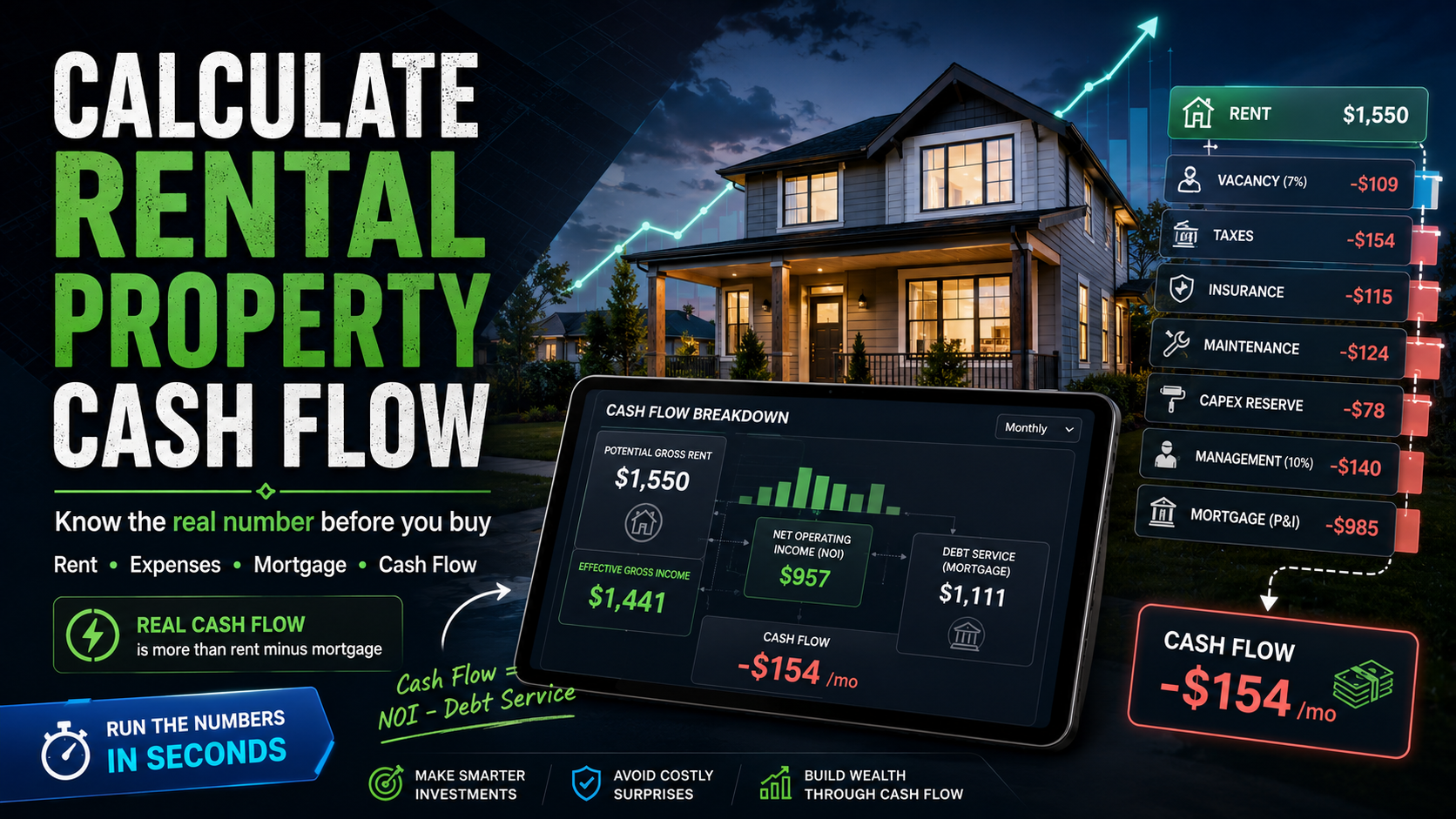
Most investors get cash flow wrong because they calculate rent minus mortgage and call it a day. That misses 35% to 45% of real costs. This guide shows how to calculate rental property cash flow accurately, with every line item, so you know the real number before you buy.
Use the free Property Cash Flow Calculator to run these numbers on any deal in seconds. For a complete deal screening process, see our guide on how to screen rental property deals.
How to Calculate Rental Property Cash Flow: The Formula
To calculate rental property cash flow accurately, use these three layers:
| Layer | Formula |
|---|---|
| Gross Rental Income | Monthly rent × 12 |
| Effective Gross Income | Gross rent − vacancy loss |
| Net Operating Income (NOI) | Effective gross income − operating expenses |
| Cash Flow | NOI − debt service (mortgage payment) |
When you calculate rental property cash flow correctly, the result is what remains after every single cost is paid. If any layer is wrong, the final number is wrong.
Expenses Most Investors Forget
Rent minus mortgage is not cash flow. Here is everything that comes out before cash flow:
| Expense | Typical % | On $1,800/mo rent |
|---|---|---|
| Vacancy | 5%–8% | $90–$144 |
| Property taxes | Varies by state | $200–$400 |
| Insurance | 0.4%–0.7% of value/yr | $100–$150 |
| Maintenance & repairs | 8%–10% | $144–$180 |
| Capital expenditures (CapEx) | 5%–8% | $90–$144 |
| Property management | 8%–10% | $144–$180 |
| Lawn/snow/HOA | Varies | $0–$100 |
| Total operating expenses | 35%–50% | $768–$1,298 |
On $1,800/month rent, operating expenses eat $768 to $1,298 before you even make the mortgage payment. The investor who only subtracted the mortgage from rent is off by $768+ per month.
Worked Example: Indianapolis Single-Family Rental
Here is how to calculate rental property cash flow on a real deal, line by line.
Property: 3BR/2BA ranch, $185,000 purchase price, $1,550/month market rent, 20% down payment, 7% interest rate, 30-year term.
| Item | Monthly | Annual |
|---|---|---|
| Gross Rent | $1,550 | $18,600 |
| Vacancy (7%) | −$109 | −$1,302 |
| Effective Gross Income | $1,441 | $17,298 |
| Property Taxes (1.0%) | −$154 | −$1,850 |
| Insurance | −$115 | −$1,380 |
| Maintenance (8%) | −$124 | −$1,488 |
| CapEx Reserve (5%) | −$78 | −$930 |
| Property Management (9%) | −$140 | −$1,674 |
| NOI | $831 | $9,976 |
| Mortgage P&I ($148,000 @ 7%) | −$985 | −$11,817 |
| Monthly Cash Flow | −$154 | −$1,841 |
This property has negative cash flow of $154/month at 20% down. The investor who only calculated rent minus mortgage ($1,550 − $985 = $565 “profit”) would have been off by $719/month — and shocked by the reality.
What Makes This Deal Work?
Three options to fix the cash flow:
| Change | New Cash Flow | Impact |
|---|---|---|
| 25% down instead of 20% | −$31/mo | Smaller loan reduces P&I by $123 |
| Negotiate price to $170,000 | +$11/mo | Lower loan + lower taxes |
| Self-manage (drop PM fee) | −$14/mo | Save $140/mo but add work |
| Negotiate price to $170K + self-manage | +$151/mo | Both changes together = positive |
The deal works at $170,000 with self-management. At the asking price of $185,000, it does not cash flow at 20% down. This is exactly why you should calculate rental property cash flow before making an offer — not after. Test different scenarios with the Cash Flow Calculator.
The 50% Rule: Quick Screening
For a fast gut-check before running full numbers, the 50% Rule says that approximately half of gross rent goes to operating expenses (not including mortgage). So:
Quick Cash Flow = (Rent × 50%) − Mortgage Payment
Indianapolis example: ($1,550 × 50%) − $985 = $775 − $985 = −$210/month. The 50% Rule flagged this as negative cash flow in 5 seconds.
The 50% Rule is a screening tool, not a calculation. Always run full numbers before making an offer. But if a deal fails the 50% Rule, it almost never works with real expenses either.
Cash Flow by Market: What to Expect
The results when you calculate rental property cash flow vary dramatically by market. High-price markets rarely cash flow. Midwest and Southeast markets offer the best cash flow potential.
| Market | Median Price | Typical Rent | Est. Cash Flow (20% down) |
|---|---|---|---|
| Cleveland, OH | $130,000 | $1,200 | +$150–$250/mo |
| Indianapolis, IN | $185,000 | $1,550 | −$50 to +$100/mo |
| Memphis, TN | $170,000 | $1,400 | +$50–$150/mo |
| Birmingham, AL | $140,000 | $1,100 | +$100–$200/mo |
| Dallas, TX | $290,000 | $1,900 | −$200 to −$50/mo |
| Denver, CO | $450,000 | $2,200 | −$500 to −$300/mo |
| San Diego, CA | $750,000 | $3,000 | −$1,200 to −$800/mo |
Cleveland and Birmingham produce the strongest cash flow because purchase prices are low relative to rents. Coastal markets require appreciation to justify the negative monthly cash flow. Data from Zillow Research and U.S. Census Bureau.
Cash Flow vs. Total Return
Cash flow is only one piece of rental property returns. Total return includes:
- Cash flow — monthly profit after all expenses
- Equity buildup — tenant pays down your mortgage
- Appreciation — property value increases over time
- Tax benefits — depreciation and deductions reduce tax bill (see Depreciation Calculator)
A property with −$100/month cash flow but $300/month in equity buildup and 4% annual appreciation may still produce a 12%+ total return. Use the Rental Property ROI Calculator to model total return over 5, 10, or 20 years. You can also compare how much down payment affects your cash flow.
That said, negative cash flow is risky because you must fund the shortfall out of pocket every month. If you lose your job or hit an unexpected expense, the property becomes a liability. Most experienced investors require positive cash flow as a baseline, even if total return is the real goal.
How DSCR Connects to Cash Flow
DSCR (Debt Service Coverage Ratio) is a simplified version of the cash flow question. DSCR lenders calculate rent ÷ PITIA — if the ratio is above 1.0, the property technically covers its debt. But DSCR does not include maintenance, CapEx, vacancy, or management.
A property with 1.1 DSCR can still have negative cash flow after all real expenses. That is why you need both metrics: DSCR to qualify for the loan, cash flow to know if you actually make money. Run both with the DSCR Calculator and Cash Flow Calculator. For Airbnb properties, see our guide on how much you can make on Airbnb — STR cash flow works differently.
Common Cash Flow Mistakes
Using listing agent rent estimates. Agents inflate rent projections to make deals look better. Verify with 3 comparable active listings within a half-mile radius. Rentometer provides rent comp data by address.
Ignoring property tax reassessment. When you buy a property, the county reassesses the tax based on your purchase price. A property taxed at $1,200/year on a $100,000 assessment may jump to $2,200/year when you buy it for $185,000.
Skipping CapEx reserves. The roof, HVAC, water heater, and appliances will fail eventually. Setting aside 5%–8% of rent for CapEx means you are prepared. Skipping it means one $8,000 roof repair wipes out 3 years of cash flow.
Assuming 0% vacancy. Even in hot markets, assume at least 5% vacancy. Every tenant turnover costs 2–4 weeks of lost rent plus turnover costs (cleaning, minor repairs, re-listing).
Not accounting for property management. Even if you self-manage, budget 8%–10% for PM. Your time has value. And if your situation changes (you move, get busy, scale to 10+ units), you will need professional management.
Disclaimer
This article is for educational purposes only and does not constitute financial, investment, tax, or lending advice. Actual rental property cash flow depends on location, property condition, tenant quality, market conditions, tax rates, insurance costs, and financing terms. The estimates and examples provided are based on general assumptions and may not reflect your specific situation. Consult a licensed real estate professional, tax advisor, and mortgage lender before making investment decisions. ArvCalc is not a broker, lender, or financial advisor.
To calculate rental property cash flow, subtract all expenses from gross rental income: Cash Flow = Gross Rent − Vacancy − Property Taxes − Insurance − Maintenance − CapEx − Property Management − Mortgage Payment. The key is including every expense, not just the mortgage. Operating expenses typically consume 35% to 50% of gross rent before the mortgage is paid.
When investors calculate rental property cash flow, most target $100 to $200 per month per unit as a minimum acceptable cash flow. A single-family rental producing $200/month is considered solid. Below $50/month is thin — one repair or vacancy month erases multiple months of profit. Some investors accept negative cash flow in appreciation markets, but this strategy carries more risk.
The 50% Rule estimates that half of gross rental income goes to operating expenses (not including mortgage). Quick cash flow estimate: (Monthly Rent × 50%) − Monthly Mortgage Payment. If the result is negative, the property likely does not cash flow. This is a screening tool only — always run full numbers with actual expense estimates before making decisions.
When you calculate rental property cash flow and find it negative, the most common reasons are: purchase price too high relative to rent (cap rate below 5%), property taxes consuming too much income (common in Texas, New Jersey, Illinois), interest rate too high (above 7% makes many deals unprofitable), vacancy higher than expected, or deferred maintenance creating unexpected repair costs. Run the numbers with the actual expenses to identify which line item is causing the problem.
Yes. When you calculate rental property cash flow, always budget 8% to 10% for property management even if you self-manage today. Your time has value, and your situation may change — you could move to a different city, scale to more properties, or simply want to stop managing tenants. If the deal only works because you are providing free labor, it is not a good deal — it is a part-time job that happens to own real estate.
A larger down payment reduces the loan amount, which lowers the monthly mortgage payment, which increases cash flow. For example, on a $200,000 property at 7% interest: 20% down produces a $1,064 monthly P&I payment, while 25% down produces a $998 payment — a $66/month cash flow improvement. The trade-off is that more capital is locked in one deal instead of being available for additional properties.
Midwest and Southeast markets generally offer the strongest cash flow: Cleveland OH, Indianapolis IN, Memphis TN, Birmingham AL, Kansas City MO, and Columbus OH. These markets have low purchase prices relative to rents. Coastal markets like San Diego, Los Angeles, and New York typically have negative cash flow at current prices and interest rates — investors in those markets rely on appreciation rather than monthly income.
Leave a Reply