Last updated: October 7, 2026 · Originally published: July 11, 2026 · By Alex Petrov
Mark had six rental properties financed through conventional mortgages — and then his lender said no. He’d hit the wall: too many financed properties, too much DTI, no path forward on paper even though his rentals cash-flowed every single month. A colleague pointed him toward DSCR loans, where the property’s income does the qualifying, not his W-2. Eighteen months later, Mark had twelve properties in his portfolio and a completely different view of how investment financing actually works.
If you’re trying to figure out the dscr vs conventional loan question for your own strategy, this article breaks it all down — real numbers, real trade-offs, and a side-by-side worked example on the same property so you can see exactly where each loan type wins and loses.
Quick Answer: DSCR vs Conventional Loan for Investment Properties
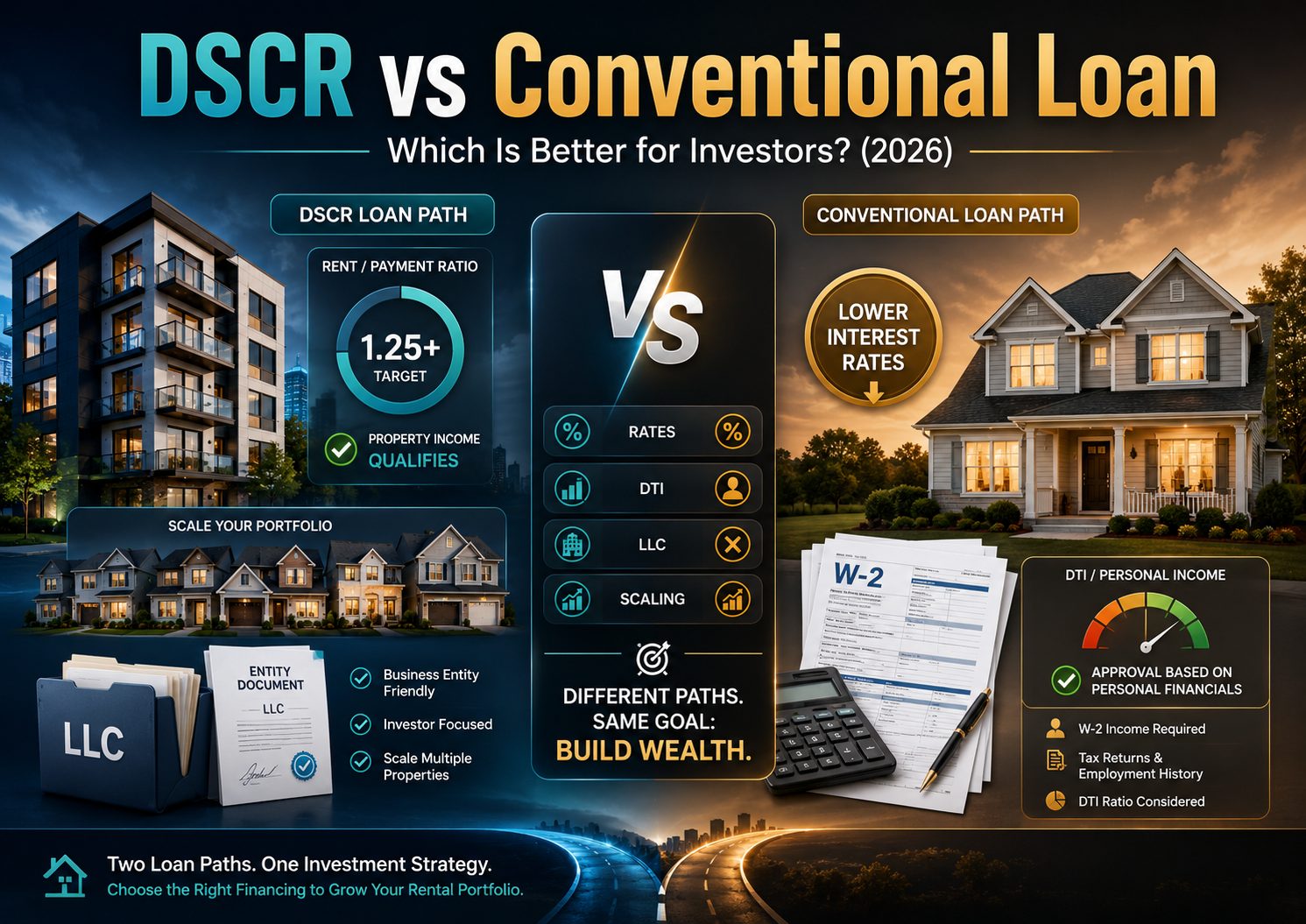
Conventional loans offer lower interest rates (typically 7.0–7.75% in 2026) and stricter qualifying — you need W-2 income, a low DTI, and you’re capped at 10 financed properties through Fannie/Freddie. They work well for investors with 1–4 properties and strong personal income.
DSCR loans qualify based on the property’s rent-to-mortgage ratio, not your personal income. Rates run higher (7.5–9.0% in 2026), but there’s no DTI requirement, no limit on financed properties, and you can close in an LLC. They’re built for scaling investors, the self-employed, and anyone whose personal income statement doesn’t tell the full story.
Bottom line: Start with conventional for your first few properties. Switch to DSCR when conventional financing stops working for you — not before.
What Is a DSCR Loan?
When investors first encounter the dscr vs conventional loan debate, DSCR can seem like a niche product. It’s not — it’s the primary financing vehicle for serious portfolio builders. DSCR stands for Debt Service Coverage Ratio. A DSCR loan is a type of non-QM (non-qualified mortgage) designed specifically for real estate investors. Instead of looking at your W-2s, tax returns, or personal debt-to-income ratio, the lender evaluates whether the rental income from the subject property covers the monthly mortgage payment.
The formula is simple:
DSCR = Gross Monthly Rent ÷ Monthly PITIA (Principal, Interest, Taxes, Insurance, HOA)
A DSCR of 1.0 means rent exactly covers the debt. A DSCR of 1.25 means the property earns 25% more than the payment — that’s the sweet spot most lenders prefer. Some lenders will approve loans down to 0.75 DSCR for strong-credit borrowers, accepting that the property won’t fully self-fund out of the gate.
You can run your own numbers right now with the DSCR Calculator at arvcalc.com — plug in your rent and estimated payment and you’ll have your ratio in seconds.
Who offers DSCR loans? Portfolio lenders, non-QM lenders, and specialty investment property lenders. Names you’ll encounter include Visio Lending, Kiavi, Lima One Capital, Griffin Funding, and dozens of regional portfolio lenders. These are not Fannie Mae or Freddie Mac products — they stay on the lender’s books or get sold into private securitization pools.
Key features of DSCR loans in 2026:
- No personal income verification required
- No DTI calculation
- Available to LLCs and other entities
- No limit on the number of financed properties
- Minimum credit score typically 620–680 depending on lender
- Down payments from 20–25% for SFR, 25–30% for 2–4 units
- Rates in the 7.5%–9.0% range for 30-year fixed in mid-2026
- Prepayment penalties common (3-2-1 or 5-4-3-2-1 step-down structures)
For a deeper look at how these loans work and what documentation you’ll actually need, the DSCR Loans Guide for 2026 covers the full picture.
What Is a Conventional Investment Property Loan?
Understanding the conventional side of the dscr vs conventional loan comparison requires knowing who’s actually setting the rules. A conventional mortgage follows guidelines set by Fannie Mae and Freddie Mac — the government-sponsored enterprises that buy most conforming loans from lenders. When you get a conventional loan for an investment property, your lender is almost certainly planning to sell it into the Fannie/Freddie secondary market, which means you have to play by their rules.
Those rules are strict for investors. According to Fannie Mae’s Selling Guide, investment property borrowers face:
- DTI limit: Generally 45% back-end DTI, sometimes up to 50% with compensating factors
- Personal income verification: Full W-2s, tax returns, pay stubs, and bank statements required
- 10-property cap: Fannie Mae allows up to 10 financed properties for experienced investors (5–10 property program), but many lenders cap at 4
- Rental income haircut: Lenders typically count only 75% of rental income toward qualifying, to account for vacancy
- Reserves: 6 months PITIA reserves required per financed investment property at the 5–10 property level
- Credit score: Minimum 620 for 1-unit investment, but competitive rates start at 740+
- Down payment: 15% minimum for 1-unit SFR, 25% for 2–4 unit properties
- No LLC closing: Conventional loans require the borrower to be an individual — you can’t close in your LLC
The big advantage conventional loans carry is rate. Because Fannie and Freddie back these loans and they go into highly liquid secondary markets, lenders can offer lower interest rates than portfolio or non-QM products. In mid-2026, conventional investment property rates are running approximately 7.0%–7.75% for 30-year fixed, compared to 7.5%–9.0% for DSCR.
That rate gap matters for cash flow. On a $240,000 loan, the difference between 7.25% and 8.25% is about $145/month. Over 30 years that’s $52,000. These numbers are real and shouldn’t be dismissed when you’re choosing loan types.
DSCR vs Conventional: Side-by-Side Comparison
Here’s the full breakdown of the dscr vs conventional loan comparison across every major factor investors need to evaluate. Bookmark this table — it answers most of the questions that come up when you’re sitting across from a lender trying to choose between the two products.
| Factor | DSCR Loan | Conventional Investment Loan |
|---|---|---|
| Interest Rate (2026) | 7.5% – 9.0% (30-yr fixed) | 7.0% – 7.75% (30-yr fixed) |
| Qualifying Basis | Property cash flow (DSCR ratio) | Personal income + DTI |
| Minimum Down Payment (SFR) | 20–25% | 15–20% |
| DTI Requirement | None | Max 45–50% |
| Minimum Credit Score | 620–680 (varies by lender) | 620 minimum; 740+ for best rates |
| Max Financed Properties | No limit | 10 (Fannie/Freddie); often 4 in practice |
| LLC Closing | Yes — most lenders allow it | No — individual borrower only |
| Income Documentation | Lease or rent schedule (Form 1007) | W-2s, tax returns, pay stubs, bank statements |
| Typical Closing Speed | 14–21 days (some lenders 10 days) | 25–45 days |
| PMI / MIP | No PMI (20%+ down required) | No PMI at 20%+ down; applies below |
| Max Loan Amount | Varies by lender; $3M–$5M common | $806,500 conforming limit (2026); jumbo available |
| Prepayment Penalty | Common — 3-2-1 or 5-year step-down | Rarely, if ever |
| Reserve Requirements | 3–12 months PITIA (varies by lender/LTV) | 6 months per financed property (5–10 program) |
| Self-Employed Friendly | Yes — no personal income reviewed | Difficult — 2 years tax returns required, write-offs hurt DTI |
The dscr vs conventional loan decision often comes down to two variables — how many properties you already own, and whether your personal income statement is your friend or your enemy. For most investors below 5 properties with strong W-2 income, conventional wins on rate. Above 5 properties or with complex income, DSCR wins on access.: how many properties you already own, and whether your personal income statement is your friend or your enemy. We’ll unpack both of those below.
When to Use a Conventional Loan
Conventional financing is usually the right answer for your first one to four properties — and sometimes up to six or seven if your personal income is strong and your DTI has room.
Conventional wins when:
- You have a strong W-2. If your personal income comfortably supports your DTI after adding the new mortgage payment, you’ll get the lower rate and better terms that conventional offers. That rate gap of 0.5%–1.0% is real money over time.
- You’re buying your first rental property. The lower down payment threshold (15% on SFR) lets you preserve capital. For a detailed walkthrough of that first purchase, see How to Buy Your First Rental Property.
- You don’t need speed. If you’re not competing with cash buyers and a 30–45 day close is fine, conventional’s slower underwriting isn’t a problem.
- You want asset protection flexibility. Yes, conventional requires individual ownership — but you can always do a quit-claim deed to your LLC after closing, or use a land trust structure with your attorney’s guidance. Not ideal, but workable for early portfolios.
- Your credit score is 740+. Conventional loan pricing rewards high credit scores aggressively. A 760-score borrower gets a materially better rate than a 680-score borrower. DSCR lenders also price on credit, but the spread isn’t as wide.
Think of conventional loans as the baseline — cheaper money, more hoops, and a ceiling that you’ll eventually hit. Use them while they’re available to you.
Understanding current investment property interest rate trends can help you time your conventional financing. The Investment Property Interest Rates guide tracks where rates are headed and what’s moving them.
When to Use a DSCR Loan
The dscr vs conventional loan comparison tips toward DSCR in a specific set of circumstances. Here’s when DSCR financing makes clear sense:
You’ve hit — or are close to hitting — the conventional property limit. Once you have 4–6 financed properties, most lenders will stop doing conventional investment loans for you. Even if Fannie Mae technically allows up to 10, the 5–10 program has reserve requirements and underwriting standards that shut out most investors. DSCR has no hard ceiling.
You’re self-employed or have complex income. Business owners, 1099 workers, and investors whose income comes primarily from their portfolio often show low taxable income on their returns (because they’re doing what they’re supposed to — taking every legal deduction). Conventional underwriting takes that low AGI at face value and says no. DSCR ignores your personal returns entirely.
You want to close in an LLC. Asset protection is a real concern once you have multiple properties. DSCR lenders routinely close loans in single-member LLCs, series LLCs, and other entity structures. This matters more as your portfolio grows.
You need to close fast. Some DSCR lenders close in 10–14 days. When you’re competing on a good deal and the seller wants a quick close, conventional’s 30–45 day timeline loses deals. DSCR’s lighter documentation process genuinely speeds things up.
The property’s income is strong but your personal DTI isn’t. If you have a property with a DSCR of 1.3 or higher, that property basically qualifies itself. You don’t need to be a high earner to get the loan — the deal does the work.
Before pulling the trigger on a DSCR loan, run the numbers on your specific deal. The Property Cash Flow Calculator will show you your projected monthly and annual cash flow so you know what you’re actually buying.
For a full breakdown of DSCR underwriting criteria, credit requirements, and documentation, the DSCR Loan Requirements Guide for 2026 has the details.
Worked Example: Same Property, Both Loan Types
Numbers cut through the debate faster than anything else. Let’s take one property and run it through both financing options so you can see exactly how the dscr vs conventional loan choice plays out in real cash flow.
The Property
- Purchase Price: $300,000
- Market Rent: $2,200/month
- Annual Property Taxes: $3,600 ($300/month)
- Annual Insurance: $1,800 ($150/month)
- HOA: None
- Vacancy Allowance: 8% ($176/month)
- CapEx + Maintenance Reserve: $200/month
- Property Management: 8% of collected rent ($176/month)
Option A: Conventional Loan
- Down payment: 20% = $60,000
- Loan amount: $240,000
- Rate: 7.25% (30-year fixed)
- Monthly P&I: $1,638
- PITIA: $1,638 + $300 + $150 = $2,088/month
Monthly Cash Flow (Conventional):
– Vacancy (8%): –$176
– Property Management (8%): –$176
– CapEx/Maintenance: –$200
– PITIA: –$2,088
──────────────────────────────────
Net Monthly Cash Flow: –$440
DSCR (Conventional): $2,200 ÷ $2,088 = 1.05
Option B: DSCR Loan
- Down payment: 25% = $75,000
- Loan amount: $225,000
- Rate: 8.0% (30-year fixed)
- Monthly P&I: $1,651
- PITIA: $1,651 + $300 + $150 = $2,101/month
Monthly Cash Flow (DSCR Loan):
– Vacancy (8%): –$176
– Property Management (8%): –$176
– CapEx/Maintenance: –$200
– PITIA: –$2,101
──────────────────────────────────
Net Monthly Cash Flow: –$453
DSCR (DSCR Loan): $2,200 ÷ $2,101 = 1.05
What the Numbers Tell You
Neither option produces positive cash flow on this specific property at these rates and this price point — which is actually the most honest and useful result of the exercise. The difference between conventional and DSCR here is $13/month in cash flow. That’s noise.
The real variable isn’t which loan type cash-flows better on one deal. It’s which loan type lets you do the deal at all. An investor at 8 financed properties simply cannot get conventional financing. The DSCR option is the only path. And an investor with a 620 credit score and a $180K salary who’s buying property #2 will almost certainly get a better conventional rate and stronger cash flow going that route.
This is exactly the kind of analysis you should run before making any offer. The Rental Property Calculator lets you model both scenarios — adjust loan amount, rate, and down payment — and see the full cash flow picture. The Investment Property Mortgage Calculator will give you your exact monthly P&I for any rate/loan combination.
For more on reading a deal correctly before you buy, see How to Analyze a Rental Property — a step-by-step guide that walks through every expense category investors forget.
Run Your Own Loan Comparison
Don’t guess which loan wins on your deal. Plug your actual numbers into the calculators and know before you offer.
Can You Switch from Conventional to DSCR?
The dscr vs conventional loan question doesn’t have to be a permanent choice. Yes — and many investors do exactly this. Refinancing from a conventional investment loan into a DSCR loan makes sense in a few specific situations.
You’ve hit the conventional property ceiling. Once you own more financed properties than conventional will allow, you can refinance existing conventional loans into DSCR loans. This frees up your conventional loan capacity for future purchases (if you use a lender that still counts based on type) or simply moves your existing properties onto a financing structure that doesn’t report to your personal DTI in the same way.
You want to move a property into an LLC. Conventional loans trigger the due-on-sale clause if you transfer title to an LLC. A DSCR refinance lets you properly put the property into an entity from day one, with the loan in the entity’s name.
You’re self-employed and your tax return is working against you. If you bought a property when you were a W-2 employee and you’re now running a business, refinancing into DSCR removes your tax return from the qualifying equation entirely.
When it doesn’t make sense to switch:
- If you locked a conventional rate below 6.5% in prior years — hold it. Don’t refinance a low-rate asset into an 8%+ DSCR loan unless you have a compelling structural reason.
- If the prepayment penalty from your existing DSCR loan would cost more than the benefit of the refinance — always check the prepay schedule first.
- If the property doesn’t qualify under DSCR underwriting (DSCR below 0.75, too many deferred maintenance issues, etc.)
The math on a refinance is straightforward: calculate your new monthly payment, subtract your old payment, and divide the closing costs by that monthly savings. That’s your break-even month. If you’re planning to hold the property past that break-even, the refi makes sense numerically.
Common Mistakes When Choosing Between DSCR and Conventional Loans
The dscr vs conventional loan comparison produces a clear wrong answer when investors misread which tool fits their situation. Here are the five mistakes that cost investors money.
Mistake 1: Using DSCR when you don’t have to. Some newer investors hear “no income docs required” and immediately want DSCR, without realizing that the rate premium costs them $100–$200/month in cash flow. If you qualify for conventional — and you’re in your first four properties with a solid W-2 — use conventional. DSCR is a tool for when conventional stops working, not a substitute for it.
Mistake 2: Not modeling the DSCR ratio before applying. Lenders have minimum DSCR thresholds, typically 1.0–1.25. If your market rent-to-payment ratio is 0.90, you won’t qualify for most DSCR programs regardless of your credit score or reserves. Calculate your DSCR before you spend time in underwriting. Use the DSCR Calculator as part of your deal analysis, not as an afterthought.
Mistake 3: Ignoring prepayment penalties on DSCR loans. A 5-4-3-2-1 prepayment penalty means if you sell or refinance in year 1, you owe 5% of the loan balance as a penalty. On a $225,000 DSCR loan, that’s $11,250. Many investors plan to “buy and refi in 12–18 months” without reading the prepay schedule. Always read it. Always price it into your exit strategy.
Mistake 4: Waiting too long to research the dscr vs conventional loan question. Many investors wait until they’re rejected for a conventional loan to start exploring DSCR. By then they’re scrambling. Learn the difference at property #2 or #3, so you’re positioned to move into DSCR financing before you need it urgently.
Mistake 5: Treating the 10-property Fannie limit as a hard wall everyone hits. Most lenders stop doing conventional investment loans after 4 financed properties, not 10. The 5–10 property program technically exists but many retail lenders don’t offer it, and the reserve requirements are steep. Don’t assume you have runway to 10 conventional properties — verify with your lender at property #3 what their actual limit is, so you can plan your DSCR transition accordingly.
Frequently Asked Questions
According to Investopedia’s definition of DSCR, the ratio is a fundamental measure of a property’s ability to service its debt. Here are the questions investors ask most often when working through the dscr vs conventional loan decision for their portfolios.
Disclaimer: The information is for educational purposes only and does not constitute financial, legal, or tax advice. Loan programs, rates, and guidelines change frequently. Consult with a licensed mortgage professional before making financing decisions for your investment properties.
Can I use a DSCR loan as a first-time investor?
Technically yes — some DSCR lenders don’t require prior landlord experience. But practically speaking, most lenders want to see that you know what you’re doing, and some require at least one prior investment property. First-time investors almost always get better terms on conventional financing anyway. Start with conventional, build experience, then move to DSCR when you need it.
What DSCR ratio do I need to qualify?
Most DSCR lenders require a minimum ratio of 1.0 (rent covers the full payment) and prefer 1.25 for the best pricing. Some lenders go as low as 0.75 DSCR — meaning the rent covers only 75% of the mortgage — but these “sub-1 DSCR” loans come with higher rates and larger down payments. Use the arvcalc.com DSCR Calculator to check your ratio before shopping lenders.
Are DSCR loan rates always higher than conventional?
Yes, typically. In mid-2026, conventional investment property rates are running 7.0%–7.75% for 30-year fixed, while DSCR rates are in the 7.5%–9.0% range. The gap reflects the additional risk lenders take on when they don’t verify personal income. Strong credit scores (740+), low LTV (65% or below), and DSCR ratios above 1.25 will get you to the lower end of the DSCR rate range.
Do DSCR loans show up on my personal credit report?
If you close the DSCR loan in an LLC or other business entity, it typically reports to business credit, not personal credit. This is one of the reasons investors use DSCR to protect their personal credit profile as their portfolio grows. If you close in your personal name, the loan will appear on your personal credit report like any other mortgage. Confirm the reporting structure with your lender before closing.
Can I use a DSCR loan on a short-term rental (Airbnb)?
Some DSCR lenders accept short-term rental income. They’ll typically use a market rent analysis from AirDNA or a similar STR data provider rather than a standard rent appraisal. Not all lenders offer STR DSCR programs, and the underwriting is more conservative — expect higher down payments and stricter credit requirements. Always verify with the lender upfront whether your intended use qualifies.
Is the BiggerPockets community mostly using DSCR or conventional?
The BiggerPockets community reflects the same pattern most experienced investors follow: conventional for the first few properties, then DSCR (or other non-QM products) as portfolios scale. The conversations on BP forums show a clear shift — investors with 5+ properties talk about DSCR routinely, while newer investors are typically still in conventional territory.
Which is better for building a rental portfolio long-term — DSCR or conventional?
Neither is universally “better” — they serve different stages of portfolio growth. A smart investor uses conventional while it’s available and accessible, then transitions to DSCR when conventional financing is no longer practical. The most effective long-term strategy is using the right tool for your current situation. If you’re at property #1, conventional probably wins. If you’re at property #7 and self-employed, DSCR is probably the only path. Run both scenarios on every deal and let the numbers tell you which financing structure produces the better outcome.
DSCR vs Conventional Loan FAQ
Is a DSCR loan better than conventional for investment property?
It depends on your situation. DSCR loans are better if you are self-employed, have multiple properties, or want faster closing without income documentation. Conventional loans are better if you have strong W-2 income and want lower rates. DSCR rates run 0.5-1.5% higher than conventional, but qualification is based on the property’s income, not yours. Run both scenarios in the DSCR calculator to compare.
What credit score do I need for a DSCR loan?
Most DSCR lenders require 660+ for the best rates, though some accept 620 with higher rates. At 720+, you qualify for the lowest rates. See current rates in our DSCR loan rates guide.
Can I use a DSCR loan for my first rental property?
Yes. DSCR loans do not require prior landlord experience. They require 20-25% down and DSCR of 1.0 or higher. First-time investors find qualification faster since no tax returns are needed.
How many DSCR loans can I have at once?
Most DSCR lenders have no limit. This is a major advantage over conventional loans, which cap at 10 financed properties per borrower (Fannie Mae). Investors with 5+ properties often switch to DSCR for this reason.
Do DSCR loans show up on my credit report?
Yes, DSCR loans are reported to credit bureaus. The loan affects your DTI for future conventional loans. But since DSCR qualification does not use DTI, this only matters for future conventional borrowing.
Related Calculators and Guides
- DSCR Calculator — check if your property qualifies
- Investment Property Mortgage Calculator
- Rental Property Calculator
- LTV Calculator
- DSCR Loan Rates 2026
- DSCR Loan Requirements Guide
- Hard Money Loan Costs
Leave a Reply