Last updated: November 3, 2026 · Originally published: October 28, 2026 · By Alex Petrov
It took me four years to buy my first rental property and 14 months to buy the next three. The difference was not money — it was understanding how to build rental property portfolio systems systematically instead of treating each purchase as a standalone event. Most investors buy one property, wait until it “feels right” to buy another, and end up with two or three rentals after a decade. The investors who reach 10, 20, or 50 units in the same period follow a repeatable system: clear deal criteria, a financing ladder that scales, and a reinvestment plan that turns each property’s equity into the next acquisition.
This guide walks through how to build rental property portfolio wealth from your first property to double digits — with the actual financing strategies, deal analysis framework, and portfolio management approach I used to go from zero to 22 units in 14 years. Run every deal through the rental property calculator before you commit capital.
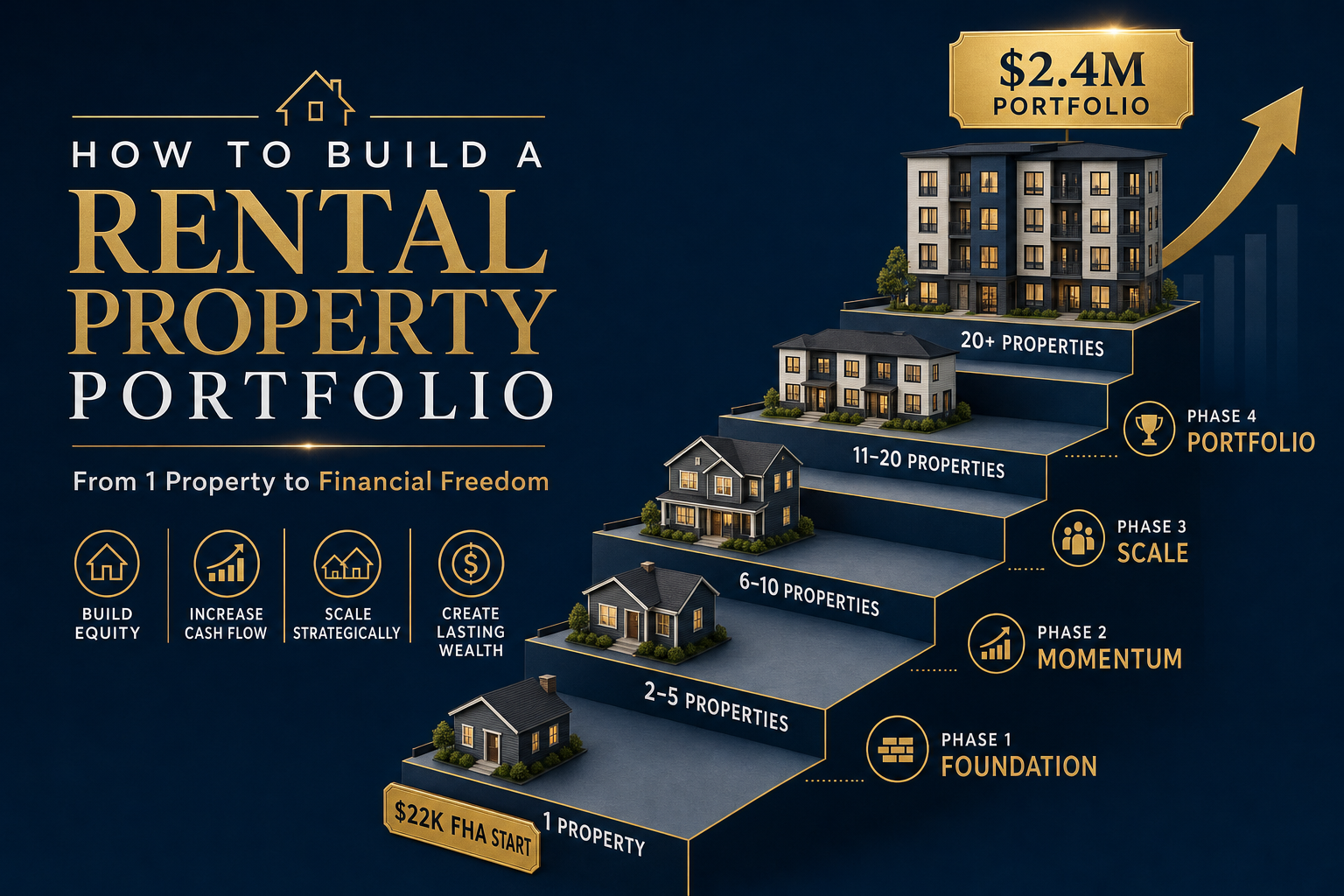
The Portfolio Building Framework: 4 Phases
When you build rental property portfolio wealth, growth is not linear — it follows a predictable four-phase pattern. Each phase has different financing options, management challenges, and scaling strategies.
| Phase | Properties | Primary Financing | Management | Timeline |
|---|---|---|---|---|
| 1. Foundation | 1-3 | FHA house hack, conventional | Self-manage | Years 1-3 |
| 2. Momentum | 4-7 | Conventional + first DSCR | Self-manage or hybrid | Years 2-5 |
| 3. Scale | 8-15 | DSCR primary, portfolio lenders | Property manager | Years 4-8 |
| 4. Portfolio | 15+ | DSCR, commercial, seller financing | PM + asset manager | Years 6-12+ |
Phase 1: Foundation (Properties 1-3)
The first phase is about getting into the game with minimum capital and maximum learning. Every mistake you make in Phase 1 costs $5,000-$15,000. The same mistake in Phase 3 costs $50,000-$150,000. Make your mistakes cheap.
Start With a House Hack
The mathematically optimal first move for most investors: buy a 2-4 unit property with an FHA loan (3.5% down), live in one unit, and rent the others. On a $400,000 fourplex, your total cash outlay is approximately $22,000 (down payment + closing costs) — compared to $112,000+ for a conventional investment property purchase at 25% down. This preserves $90,000 in capital for your next two acquisitions.
After 12 months of owner-occupancy, move out and rent all units. You now have a fully rented investment property acquired with minimal capital. Model your house hack with the house hacking calculator and check financing options in our best loans guide.
Properties 2-3: Conventional Loans While You Qualify
With W-2 income and clean credit, conventional loans offer the lowest rates (6.50-7.50% in 2026). Use them while you can — conventional underwriting gets harder after 4 financed properties because reserve requirements multiply. Buy properties 2 and 3 with 20-25% down on single-family rentals that meet your deal criteria (more on this below).
At the end of Phase 1, you own 3 properties with $40,000-$60,000 in annual gross rent. Your portfolio generates cash flow, you have learned tenant management, and you understand your local market at a level that takes non-investors years to reach. Check your portfolio’s returns with the cash-on-cash calculator.
Phase 2: Momentum (Properties 4-7)
Phase 2 is where most investors who try to build rental property portfolio wealth stall. Conventional lending tightens after property 4 (higher reserve requirements, DTI strain from multiple mortgages), and the transition to DSCR or portfolio lending feels unfamiliar. The investors who push through Phase 2 are the ones who build meaningful portfolios.
The Conventional-to-DSCR Transition
Conventional loans qualify based on your personal income. After 4-5 properties, your DTI ratio (with all those mortgage payments) makes conventional qualification increasingly difficult — even if your rental income covers every payment. This is where DSCR loans become your primary tool.
DSCR loans qualify on the property’s income, not yours. Each deal stands alone. There is no limit to how many DSCR loans you can have. The tradeoff: rates are 0.50-1.50% higher than conventional. But the ability to scale without income documentation constraints is worth the premium. Compare both options in our DSCR vs conventional guide.
Recycling Capital: The BRRRR Accelerator
The fastest way to build rental property portfolio equity through Phase 2 is the BRRRR strategy: Buy distressed, Rehab, Rent, Refinance, Repeat. A well-executed BRRRR recovers 85-100% of your invested capital on the refinance — meaning you can deploy the same $80,000 across three or four acquisitions instead of one.
I completed four BRRRR cycles between properties 5 and 9. Each cycle recovered approximately $65,000-$75,000 of my original capital. That recycled capital funded the down payments for subsequent conventional and DSCR purchases. Without BRRRR, I would have needed $300,000+ in fresh capital for those same acquisitions. Check your ARV before committing with the ARV calculator.
Phase 3: Scale (Properties 8-15)
As you build rental property portfolio scale to 8+ properties, two things change: management becomes a full-time job (if self-managing), and your portfolio generates enough income to fund acquisitions from cash flow rather than savings alone.
Hire a Property Manager
Self-managing 8+ units while working a day job is unsustainable for most people. The math supports hiring a PM at this stage: 8 units at $1,200/month average rent generates $115,200/year gross. PM at 9% costs $10,368/year — but saves you 20-30 hours per month in time and typically reduces vacancy by 2-3 percentage points (worth $3,000-$5,000/year). Net cost of PM after vacancy savings: $5,000-$7,000/year. See our PM costs guide for the full analysis.
Portfolio Lending and Scaling Strategies
Beyond DSCR, Phase 3 investors access portfolio lenders (community banks that hold loans on their books) and begin exploring commercial financing for 5+ unit buildings. Each financing type has different strengths:
- DSCR: No income docs, unlimited properties, 7-9% rates. Best for scaling 1-4 unit rentals.
- Portfolio lenders: Flexible terms, relationship-based. Best for unusual properties and repeat borrowers.
- Commercial: Required for 5+ units. NOI-based underwriting. 25-30% down, 7-9% rates.
- Seller financing: Negotiable everything. Best for off-market deals where the seller wants income.
Check qualification for each with the DSCR calculator, LTV calculator, and mortgage calculator.
Phase 4: Portfolio Management (15+ Properties)
Once you build rental property portfolio holdings to 15+ units, you are managing a business, not a side hustle. The focus shifts from acquisition to optimization: reducing expenses, increasing rents, refinancing to better terms, and selectively selling underperformers to redeploy capital into stronger assets.
The 1031 Exchange Upgrade
Per IRS Publication 544, sell a low-performing property and reinvest proceeds into a higher-quality asset through a 1031 exchange — deferring all capital gains tax. I used a 1031 to trade three single-family rentals (combined value $450,000, generating $2,800/month) into one 8-unit building ($520,000, generating $5,600/month). Same equity, double the income, fewer management headaches.
Portfolio Metrics to Track
| Metric | Target | Calculator |
|---|---|---|
| Portfolio cap rate | 6-8% | Cap rate calculator |
| Average cash-on-cash | 8%+ | CoC calculator |
| Portfolio vacancy | Under 5% | Vacancy calculator |
| Average DSCR | 1.25+ | DSCR calculator |
| Monthly NOI per unit | $200+ | NOI calculator |
Deal Criteria: What to Buy (and What to Skip)
The biggest mistake when you build rental property portfolio holdings is buying everything that “looks like a deal.” Without clear criteria, you end up with a scattered collection of properties that do not work as a portfolio. Here is my framework:
Must-Have Criteria
- Cash flow positive at current rates. The property must produce positive monthly cash flow after all expenses including reserves. No “it will cash flow when rates drop” speculation.
- DSCR 1.0+ at purchase. If the property cannot cover its debt from rental income, it does not belong in a portfolio. Check with the DSCR calculator.
- Cap rate at or above local market average. Paying above market means overpaying — unless you have a specific value-add plan. Verify with the cap rate calculator.
- Pass due diligence. Every item on our due diligence checklist must clear before closing.
Nice-to-Have Criteria
- Below-market rent with room for increase (forced appreciation)
- In a market with 1%+ population growth
- Near employment centers (hospitals, universities, military bases)
- Manageable by your existing PM company (avoid scattering across too many markets)
Walk-Away Triggers
- Cash-flow negative at purchase (appreciation-only bets do not build portfolios)
- Declining population in the submarket
- Major deferred maintenance exceeding 10% of property value
- Property tax rate above 2% (eats cash flow faster than you can raise rent)
Financing Ladder: How Capital Scales
| Properties | Capital Source | Typical Down Payment | Note |
|---|---|---|---|
| 1 | FHA house hack | 3.5% ($14,000 on $400K) | Lowest entry, must owner-occupy 12 months |
| 2-4 | Conventional | 20-25% | Best rates, income-qualified |
| 3-6 | BRRRR + conventional | Recycled capital | Same money funds multiple deals |
| 5-10 | DSCR | 20-25% | No income docs, unlimited scale |
| 8-15 | Portfolio lender + DSCR | 20-30% | Relationship-based flexibility |
| 15+ | Commercial + seller finance | 25-30% | Larger deals, NOI-based |
The pattern: start with government-backed leverage (FHA), graduate to conventional, pivot to DSCR when income docs become limiting, and add commercial/portfolio as you scale. Each transition opens access to more properties but at slightly higher cost. The key insight: do not wait for “perfect” financing — use the best tool available at each phase and refinance later if better terms emerge. Full financing comparison in our best loans guide.
Common Mistakes That Stall Portfolio Growth
When trying to build rental property portfolio scale, saving for each down payment separately. This is the #1 growth killer. If you save $70,000 for each 25% down payment on a $280,000 property, you buy one property every 2-3 years. Instead, use BRRRR to recycle capital, leverage FHA for entry, and let cash flow from existing properties fund future down payments.
Waiting for the “perfect” deal. The deal that checks every box does not exist at market price. The deals that build a rental property portfolio check the must-have criteria and leave room for the investor to add value. Stop analyzing and start closing — imperfect action beats perfect paralysis.
Diversifying too early across markets. Owning one property in five different cities creates five times the management overhead with zero economies of scale. Build concentration in one or two markets first (10+ units), then diversify into a third market. Your PM relationships, contractor network, and market knowledge all improve with concentration.
Ignoring reserves. Buying property #5 with the capital that should have been reserves for properties #1-4. One bad month across the portfolio — a vacancy here, a repair there — and you are funding operations on credit cards. Keep 6 months PITIA per property in reserves. See our cash reserves guide.
Never selling. Not every property deserves a permanent place in your portfolio. A property with a 3% cap rate, rising taxes, and flat rent growth is consuming capital that would produce 7% elsewhere. Use 1031 exchanges to upgrade without triggering taxes. Sell the worst performer annually and redeploy into something better.
Worked Example: 0 to 10 Properties in 6 Years
| Year | Action | Capital Used | Monthly Cash Flow | Total Units |
|---|---|---|---|---|
| Year 1 | FHA fourplex house hack | $22,000 | -$350 (living in 1 unit) | 4 |
| Year 2 | Move out + buy SFR conventional | $60,000 | $1,650 (fourplex) + $150 (SFR) | 5 |
| Year 3 | BRRRR #1 + conventional SFR | $75,000 (recycled $60K) | $2,100 | 7 |
| Year 4 | BRRRR #2 + DSCR duplex | $80,000 (recycled $65K) | $2,950 | 10 |
| Year 5 | Hire PM, stabilize | $0 (cash flow funds reserves) | $2,500 (after PM fees) | 10 |
| Year 6 | DSCR triplex + 1031 upgrade | $90,000 | $3,400 | 12 |
Total capital deployed over 6 years: approximately $327,000. But because of BRRRR recycling, the actual out-of-pocket was closer to $200,000. Portfolio value at year 6: approximately $2.4 million with $600,000+ in equity. Monthly cash flow after all expenses and PM: $3,400.
This is not theoretical — it is a simplified version of my actual acquisition path. The numbers vary by market, but the pattern is universal: leverage early, recycle mid-portfolio, professionalize management as you scale. Run your own growth plan through the rental property calculator.
Frequently Asked Questions
How many rental properties do I need to retire?
How many units you need to build rental property portfolio income depends on your expenses and target cash flow. At $200/month cash flow per unit (conservative after reserves), you need 25 units to generate $5,000/month. At $300/month per unit (achievable in strong cash flow markets), 17 units produces $5,100/month. Most investors target 15-25 units for financial independence. Use the rental property calculator to model your specific numbers per property, then multiply by your target unit count.
How much money do I need to start building a rental portfolio?
As little as $15,000-$25,000 with an FHA house hack on a 2-4 unit property. For a conventional investment property purchase: $50,000-$80,000 (20-25% down plus closing costs and reserves on a $200,000-$250,000 property). The key to growth is not starting capital — it is recycling capital through BRRRR and reinvesting cash flow. $100,000 deployed efficiently can acquire 5-8 properties over 3-4 years through recycling.
Should I buy in one market or diversify across cities?
As you build rental property portfolio holdings, concentrate first and diversify later. Build 8-10+ units in one or two markets before adding a third. Concentration gives you PM relationships, contractor networks, market knowledge, and management efficiency that scattered ownership does not. Diversify into a second market once your primary market is stabilized and generating cash flow that funds new acquisitions.
When should I switch from conventional to DSCR loans?
When conventional qualification becomes limiting — typically after 4-5 financed properties, or when your tax returns show low income due to depreciation deductions. DSCR rates are 0.50-1.50% higher but qualify on property income alone with no property count limit. Most portfolio builders use conventional for properties 1-4 and DSCR for everything after. Compare with the DSCR calculator.
How fast should I scale my rental portfolio?
Buy as fast as deals meet your criteria AND your reserves support the acquisition. The constraint should be deal quality and reserve depth — not an arbitrary timeline. Some investors add 3-4 properties per year. Others add one. The investors who fail are the ones who buy faster than their reserves can support. Keep 6 months PITIA per property in reserves at all times. See our reserves guide.
Start With One, Build to Many
Every investor who managed to build rental property portfolio wealth started with a single property and a decision to treat real estate as a system, not a hobby. The framework to build rental property portfolio wealth is straightforward: start with maximum leverage (FHA), graduate to conventional, pivot to DSCR when income docs limit you, recycle capital through BRRRR, hire management when scale demands it, and optimize through 1031 exchanges as the portfolio matures.
The investors who reach financial independence through rental property are not the smartest or the wealthiest — they are the most consistent. One good deal per quarter, properly analyzed and financed, compounds into a portfolio that changes your life. Start with the rental property calculator, find a deal that meets your criteria, and make your first (or next) acquisition.