Published: October 20, 2026 · By Alex Petrov
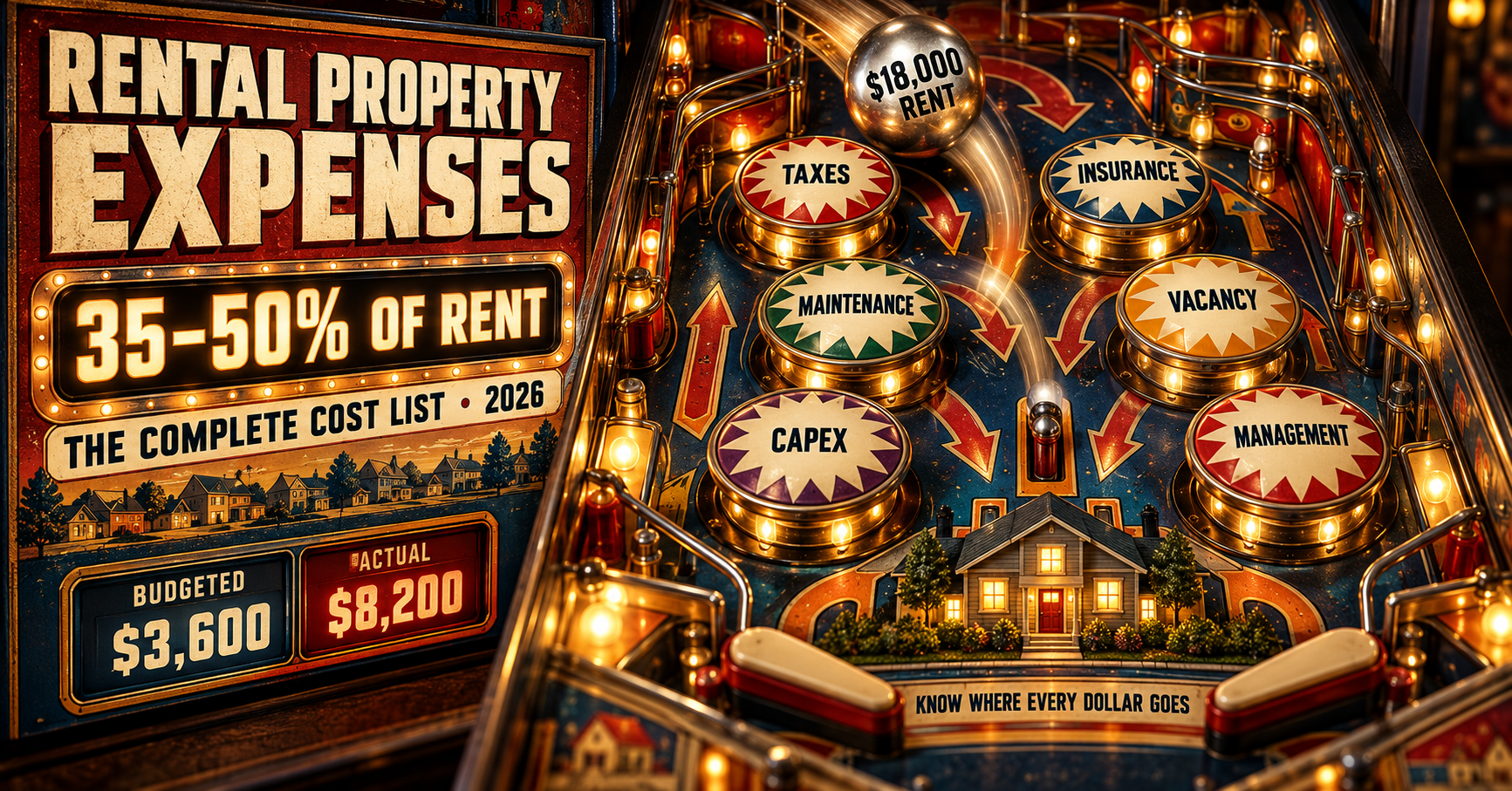
After 14 years of owning rental properties, I can tell you exactly where every dollar goes — because I tracked it. My first year as a landlord, I budgeted $3,600 for annual expenses on a $1,400/month rental. Actual expenses came in at $8,200. That $4,600 gap nearly turned a cash-flowing property into a monthly loss. The problem was not the property — it was my understanding of rental property expenses.
Total rental property expenses typically consume 35-50% of gross rental income on residential properties. On a $1,500/month rental collecting $18,000 per year, expect to spend $6,300-$9,000 on operating costs before mortgage payments. This guide lists every expense category with real dollar amounts from my portfolio and industry benchmarks so you can build an accurate budget before you buy. Run your numbers alongside this article using the rental property calculator to see how expenses affect your cash flow.
Rental Property Expenses: The Complete List
Every rental property expense falls into one of three categories: fixed costs that stay roughly the same every month, variable costs that fluctuate based on occupancy and property condition, and capital expenditures that happen infrequently but cost thousands when they do. Here is the full breakdown of rental property expenses.
| Expense Category | Typical Range (Annual) | % of Gross Rent | Type |
|---|---|---|---|
| Property taxes | $2,400-$12,000+ | 8-15% | Fixed |
| Insurance | $1,200-$3,600 | 4-8% | Fixed |
| Property management | $1,800-$4,500 | 8-12% | Fixed |
| Maintenance & repairs | $1,500-$4,000 | 5-10% | Variable |
| Vacancy loss | $900-$3,600 | 5-10% | Variable |
| Capital expenditures (CapEx) | $1,000-$3,000 | 5-10% | Reserve |
| Utilities (landlord-paid) | $0-$3,600 | 0-10% | Variable |
| HOA / condo fees | $0-$6,000 | 0-15% | Fixed |
| Landscaping / snow removal | $600-$2,400 | 2-5% | Seasonal |
| Accounting & legal | $500-$1,500 | 1-3% | Fixed |
| Advertising / marketing | $100-$500 | 0.5-1% | Variable |
| Pest control | $200-$600 | 0.5-1% | Fixed |
Add these up for a typical single-family rental at $1,500/month: total rental property expenses land between $7,200 and $12,300 per year — 40-68% of gross rent. The mortgage payment is on top of this. Use the NOI calculator to see your net operating income after all expenses.
Property Taxes: Your Largest Fixed Expense
Property taxes are the single largest rental property expense category and the most significant of all rental property expense in most markets. They are also the least controllable — you cannot negotiate them down, and they tend to increase 2-5% per year through reassessment.
What New Investors Get Wrong
The most common mistake: using the seller’s tax bill to project your expenses. In many states, the property gets reassessed at the purchase price when ownership transfers. A seller paying $3,200/year in taxes on a property they bought for $180,000 in 2015 does not mean you will pay $3,200. If you buy for $280,000, your assessment jumps to roughly $280,000, and your tax bill could rise to $5,600 or more.
Always check the current effective tax rate for your county and multiply by your purchase price. That gives you a realistic tax projection. Factor this into your cap rate calculation — a 2% tax rate versus a 1% rate on a $300,000 property is $3,000/year in additional expense, which can swing your cap rate by a full percentage point.
Property Tax by State
| State | Effective Tax Rate | Annual Tax on $300K Property |
|---|---|---|
| New Jersey | 2.47% | $7,410 |
| Illinois | 2.23% | $6,690 |
| Texas | 1.80% | $5,400 |
| Ohio | 1.59% | $4,770 |
| Indiana | 0.85% | $2,550 |
| Florida | 0.89% | $2,670 |
| North Carolina | 0.84% | $2,520 |
| Tennessee | 0.71% | $2,130 |
| Georgia | 0.92% | $2,760 |
| Hawaii | 0.28% | $840 |
The difference between investing in Texas (1.80%) versus Tennessee (0.71%) on a $300,000 property is $3,270 per year in taxes alone. That is $272/month straight off your cash flow. Market selection matters as much as deal selection when it comes to rental property expenses. Compare markets side by side in our best cities for real estate investment guide.
Insurance: Investor Policies Cost More
A landlord insurance policy (also called a dwelling fire or DP-3 policy) costs 15-25% more than a standard homeowner’s policy on the same property. The reason: you do not live there, so insurers view it as higher risk for liability claims and property damage.
What Landlord Insurance Covers
- Dwelling coverage: Structure repair or replacement from fire, storms, vandalism
- Liability coverage: $300,000-$1,000,000 for injuries on the property
- Loss of rental income: Covers rent during repairs after a covered event (typically 12 months)
- Personal property: Covers landlord-owned items in the unit (appliances, fixtures)
What it does NOT cover: tenant belongings (that is renter’s insurance), flood damage (separate flood policy needed), or normal wear and tear. For a complete state-by-state breakdown of insurance costs, see our rental property insurance guide.
How to Reduce Insurance Costs
Bundle multiple properties with one insurer for 10-15% multi-policy discount. Increase your deductible from $1,000 to $2,500 — this cuts premiums 15-20% but requires you to self-insure smaller claims. Install smoke detectors, deadbolts, and security cameras for an additional 5-10% discount at most carriers.
Maintenance and Repairs: Budget 1% of Property Value
The standard rule of thumb: budget 1% of the property’s value per year for maintenance and repairs. On a $300,000 property, that is $3,000/year or $250/month. In my experience across 22 units over 14 years, actual maintenance has averaged 1.2% of property value — slightly above the rule of thumb, but within the range.
What Maintenance Actually Costs
| Repair | Average Cost | Frequency |
|---|---|---|
| HVAC service / repair | $150-$500 | 1-2x per year |
| Plumbing repair | $200-$600 | 1-2x per year |
| Appliance repair | $100-$400 | 1-3x per year |
| Electrical repair | $150-$400 | 0-1x per year |
| Turnover paint | $300-$600 | Per turnover |
| Turnover cleaning | $150-$400 | Per turnover |
| Carpet cleaning / replacement | $200-$1,200 | Per turnover |
| Lock change | $75-$150 | Per turnover |
| Pest control (per visit) | $75-$200 | Quarterly |
| Gutter cleaning | $100-$250 | 2x per year |
Older properties (pre-1980) cost more to maintain — budget 1.5-2% of value. Newer properties (built after 2000) can often get by with 0.5-0.8%. The age and condition of major systems (roof, HVAC, plumbing, electrical) drive the variance more than anything else. Get a detailed rehab estimate using our rehab cost estimation guide.
Vacancy Loss: The Expense Nobody Budgets Correctly
Vacancy is a major rental property expense even though it is technically lost income rather than a cash outflow. When a unit sits empty, you still pay the mortgage, taxes, insurance, and utilities. Budget 5-8% of gross rent for vacancy in stable markets with low turnover, and 8-12% in markets with higher tenant mobility.
On a $1,500/month rental at 7% vacancy, you lose $1,260 per year in rent. Add turnover costs (paint, cleaning, listing, screening) of $1,500-$2,500 per turnover event, and each vacancy cycle costs $2,760-$3,760 total. Reducing vacancy from 10% to 5% saves $900/year in lost rent alone — plus you avoid one turnover cycle. Read our vacancy reduction strategies guide for tactics that cut turnover in half, and model different vacancy scenarios in the vacancy rate calculator.
Capital Expenditures (CapEx): The Expenses That Come in Waves
CapEx is the rental property expense category that covers the big-ticket items that wear out over 10-30 year cycles: roof, HVAC system, water heater, flooring, windows, and exterior paint. These are not annual expenses — they are periodic, expensive, and guaranteed to happen eventually.
CapEx Reserve Schedule
| Item | Replacement Cost | Lifespan | Monthly Reserve |
|---|---|---|---|
| Roof | $7,000-$15,000 | 25-30 years | $25-$50 |
| HVAC system | $4,000-$8,000 | 15-20 years | $20-$45 |
| Water heater | $800-$2,000 | 10-15 years | $5-$15 |
| Flooring (full unit) | $2,000-$5,000 | 7-15 years | $15-$35 |
| Exterior paint | $3,000-$6,000 | 7-10 years | $25-$50 |
| Appliances (all) | $2,000-$4,000 | 10-15 years | $15-$30 |
| Windows | $3,000-$8,000 | 20-30 years | $10-$25 |
| Driveway / parking | $2,000-$5,000 | 15-25 years | $10-$20 |
Total recommended CapEx reserve: $125-$270 per month per unit, or roughly $1,500-$3,240 per year. This is the expense category that catches new investors off guard. A roof replacement in year three that you did not budget for can wipe out three years of cash flow in a single invoice.
Utilities: Who Pays What
The utility portion of your rental property expenses depends entirely on how you structure the lease. In single-family rentals, tenants typically pay all utilities. In multifamily with shared meters, the landlord often pays water, sewer, and trash while tenants pay electric and gas.
| Utility | SFR (tenant pays) | Multifamily (landlord pays) | Annual Cost if Landlord-Paid |
|---|---|---|---|
| Water / sewer | Tenant | Often landlord | $600-$1,800/unit |
| Trash | Tenant or landlord | Landlord | $300-$600/unit |
| Electric | Tenant | Tenant (if separately metered) | $1,200-$2,400/unit |
| Gas / heat | Tenant | Varies | $600-$1,800/unit |
| Internet / cable | Tenant | Tenant | N/A |
If you are paying water on a multifamily property, consider implementing RUBS (Ratio Utility Billing System) to pass a portion of the water cost to tenants based on unit size or occupancy. I implemented RUBS on my 16-unit building and reduced my landlord-paid water expense from $14,400/year to $7,200/year. That $7,200 savings went straight to NOI. Calculate how utility structures affect your bottom line with the NOI calculator.
The 50% Rule: Does It Actually Work?
The 50% rule estimates that total rental property expenses (excluding mortgage) (rental property expenses) will consume approximately 50% of gross rental income. On a $1,500/month rental, the rule predicts $750/month in operating expenses, leaving $750 for debt service and cash flow.
Testing the Rule Against Real Data
I tracked every dollar across my 22-unit portfolio for the past five years. Here are the actual expense ratios:
| Property Type | Avg Rent | Actual Expense Ratio | 50% Rule Accuracy |
|---|---|---|---|
| SFR (newer, built 2005) | $1,400 | 38% | Overestimates by 12% |
| SFR (older, built 1978) | $1,100 | 52% | Accurate |
| Duplex (self-managed) | $2,200 total | 35% | Overestimates by 15% |
| 16-unit (PM-managed) | $17,600 total | 47% | Close — within 3% |
The 50% rule is a useful screening tool for quick deal analysis but not accurate enough for underwriting. Newer self-managed properties run 35-40%. Older professionally managed properties run 45-55%. Always build a line-item expense budget rather than relying on a single percentage. The rental property calculator lets you enter each expense individually for an accurate projection.
Worked Example: Full Expense Budget for a $300,000 Rental
Here is a real expense budget from one of my single-family rentals — a 3BR/2BA built in 1998, purchased for $295,000, renting at $1,800/month in a suburban Indianapolis neighborhood.
| Expense | Monthly | Annual | % of Gross Rent |
|---|---|---|---|
| Property taxes | $210 | $2,520 | 11.7% |
| Insurance | $158 | $1,896 | 8.8% |
| Property management (9%) | $162 | $1,944 | 9.0% |
| Maintenance reserves | $200 | $2,400 | 11.1% |
| CapEx reserves | $150 | $1,800 | 8.3% |
| Vacancy (5%) | $90 | $1,080 | 5.0% |
| Landscaping | $75 | $900 | 4.2% |
| Pest control | $25 | $300 | 1.4% |
| Accounting / legal | $50 | $600 | 2.8% |
| Total operating expenses | $1,120 | $13,440 | 62.2% |
| NOI | $680 | $8,160 | 37.8% |
Expense ratio: 62.2% — well above the 50% rule. The property still cash flows because the mortgage payment ($1,540/month at 7% on a $221,250 loan with 25% down) leaves -$860/month before NOI. Wait — that means monthly cash flow is $680 (NOI) minus $1,540 (mortgage) = -$860? No. NOI of $680/month with a $1,540 mortgage means negative cash flow of $860/month.
This is exactly why expense budgeting matters. At the “50% rule” estimate ($900/month in expenses), projected cash flow would be $900 NOI – $1,540 mortgage = -$640. The real number is $220 worse because actual expenses are higher than the rule of thumb. Without an accurate expense budget, you might buy this property expecting thin positive cash flow and discover it is actually cash-flow negative. Check your deal with the rental property calculator before making an offer.
How to Reduce Rental Property Expenses
You cannot eliminate total rental property expenses, but you can control them. Here are the strategies that saved me the most money across my portfolio.
1. Appeal Your Property Tax Assessment
Most counties allow annual tax appeals. If your assessment is above market value, file an appeal with comparable sales data showing lower values. Success rate on tax appeals averages 30-40% nationally, according to the National Association of Realtors. A successful appeal on a $300,000 property that reduces the assessed value by $30,000 saves $300-$500 per year depending on your local tax rate.
2. Shop Insurance Every Two Years
Insurance premiums creep up 3-8% annually through automatic renewals. Get three competing quotes every two years. I saved $1,400 across my portfolio by switching carriers in 2025 — same coverage levels, lower premiums, simply because I asked.
3. Build a Vendor Network
Paying retail rates for plumbing, electrical, and HVAC work adds 20-30% to your maintenance costs. Build relationships with 2-3 reliable contractors in each trade. Offer consistent volume (multiple properties) in exchange for preferred pricing. My preferred plumber charges $85/hour. The going rate for one-off calls in my market is $125/hour. Over $4,000 in annual plumbing costs, that relationship saves roughly $1,400/year.
4. Implement Preventive Maintenance
A $150 annual HVAC tune-up prevents a $4,000 compressor replacement. A $200 annual plumbing inspection catches a slow leak before it causes $8,000 in water damage. Preventive maintenance costs $500-$800/year per property and saves 2-3x that amount in avoided emergency repairs.
5. Self-Manage Under 8 Units
Property management at 10% costs $1,800-$3,600/year per single-family rental. If you have fewer than 8 local units, self-management saves that entire line item. Read our property management costs guide for the full break-even analysis on when to hire a PM versus self-manage.
Rental Property Expenses and Tax Deductions
Nearly every rental property expense category is tax-deductible on Schedule E. This includes property taxes, insurance, maintenance, management fees, advertising, travel to the property, and professional services. The IRS Publication 527 provides the complete list of deductible rental expenses.
At a 24% marginal tax rate, $13,440 in annual operating expenses produces $3,226 in tax savings. Your after-tax expense burden drops from $13,440 to $10,214. Additionally, depreciation — a non-cash expense — adds another $8,000-$10,000 in annual deductions on a $300,000 property (excluding land value). See our rental property tax deductions guide for the full list of deductible expenses and how to maximize your write-offs.
Related Calculators
Run your numbers with these free real estate investment calculators:
- ARV Calculator — estimate after-repair value from comparable sales
- Rental Property Calculator — full deal analysis with cash flow projections
- Cash-on-Cash Calculator — measure your return on invested capital
- Cash Flow Calculator — monthly and annual cash flow breakdown
- DSCR Calculator — check if your property qualifies for a DSCR loan
- Fix and Flip Calculator — project profit, holding costs, and ROI
- Capital Gains Tax Calculator — estimate taxes when you sell
- Cap Rate Calculator — compare properties by capitalization rate
Frequently Asked Questions
What percentage of rental income goes to expenses?
Total rental property expenses typically consume 35-50% of gross rental income for residential properties, excluding mortgage payments. The exact percentage depends on property age (newer = lower), management type (self-managed = lower), market (high-tax states = higher), and property condition. The commonly cited “50% rule” works as a screening tool but is not accurate enough for underwriting. Always build a line-item expense budget for each property using the rental property calculator.
What is the biggest expense for rental property owners?
For most investors, property taxes are the largest single rental property expense, typically consuming 8-15% of gross rent. In high-tax states like New Jersey (2.47% effective rate) or Illinois (2.23%), taxes can exceed $6,000-$7,000 per year on a $300,000 property. In low-tax states like Tennessee (0.71%) or Hawaii (0.28%), taxes are far more manageable. The second-largest expense is usually either insurance or property management, depending on whether you self-manage.
How much should I budget for maintenance on a rental property?
Budget 1-1.5% of the property’s value per year for routine maintenance and repairs. On a $300,000 property, that is $3,000-$4,500 annually ($250-$375/month). Additionally, set aside $125-$270/month for capital expenditure reserves (roof, HVAC, water heater, etc.). Total maintenance and CapEx budget: $375-$645/month. Older properties (pre-1980) should budget toward the higher end; newer properties can budget lower. Track actual costs for 2-3 years to refine your estimate for each property.
Are rental property expenses tax deductible?
Yes — nearly all operating expenses for rental properties are tax-deductible on Schedule E of your federal tax return. This includes property taxes, insurance premiums, property management fees, maintenance and repairs, advertising costs, professional services (accounting, legal), travel to the property, and mortgage interest. Capital improvements (roof replacement, HVAC installation) are depreciated over their useful life rather than deducted in the year paid. See IRS Publication 527 for the complete rules.
What expenses does a landlord have to pay?
Landlords are responsible for property taxes, landlord insurance, structural maintenance, and compliance with habitability standards (working plumbing, heating, electrical, and structural integrity). In many jurisdictions, landlords also pay for pest control and common-area maintenance. Property management, landscaping, and accounting are optional but common expenses. Utilities vary by lease structure — single-family tenants typically pay all utilities, while multifamily landlords often pay water and trash on shared-meter properties.
Build Your Expense Budget Before You Buy
Controlling rental property expenses separates profitable investors from struggling ones. The investors who consistently find cash-flowing deals are not the ones who find properties with higher rents — they are the ones who underwrite expenses accurately. A $1,800/month rental looks great on paper until you discover the tax reassessment adds $200/month, the insurance is $50/month more than you assumed, and the 1985 HVAC system needs replacing within two years.
Before making an offer on any investment property:
- Build a line-item budget using the expense categories in this guide. Do not use the 50% rule for anything beyond initial screening.
- Verify property taxes at the county assessor’s website using your purchase price, not the seller’s current bill.
- Get insurance quotes from three carriers before closing — not after.
- Inspect major systems and estimate remaining useful life. A roof with 5 years left means budgeting $200-$500/month in CapEx reserves for that property alone.
- Run the full analysis in the rental property calculator with realistic expense inputs, then check your NOI and cap rate against your investment criteria.
Accurate expense budgeting is not exciting. It does not make for good podcast content. But it is the single skill that separates investors who build sustainable portfolios from investors who sell their properties at a loss three years after buying.