
DSCR loans have become the default financing tool for rental property investors who can’t (or don’t want to) qualify based on personal income. Instead of W-2s and tax returns, the lender asks one question: does the property’s rent cover the mortgage?
That number is the Debt Service Coverage Ratio.
This guide covers how DSCR works, what ratio lenders require in 2026, how to calculate it correctly, and the mistakes that get applications denied.
:
What Is DSCR?
This ratio measures whether a rental property’s income is enough to pay its mortgage. A DSCR of 1.25x means the property earns 25% more than the loan payment requires. Below 1.0x, the rent doesn’t cover the debt and the investor pays out of pocket every month.
Lenders use DSCR as their primary risk filter for investment property loans. The Consumer Financial Protection Bureau (CFPB) classifies these as non-QM products, meaning they fall outside standard mortgage qualification rules. Unlike conventional mortgages that rely on your salary and debt-to-income ratio, DSCR loans qualify the property instead of the borrower.
The DSCR Formula
DSCR = Net Operating Income / Annual Debt Service
Where:
- Net Operating Income (NOI) = Gross rent – vacancy – operating expenses (taxes, insurance, management, maintenance)
- Annual Debt Service = Total mortgage payments for the year (principal + interest). Some lenders also include property taxes and insurance in this figure (PITIA).
Worked example (duplex, Atlanta GA, 2026 assumptions):
- Monthly rent: $1,800/unit x 2 = $3,600/mo ($43,200/year)
- Vacancy 6%: -$2,592
- Operating expenses: taxes $3,600, insurance $2,100, management 8% = $3,456, maintenance $2,400, misc $600 = -$12,156
- NOI: $43,200 – $2,592 – $12,156 = $28,452
- Loan: $300,000 at 7.25%, 30-year fixed = $2,047/mo = $24,564/year
- DSCR: $28,452 / $24,564 = 1.16x
At 1.16x this duplex would qualify with some DSCR lenders, but at tighter terms (higher rate, larger down payment). Most DSCR loan programs want 1.20x or above. Run your own scenario with the DSCR Calculator.
DSCR Tiers: What Lenders Actually Require
Different DSCR ratios get different treatment from lenders. How lenders typically bucket DSCR loans (based on published guidelines from major DSCR lenders including Angel Oak, Kiavi, and Lima One as of Q1 2026):
| DSCR Range | Lender View | Typical Terms |
|---|---|---|
| Below 1.0x | Does not qualify | Auto-decline at most programs |
| 1.0x – 1.19x | Marginal | Higher rate (+0.5-1%), 25-30% down, limited options |
| 1.20x – 1.24x | Acceptable | Standard DSCR loan terms, 20-25% down |
| 1.25x – 1.49x | Strong | Better pricing, 15-20% down possible, more lender competition |
| 1.50x+ | Excellent | Best rates and terms, strong negotiating position |
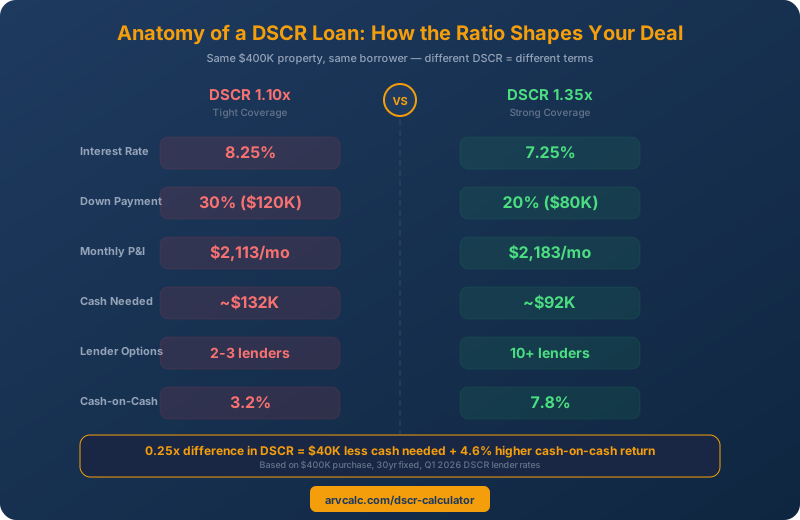
The magic number most investors should target: 1.25x. That’s the threshold where you get standard pricing from the widest range of DSCR lenders.
How DSCR Loans Work in 2026
DSCR loans are a specific product type offered by non-QM (non-qualified mortgage) lenders. They differ from conventional investment property loans in several ways:
- No income verification. No W-2s, no tax returns, no pay stubs. The property’s rent is the only income that matters.
- Faster closing. Without income documentation, underwriting is simpler. Many DSCR loans close in 14-21 days vs. 30-45 for conventional.
- Higher rates. Expect 0.5-1.5% above conventional investment property rates. As of Q1 2026, typical DSCR loan rates run 7.0-8.5% depending on DSCR ratio, credit score, and LTV.
- Entity-friendly. Most DSCR lenders allow borrowing through an LLC, which conventional lenders typically don’t.
- Scalable. No limit on number of properties (conventional caps at 10 financed properties per Fannie Mae eligibility guidelines).
Worth knowing: Some DSCR lenders calculate the ratio using gross rent (from an appraisal or rent schedule), not actual collected rent. Ask upfront which method your lender uses. The difference can swing your DSCR by 0.1-0.2x.
5 Mistakes That Get this tool Applications Denied
- Using asking rent instead of market rent. Lenders use the appraiser’s rent estimate or a 1007 rent schedule, not what you hope to charge. If you’re banking on above-market rent, the DSCR at underwriting will be lower than your projections.
- Forgetting that lenders use PITIA — beyond just P&I. Many DSCR programs define “debt service” as principal + interest + taxes + insurance + HOA. That’s a bigger denominator than just the mortgage payment, pushing your ratio down.
- Short-term rental income assumptions. Most DSCR lenders don’t accept Airbnb projections. They use long-term rental comps. If your property only works as a short-term rental, your DSCR application is dead on arrival at most lenders.
- Not accounting for vacancy. Some lenders haircut gross rent by 5-10% for vacancy. If your DSCR is already tight at 1.21x, that haircut drops you below the 1.20x threshold.
- Low credit score. The calculators qualify the property, but most programs still require 660+ credit. Below 700, expect rate add-ons of 0.25-0.75% that further compress your DSCR.
How to Improve a Low DSCR Before Applying
If your this tool application comes in below the 1.25x target, here are concrete levers to pull:
- Put more money down. A larger down payment reduces the loan amount and monthly payment. Going from 20% to 25% down on a $400K property cuts annual debt service by roughly $2,400, which can add 0.08-0.10x to your DSCR.
- Buy down the rate. Paying 1-2 points upfront to lower the interest rate by 0.25-0.5% reduces monthly payments. On a $300K loan, 0.25% rate reduction saves ~$500/year in debt service.
- Increase rent before closing. If you’re buying an occupied property with below-market rents, negotiate with the seller to raise rents pre-closing, or get a lease amendment signed. Lenders use current rent, not future projections.
- Choose a longer amortization. 30-year am vs. 25-year reduces monthly payments by ~10%. Some lenders offer 40-year amortization with interest-only periods that push DSCR higher.
- Appeal the property tax assessment. Lower taxes = higher NOI = higher DSCR. If the assessed value is above recent comps, file an appeal before your loan application.
What DSCR Doesn’t Tell You
- No equity picture. DSCR only measures income vs. debt. A property with 1.30x DSCR and 5% equity is far riskier than one with 1.30x and 40% equity. LTV matters separately.
- Ignores capex. NOI excludes capital expenditures. A property might show 1.25x DSCR today but need a $25,000 roof next year. The ratio doesn’t flag that.
- Static moment in time. DSCR uses current rent and current loan terms. If you have an ARM, the ratio will change when the rate adjusts. If the market softens, rents drop and so does DSCR.
- Doesn’t reflect total return. A property with 1.10x DSCR in an 8% appreciation market might be a better investment than 1.50x in a flat market. DSCR only sees the income side.
- Lender DSCR may differ from yours. You might calculate 1.28x using actual expenses, but the lender calculates 1.18x using their own expense assumptions and PITIA. Always ask how your lender defines the inputs.
Who Should Use DSCR Loans?
the calculators work best for a specific investor profile. Here’s a quick breakdown of who benefits most and who should look elsewhere:
| Investor Type | this tools Fit? | Why |
|---|---|---|
| Self-employed / business owner | Yes | Tax returns understate income. The calculators skip income verification. |
| Scaling investor (5+ properties) | Yes | No Fannie Mae 10-property cap. Each deal stands on its own DSCR. |
| Foreign national | Yes | Many DSCR lenders accept foreign nationals with 25-30% down. |
| W-2 employee buying first rental | Maybe | Conventional loan is cheaper. Use this tools only if DTI is maxed. |
| House hacker (living in the property) | No | the calculators are investment-only. Use FHA or conventional for owner-occupied. |
Common Mistakes When Using a DSCR Calculator
Even experienced investors slip up with DSCR. The calculator outputs a number, but garbage in means garbage out. Here are five errors that cost real money.
Overestimating Gross Rental Income
The biggest mistake is using “pro forma” rent—what the seller or agent claims the property *could* earn. A DSCR calculator needs actual market rent, not wishful thinking. Pull comps from active rentals in the same complex or block. Use 5-10% vacancy factor even in hot markets. If you plug $2,500/month but the real rent is $2,200, your DSCR drops from 1.30 to 1.15. That could kill your loan approval.
Ignoring Non-Mortgage Operating Expenses
DSCR covers the mortgage payment, but lenders include taxes, insurance, HOA fees, and property management in the expense ratio. Many investors only input P&I (principal and interest). A $1,500 P&I payment with $400 in taxes and $200 in HOA becomes a $2,100 total housing cost. Your DSCR of 1.25 on P&I alone falls to 1.05 when you add those items. Run the calculator with full operating expenses, not just debt service.
Using the Wrong Interest Rate for Loan Type
DSCR rates differ from conventional rates. In 2026, a 30-year fixed conventional loan runs around 7.5%. This tool with the same term hits 8.25%. Hard money for short-term flips is 12%. If you plug 7.5% into a DSCR calculator but your lender quotes 8.25%, your monthly payment jumps $50–$70 per $100,000 borrowed. That 0.75% spread can drop your DSCR by 0.10–0.15 points. Always confirm your actual rate before running numbers.
Forgetting Cash-Out Refinance Costs
BRRRR investors often use a DSCR calculator to estimate refinance feasibility. They forget to include closing costs for the new loan—typically 2-5% of the loan amount. A $200,000 cash-out refinance with 3% closing costs adds $6,000 in upfront expense. If your after-repair value (ARV) is $250,000, your net equity drops. The calculator assumes you get that cash, but real costs eat into your returns. Factor in those fees before you commit.
Assuming DSCR Stays Constant Over Time
DSCR is a snapshot, not a prediction. Interest rates change, rents rise (or fall), and expenses increase. A property that qualifies at 1.25 today might drop to 1.10 if rates go up 1% or if a major repair hits. Use the calculator with a stress test: run it at your current rate, then again at 1% higher. If the second result falls below 1.0, you have no margin for error. Smart investors only buy when DSCR stays above 1.20 even under stress.
Strategy Guide: Using the DSCR Calculator by Investor Type
Your experience level and deal structure change how you should use this tool. How to apply it for three common investor profiles.
For Beginners: Focus on Safety Margin
If you are buying your first rental property, your goal is survival, not maximum advantage. Use the DSCR calculator with conservative inputs. Assume 90% of market rent, 10% vacancy, and 8% for repairs and maintenance. Do not stretch for a 1.20 minimum—aim for 1.30 or higher. That extra buffer covers unexpected vacancies or rate increases.
Run the calculator on three properties in the same price range. Compare DSCR outputs. The property with the highest DSCR (all else equal) is your safest bet. You can also pair the DSCR result with our rental property calculator to see total cash flow and equity growth over 5 years.
Avoid hard money or adjustable-rate the calculators as a beginner. Stick with fixed-rate this tools at 8.25% (2026 rates). Your monthly payment stays predictable. If the calculator shows DSCR below 1.25 with those inputs, reconsider the assumptions. There will be another deal.
For Experienced Investors: Optimize for Cash Flow and Advantage
You already know the basics. Now use the DSCR calculator to compare financing structures. Run the same property with a 30-year fixed the calculator at 8.25% and a 5-year interest-only this tool at 8.5%. The interest-only option lowers your monthly payment by 20-30%, boosting DSCR by 0.15–0.25 points. That might let you qualify for a property that barely misses the cutoff with amortization.
But be careful. Interest-only periods end. Run the calculator again with the fully amortized payment at year 5. If DSCR drops below 1.0, you need a refinance or rent growth plan. Experienced investors also layer in our cash-on-cash calculator to see how DSCR affects your actual return on cash invested. A property with 1.30 DSCR and 8% cash-on-cash is better than one with 1.15 DSCR and 10% cash-on-cash if you have low risk tolerance.
Also use the calculator to test multiple exit strategies. If you plan to sell in 3 years, run the numbers with a 5/1 ARM the calculator at 7.75% (2026 rate). Lower payment, higher DSCR, but rate resets. Make sure your exit timeline matches the rate lock.
For BRRRR Investors: Stress-Test the Refinance
The BRRRR method (Buy, Rehab, Rent, Refinance, Repeat) lives or dies on the refinance step. You buy with hard money at 12% (2026 rate), rehab, then refinance into this tool. Use the calculator before you buy. Input your projected after-repair value (ARV), estimated rent, and the calculator rate (8.25%). If DSCR is below 1.20, your refinance may not work.
Hard money payments are high. Run the calculator with your hard money terms to see if you can carry the property during rehab. If the DSCR on hard money is below 0.80, you are bleeding cash every month. That forces a quick sale, not a long-term hold.
After refinance, your DSCR should hit 1.25 or higher. If not, you either overpaid for the property, underestimated rehab costs, or picked a market with weak rents. Use our compare deals tool tool to stack your BRRRR property against other deals in the same area. The best BRRRR candidates show a DSCR of 1.30+ after refinance with a 75% LTV loan.
2026 Market Context: How Current Rates Affect DSCR
The 2026 lending environment is not your grandfather’s market. Rates are high across the board, and this tools are no exception. How the numbers play out.
Conventional vs. DSCR vs. Hard Money Rates
In 2026, a conventional 30-year fixed mortgage for an owner-occupied home averages 7.5%. The calculators for investment properties run 8.25%—a 0.75% premium for the flexibility of using rental income instead of personal income. Hard money for short-term flips or bridge financing sits at 12%, reflecting higher risk and shorter terms.
That spread matters. On a $300,000 loan, the monthly payment difference between 7.5% and 8.25% is about $140. Over a year, that is $1,680 less cash flow. Your DSCR drops by roughly 0.08–0.10 points. A property that barely qualifies at 8.25% would easily pass at 7.5%.
Impact on Deal Feasibility
Higher DSCR rates mean you need more rent per dollar of purchase price. In 2021, a $200,000 property with $1,800/month rent might have hit 1.25 DSCR at 4.5%. In 2026, at 8.25%, that same deal yields a DSCR around 1.05—below most lender minimums. You either need cheaper financing, higher rent, or a lower purchase price.
The practical effect: investors are buying smaller properties or targeting markets with stronger rent-to-price ratios. Midwest and Sun Belt markets with $1,500 rent on a $150,000 purchase price still work. Coastal markets with $3,000 rent on a $600,000 purchase price often fail the DSCR test.
Strategic Adjustments for 2026
If you are using a DSCR calculator in 2026, adjust your inputs upward. Use 8.25% as your base rate, not 7.5%. If you are considering a hard money bridge loan, use 12% for the holding period. Run the calculator with a 1.25 minimum DSCR, not 1.20. Lenders are tightening standards as rates stay high.
Consider shorter loan terms to lower your rate. A 5-year interest-only this tool might run 7.75% in 2026—0.50% below the 30-year fixed. That saves $125/month on a $300,000 loan and boosts DSCR by 0.07 points. The trade-off is refinance risk, but for investors with a 3-5 year hold plan, it works.
Also watch for rate buydowns. Some lenders offer 1-0 temporary buydowns (1% lower for year one, then back to normal). That can help you qualify today while you push rents higher. Run the calculator with the bought-down rate and the standard rate to see your margin over time.
Finally, do not ignore the hard money option for short-term plays. At 12%, a flip or small multifamily with a 6-month timeline may still pencil out if the after-repair value gives you 20%+ equity. Use the DSCR calculator to confirm you can cover the hard money payment during the rehab period. If the numbers work, the higher rate is just a cost of doing business, not a deal killer.
For ongoing deal analysis, bookmark our rental property calculator, cash-on-cash calculator, and compare deals tool tool. These three resources, combined with accurate DSCR inputs, give you a broader view in any rate environment.
FAQ
What is a good DSCR for rental property?
1.25x is the standard target. At that level, you qualify with most DSCR lenders at competitive terms. Above 1.50x you’ll get the best pricing. Below 1.20x, options narrow and costs increase.
Can I get a DSCR loan with 1.0x?
In practice, a few lenders offer 1.0x DSCR programs, meaning rent just barely covers the mortgage. Expect to pay a premium: rates 0.5-1% higher, 25-30% down required, and typically limited to borrowers with 720+ credit. Some lenders even offer below-1.0x programs (called “no-ratio” DSCR), but at steep cost.
Is DSCR the same as cap rate?
No. Cap rate compares NOI to property value and ignores debt entirely. DSCR compares NOI to debt payments. A property can have a great cap rate but terrible DSCR if it’s highly leveraged, or vice versa. Use both: cap rate to evaluate the property, DSCR to evaluate the financing.
Do DSCR loans require a personal guarantee?
Most do, even when the borrower is an LLC. The personal guarantee means you’re on the hook if the property income fails to cover the loan. True non-recourse the calculators exist but typically require DSCR above 1.30x, LTV under 65%, and strong borrower liquidity.
How do I calculate DSCR for a multi-unit property?
The process is straightforward. Add up gross rent from all units, subtract vacancy and operating expenses to get NOI, then divide by annual debt service. On a 4-unit, treat it as one property with combined income. Use the DSCR Calculator to run the numbers with detailed expense breakdown.
Should You Use a DSCR Loan?
DSCR loans make sense when:
- You’re self-employed or have complex tax returns that understate income
- You already have 5-10 conventional mortgages and hit Fannie Mae limits
- You want to buy through an LLC for liability protection
- You need to close fast (14-21 days)
They don’t make sense when:
- You qualify for conventional financing (rates are 0.5-1.5% lower)
- The property’s DSCR is below 1.0x (you’ll bleed cash monthly)
- You’re buying a primary residence (DSCR is investment property only)
When evaluating DSCR loans, remember that the ratio is a screening tool for lenders and a sanity check for investors. If the property can’t cover its own mortgage, that’s a signal to renegotiate the price, increase the down payment, or reconsider the assumptions.
Check Your Deal’s DSCR
4 calculation modes including reverse-solve for max loan amount. Instant lender-tier rating.
Disclaimer: This article is for educational purposes only and does not constitute financial, investment, legal, or tax advice. Real estate investing involves significant risk, including the potential loss of capital. All numbers, rates, and projections are illustrative examples and may not reflect your specific situation. Consult qualified financial, legal, and tax professionals before making any investment decisions.
Leave a Reply