Last updated: November 3, 2026 · Originally published: October 23, 2026 · By Alex Petrov
My first South Carolina closing caught me off guard with a $1,100 attorney fee I did not expect. In Ohio, I had closed eight deals through a title company — no attorney, $0 legal cost at closing. South Carolina requires a licensed attorney at every real estate closing, and that is just the first of several SC-specific costs that differ from other investor states. Total South Carolina closing costs for investment property buyers run 2.5-4.0% of purchase price — moderate nationally, but the line items look different from what out-of-state investors expect.
This guide breaks down every South Carolina closing costs investment property fee with real dollar amounts, explains the SC-specific items (attorney requirement, deed stamps, 6% tax assessment), and shows you how costs differ between Charleston, Greenville, Columbia, and other markets. Estimate your total with the South Carolina closing costs calculator.
South Carolina Closing Cost Breakdown: Line by Line
| Fee | Range | SC-Specific? | Notes |
|---|---|---|---|
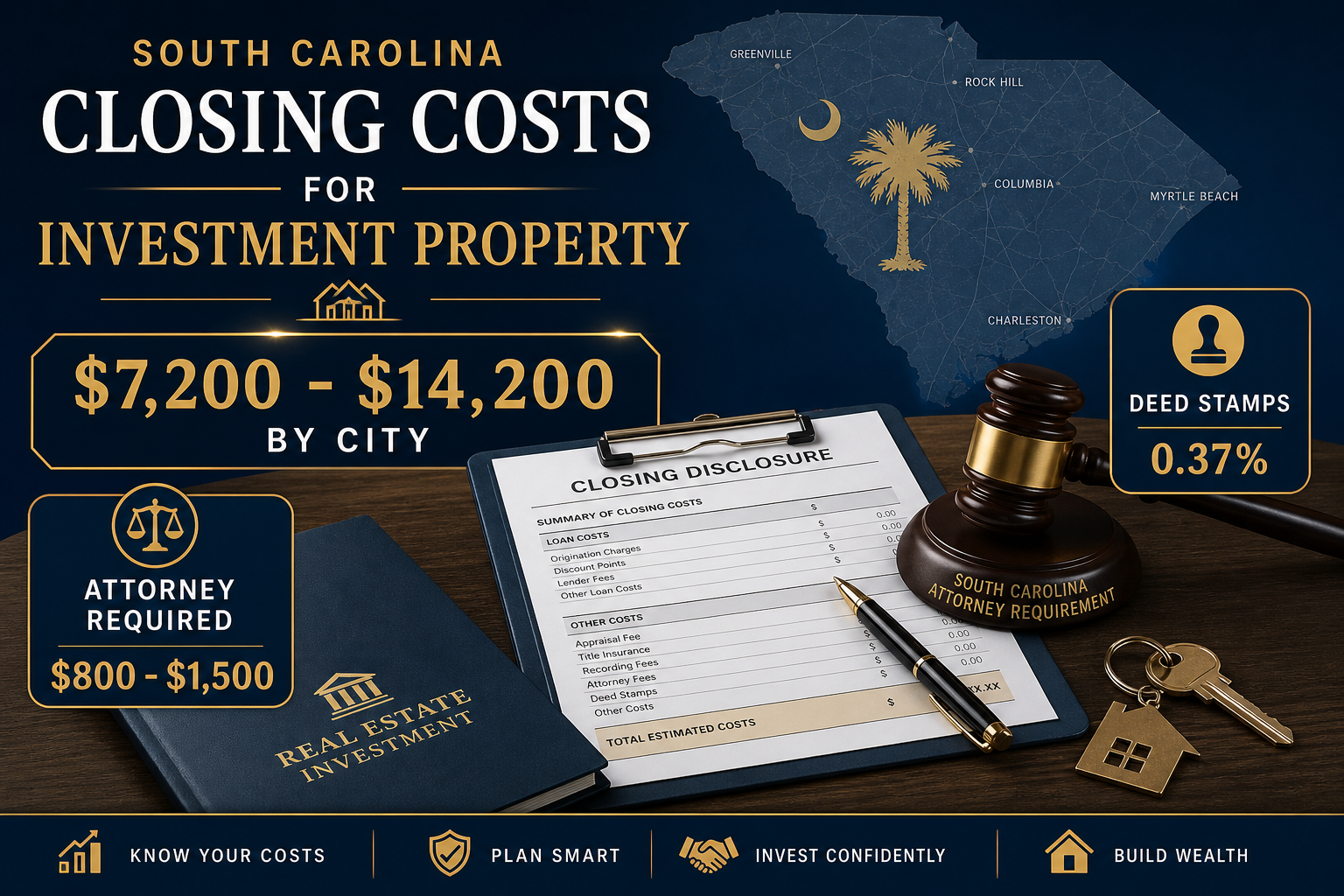
| Attorney fee | $800-$1,500 | Yes — required | SC mandates attorney at closing. Handles title search, docs, escrow. |
| Title insurance | $1,000-$3,000 | No | One-time premium based on purchase price |
| State deed stamps | 0.37% of price | Yes | $1,110 on $300K. Paid by buyer. Non-negotiable. |
| Recording fees | $50-$150 | No | County recorder |
| Survey | $300-$600 | Often required | Especially rural properties. Can waive if recent survey exists. |
| Appraisal | $400-$700 | No | Ordered by lender |
| Lender origination | 0.5-1.5% of loan | No | Negotiable — show competing quotes |
| Prepaid taxes (4 mo) | $600-$1,400 | SC trap — see below | Based on 6% investment assessment, not seller’s 4% rate |
| Prepaid insurance (12 mo) | $1,500-$4,200 | Coastal premium | Inland $1,500-$2,000. Charleston/Myrtle Beach $3,000-$4,200. |
When calculating South Carolina closing costs, on a $300,000 Greenville investment property: total closing costs approximately $8,500-$11,000 (2.8-3.7%). On a $420,000 Charleston property: $12,000-$16,000 (2.9-3.8%) because of higher insurance prepaids and larger deed stamp amount.
Why SC Requires an Attorney at Closing
According to the American Bar Association, South Carolina is one of roughly 20 “attorney states” where a licensed attorney must supervise real estate closings. The attorney conducts the title search, prepares all closing documents, manages the escrow account, and supervises the signing. This replaces the title company role used in states like Florida, Texas, and Ohio.
What the Attorney Does vs What a Title Company Does
In a title-company state, you get a title agent who follows a standardized process. In SC, you get a licensed attorney who can identify legal issues that a title agent might miss: boundary disputes, easement problems, HOA litigation, and complex ownership structures. The downside: you pay $800-$1,500 for this service versus $0 in title-company states.
For investment property closings with unusual structures (LLC purchases, 1031 exchanges, seller financing), the attorney review is genuinely valuable. For straightforward purchases, it is an added cost with modest additional benefit. Either way, it is required — budget for it.
How to Choose an SC Closing Attorney
Shop at least three attorneys. The fee range ($800-$1,500) is wide for the same standard service on a standard purchase. Ask for a flat fee quote, not hourly billing. Confirm they handle investment property closings regularly — some attorneys primarily do residential owner-occupied transactions and may be slower or less familiar with investor-specific issues (like 6% assessment implications).
SC Deed Stamps: The 0.37% Transfer Tax
South Carolina closing costs investment property include state deed recording stamps at $1.85 per $500 of property value — equivalent to 0.37% of the purchase price. This is a state-level charge with no local additions.
| Purchase Price | Deed Stamps (0.37%) |
|---|---|
| $200,000 | $740 |
| $280,000 | $1,036 |
| $350,000 | $1,295 |
| $420,000 (Charleston) | $1,554 |
For comparison: Florida charges 0.70% (nearly double SC), Pennsylvania charges 1% (state) plus up to 1% local. Ohio and Indiana charge no state transfer tax at all. SC’s 0.37% is moderate — not a deal-breaker but not free. For BRRRR investors who cycle through multiple purchases, the deed stamps accumulate: four BRRRR cycles on $250K properties = $3,700 in total deed stamps. Check full BRRRR costs with the SC BRRRR calculator.
The Tax Reassessment Trap at Closing
This is the single most expensive surprise for first-time SC investors. South Carolina assesses owner-occupied homes at 4% of fair market value but investment property at 6%. When you buy a property that was owner-occupied and convert it to rental, the assessment ratio changes — and your property tax jumps 40-50%.
How This Plays Out at Closing
The prepaid tax escrow at closing is calculated using the current tax bill — which reflects the seller’s 4% owner-occupied rate. Your actual tax bill in year one will be recalculated at the 6% investment rate. On a $280,000 property:
- Seller’s tax (4% assessment): ~$1,600/year
- Your tax (6% assessment): ~$2,408/year
- Year-one surprise: $808 more than the prorated closing amount suggested
Budget for this increase before you close. Add $800-$1,200 to your year-one expense projection. This affects your cap rate, DSCR, and cash flow calculations. The SC rental property calculator uses the 6% investment rate automatically.
Closing Costs by South Carolina Market
| Market | Median Price | Closing Costs | Down (25%) | Total Cash |
|---|---|---|---|---|
| Spartanburg | $210,000 | $7,200 | $52,500 | $59,700 |
| Columbia | $225,000 | $7,800 | $56,250 | $64,050 |
| Greenville | $285,000 | $9,400 | $71,250 | $80,650 |
| Myrtle Beach | $310,000 | $11,500 | $77,500 | $89,000 |
| Charleston | $420,000 | $14,200 | $105,000 | $119,200 |
This South Carolina closing costs comparison shows the Charleston-to-Spartanburg spread is $59,500 in total cash needed — enough to buy two Spartanburg properties for the cash required for one Charleston property. This is why capital-efficient investors often start in Columbia or Spartanburg and add Charleston later. Use the SC closing costs calculator for your specific scenario.
How to Reduce SC Closing Costs
1. Negotiate Seller Concessions (Save $3,000-$8,000)
Ask the seller to contribute 2-3% of purchase price toward your closing costs. This is common on properties with 30+ days on market. On a $300,000 purchase, a 2% seller concession saves $6,000 at closing.
2. Shop Attorneys (Save $300-$700)
Get three flat-fee quotes. The range is $800-$1,500 for the same standard purchase closing. Do not accept the first quote or the lender’s “preferred” attorney without comparing.
3. Negotiate Lender Origination (Save $750-$2,250)
Origination fees range from 0.5% to 1.5% of loan amount. Show competing lender quotes — most will reduce origination to win your business. On a $225,000 loan, dropping from 1.5% to 0.75% saves $1,687.
4. Skip the Survey If One Exists (Save $300-$600)
If a recent survey is available (common on properties that sold within the last 5 years), ask the lender to waive the new survey requirement. Not always possible but worth asking.
5. Use Lender Credits for Short-Term Holds (Save $2,000-$4,000)
Accept a slightly higher interest rate (0.125-0.25% more) in exchange for lender credits that offset closing costs. This makes sense if you plan to refinance or sell within 2-3 years — the higher rate costs less over a short period than the closing costs you avoid. Check the breakeven point with the mortgage calculator.
Worked Example: $285,000 Greenville Investment Property
Here is the actual closing cost breakdown from a Greenville SFR purchase — a 3BR/2BA built in 2004, purchased as a long-term rental with a DSCR loan at 25% down.
| Line Item | Amount |
|---|---|
| Down payment (25%) | $71,250 |
| Attorney fee | $1,100 |
| Title insurance | $1,725 |
| Title search | $300 |
| Deed stamps (0.37%) | $1,055 |
| Survey | $425 |
| Appraisal | $550 |
| Lender origination (1%) | $2,138 |
| Prepaid taxes (4 months at 6%) | $818 |
| Prepaid insurance (12 months) | $1,800 |
| Recording fees | $75 |
| Total closing costs | $9,986 |
| Total cash to close | $81,236 |
Closing costs came to 3.5% of purchase price — mid-range for SC. The attorney fee ($1,100) was the biggest SC-specific cost. The deed stamps ($1,055) were unavoidable. The lender origination ($2,138) was the largest negotiable item — getting it down to 0.75% would have saved $534.
Add reserves (6 months PITIA = $12,900) and the true capital requirement is $94,136 — not the $71,250 down payment most investors initially budget. The gap between “down payment” and “total capital needed” is $22,886 — closing costs plus reserves. Always budget the full picture before making an offer. See our cash reserves guide for the reserve calculation methodology.
Closing Timeline in South Carolina
SC closings take 30-45 days from contract to close for conventional and DSCR loans. The attorney-close requirement does not significantly slow the process — most SC real estate attorneys handle closings daily and can schedule within 1-2 weeks of title clearance.
Typical timeline:
- Days 1-3: Earnest money deposited, attorney engaged, title search ordered
- Days 3-7: Inspection, appraisal ordered
- Days 7-14: Title search complete, inspection results reviewed
- Days 14-25: Loan underwriting, appraisal received
- Days 25-35: Clear to close, attorney prepares documents
- Day 30-45: Closing at attorney’s office
For hard money purchases (BRRRR acquisitions), closing can happen in 14-21 days. The attorney can expedite if needed — but expect a rush fee of $200-$500 for closings under 14 days.
SC Closing Costs vs Other Investor States
| State | Closing Cost % | Transfer Tax | Attorney Required? | Key Difference |
|---|---|---|---|---|
| South Carolina | 2.5-4.0% | 0.37% | Yes | Attorney + deed stamps + 6% assessment |
| Ohio | 2.0-3.5% | 0% | No | No transfer tax = lowest closing costs |
| Florida | 2.5-4.5% | 0.70% | No | Double the transfer tax of SC |
| Texas | 2.0-3.5% | 0% | No | State-regulated title insurance rates |
| Tennessee | 2.5-3.5% | $0.37/$100 | No | Similar transfer tax to SC |
| Georgia | 2.0-3.5% | $1/$1,000 | Yes (most counties) | Attorney required in most counties |
South Carolina closing costs are in the middle nationally — higher than Ohio (zero transfer tax, no attorney) but lower than Florida (0.70% transfer tax). The attorney requirement adds $800-$1,500 that title-company states do not charge, but it is partially offset by the lower deed stamp rate (0.37% vs Florida’s 0.70%). Compare markets in our best cities guide.
Understanding closing costs is critical for BRRRR investors who close twice — once to buy, once to refinance. See our BRRRR strategy in South Carolina guide for the full cost breakdown.
Frequently Asked Questions
How much are closing costs in South Carolina for investment property?
South Carolina closing costs investment property run 2.5-4.0% of purchase price: $7,500-$12,000 on a $300,000 property. Includes mandatory attorney fee ($800-$1,500), state deed stamps (0.37% = $1,110 on $300K), title insurance, lender fees, and prepaids. Coastal properties (Charleston, Myrtle Beach) have higher costs due to expensive insurance prepaids ($3,000-$4,200/year vs $1,500-$2,000 inland).
Does South Carolina require an attorney at closing?
Yes. South Carolina is an attorney-close state. A licensed attorney must supervise the closing, conduct the title search, prepare documents, and manage escrow. Cost: $800-$1,500. This replaces the title company role in states like Florida, Ohio, and Texas. Shop at least three attorneys for flat-fee quotes — the range is wide for the same service.
What is the transfer tax in South Carolina?
Per SC Department of Revenue guidelines, South Carolina charges state deed stamps at $1.85 per $500 of property value = 0.37% of purchase price. On $300,000: $1,110. No additional local transfer tax. This is lower than Florida (0.70%) and Pennsylvania (1%+) but higher than Ohio and Texas (0%). For BRRRR investors, deed stamps apply on each purchase — budget accordingly for multiple cycles.
Why will my SC property tax be higher than the seller’s?
SC assesses owner-occupied homes at 4% of value but investment property at 6%. When you buy a previously owner-occupied home as an investment, your assessment ratio increases 50%. On a $280,000 property: seller paid ~$1,600/year at 4%, you will pay ~$2,408/year at 6%. This $808 difference is not reflected in closing prorations — budget for it separately.
How can I reduce closing costs in South Carolina?
Five strategies: (1) Negotiate 2-3% seller concessions — saves $6,000-$9,000 on $300K. (2) Shop three attorneys — save $300-$700. (3) Negotiate lender origination down from 1.5% to 0.75% — save $1,687 on $225K loan. (4) Waive survey if recent one exists — save $300-$600. (5) Use lender credits for short-term holds — accept higher rate to eliminate $2,000-$4,000 in upfront costs.
Budget the Full Picture Before You Close
Your South Carolina closing costs investment property total is not the only cash you need. Add down payment (typically 20-25%) and reserves (6 months PITIA per our cash reserves guide) to get the true capital requirement. On a $280,000 Greenville rental: down payment $70,000 + closing costs $9,400 + reserves $13,164 = $92,564 total. The closing costs are 10% of your total capital commitment — significant but not the largest piece.
The bottom line on South Carolina closing costs for South Carolina closing costs investment property: they are moderate nationally but structured differently from title-company states. The attorney requirement, deed stamps, and 6% assessment trap are SC-specific items that out-of-state investors must understand before closing. Budget 3-4% of purchase price for closing costs, verify the investment property tax rate with the county assessor, and get three insurance quotes before committing.
Start with the SC closing costs calculator for a line-item estimate, then run the full deal through the SC rental property calculator to confirm the property cash flows after all costs are accounted for.
For investors comparing South Carolina to other states, the attorney requirement adds $800-$1,500 that title-company states do not charge — but SC deed stamps at 0.37% are lower than Florida (0.70%) and Pennsylvania (1%+). The net difference is modest. What matters more is the 6% investment property tax assessment — budget for the year-one tax increase before you calculate your true all-in cost.