Last updated: November 14, 2026 · Originally published: November 13, 2026 · By Alex Petrov
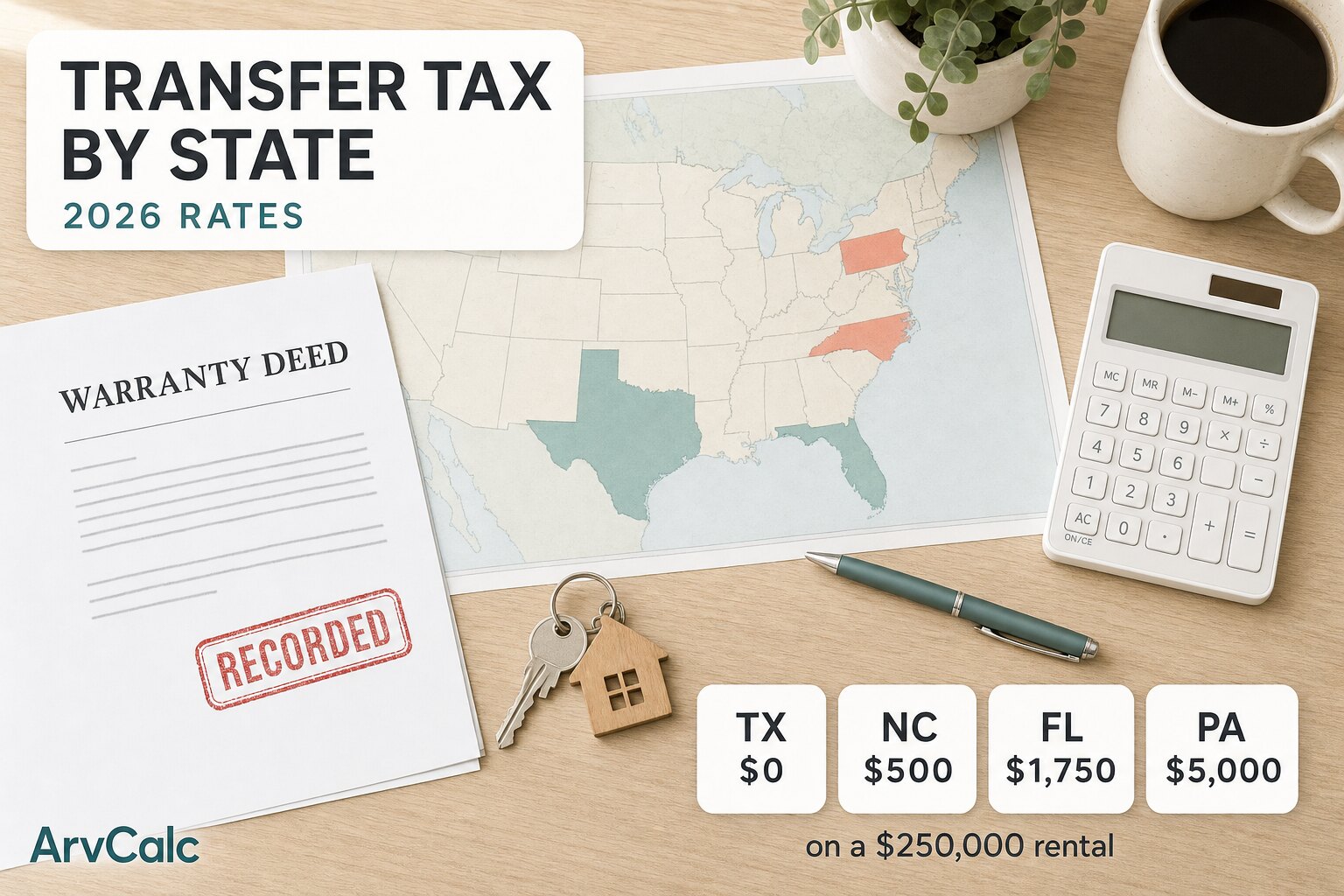
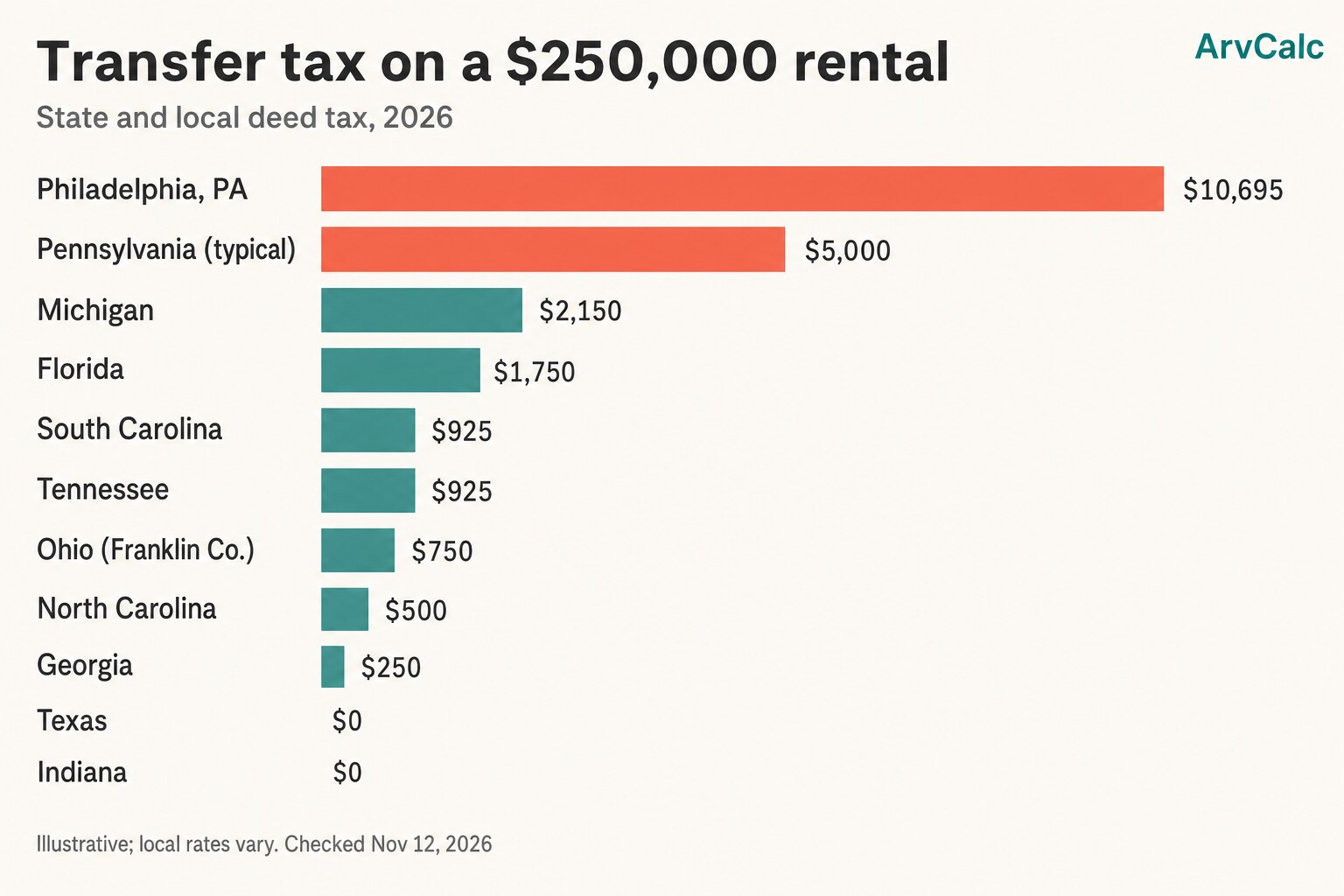
A transfer tax calculator answers a simple question that many rental investors skip: how much will the state and county take when the deed changes hands? On a $250,000 rental the answer ranges from $0 in Texas to more than $10,000 in Philadelphia. This guide gives you the 2026 rates, the rounding rules and the formula for each state ArvCalc covers, so you can run the number yourself before you sign.
Rates checked November 12, 2026, against state revenue departments, statutes and county or city sources linked below. Educational analysis, not tax or legal advice. Your title company or closing attorney has the final figure.
What a transfer tax calculator actually measures
A real estate transfer tax is a one-time charge on recording a deed. States call it different things: documentary stamp tax in Florida, excise tax in North Carolina, recordation tax in Tennessee, deed recording fee in South Carolina and conveyance fee in Ohio. The idea is the same. The deed cannot be recorded until the tax is paid, so it shows up as a line on the closing statement.
It is not the same as property tax. Property tax is a yearly bill based on assessed value; transfer tax happens once per sale. It is also separate from mortgage taxes, which some states charge on the loan rather than the deed. A good transfer tax calculator keeps these three apart, because they land on different people and affect different parts of your analysis.
For a buy-and-hold investor the tax matters twice: once when you buy, if your state or contract puts it on the buyer, and once when you sell. For a flipper it can hit both ends of a deal that lasts six months. Our guide to closing costs on investment property covers the other lines on the statement.
The transfer tax calculator formula in three steps
Every state on this page uses the same basic shape. Only the unit, the rate and the rounding change.
- Find the taxable base. Usually the sale price. Some states use the higher of price or value, and some include debt the buyer assumes. In Florida and Pennsylvania a deed with an existing mortgage can be taxed on that mortgage even when no cash changes hands.
- Divide by the unit and round. If the statute says “each $500 or fractional part,” round up. A $250,250 sale in North Carolina is 501 units of $500, not 500.5.
- Multiply by the rate and add local layers. State rate first, then any county, city or school district rate. Michigan, Ohio, Pennsylvania and Miami-Dade all have a second layer.
Written as one line: tax = ceiling(base ÷ unit) × rate per unit + local tax. You can put the result straight into the closing costs field of the ArvCalc closing costs calculator or the rental property calculator.
Transfer tax by state: 2026 rates for a $250,000 rental
The table uses one example for every state: a $250,000 purchase. Rates are per the sources linked in the state notes below.
| State | Rate and unit | Tax on $250,000 | Usually paid by |
|---|---|---|---|
| Florida (not Miami-Dade) | $0.70 per $100 or portion | $1,750 | Seller, by custom |
| Florida, Miami-Dade | $0.60 per $100; plus $0.45 surtax unless single-family | $1,500 (house) / $2,625 (duplex) | Negotiated |
| Georgia | $1 first $1,000, then $0.10 per $100 | $250 | Seller, by statute |
| Indiana | No transfer tax; $20 sales disclosure fee | $0 | n/a |
| Michigan | $3.75 state + $0.55 county per $500 | $2,150 | Seller, by custom |
| North Carolina | $1 per $500 or fraction | $500 | Seller, by custom |
| Ohio | $1 state + up to $3 county per $1,000 | $250 to $1,000 ($750 in Franklin County) | Seller, by custom |
| Pennsylvania | 1% state + local (often 1%) | About $5,000; $10,695 in Philadelphia | Split 50/50, by custom |
| South Carolina | $1.85 per $500 or fraction | $925 | Seller, by custom |
| Tennessee | $0.37 per $100 | $925 | Buyer, by custom |
| Texas | No transfer tax | $0 | n/a |
“By custom” means the contract can change it. In a hot market a seller may push the tax onto the buyer, and in a slow one a buyer can ask the seller to cover a share. Read the purchase agreement, not the table, for your deal.
State notes: how each transfer tax calculator differs
Florida documentary stamp tax
The Florida Department of Revenue sets deed stamps at 70 cents per $100 or portion of the consideration. Miami-Dade is the exception: 60 cents per $100, plus a 45-cent surtax unless the deed transfers only a single-family dwelling. A duplex or small apartment building in Miami-Dade therefore pays $1.05 per $100. Florida also taxes the loan, which we cover below. For the full closing picture see Florida closing costs for investment property.
Michigan state and county transfer tax
Michigan charges $3.75 per $500 at the state level and $0.55 per $500 at the county level, for $4.30 per $500 or $8.60 per $1,000 in total (county register of deeds summary). A common error is to add the two rates as if one were per $1,000; that overstates the bill by about 13%. If you are buying in Michigan, the bigger surprise is usually the annual tax, explained in our Michigan property tax calculator for rentals.
North Carolina excise tax
Under G.S. 105-228.30, the excise tax on conveyances is $1 on each $500 or fractional part, which is effectively 0.2%. It is one of the cheapest in the region, and the seller normally pays it. See North Carolina closing costs for attorney and title fees, which are usually larger.
Tennessee recordation tax
The Tennessee Department of Revenue applies a realty transfer tax of 37 cents per $100 and a separate indebtedness tax of 11.5 cents per $100 of the loan, with the first $2,000 exempt. Unlike most states here, the buyer usually pays. That makes Tennessee one of the few places where a transfer tax calculator belongs in your purchase budget, not your exit budget. More in Tennessee closing costs.
Georgia transfer tax and intangible recording tax
The Georgia Department of Revenue sets the transfer tax at $1 for the first $1,000 and 10 cents for each additional $100 or fraction, so roughly $1 per $1,000, and the statute makes the seller liable. The heavier Georgia line is the intangible recording tax on long-term loans: $1.50 per $500 of the note, capped at $25,000. See Georgia closing costs.
South Carolina deed recording fee
The South Carolina Department of Revenue (Revenue Ruling 24-1) describes a $1.85 fee for each $500 or fractional part of value: $1.30 to the state and $0.55 to the county. Do not confuse it with the flat recording charge for the document itself. Details in South Carolina closing costs.
Ohio conveyance fee
Ohio charges a mandatory $1 per $1,000 in every county, and each county may add up to $3 more. Franklin County (Columbus) charges $3 per $1,000 in total, according to the Franklin County Auditor’s calculator. Check the county auditor’s site for Cuyahoga, Hamilton or Summit before you rely on a statewide figure. See Ohio closing costs.
Pennsylvania realty transfer tax
Pennsylvania levies 1%, and most municipalities and school districts add their own share, commonly another 1% combined. Philadelphia is the outlier: the City of Philadelphia lists 3.278% city plus 1% state, a 4.278% total. Buyer and seller customarily split it. On a flip, that split applies on the way in and on the way out, as the example below shows.
Texas and Indiana
Neither state has a real estate transfer tax. Indiana does require a sales disclosure form, and the county auditor charges a $20 fee to file it (Indiana DLGF). In Texas the saving is real, but title insurance and higher property taxes take its place. See Texas closing costs and Indiana closing costs.
Taxes on the mortgage: the second line most calculators miss
Three states on the list also tax the loan. These charges sit next to the deed tax on the closing statement, and the buyer pays them. On the same $250,000 purchase with 25% down, the loan is $187,500.
| State | Loan-side tax | On a $187,500 loan |
|---|---|---|
| Florida | Doc stamps on the note, $0.35 per $100, plus intangible tax of 0.2% | $656.25 + $375 = $1,031.25 |
| Georgia | Intangible recording tax, $1.50 per $500 | $562.50 |
| Tennessee | Indebtedness tax, $0.115 per $100 after the first $2,000 | $213.33 |
A Florida buyer who finances therefore pays about $1,031 of loan taxes even though the seller usually covers the $1,750 deed tax. A cash buyer skips that line. The same logic applies to a cash-out refinance: new money on a new note can be taxed again, which matters for a BRRRR in Florida. Ask the closing agent how a refinance will be taxed before you budget it.
Worked example: one rental, three states
Take a $250,000 single-family rental bought with a $187,500 loan, and assume the buyer pays only what the law or local custom puts on the buyer.
| Line | Tennessee | Florida | Michigan |
|---|---|---|---|
| Deed transfer tax | $925 (buyer) | $1,750 (seller) | $2,150 (seller) |
| Loan-side tax | $213.33 | $1,031.25 | $0 |
| Buyer’s tax cost at purchase | $1,138.33 | $1,031.25 | $0 |
| Seller’s tax cost at a future $250,000 sale | $0 | $1,750 | $2,150 |
The buyer’s numbers look similar in Tennessee and Florida, but the exit is very different. A Michigan investor pays nothing at purchase and $2,150 when selling at the same price. Put the exit figure into your sale assumptions in the IRR calculator, because a cost at the end of a hold still reduces the return.
For taxes, the IRS treats transfer taxes paid by the buyer as part of the property’s basis, and taxes paid by the seller as a selling expense (IRS Publication 551). Neither is a current-year deduction for a rental purchase, so they do not show up in your first-year cash flow.
Worked example: a Pennsylvania flip pays twice
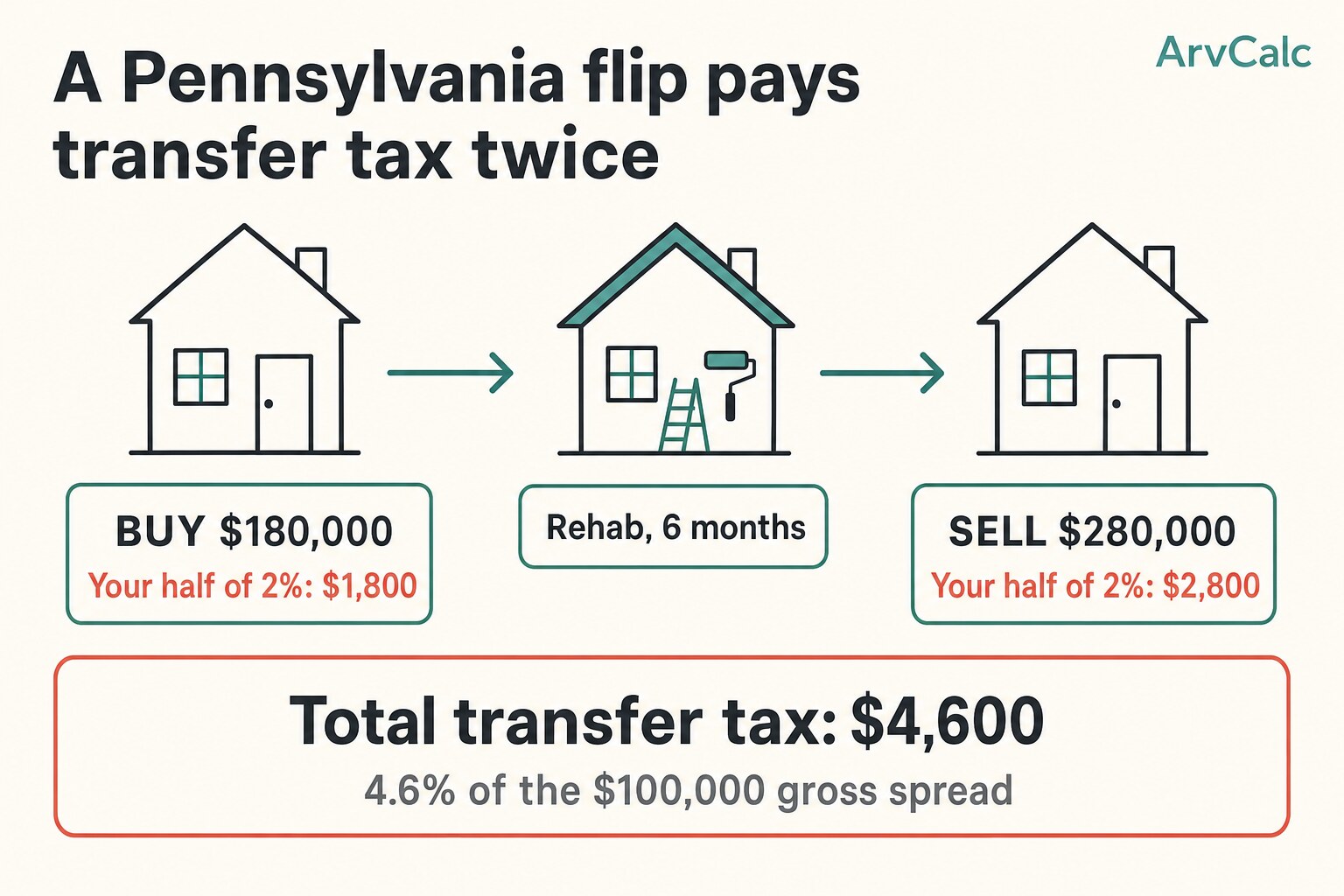
A flipper buys a house outside Philadelphia for $180,000 and sells it six months later for $280,000. Assume 2% combined state and local tax, split 50/50 by custom.
- At purchase, the flipper pays half of 2% of $180,000: $1,800.
- At sale, the flipper pays half of 2% of $280,000: $2,800.
- Total transfer tax on the deal: $4,600, or 4.6% of the $100,000 gross spread.
The same flip in Florida would cost about $1,960 in deed stamps on the sale, paid by the flipper as seller, plus loan taxes on the purchase if it was financed. In Texas it would cost nothing. Add the right figure to the holding and selling costs in the fix and flip calculator; a 2% to 4% swing in exit costs can decide whether the 70% rule leaves any profit.
Five transfer tax mistakes that cost investors money
- Using a percentage instead of the unit rule. Rounding up to the next $100 or $500 adds only a few dollars, but adding a state rate per $500 to a county rate per $1,000 can overstate or understate the total by hundreds.
- Forgetting the local layer. Pennsylvania, Ohio and Miami-Dade all add county, city or surtax amounts that can double the state figure.
- Ignoring loan-side taxes. In Florida, Georgia and Tennessee the buyer’s tax bill comes mostly from the mortgage, not the deed.
- Assuming a deed into your LLC is free. Moving a financed property into an entity can be taxable. Florida can tax the deed on the mortgage balance, and Pennsylvania taxes certain transfers of a controlling interest in a real estate company. Check before you re-title.
- Leaving the exit out of the analysis. If custom puts the tax on the seller, you will pay it at sale. Model it in your exit costs alongside commissions, and in 1031 exchange planning, since an exchange defers income tax but not transfer tax.
What the ArvCalc calculators can and cannot do
The closing costs calculator gives a full estimate of purchase costs, and you can enter the transfer tax figure from this page as its own line. The state pages, such as Florida, Ohio and Pennsylvania, show local market data you can pair with the tax.
None of these tools can tell you about exemptions, local surtaxes adopted after our check date, or what your contract says about who pays. Rates for counties and cities change by ordinance. Use the state formula for screening, then confirm the exact number with the title company or closing attorney before you set your offer.
A transfer tax calculator is a five-minute check, but it changes the deal in high-tax places like Philadelphia and Miami-Dade and on short holds like flips. Run it on both ends of the deal, and you will not be surprised at the closing table.
Frequently asked questions
How do I calculate real estate transfer tax?
Divide the sale price by the state’s unit ($100, $500 or $1,000), round up if the law says “or fractional part,” and multiply by the rate per unit. Add any county or city tax. For example, $250,000 in North Carolina is 500 units of $500 at $1, or $500.
Which states have no real estate transfer tax?
Among the states ArvCalc covers, Texas and Indiana have none. Indiana charges a $20 fee to file the sales disclosure form, which is not a transfer tax.
Who pays transfer tax, the buyer or the seller?
It depends on the state and the contract. Sellers usually pay in Florida, Michigan, North Carolina, South Carolina, Ohio and Georgia; buyers usually pay in Tennessee; Pennsylvania customarily splits it. The purchase agreement can override custom.
What is the Florida transfer tax on a $300,000 house?
Outside Miami-Dade it is $0.70 per $100, or $2,100. In Miami-Dade a single-family house pays $0.60 per $100, or $1,800. A duplex or other property there also pays the $0.45 surtax, for $3,150.
How much is Michigan transfer tax?
$8.60 per $1,000 in total: $7.50 state and $1.10 county per $1,000, charged in $500 steps. A $250,000 sale pays $2,150, usually by the seller.
Is transfer tax deductible for a rental property?
Not as a current expense. Transfer taxes the buyer pays are added to the basis and recovered through depreciation and at sale. Taxes the seller pays reduce the amount realized on the sale.
Do I pay transfer tax when I refinance?
Usually not on the deed, because ownership does not change. Loan-side taxes are different: in Florida, Georgia and Tennessee a new note with new money can be taxed again. Ask your lender or closing agent.
Leave a Reply