Last updated: November 13, 2026 · Originally published: November 14, 2026 · By Alex Petrov
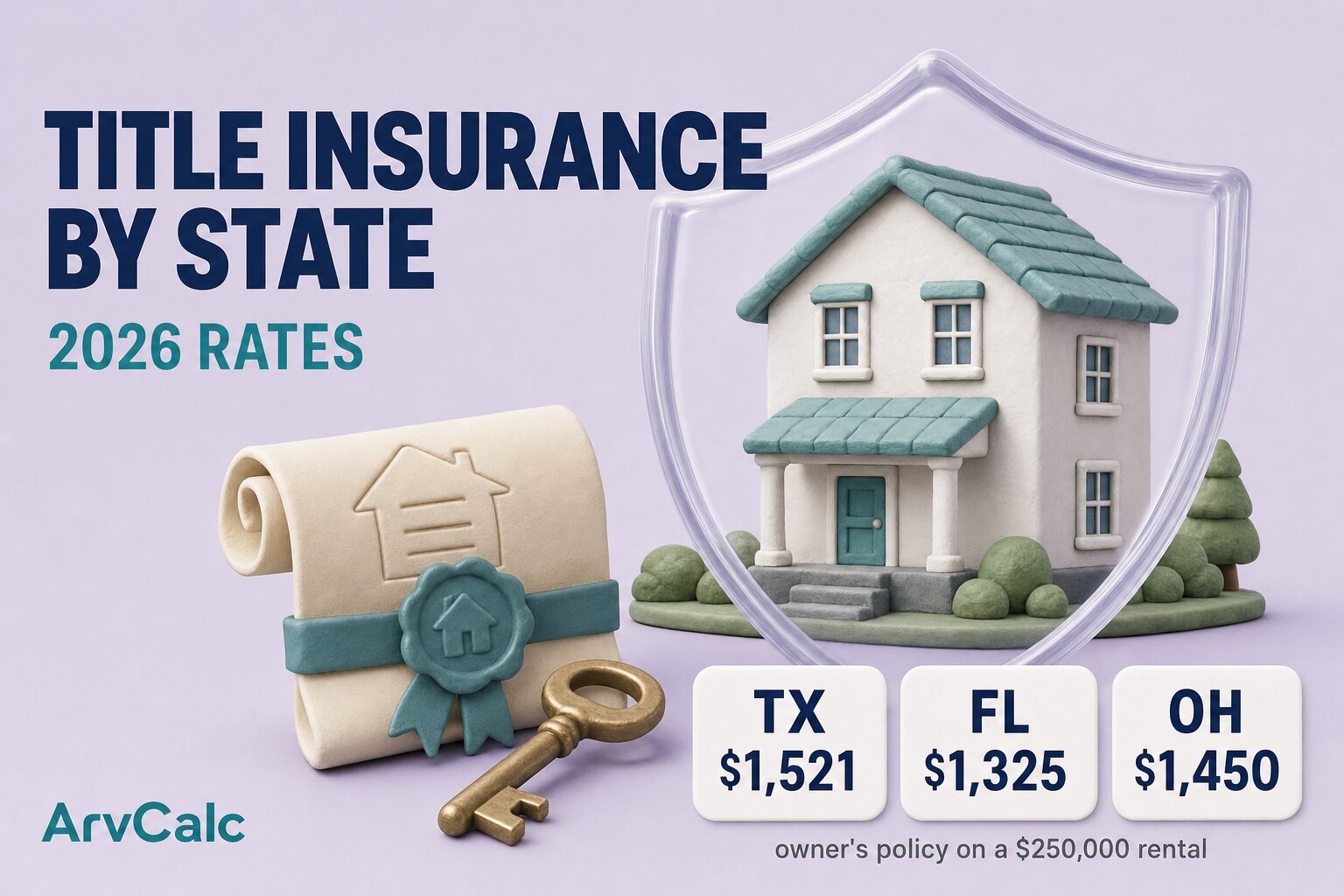
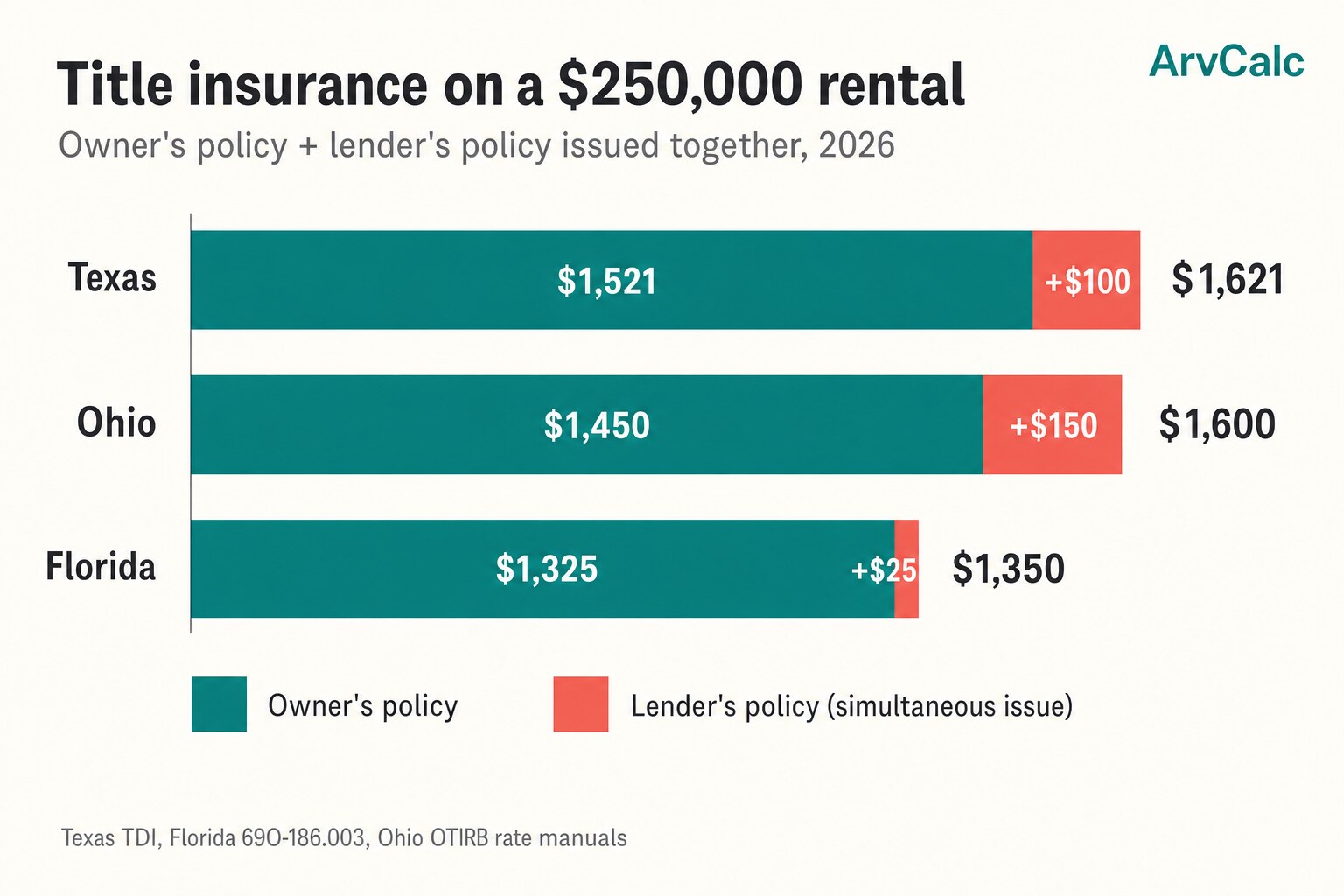
A title insurance calculator should tell you two numbers before you make an offer: what the owner’s policy costs and what the lender’s policy adds. On a $250,000 rental in 2026 the owner’s policy is $1,521 in Texas, $1,450 in Ohio and $1,325 in Florida, and the lender’s policy issued at the same closing adds only $100, $150 or $25. This guide shows the exact rate tables for those three states, explains why other states can only be quoted, and walks through the math for a buy-and-hold deal and a refinance.
Rates checked November 13, 2026, against the Texas Department of Insurance rate schedule effective March 1, 2026, Florida rule 69O-186.003 and the Ohio Title Insurance Rating Bureau manual dated March 1, 2026. Educational analysis, not legal or insurance advice. Your title agent has the final figure.
What a title insurance calculator actually prices
Title insurance pays for losses from problems with ownership that existed before you bought: a forged deed, an unpaid contractor lien, a missing heir, a recording error. You pay one premium at closing and the policy lasts as long as you or your heirs own the property. There is no monthly bill.
Most closings involve two policies. The lender’s policy protects the bank up to the loan amount, and almost every mortgage lender requires it. The owner’s policy protects you up to the purchase price. It is optional in most states, but without it a title defect becomes your loss, not the insurer’s.
A title insurance calculator prices the premium only. The title company will also charge a settlement or escrow fee, search and exam fees, and sometimes endorsements. Those fees are set by the company, not by the rate table, so they belong on a separate line of your closing costs calculator estimate. Our guide to closing costs on investment property covers the full list.
Why some states have one price and others do not
How you calculate the premium depends on how the state regulates it. There are three systems, and they decide whether a title insurance calculator can give you an exact number or only an estimate.
- Promulgated rates. The state sets the premium and every company must charge it. Texas and Florida work this way. The same policy costs the same amount at every title company, so the math below is exact.
- Rating bureau rates. A bureau files one rate manual that its member insurers use. Ohio is the clearest example: the Ohio Title Insurance Rating Bureau publishes the schedule most underwriters in the state follow.
- Filed rates. Each underwriter files its own rates with the state insurance department. This is the system in most states ArvCalc covers, including Georgia, Tennessee, North Carolina, Michigan, Indiana and South Carolina. Two title agents can quote different premiums for the same house.
In filed-rate states, ask each title agent which underwriter they use and for the page of its rate manual that produced the quote. That turns a vague estimate into a number you can check.
Title insurance calculator: 2026 rates for a $250,000 rental
The table uses a $250,000 purchase and a $187,500 loan (75% loan-to-value), with both policies issued at the same closing. All figures come straight from the official rate tables.
| State | Owner’s policy rate | Owner’s policy on $250,000 | Lender’s policy, same closing | Total premium |
|---|---|---|---|---|
| Texas | TDI formula (see below) | $1,521 | $100 | $1,621 |
| Ohio | $5.80 per $1,000 up to $250,000 | $1,450 | $150 ($175 expanded) | $1,600 |
| Florida | $5.75 per $1,000 to $100,000, then $5.00 | $1,325 | $25 minimum | $1,350 |
| Georgia, Tennessee, North Carolina, Michigan, Indiana, South Carolina | Filed by each underwriter | Get a quote | Varies | Varies |
The lender’s policy is cheap only when it is issued together with an owner’s policy and does not insure more than the owner’s policy. A cash buyer who later adds a loan, or a buyer who skips the owner’s policy, pays the full lender’s rate instead. That is one reason to buy both at the same closing.
Texas title insurance calculator: the TDI formula
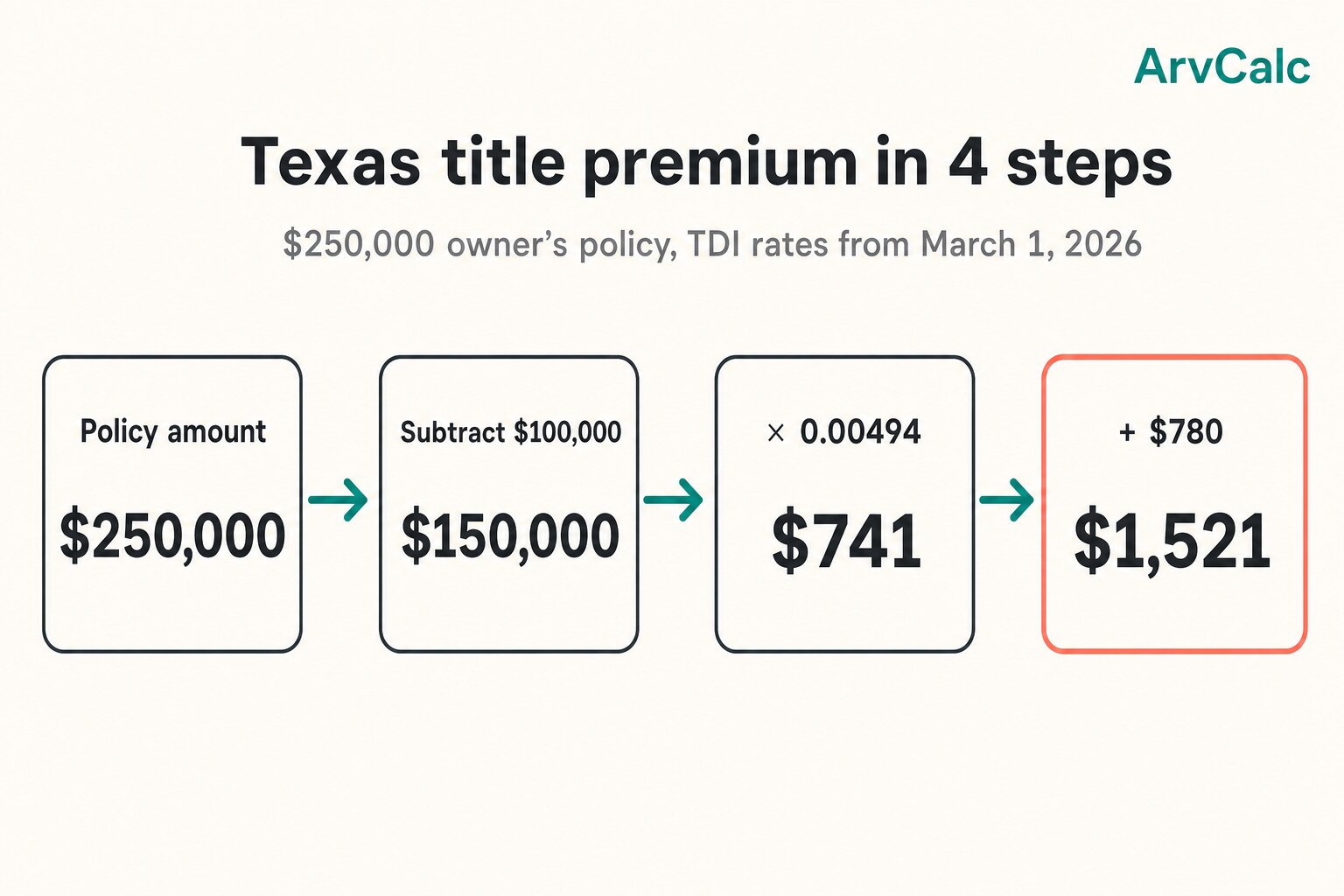
The Texas Department of Insurance sets one basic premium for the whole state. Under Commissioner’s Order 2025-9697, rates fell 6.2% for policies issued on or after March 1, 2026. Policies up to $100,000 are read from a table. Above $100,000, the TDI 2026 rate schedule gives a four-step formula.
- Find the range that includes the policy amount.
- Subtract the range floor ($100,000 for policies up to $1,000,000).
- Multiply by the range factor (0.00494) and round to the nearest dollar.
- Add the fixed amount for the range ($780).
For $250,000: $250,000 minus $100,000 is $150,000; times 0.00494 is $741; plus $780 is $1,521. For a $400,000 duplex: $300,000 times 0.00494 is $1,482, plus $780 is $2,262. Between $1,000,001 and $5,000,000 the factor drops to 0.00406 and the fixed amount is $5,226.
Under TDI rate rule R-5, a loan policy issued at the same time as the owner’s policy, on the same land and for no more than the owner’s amount, costs $100. Who pays the owner’s policy is set in the purchase contract; on the standard Texas form the parties check a box, and the seller often agrees to furnish it. Read paragraph 6 before you sign. More on Texas costs in Texas closing costs for investment property.
Florida title insurance: promulgated rates and who pays by county
Florida’s rates are set by Florida Administrative Code rule 69O-186.003. The original rate for owner’s and mortgage policies is the same:
- $5.75 per $1,000 for the first $100,000 of coverage;
- $5.00 per $1,000 from $100,000 to $1 million;
- $2.50 per $1,000 from $1 million to $5 million;
- minimum premium $100.
On $250,000 that is $575 for the first $100,000 plus $750 for the next $150,000, or $1,325. A mortgage policy issued at the same time costs a minimum of $25 if it does not exceed the owner’s amount. On a $400,000 property the owner’s policy is $575 plus $1,500, or $2,075.
Who pays is a local custom, not a rule. In most Florida counties the seller pays for the owner’s policy and chooses the title company. In Miami-Dade and Broward the buyer customarily pays. The contract can override either custom, and some other counties are disputed, so ask your agent. See Florida closing costs for investment property for doc stamps and the intangible tax that sit next to the premium.
Ohio title insurance calculator: the rating bureau schedule
Ohio’s rates rose in 2026 for the first time in years. The Ohio Title Insurance Rating Bureau manual dated March 1, 2026 sets the owner’s rate (rule PR-1) per $1,000 or fraction:
- $5.80 up to $250,000;
- $4.10 from $250,000 to $500,000;
- $3.20 from $500,000 to $1,000,000;
- minimum premium $225.
On $250,000 the owner’s policy is $1,450. On $400,000 it is $1,450 plus $615, or $2,065. Under rule PR-6, a loan policy issued with the owner’s policy adds $150 for a standard policy or $175 for an expanded residential policy, as long as the loan does not exceed the owner’s amount. The Homeowner’s Policy, with broader coverage, costs the PR-1 rate plus 15%.
Ohio also gives a reissue rate under rule PR-4: 70% of the original rate, up to the amount of a prior owner’s policy, when the title agent gets a copy of that policy. On a $250,000 house with a prior policy at the same amount, that is $1,015 instead of $1,450, a $435 saving. Ask the seller for their old policy early. More on the state in Ohio closing costs.
Filed-rate states: how to check a quote
In Georgia, Tennessee, North Carolina, Michigan, Indiana and South Carolina there is no single state price. Each underwriter files a schedule, and title agents choose which underwriter to use. A title insurance calculator for these states can only be as good as the schedule you feed it.
Three steps keep the quote honest:
- Get two written quotes for the same coverage amount and the same policy form. Ask each agent to separate the premium from settlement, search and exam fees.
- Ask for the rate manual page and the underwriter’s name. A premium should be reproducible from the published schedule.
- Ask about reissue or substitution credits. Many filed schedules discount a policy when a prior policy exists, but you usually have to request it and supply the old policy.
Custom on who pays differs too. In Michigan and Tennessee the seller usually pays for the owner’s policy; in Georgia and North Carolina the buyer usually does, and in North Carolina an attorney handles the closing. Confirm in your contract. State guides: Georgia, Tennessee, North Carolina, Michigan, Indiana and South Carolina.
Worked example: one $250,000 rental, three states
Same purchase price, same $187,500 loan, both policies at closing, buyer pays both premiums. This is the worst case for the buyer, which is the right assumption for underwriting a deal.
| Line | Texas | Ohio | Florida |
|---|---|---|---|
| Owner’s policy | $1,521 | $1,450 | $1,325 |
| Lender’s policy, same closing | $100 | $150 | $25 |
| Total premium | $1,621 | $1,600 | $1,350 |
| Share of price | 0.65% | 0.64% | 0.54% |
| If the seller pays the owner’s policy | $100 | $150 | $25 |
The rate tables are close; who pays is what moves the number. A Florida buyer outside Miami-Dade often pays only the $25 lender’s charge, while the same buyer in Miami-Dade pays $1,350. Enter the figure that matches your contract in the rental property calculator, because closing costs raise your cash invested and lower cash-on-cash return.
The premium also changes your tax basis. The IRS (Publication 551) lists title insurance among the settlement costs added to the basis of a purchased property, so the owner’s premium is recovered through depreciation on a rental. Costs of getting the loan are treated differently; ask your tax preparer how to handle the lender’s policy.
Worked example: a BRRRR refinance in Texas
An investor buys a Texas house for $160,000 in cash, renovates it and refinances at an appraised value of $250,000 with a 75% loan of $187,500. At purchase there was no loan, so only the owner’s policy was bought: $60,000 times 0.00494 is $296, plus $780, or $1,076.
At the refinance there is no new owner’s policy to pair with, so the simultaneous $100 rate does not apply. The new lender needs its own loan policy, priced from the basic rate on $187,500: $87,500 times 0.00494 is $432, plus $780, or $1,212. Texas rate rules allow credits on some refinance loan policies when a prior loan policy exists; ask the title agent whether the deal qualifies.
The lesson for BRRRR investors: the title cost of the refinance is often larger than the lender’s charge at a normal financed purchase. Budget for it in the refinance column, not as a rounding error. Hard money and bridge loans add their own policies; see hard money loan costs.
Five title insurance mistakes that cost investors money
- Skipping the owner’s policy to save money. The lender’s policy protects only the lender. If a lien from the prior owner appears, the bank is covered and you are not.
- Buying the policies at different times. The simultaneous rate ($100 in Texas, $150 in Ohio, $25 in Florida) applies only when both are issued together and the loan is not larger than the owner’s amount.
- Not asking for the reissue rate. In Ohio a prior owner’s policy can cut the premium by 30%. In filed-rate states similar credits exist but are rarely applied unless requested.
- Comparing only the premium. In promulgated states every company charges the same premium; the difference is in settlement, search and courier fees. Compare the whole title section of the Loan Estimate.
- Deeding the property to an LLC without asking about coverage. A transfer after closing can affect who is insured under the owner’s policy. Ask the title agent before you move a rental into an LLC, or buy in the LLC’s name from the start.
What the ArvCalc calculators can and cannot do
The closing costs calculator has a title insurance line; enter the premium from this page for Texas, Florida or Ohio, or the quote you received elsewhere. Pair it with the transfer tax calculator by state, because the deed tax and the title premium are the two largest rate-driven lines on most closing statements. State pages such as Texas, Florida and Ohio show the market data you can combine with these costs.
No calculator can price endorsements your lender requires, local settlement fees or a filed-rate state’s schedule you have not seen. Treat any number here as a check on the quote, not a replacement for it. The CFPB home buying guide explains where title charges appear on the Loan Estimate and Closing Disclosure.
Frequently asked questions
How much is title insurance on a $250,000 house?
In 2026 the owner’s policy is $1,521 in Texas, $1,450 in Ohio and $1,325 in Florida. A lender’s policy issued at the same closing adds $100, $150 or $25. In filed-rate states such as Georgia or Tennessee, get a quote; prices vary by underwriter.
How do you calculate title insurance in Texas?
For policies from $100,001 to $1,000,000, subtract $100,000, multiply by 0.00494, round, and add $780. A $250,000 policy costs $1,521 under the TDI rates effective March 1, 2026.
How much is title insurance in Ohio in 2026?
$5.80 per $1,000 up to $250,000 and $4.10 per $1,000 from $250,000 to $500,000, with a $225 minimum. A $250,000 owner’s policy is $1,450; a standard loan policy issued with it adds $150.
Who pays for title insurance, buyer or seller?
It depends on local custom and the contract. The buyer usually pays for the lender’s policy. The owner’s policy is often paid by the seller in most of Florida, Michigan and Tennessee, and by the buyer in Miami-Dade, Broward, Georgia and North Carolina. In Texas the contract form lets the parties choose.
Is owner’s title insurance worth it for a rental property?
Usually yes. It is a one-time cost of about half a percent of the price in the states above, and it protects your equity against defects that existed before you bought. The lender’s policy does not protect you.
Is title insurance tax deductible on a rental?
Not as a current expense. The IRS treats owner’s title insurance as a settlement cost added to the property’s basis, so it is recovered through depreciation and at sale. Ask a tax professional about the lender’s policy.
Can I shop for title insurance?
Yes. Your Loan Estimate shows which title services you can shop for. In Texas and Florida the premium is the same everywhere, so compare the other title fees; in filed-rate states compare the premium too.
Leave a Reply