How Much Does It Cost to Rehab a House?
Rehab costs for investment properties typically range from $15 to $60 per square foot depending on the scope of work, property condition, and local labor rates. A light cosmetic rehab on a 1,200 sq ft house runs $18,000 to $30,000. A full gut renovation on the same house can exceed $72,000.
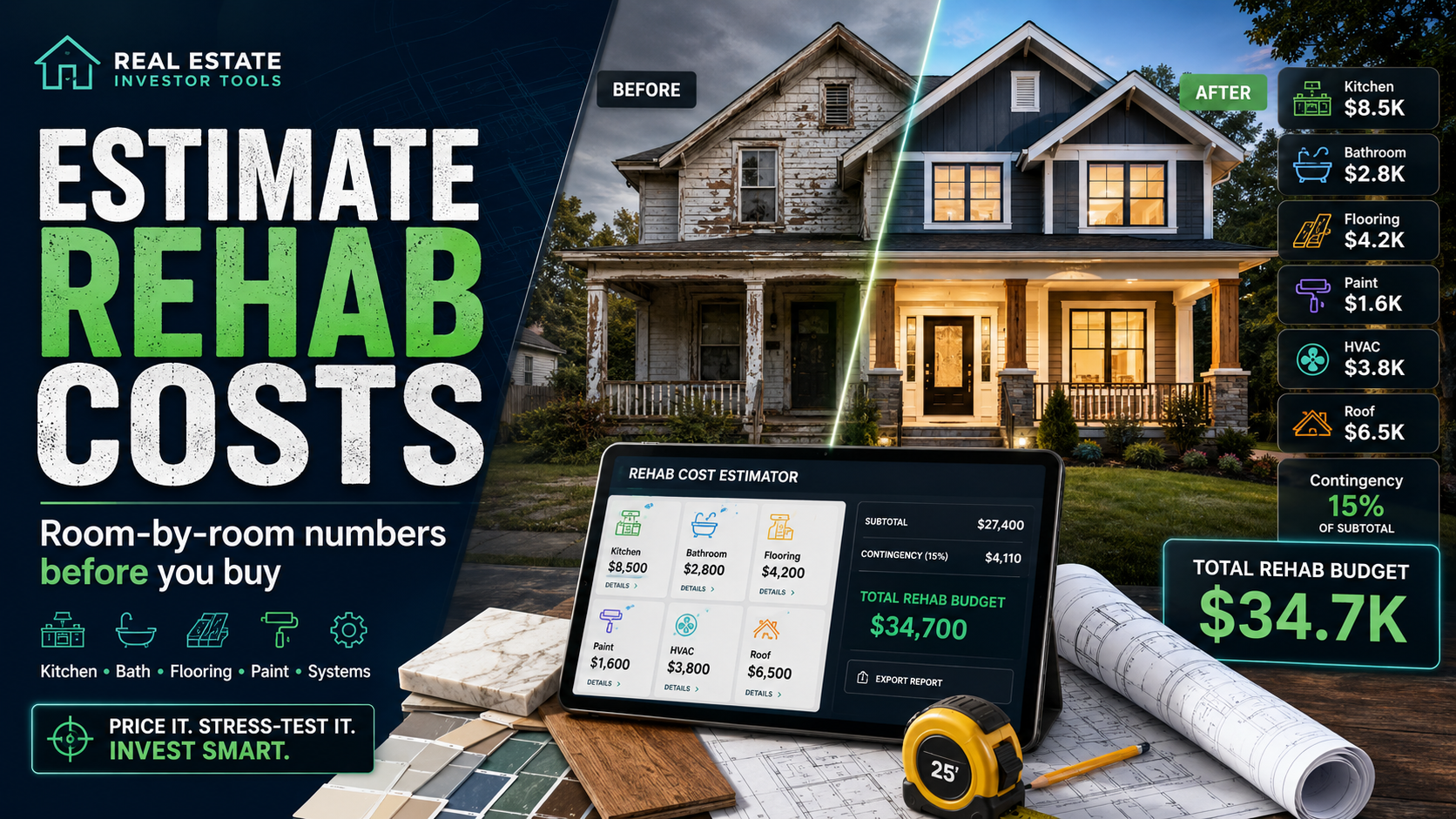
The problem is that most investors estimate rehab costs using rough guesses or rules of thumb that miss critical line items. Then the contractor invoice comes in 30% over budget, and the deal that looked profitable on paper turns into a lesson learned.
This guide answers the question “how much does it cost to rehab a house” with room-by-room breakdowns based on 2026 contractor pricing, explains what drives costs up or down, and shows how to build a budget that holds. Use the free Rehab Cost Estimator to price out any project.
Cost to Rehab a House: Light, Medium, and Full Tiers
Before getting into room-by-room numbers, understand the three tiers of rehab. Each tier has a different cost range, timeline, and profit profile.
| Tier | Cost/Sq Ft | Timeline | What It Includes |
|---|---|---|---|
| Light Cosmetic | $15–$25 | 2–4 weeks | Paint, flooring, fixtures, cleaning, landscaping |
| Medium Rehab | $25–$40 | 4–8 weeks | Kitchen/bath remodel, some drywall, electrical updates |
| Full Gut Renovation | $40–$60+ | 8–16 weeks | Structural, plumbing, electrical, HVAC, everything new |
For BRRRR and fix-and-flip deals, most investors target medium rehab properties. Light cosmetics rarely create enough equity to justify the acquisition effort. Full gut renovations tie up capital for months and carry the highest risk of budget overruns.
Room-by-Room Rehab Cost Breakdown
Kitchen
The kitchen drives more property value than any other room. It is also the most expensive room to renovate. Budget 30% to 40% of your total rehab spend here.
| Item | Budget Range | Investor Grade |
|---|---|---|
| Cabinets (stock, 10-12 LF) | $2,500–$5,000 | RTA or big-box stock |
| Countertops (laminate/butcher block) | $800–$2,000 | Avoid granite — cost vs value poor in <$200K homes |
| Appliances (4-piece package) | $1,500–$3,000 | Stainless steel, basic models |
| Flooring (LVP, ~120 sq ft) | $500–$1,000 | Waterproof luxury vinyl plank |
| Backsplash | $300–$800 | Subway tile or peel-and-stick |
| Sink + Faucet | $200–$500 | Stainless undermount |
| Paint | $200–$400 | Neutral tones |
| Lighting | $150–$400 | Recessed or pendant over island |
| Kitchen Total | $6,150–$13,100 |
Bathroom
Bathrooms are the second highest value-add. Most investment properties need at least one bathroom updated.
| Item | Budget Range | Notes |
|---|---|---|
| Vanity + top | $300–$800 | 36″ single vanity from big-box store |
| Toilet | $150–$300 | Standard white, elongated bowl |
| Tub/shower surround | $400–$1,200 | Acrylic surround kit or tile |
| Tile flooring (~50 sq ft) | $300–$700 | Ceramic or porcelain |
| Faucet + fixtures | $150–$350 | Brushed nickel or matte black |
| Mirror + lighting | $100–$300 | Framed mirror, 3-light vanity bar |
| Paint | $100–$200 | Semi-gloss for moisture resistance |
| Bathroom Total | $1,500–$3,850 |
Flooring (Whole House)
| Type | Cost/Sq Ft (installed) | Best For |
|---|---|---|
| Luxury Vinyl Plank (LVP) | $3.50–$6.00 | Most investment properties — durable, waterproof, tenant-proof |
| Laminate | $2.50–$4.50 | Budget rehabs, low-moisture areas |
| Carpet (bedrooms only) | $2.00–$4.00 | Bedrooms in rental properties |
| Tile | $5.00–$10.00 | Bathrooms, kitchens, entryways |
| Hardwood refinish | $3.00–$5.00 | Existing hardwood in good condition |
For a 1,200 sq ft house: LVP throughout = $4,200–$7,200. Most investors use LVP everywhere except bathrooms (tile) and bedrooms (carpet in rentals, LVP in flips).
Paint (Whole House)
| Scope | Cost | Notes |
|---|---|---|
| Interior only (1,200 sq ft) | $2,000–$4,000 | 2 coats, primer on dark walls |
| Exterior | $2,500–$5,000 | Pressure wash + 2 coats |
| DIY interior | $400–$800 | Materials only — saves $1,500+ |
Paint is the highest ROI item in any rehab. A $3,000 paint job can add $10,000+ to the perceived value of a property.
Major Systems
| System | Repair Cost | Full Replacement | Typical Lifespan |
|---|---|---|---|
| Roof (asphalt shingle) | $500–$2,000 | $6,000–$12,000 | 20–25 years |
| HVAC (furnace + AC) | $300–$1,500 | $5,000–$10,000 | 15–20 years |
| Plumbing (whole house) | $500–$2,000 | $4,000–$8,000 | 40–70 years (copper) |
| Electrical panel upgrade | — | $1,500–$3,000 | 30–40 years |
| Water heater | $200–$500 | $800–$1,500 | 8–12 years |
| Foundation repair | $2,000–$5,000 | $10,000–$30,000 | Permanent if done right |
Major systems are where budgets blow up. Always inspect roof, HVAC, plumbing, and electrical before making an offer. A property that needs a new roof AND HVAC adds $11,000–$22,000 that many investors miss in their initial estimate.
Full Rehab Budget Example: Cleveland 3BR/1BA
Purchase price: $85,000. ARV: $155,000. 1,100 sq ft ranch built in 1965.
| Category | Scope | Cost |
|---|---|---|
| Kitchen | New cabinets, counters, appliances, LVP, backsplash | $8,500 |
| Bathroom | New vanity, toilet, tub surround, tile floor | $2,800 |
| Flooring | LVP throughout living areas (750 sq ft) | $3,400 |
| Paint | Full interior + exterior touch-up | $3,200 |
| Electrical | Panel upgrade to 200A, new outlets in kitchen | $2,200 |
| Plumbing | Replace galvanized supply lines, new water heater | $3,500 |
| HVAC | New furnace (existing AC OK) | $3,800 |
| Exterior | Landscaping, front door, mailbox, house numbers | $1,200 |
| Dumpster + cleanup | 2 dumpster loads | $1,000 |
| Permits | Electrical + plumbing | $600 |
| Subtotal | $30,200 | |
| Contingency (15%) | $4,530 | |
| Total Rehab Budget | $34,730 |
At $34,730 rehab on an $85,000 purchase, the all-in cost is $119,730. With ARV of $155,000, the investor has $35,270 in equity — enough for a successful BRRRR refinance at 75% LTV ($116,250 loan). Use the BRRRR Refinance Calculator to model the refinance numbers. For the full BRRRR process, read our BRRRR refinance guide.
The 70% Rule check: $155,000 × 0.70 − $34,730 = $73,770 max offer. We paid $85,000 — above the 70% threshold but workable because actual rehab costs came in reasonable. Verify with the 70% Rule Calculator.
What Drives Rehab Costs Up
Permits and code compliance. Pulling permits adds $500–$3,000 and triggers inspections that may require additional work to meet current code. Unpermitted work saves money now but creates legal and resale problems later.
Structural issues discovered during demo. Termite damage, water-rotted framing, and cracked foundations only show up after walls are opened. Budget 15% contingency for this reason.
Scope creep. “While we’re at it” is the most expensive phrase in rehabbing. Define the scope before starting and stick to it. Every add-on costs money and extends the timeline — which adds holding costs.
Market-rate labor in hot metros. The same kitchen remodel costs $8,000 in Cleveland and $15,000 in Denver. Always get 3 bids from local contractors. According to Bureau of Labor Statistics data, construction labor rates vary 40%+ between markets.
Material upgrades that do not add proportional value. Granite countertops in a $120,000 neighborhood do not return their cost. Match finishes to the price point — the ARV Calculator helps you validate what comparable properties actually have. Also check how down payment size affects your total cash needed.
How to Get Accurate Rehab Estimates
- Walk the property with a contractor before making an offer. Most contractors will do a free walkthrough if you explain you are an active investor with ongoing deal flow.
- Use a standardized scope of work template. List every room, every item, every material spec. This prevents “I thought you wanted…” conversations that cost thousands.
- Get three bids. The lowest bid is not always the best — check references, insurance, and timeline. The cheapest contractor who takes 8 months costs more in holding costs than a mid-price contractor who finishes in 10 weeks.
- Add 15% contingency. This is not optional. In 50+ rehab projects, fewer than 10% have come in under budget. Most are within 5–15% over the initial estimate.
- Use the Rehab Cost Estimator to build a detailed budget before you bid on the property. It covers every line item from foundation to landscaping.
Rehab Cost vs Property Value: The Break-Even Rule
When budgeting the cost to rehab a house, never spend more than 70% of the equity you expect to create. If a property needs $40,000 in rehab and you project $50,000 in new equity (ARV minus purchase price minus rehab), your rehab-to-equity ratio is 80% — too thin for comfort.
Target a rehab-to-equity ratio of 50% or less. On the Cleveland example: $34,730 rehab created $35,270 in equity — a 98% ratio. This is tight but acceptable because the BRRRR refinance recovers most of the capital.
For fix-and-flip deals, the margin needs to be wider because you also pay selling costs (5–6% agent commission + closing costs). The Fix-and-Flip Calculator models all costs including holding, selling, and financing to give you true profit. Before buying any flip, screen the deal with 5 key metrics to avoid costly mistakes.
Disclaimer
This article is for educational purposes only. The cost to rehab a house varies significantly by location, property condition, contractor pricing, material choices, and local code requirements. The figures provided are rough estimates based on 2026 national averages and should not be used as a substitute for professional contractor bids. Consult licensed contractors, inspectors, and real estate professionals before committing to a renovation project. ArvCalc is not a contractor, inspector, or construction advisor.
The cost to rehab a house for flipping typically runs $20,000 to $50,000 for a medium scope renovation on a 1,000 to 1,500 square foot house. Light cosmetic rehabs (paint, flooring, fixtures) run $15,000 to $25,000. Full gut renovations including structural, plumbing, electrical, and HVAC can exceed $60,000 to $80,000. Always add a 15% contingency to your initial estimate.
When calculating the cost to rehab a house, the kitchen is typically the most expensive room, accounting for 30% to 40% of total rehab cost. A full kitchen remodel for an investment property runs $6,000 to $13,000. After that, major systems (roof, HVAC, plumbing) are the biggest cost drivers — a roof replacement alone can add $6,000 to $12,000.
The cost to rehab a house at a light cosmetic level runs $15 to $25 per square foot. Medium rehab with kitchen and bathroom remodels costs $25 to $40 per square foot. Full gut renovation runs $40 to $60+ per square foot. These figures vary significantly by market — labor costs in coastal cities can be 40% to 60% higher than Midwest markets.
Yes, for any work involving electrical, plumbing, structural changes, or HVAC. Unpermitted work can cause problems during resale, refinancing, and insurance claims. Permit costs ($500 to $3,000 depending on scope) are small compared to the legal and financial risks of skipping them. Cosmetic work like paint, flooring, and fixtures typically does not require permits.
Budget 15% above your estimated rehab cost as contingency. On a $30,000 rehab, that means setting aside $4,500 extra. This covers unexpected discoveries like termite damage, water-rotted framing, or code compliance issues that only appear after walls are opened. Fewer than 10% of rehab projects come in under the original estimate.
The highest ROI renovations for investment properties are: paint (interior and exterior), kitchen updates (cabinets, counters, appliances), bathroom updates (vanity, fixtures, tile), and flooring replacement. These cosmetic improvements change the look and feel of the property without the cost and risk of major system replacements. Curb appeal improvements like landscaping and a new front door also produce outsized returns relative to cost.
To estimate the cost to rehab a house accurately, walk the property with a contractor for a free estimate, or use a per-square-foot multiplier based on rehab tier (light: $15-25/sqft, medium: $25-40/sqft, full: $40-60/sqft). For a more detailed estimate, list every room and every item that needs work, then price each line item using local contractor rates. Online rehab cost estimators can help you build a preliminary budget before scheduling contractor walkthroughs.
Leave a Reply