What Is Gross Rent Multiplier?
Gross Rent Multiplier (GRM) is the fastest way to compare rental property prices. It tells you how many years of gross rent it takes to pay for the property — without needing detailed expense data, financing terms, or tax calculations.
A property listed at $200,000 with $24,000 in annual gross rent has a GRM of 8.3. A similar property at $180,000 with the same rent has a GRM of 7.5 — it is cheaper per dollar of income. That is GRM in 10 seconds.
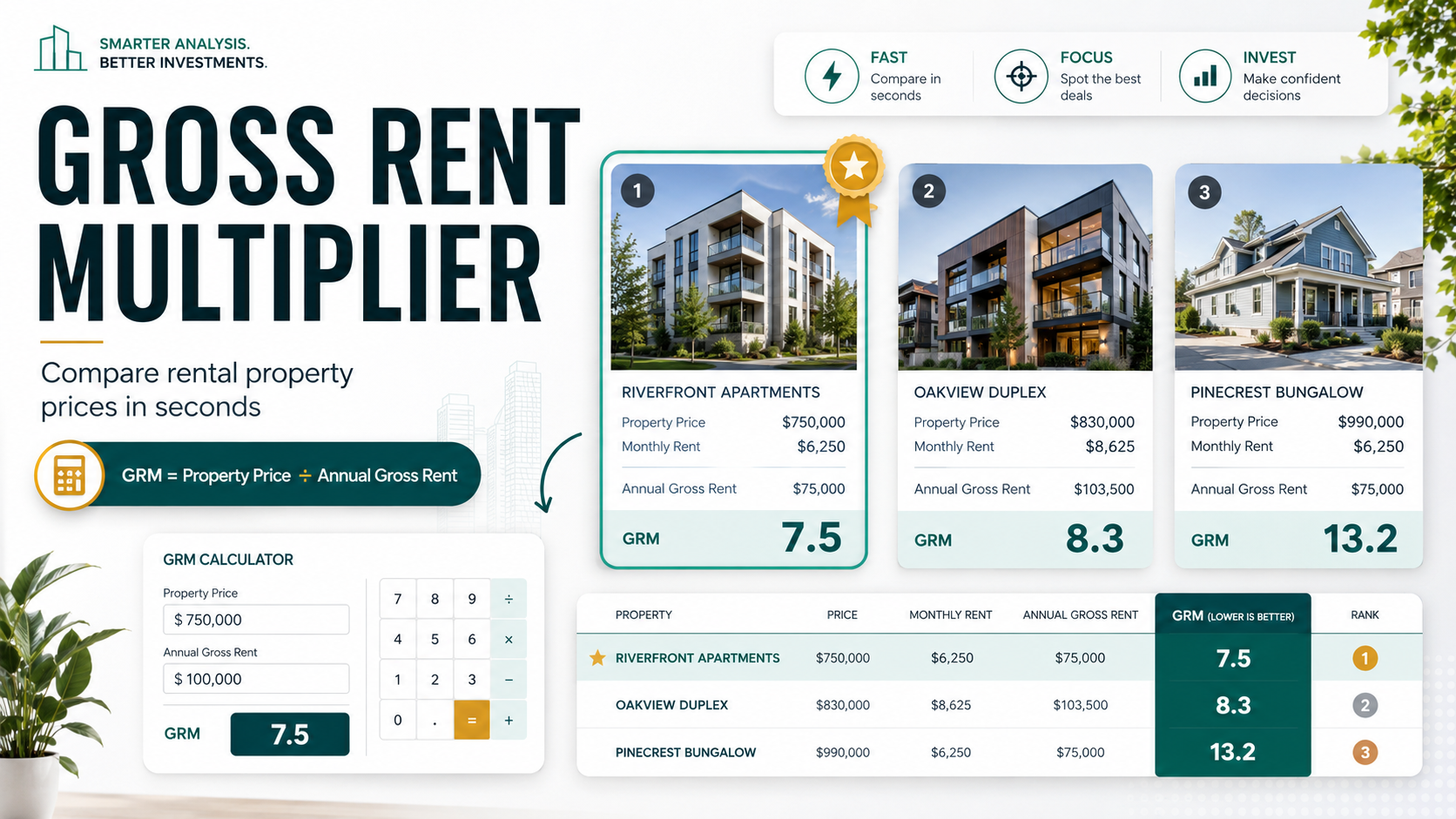
This guide explains how gross rent multiplier works, when to use it, when not to, and how it compares to cap rate. Use the free GRM Calculator to run the numbers on any deal.
How to Calculate Gross Rent Multiplier
Formula: GRM = Property Price ÷ Annual Gross Rental Income
Or monthly: GRM = Property Price ÷ (Monthly Rent × 12)
| Property Price | Monthly Rent | Annual Rent | GRM |
|---|---|---|---|
| $150,000 | $1,300 | $15,600 | 9.6 |
| $200,000 | $1,800 | $21,600 | 9.3 |
| $250,000 | $2,000 | $24,000 | 10.4 |
| $350,000 | $2,200 | $26,400 | 13.3 |
| $500,000 | $2,800 | $33,600 | 14.9 |
Lower GRM = cheaper property relative to its rental income. A GRM of 8 means the price equals 8 years of gross rent. A GRM of 15 means 15 years of rent to cover the price.
What Is a Good Gross Rent Multiplier?
| GRM | Rating | Typical Markets |
|---|---|---|
| Below 7 | Excellent | Distressed areas, high-yield Midwest markets |
| 7–10 | Good | Cleveland, Memphis, Indianapolis, Birmingham |
| 10–14 | Average | Nashville, Dallas, Atlanta, Charlotte |
| 14–20 | Expensive | Denver, Austin, Seattle, Portland |
| Above 20 | Very Expensive | San Francisco, NYC, San Diego, LA |
According to Zillow Research data, in Midwest cash flow markets GRMs of 7-10 are common and properties often cash flow from day one. In coastal markets, GRMs above 15 mean you rely on appreciation — monthly cash flow is usually negative at current interest rates.
GRM by Property Type
| Property Type | Typical GRM | Why |
|---|---|---|
| Single-family rental | 8–14 | Depends heavily on market |
| Duplex/Triplex | 7–11 | Multiple units push rent higher relative to price |
| Small apartment (5-20 units) | 6–10 | Priced on income, not comps |
| Large apartment (20+ units) | 8–13 | Institutional pricing, lower cap rates |
GRM vs Cap Rate: What Is the Difference?
Both metrics compare price to income, but they answer different questions:
| Metric | Formula | Includes Expenses? | Best For |
|---|---|---|---|
| GRM | Price ÷ Gross Rent | No | Quick comparison of similar properties |
| Cap Rate | NOI ÷ Price | Yes | Comparing properties with different expense profiles |
GRM is faster — you only need price and rent. Cap rate is more accurate — it accounts for taxes, insurance, vacancy, and maintenance. Use GRM to filter deals in 10 seconds, then cap rate for deeper analysis.
Example: Two duplexes both have GRM of 9.0. But Property A has $3,000/year in taxes and Property B has $6,000. Their GRMs are identical, but Property A has a higher cap rate and better cash flow. GRM misses this because it ignores expenses.
Run both: GRM Calculator for quick screening, Cap Rate Calculator for full analysis. Read the cap rate guide for detailed benchmarks.
How to Use Gross Rent Multiplier in Practice
1. Screening Listings Fast
When scrolling through 50 listings on Zillow, you do not have time to calculate cap rate on each one. GRM takes 5 seconds per listing:
$195,000 asking ÷ ($1,650 rent × 12) = GRM of 9.8. Is that good for Indianapolis? Yes — below 10 is solid. Move to deeper analysis.
$320,000 asking ÷ ($2,100 rent × 12) = GRM of 12.7. For the same market? Above 10 — probably won’t cash flow. Skip or offer lower.
2. Estimating Property Value
GRM works in reverse to estimate what a property should be worth based on its rent and market GRM:
Estimated Value = Annual Gross Rent × Market GRM
If the market GRM for duplexes in Memphis is 8.5, and a duplex rents for $2,400/month:
Value = $28,800 × 8.5 = $244,800
If it is listed at $280,000, it is overpriced by $35,200 relative to comparable rental income. If listed at $225,000, it is a potential deal.
3. Comparing Multiple Properties
| Property | Price | Monthly Rent | GRM | Verdict |
|---|---|---|---|---|
| Cleveland 3BR | $125,000 | $1,150 | 9.1 | Good — standard for market |
| Memphis duplex | $195,000 | $1,750 | 9.3 | Good — slightly higher but 2 units |
| Indianapolis SFR | $210,000 | $1,600 | 10.9 | Average — may not cash flow |
| Nashville condo | $285,000 | $1,800 | 13.2 | Expensive — appreciation play |
The Cleveland and Memphis properties win on GRM. But GRM alone is not enough — run all five screening metrics with our deal screening guide.
Limitations of Gross Rent Multiplier
Ignores operating expenses. A property with $8,000/year in taxes and one with $2,000 in taxes have very different profitability — GRM treats them the same.
Ignores vacancy. GRM uses gross rent, assuming 100% occupancy. In markets with 10%+ vacancy, the effective income is lower and GRM overstates value. Check local vacancy with the Vacancy Rate Calculator.
Ignores financing. Two buyers paying cash vs 80% LTV have vastly different returns on the same GRM. Use the Cash-on-Cash Calculator to factor in financing.
Only useful for comparing similar properties. Comparing a GRM of 8 in Cleveland to a GRM of 15 in San Diego is meaningless — they are entirely different markets with different risk profiles, appreciation rates, and tenant demographics.
GRM and the 1% Rule
The 1% Rule says monthly rent should be at least 1% of purchase price. This is equivalent to a GRM of 8.3:
If rent = 1% of price → Annual rent = 12% of price → GRM = price ÷ (0.12 × price) = 8.33
So the 1% Rule is really just saying “buy properties with GRM below 8.3.” In 2026, this eliminates most markets except deep-value Midwest cities. Data from U.S. Census Bureau housing surveys shows that most investors now target the 0.8% rule (GRM of 10.4) or even 0.7% (GRM 11.9) in growth markets. For a full analysis of whether the 1% rule still works, see the cash flow calculation guide.
Disclaimer
This article is for educational purposes only. Gross rent multiplier is a screening tool, not a valuation methodology. Property values depend on condition, location, expenses, financing, and many factors not captured by GRM. Consult a licensed real estate professional, appraiser, and financial advisor before making investment decisions. ArvCalc is not a broker, appraiser, or financial advisor.
A good gross rent multiplier for rental property is between 7 and 10 in most Midwest and Southeast markets. Below 7 is excellent and typically found in distressed or high-yield areas. Above 14 means the property is expensive relative to its rental income and usually only works as an appreciation investment. The target GRM depends on your market and strategy.
Divide the property price by the annual gross rental income. For example, a $200,000 property renting for $1,800/month ($21,600/year) has a GRM of 9.3. You can also think of GRM as how many years of gross rent it takes to equal the purchase price. Use monthly rent times 12 to get annual rent.
GRM is faster — it only needs price and rent, making it ideal for quick screening of multiple listings. Cap rate is more accurate because it accounts for operating expenses (taxes, insurance, vacancy, maintenance). Use GRM to filter deals in seconds, then run cap rate on the ones that pass. Both have value at different stages of the analysis process.
A GRM of 10 means the property price equals 10 years of gross rental income. It also means the annual gross rent is 10% of the purchase price (equivalent to the 0.83% monthly rule). In most markets, a GRM of 10 is average — it may or may not produce positive cash flow depending on expenses, taxes, and financing terms.
The 1% rule (monthly rent should be at least 1% of purchase price) is equivalent to a GRM of 8.33. If a property meets the 1% rule, its GRM is 8.33 or lower. In 2026, very few markets meet the traditional 1% rule. Most investors have adjusted to the 0.7% to 0.8% rule, which corresponds to GRMs of 10 to 12.
Yes. Multiply the annual gross rent by the market average GRM to estimate what a property should be worth. If the market GRM for duplexes is 8.5 and the property rents for $2,400/month ($28,800/year), estimated value is $28,800 times 8.5 equals $244,800. If it is listed above that, it may be overpriced relative to comparable rental income.
GRM varies by market because property prices and rents do not move in proportion. In expensive coastal markets, prices are high relative to rents (GRM 15-25) because buyers pay a premium for appreciation and lifestyle. In Midwest markets, prices are low relative to rents (GRM 7-10) because demand is driven by income rather than speculation. Local taxes, insurance, and regulations also affect the relationship between price and rent.
Leave a Reply