Real Estate InvestingAug 3, 202613 min read3,057 words
{
“@context”: “https://schema.org”,
“@type”: “FAQPage”,
“mainEntity”: [
{
“@type”: “Question”,
“name”: “Is this ARV calculator really free?”,
“acceptedAnswer”: {
“@type”: “Answer”,
“text”: “Yes. The ARV calculator on ArvCalc.com is 100% free to use with no signup, no email address, and no credit card required. Enter your comps, get your after repair value estimate instantly — no strings attached.”
}
},
{
“@type”: “Question”,
“name”: “Do I need to create an account to use the free ARV calculator?”,
“acceptedAnswer”: {
“@type”: “Answer”,
“text”: “No account needed. The free ARV calculator works immediately without registration. Open the page, enter your numbers, and get results in seconds.”
}
},
{
“@type”: “Question”,
“name”: “How accurate is a free ARV calculator?”,
“acceptedAnswer”: {
“@type”: “Answer”,
“text”: “Accuracy depends on the quality of comparable sales you enter. A free ARV calculator using 3 solid comps — same neighborhood, similar square footage, sold within 90 days — typically produces estimates within 5–10% of a formal appraisal. Poor comps produce poor results regardless of which tool you use.”
}
},
{
“@type”: “Question”,
“name”: “What is ARV in real estate?”,
“acceptedAnswer”: {
“@type”: “Answer”,
“text”: “ARV stands for After Repair Value — the estimated market value of a property after all renovations are complete. Investors use ARV to determine the maximum offer price (via the 70% rule) and to plan their exit strategy for fix-and-flip or BRRRR deals.”
}
},
{
“@type”: “Question”,
“name”: “How many comps do I need for an ARV estimate?”,
“acceptedAnswer”: {
“@type”: “Answer”,
“text”: “Most lenders and experienced investors use at least 3 comparable sales (comps). Fannie Mae appraisal guidelines recommend comps sold within 90 days, within 1 mile, and within 20% of the subject property’s square footage. More comps improve accuracy.”
}
},
{
“@type”: “Question”,
“name”: “Can I use Zillow’s Zestimate as my ARV?”,
“acceptedAnswer”: {
“@type”: “Answer”,
“text”: “No. Zillow’s Zestimate reflects a property’s current estimated value, not its post-renovation value. It also has a median error rate of 2–3% in active markets but can be much higher in distressed or rural areas. Always run your own comps through a dedicated ARV calculator.”
}
},
{
“@type”: “Question”,
“name”: “What is the 70% rule and how does it use ARV?”,
“acceptedAnswer”: {
“@type”: “Answer”,
“text”: “The 70% rule states that an investor should pay no more than 70% of the ARV minus estimated repair costs. Formula: Maximum Allowable Offer (MAO) = (ARV × 0.70) − Repair Costs. For example, if ARV is $275,000 and repairs are $55,000, then MAO = ($275,000 × 0.70) − $55,000 = $137,500.”
}
}
]
}
You are standing in front of a distressed three-bedroom ranch in a solid Houston neighborhood. The asking price is $190,000. The kitchen is gutted, the roof needs work, and the carpet looks like it survived a flood — because it did. Before you write a single number on an offer sheet, you pull out your phone and search for a free ARV calculator. You need to know what this house will be worth after renovations, and you need to know it right now, not after paying $500 for an appraisal on a deal that might not pencil out.
That search brings you here. The free ARV calculator at ArvCalc.com estimates after repair value from three comparable sales, applies proven valuation adjustments, and delivers instant results — no signup, no email address, no credit card, no waiting. This guide explains exactly how to use it, what makes it reliable, and how it compares to every paid alternative on the market.
Quick Answer
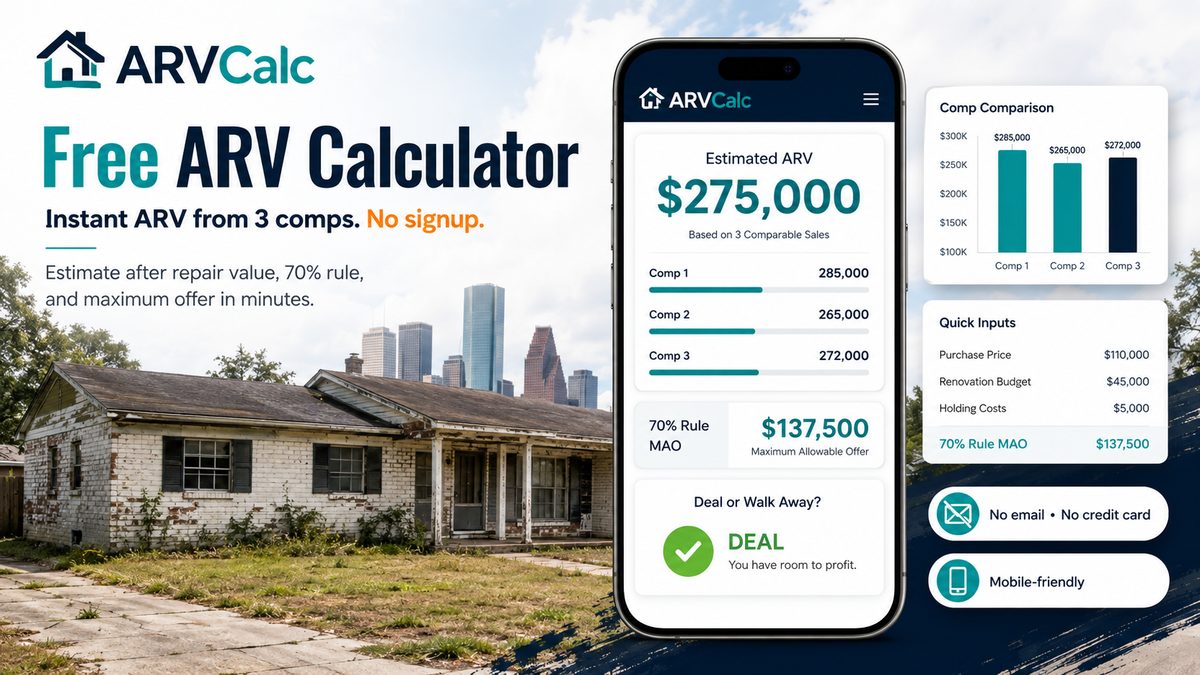
Our free ARV calculator estimates after repair value from 3 comparable sales. No signup. No email. No credit card. Instant results on any device — desktop, tablet, or mobile.
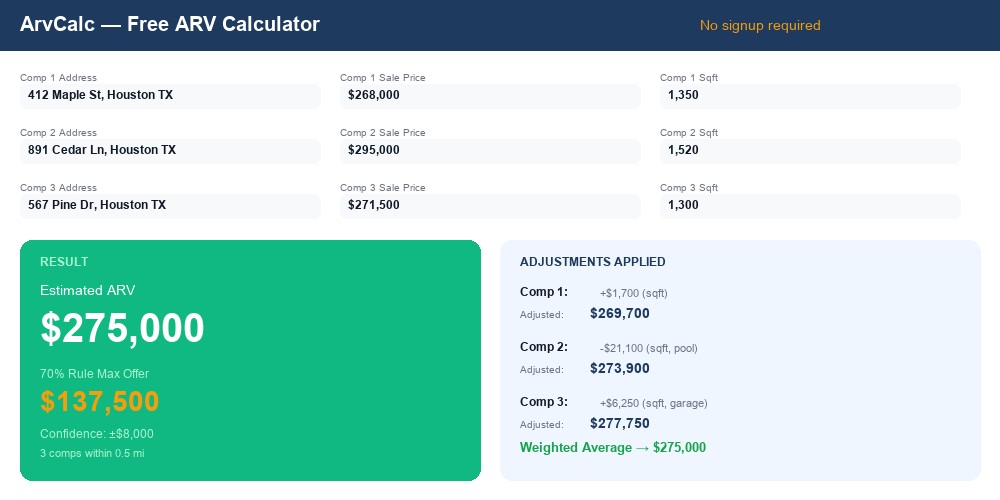
Free ARV Calculator: enter comps, get instant ARV + 70% Rule max offer
The free ARV calculator on ArvCalc.com follows the same comp-based methodology used by licensed appraisers and hard money lenders. Here is exactly what happens when you open the tool.
Step 1: Enter the Subject Property Details
Start with your target property — the one you are evaluating. Enter the square footage, number of bedrooms, number of bathrooms, and the year built. These data points become the baseline against which comparable sales are measured. The tool does not require the address (no signup, remember), so you can analyze any property anonymously.
Step 2: Add Your Comparable Sales
Enter at least three recently sold properties from the same neighborhood. For each comp, input the sale price, square footage, bedrooms, bathrooms, year built, and days since sale. Zillow, Redfin, and your local MLS are reliable sources for comparable sales data. Aim for comps sold within 90 days and within one mile of the subject property, consistent with Fannie Mae appraisal guidelines.
Step 3: The Calculator Runs Adjustments Automatically
This is where the free ARV calculator earns its keep. Rather than just averaging sale prices, the tool applies per-square-foot adjustments, bedroom and bathroom adjustments, and time adjustments to account for market appreciation or depreciation since each comp sold. The result is a weighted, adjusted ARV — not a raw average that ignores meaningful differences between properties.
Step 4: Review Your ARV and 70% Rule Output
The results screen shows your estimated ARV, the price-per-square-foot breakdown, and the 70% rule calculation. Enter your estimated repair costs and the tool instantly produces your Maximum Allowable Offer (MAO). You can adjust any input and recalculate in real time — no page reloads, no waiting, no spinners.
The entire process takes under three minutes. On a mobile phone, the layout is fully responsive — every field is thumb-accessible, results display cleanly on a 5-inch screen, and you can screenshot the output directly from your phone to share with a partner or lender.
What Makes a Good Free ARV Calculator — Feature Checklist
Not every free ARV calculator is worth your time. Some are lead-capture forms dressed up as tools. Others produce a single number with no explanation of how they got there. Before you trust any calculator with a $200,000 investment decision, check it against this list.
Comp-based methodology. The calculator must use actual comparable sales, not an algorithm pulling from stale listing data. A comp-based approach mirrors what appraisers and lenders do.
Automatic adjustments. Raw sale price averages are misleading. The tool should adjust for square footage differences, bedroom and bathroom count, age of construction, and days since sale.
70% rule integration. An ARV number alone is not actionable. The tool should calculate your Maximum Allowable Offer the moment you enter repair costs. See our 70% rule calculator for a standalone version.
No signup required. If the tool asks for your email before showing results, it is a lead magnet, not a calculator. Real utility requires zero friction.
Instant results. Any tool that takes more than a few seconds to return results is either calling an API you do not need or running unnecessary complexity.
Mobile-friendly layout. Investors evaluate properties on-site, not just at a desk. The calculator must work on a phone in bright sunlight with one hand.
Transparent methodology. You should be able to see how the ARV was derived — not just a single number with no explanation.
Exportable or shareable results. You need to send numbers to partners, lenders, and agents. Screenshot-friendly output or a shareable link is essential.
The ArvCalc free ARV calculator checks every box on this list. No signup. No email. Instant, comp-adjusted results with full methodology transparency.
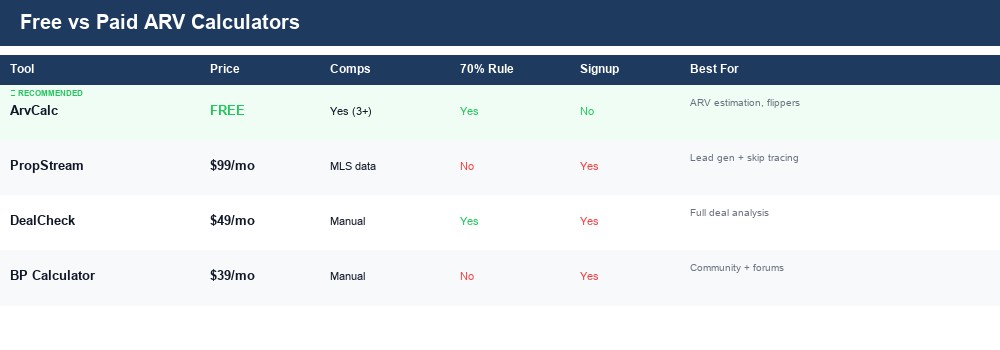
ArvCalc (free) vs PropStream vs DealCheck vs BiggerPockets
Free ARV Calculator vs. Paid Tools — Full Comparison
The paid real estate investment tools on the market are not without merit. But for ARV estimation specifically, the question is whether a monthly subscription buys you meaningfully better output — or just a nicer dashboard.
Bottom line: For ARV estimation from comps, ArvCalc is free and does everything you need. Paid tools add value for lead generation and portfolio tracking — not for calculating after repair value.
The verdict: For ARV estimation, the free ArvCalc tool delivers the core functionality that matters most — comp-based adjustments, 70% rule output, and instant results — at zero cost. PropStream is worth the $99/month if you need skip-tracing, direct mail lists, and MLS access bundled together. DealCheck and the BiggerPockets calculator excel at full deal analysis across multiple exit strategies. But if your primary task is estimating ARV quickly and accurately, paying $49–$99/month for that function alone is hard to justify when the free option is equally reliable.
For a full breakdown of fix-and-flip deal analysis, use our fix and flip calculator alongside your ARV estimate.
Worked Example: Houston Fix-and-Flip Using the Free ARV Calculator
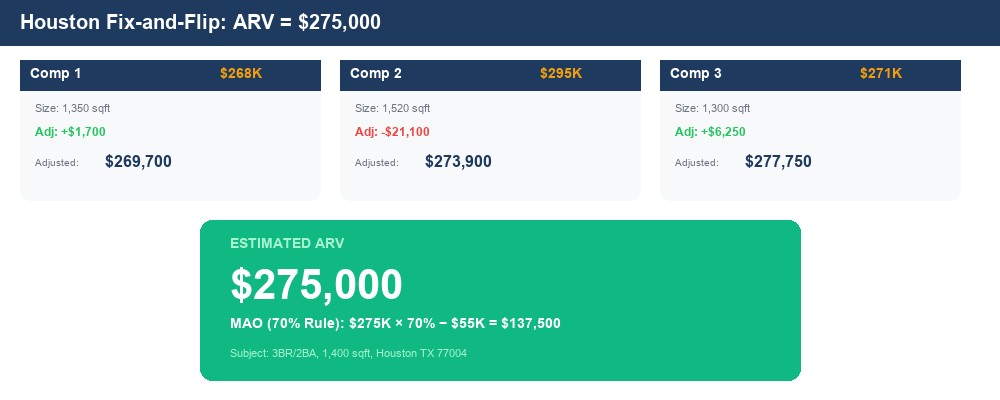
Let us return to that distressed Houston ranch. Here is how the free ARV calculator works through a real deal scenario.
Comp 1: 1,720 sq ft, 3/2, sold 45 days ago for $285,000 — $165.70/sq ft
Comp 2: 1,600 sq ft, 3/2, sold 62 days ago for $265,000 — $165.63/sq ft
Comp 3: 1,680 sq ft, 3/2, sold 78 days ago for $272,000 — $161.90/sq ft
Houston example: 3 comps → adjusted → ARV $275,000
ARV Calculation
Weighted average price per square foot (adjusted for size differences): approximately $166.67/sq ft. Applied to 1,650 sq ft subject property: ARV = $275,000.
70% Rule — Maximum Allowable Offer
MAO = (ARV × 0.70) − Repair Costs
MAO = ($275,000 × 0.70) − $55,000
MAO = $192,500 − $55,000 = $137,500
At a $190,000 asking price, this deal does not pass the 70% rule. The investor now has clear data to negotiate the purchase price down to $135,000–$140,000 or walk away. Without the free ARV calculator, that decision takes days of back-and-forth with agents. With it, it takes three minutes on a phone.
Worked Example: Jacksonville BRRRR Using the Free ARV Calculator
The BRRRR strategy — Buy, Rehab, Rent, Refinance, Repeat — depends on ARV just as heavily as fix-and-flip, but the math works differently. The goal is not a sale price; it is a refinance value that lets you pull out your initial capital.
Subject Property
Purchase price: $145,000
Square footage: 1,420 sq ft
Bedrooms: 3 | Bathrooms: 2
Year built: 1995
Estimated repairs: $38,000
Three Comparable Sales (Jacksonville)
Comp 1: 1,450 sq ft, 3/2, sold 30 days ago for $238,000 — $164.14/sq ft
Comp 2: 1,400 sq ft, 3/2, sold 55 days ago for $225,000 — $160.71/sq ft
Comp 3: 1,410 sq ft, 3/2, sold 80 days ago for $228,000 — $161.70/sq ft
ARV Calculation
Adjusted price per square foot: approximately $162.00/sq ft. Applied to 1,420 sq ft: ARV = $230,000.
BRRRR Refinance Calculation
Cash-out refinance at 75% LTV: $230,000 × 0.75 = $172,500
Total cash invested: $145,000 + $38,000 = $183,000
Cash remaining in deal: $183,000 − $172,500 = $10,500
The investor recovers nearly all of their capital, keeps the property as a rental, and has a solid equity cushion. The ARV estimate from the free calculator made that analysis possible in minutes — before committing to a $145,000 purchase. For a full BRRRR analysis, run your numbers through the BRRRR calculator.
Understanding rehab costs is equally critical to both strategies. Our guide on cost to rehab a house breaks down typical renovation budgets by scope.
5 Free ARV Calculator Mistakes Investors Make When Using ARV Calculators
A free ARV calculator is only as good as the inputs you give it. These five mistakes consistently produce bad ARV estimates — and bad investment decisions.
1. Trusting Zillow’s Zestimate as ARV
Zillow’s Zestimate is a current-value estimate of the property as it stands today, not a projection of post-renovation value. According to NAR research, automated valuation models have median error rates that can exceed 6% in thin markets and are especially unreliable for distressed or unique properties. The Zestimate of a gutted house is not your ARV. Your ARV is what comparable renovated houses sold for.
2. Using Too Few Comps
One or two comps is not a dataset — it is a guess with extra steps. Fannie Mae’s appraisal guidelines call for a minimum of three sales, and experienced investors often want five or more for high-value decisions. The more comps you feed into a free ARV calculator, the more the noise of any single outlier sale gets averaged out.
3. Ignoring Time Adjustments
A comp that sold 12 months ago in a market that has moved 8% is not comparable — it is misleading. Always check the sale date. In rising markets, older comps understate ARV. In cooling markets, they overstate it. Our calculator applies time adjustments automatically, but you still need to think critically about whether your local market has shifted significantly since your comps sold.
4. Mismatching Square Footage
Comparing a 1,400 sq ft subject property to a 2,100 sq ft comp without adjustment is a classic rookie error. The per-square-foot adjustment methodology accounts for this, but you need to double-check that the square footage you are entering is the finished, above-grade living area — not the total including garage, basement, or unfinished space. Inconsistent square footage measurements are one of the most common sources of ARV error.
5. Skipping Agent or Appraiser Verification on Large Deals
A free ARV calculator is your first filter, not your final answer. On deals above $300,000 in purchase price, or in markets you do not know well, always verify your ARV with a local agent’s comparative market analysis (CMA) or a licensed appraiser. The calculator gets you to 90% confidence quickly. Getting to 99% on a six-figure commitment is worth an extra phone call. See our complete fix and flip guide for a full due diligence checklist.
When a Free ARV Calculator Is Not Enough ARV Calculator
The free ARV calculator is the right tool for most situations. But there are specific scenarios where you should spend more — either on a professional appraiser or a paid data platform.
When to Hire a Licensed Appraiser ($400–$600)
Hard money lender requires it. Most hard money lenders require an independent appraisal before funding. Your ARV calculator estimate will not satisfy their underwriting — but it will tell you whether to bother ordering the appraisal.
Thin comp market. Rural properties, unusual architectures, or markets with fewer than 10 sales per year cannot be accurately valued from three comps. An appraiser’s local knowledge fills that gap.
Major renovation budget. When your rehab budget exceeds $150,000, the potential error on an ARV estimate — even a 5% miss — represents $10,000+ in miscalculation. Professional validation is cheap relative to the risk.
Dispute or legal matter. Appraisals carry legal standing. A calculator result does not.
When a Paid Tool Is Worth It
You are analyzing 20+ deals per month. At scale, PropStream’s MLS-integrated comp data and skip-tracing tools justify the subscription cost through time savings.
You need direct mail or lead lists. Paid platforms bundle ARV analysis with lead generation. If you are doing both, the combined cost may make sense.
You require full deal underwriting in one platform. DealCheck and BiggerPockets Pro offer cash flow analysis, hold scenarios, and partnership splits alongside ARV — useful if you are presenting to investors or syndicating deals.
For the majority of investors evaluating individual deals, the free ARV calculator is the right call every time. It is fast, accurate, and costs nothing.
Frequently Asked Questions About the Free ARV Calculator
Is this ARV calculator really free?
Yes — completely free. No trial period, no freemium tier, no feature gates. The ArvCalc free ARV calculator is available to every investor, every time, with no cost and no registration. We built it to remove the cost barrier that keeps new investors from doing proper due diligence.
Do I need to create an account?
No. You do not need an email address, a username, or a password. Open the calculator, enter your numbers, and get your ARV estimate. No friction, no follow-up marketing emails, no sales calls.
How accurate is a free ARV calculator?
Accuracy is primarily a function of comp quality, not tool cost. With three solid comps — sold within 90 days, within one mile, and within 20% of the subject property’s square footage — our calculator produces estimates that typically land within 5–10% of a formal appraisal. That level of accuracy is sufficient to make or reject a deal at the early evaluation stage.
What is ARV in real estate?
ARV stands for After Repair Value. It is the estimated market value of a property once all planned renovations are complete, based on what comparable renovated properties have sold for. ARV is the foundation of fix-and-flip analysis, the 70% rule, BRRRR refinancing, and hard money lending decisions.
How many comps do I need?
A minimum of three comparables is the industry standard, aligned with Fannie Mae appraisal guidelines. Use comps sold within 90 days, within one mile of the subject, and with square footage within 20% of the subject. In thin markets, you may need to expand to 6 months or a broader radius — document your reasoning.
Can I use the ARV calculator on my phone?
Yes. The free ARV calculator is fully mobile-responsive. Every input field, dropdown, and results display is optimized for phone screens. Investors routinely use it on-site during property walkthroughs to run preliminary numbers before leaving the driveway.
What is the 70% rule and how does the calculator apply it?
The 70% rule is the standard investor formula for maximum offer price: MAO = (ARV × 0.70) − Repair Costs. Our calculator applies it automatically once you enter your ARV and estimated repair budget. You can also use the standalone 70% rule calculator for a quicker check. For more on how to use this rule effectively, see our 70% rule guide.
Related Calculators and Resources
The ARV estimate is the starting point of every investment analysis, not the end. Once you have your number, these tools help you complete the full picture:
Free ARV Calculator — Estimate after repair value from 3 comparable sales. No signup.
Fix and Flip Calculator — Full profit analysis: ARV, purchase price, rehab costs, holding costs, selling costs, net profit.
Cost to Rehab a House — Typical renovation budgets by scope, from cosmetic to full gut rehab.
Fix and Flip Guide — Complete walkthrough of the fix-and-flip process from acquisition to closing.
Bottom line: The next time you are standing in front of a distressed property wondering if the numbers work, you do not need a $99/month subscription to find out. Open the free ARV calculator, enter three comps, add your repair estimate, and have your answer before you finish the walkthrough. No signup. No credit card. No waiting. Just the number you need to make a smart offer — or walk away from a bad one.
Leave a Reply