Published: November 18, 2026 · By Alex Petrov
Your rental property cost basis is the number the IRS uses twice: once every year to figure depreciation, and once at the end to figure your gain when you sell. Most investors set it on the day they close and never look at it again, which is how closing costs go missing, loan fees get depreciated over the wrong period and land gets valued at a guess. This guide shows which closing costs go into basis, which are recovered another way, how to split land from building, and how the number changes until you sell.
Rules checked November 17, 2026, against IRS Publication 551 (Basis of Assets), Publication 527 (Residential Rental Property), Publication 946 (How To Depreciate Property), Publication 544 and Tax Topic 409. Closing cost amounts in the example come from our buyer closing costs by state guide and are assumptions, not quotes. Educational analysis, not tax or legal advice. Confirm your own numbers with a tax preparer.
What rental property cost basis means
Basis is your investment in the property for tax purposes. For a purchase it starts as your cost: the price plus certain costs of buying. Over the years it moves. Capital improvements raise it, and depreciation you deducted (or could have deducted) lowers it. The result at any point is your adjusted basis.
Two numbers come out of it, and they are not the same:
- Depreciable basis. The building part of your basis. Land is never depreciated, so this is always smaller than total basis. It drives your yearly depreciation deduction on Schedule E.
- Adjusted basis at sale. Total basis, land included, after all increases and decreases. Your gain is the amount realized on the sale minus this number.
Getting the starting point right matters because every later figure is built on it. An error on day one repeats in every depreciation deduction for 27.5 years and shows up again in the gain when you sell.
Which closing costs go into rental property cost basis
IRS Publication 551 gives a simple test: a fee for buying property is a cost you would pay even if you bought the property for cash. Those fees go into basis. Fees you pay only because you took a loan do not. Publication 551 and Publication 527 list the same core items.
| Closing cost line | Treatment for a rental | Why |
|---|---|---|
| Owner’s title insurance | Add to basis | Cost of buying; listed in Pub. 551 |
| Settlement, escrow or attorney fee for the purchase | Add to basis | Legal and closing fees for buying |
| Deed recording fee | Add to basis | Recording fees are listed in Pub. 551 |
| Transfer tax you pay as buyer | Add to basis | Listed in Pub. 551 |
| Survey, abstract or title search | Add to basis | Listed in Pub. 551 |
| Utility installation charges | Add to basis | Listed in Pub. 551 |
| Seller’s back taxes, repairs or commission you agree to pay | Add to basis | Amounts the seller owes that you take over |
| Points, origination fee | Amortize over the loan | Prepaid interest; not basis |
| Underwriting, appraisal, credit report | Amortize over the loan | Charges connected with getting a loan |
| Hazard insurance premium | Deduct as rental expense | Casualty insurance is excluded from basis |
| Escrow deposits for taxes and insurance | Neither; deduct when paid out | Excluded from settlement costs |
| Prepaid interest at closing | Deduct as interest | Interest for the period after closing |
Transfer tax is usually a seller cost, so many buyers have none to add. Where custom puts it on the buyer, such as the recordation tax in Tennessee or half of the tax in Pennsylvania, it belongs in basis. Our transfer tax by state guide shows who pays in each state, and the title insurance by state guide shows where the owner’s policy falls on the buyer.
Two lines sit in a gray zone. The lender’s title policy and the fee to record the mortgage exist only because of the loan, so Publication 551’s loan test points to amortizing them. Publication 527, however, lists title insurance and mortgage recording fees among capital costs that are part of basis. The amounts are small, usually a few hundred dollars, but pick one treatment with your preparer and apply it the same way on every property.
Loan costs: recovered over the loan, not the building
Loan costs on a rental are not lost. They are deducted, just on a different clock than the building. Publication 527 treats points as prepaid interest that you deduct over the term of the loan, following the original issue discount rules. Publication 551 says other charges for getting a loan on business property, such as the credit report and a lender-required appraisal, are capitalized as costs of getting the loan and deducted over the period of the loan.
For most investor mortgages the math is simple. Points are treated as de minimis when they are less than 0.25% of the loan amount times the number of full years in the term. On a 30-year loan the threshold is 7.5% of the loan, so 1 to 3 points easily qualify and can be spread evenly over the term. On $5,320 of loan costs and a 30-year loan, that is about $177 a year, or $14.78 a month.
Two events speed it up. If you pay off or refinance the loan with a different lender, Publication 527 lets you deduct the remaining points in that year. If you refinance with the same lender, the remainder is generally spread over the new loan instead. Track the unamortized balance in your books so you do not lose it at a sale. Our rental property bookkeeping guide shows a simple way to keep that schedule.
Prepaids and escrow: not basis, not loan costs
The prepaid section of your settlement statement is the easiest to misfile because it is often the second-largest block of cash after the down payment. None of it goes into rental property cost basis.
- Hazard insurance. Publication 551 excludes casualty insurance premiums from basis and says they are deductible for business property. For a rental, the first-year premium is a Schedule E insurance expense.
- Prepaid interest. Interest from closing to the end of the month is ordinary mortgage interest for the rental. It appears on your Form 1098 for the year.
- Escrow reserves. Settlement costs do not include amounts placed in escrow for the future payment of taxes and insurance. You deduct the taxes and insurance when the servicer pays them, not when you fund the account.
Property tax prorations follow their own rule. If you pay real estate taxes the seller owed and the seller does not reimburse you, Publication 551 says those taxes are added to basis and are not deductible. If you reimburse the seller for taxes the seller prepaid for your part of the year, you can usually deduct that amount instead. Look for the proration lines on the settlement statement and treat each one by who it pays for.
Splitting rental property cost basis between land and building
Only the building is depreciated, so you have to divide total basis between land and building. Publication 551 and Publication 527 say to use the ratio of each part’s fair market value to the value of the whole property at purchase. If you are not certain of those values, you can use the ratio from the property tax assessment. Publication 527’s own example allocates 85% to the house and 15% to the land from a $160,000 assessment.
Land share varies far more than most investors assume. In older cities and suburbs with cheap lots it can be 10% to 20%. In coastal metros it can be well over half. The allocation is often the single largest lever in your depreciation, larger than all the closing costs combined.
On a $302,430 basis, moving the land share from 20% to 30% cuts the depreciable building from $241,944 to $211,701 and the yearly deduction by about $1,100. The ArvCalc cost basis calculator defaults to 20% land; replace it with your county assessor’s split or an appraisal. For larger buildings, a cost segregation study goes further and splits the building into shorter-lived components.
Worked example: cost basis on a $300,000 Ohio rental
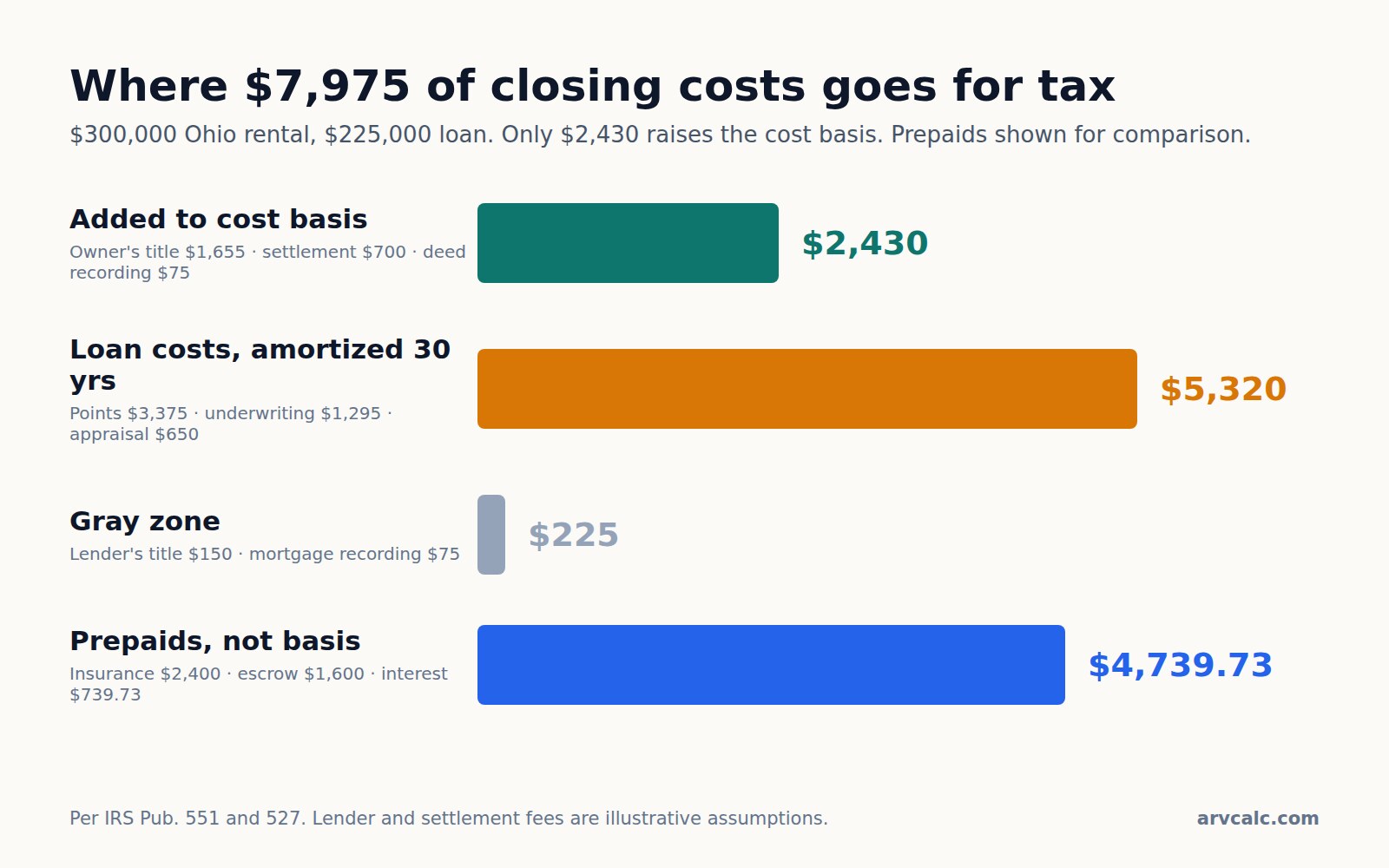
We reuse the Ohio purchase from our buyer closing costs guide: a $300,000 single-family rental, 25% down, a $225,000 30-year loan at 7.5%, closing June 15. The buyer pays the owner’s title policy by Ohio custom, as our Ohio closing costs guide explains, and the closing costs calculator produces the same line items for other states. Lender and settlement fees are illustrative assumptions, and we split the $150 recording estimate evenly between the deed and the mortgage.
| Line on the settlement statement | Amount | Where it goes |
|---|---|---|
| Owner’s title policy | $1,655 | Basis |
| Settlement / closing fee | $700 | Basis |
| Deed recording | $75 | Basis |
| Added to basis | $2,430 | |
| Origination, 1.5 points | $3,375 | Amortize over 30 years |
| Underwriting | $1,295 | Amortize over 30 years |
| Appraisal | $650 | Amortize over 30 years |
| Loan costs | $5,320 | About $177 a year |
| Lender’s title policy | $150 | Gray zone (see above) |
| Mortgage recording | $75 | Gray zone (see above) |
| Hazard insurance, 12 months | $2,400 | Rental expense |
| Escrow reserves | $1,600 | Deduct when paid out |
| Prepaid interest, 16 days | $739.73 | Mortgage interest |
Starting basis is $300,000 + $2,430 = $302,430. If you and your preparer put the two gray-zone lines in basis instead, it is $302,655. We use $302,430 below.
With a 20% land share from the assessment, land is $60,486 and the building is $241,944. Residential rental property is depreciated straight line over 27.5 years with a mid-month convention. Publication 946’s Table A-6 gives 1.970% for a property placed in service in June and 3.636% for each full year after. That is $4,766 of depreciation in year 1 and about $8,797 a year from year 2.
From cost basis to adjusted basis at sale
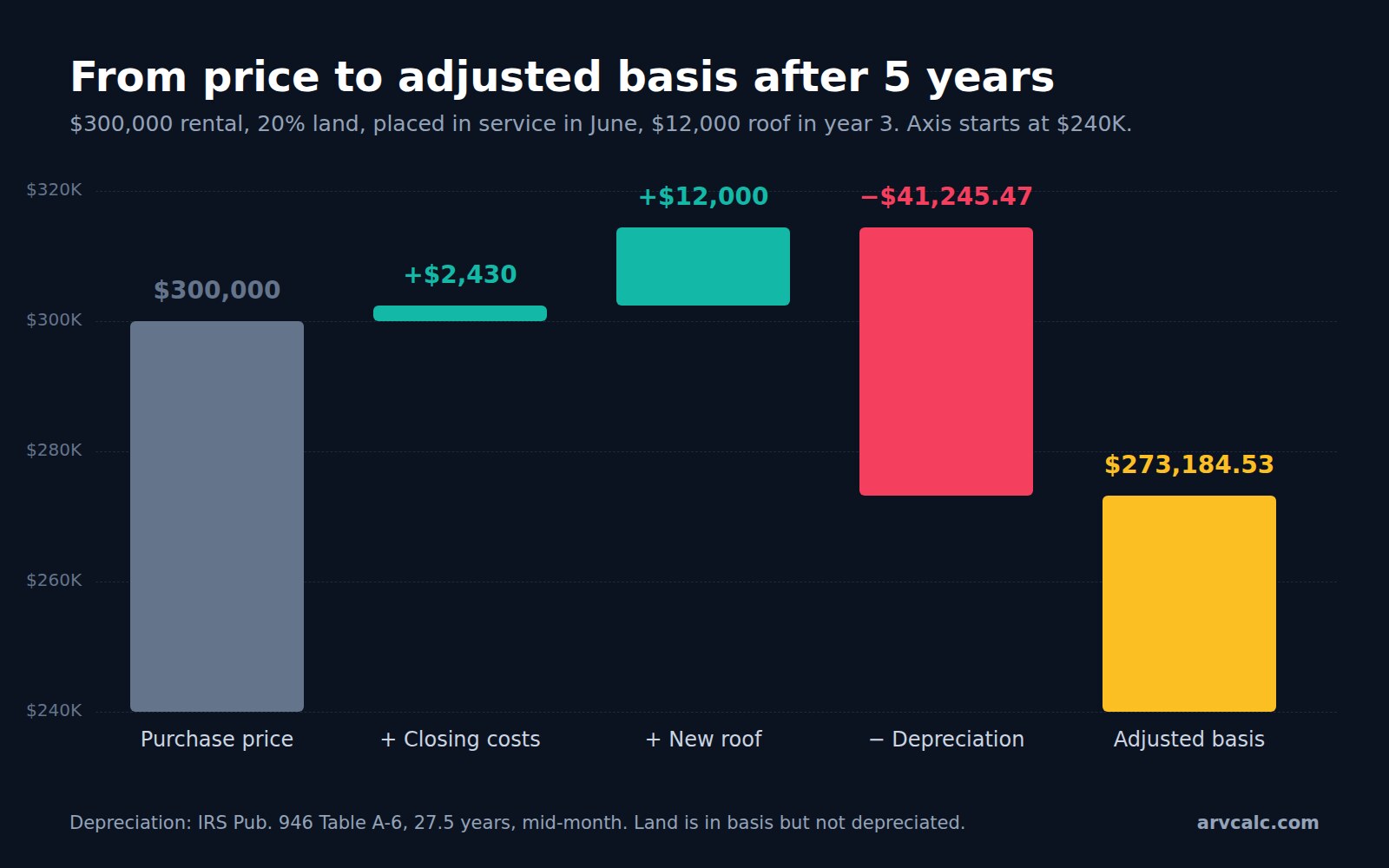
Rental property cost basis keeps moving after closing. Hold the property for five tax years. In January of year 3 you replace the roof for $12,000. Publication 551’s Table 1 lists replacing an entire roof as a capital improvement, so it increases basis and is depreciated on its own 27.5-year schedule starting in January (3.485% in its first year).
- Building depreciation, years 1 to 5: 1.970% + 4 × 3.636% of $241,944 = $39,954.63.
- Roof depreciation, years 3 to 5: 3.485% + 2 × 3.636% of $12,000 = $1,290.84.
- Adjusted basis: $302,430 + $12,000 − $39,954.63 − $1,290.84 = $273,184.53.
You then sell for $360,000 and pay 7% in selling costs, $25,200. The amount realized is $334,800, and the gain is $334,800 − $273,184.53 = $61,615.47. Of that, $41,245.47 equals the depreciation taken and is unrecaptured Section 1250 gain, taxed at a maximum 25% rate according to IRS Tax Topic 409. The remaining $20,370 is ordinary long-term capital gain, taxed at 0%, 15% or 20% depending on income.
Depreciation lowers basis whether you claimed it or not. Publication 551 says to reduce basis by the depreciation you deducted or could have deducted. Skipping the deduction does not avoid the 25% tax later; it only loses the deduction. Our depreciation recapture guide covers that part of the sale in detail.
Special cases: converted homes, inheritance and 1031 exchanges
Not every rental starts with a purchase. Three common cases change the starting number.
- Former home turned rental. Publication 551 sets the basis for depreciation at the lower of the property’s fair market value on the date of the change or your adjusted basis on that date. If values fell since you bought, you depreciate from the lower market value.
- Inherited property. Basis is generally the fair market value on the date of the owner’s death, or the value reported on Schedule A of Form 8971 when the estate files an estate tax return. Depreciation restarts from that value.
- 1031 exchange. The replacement property generally carries over the basis of the property you gave up, adjusted for boot and added cash. Use the 1031 exchange calculator and our 1031 boot guide before you assume your new basis equals the new price.
Five rental property cost basis mistakes
- Using the price as the basis. Leaving out $2,430 of eligible closing costs in our example costs about $71 a year of depreciation and raises the final gain by $2,430. Small per year, but it adds up across a portfolio.
- Depreciating loan costs with the building. Points and lender fees belong on the loan’s schedule. Lumping them into basis stretches them over 27.5 years and loses the write-off when you refinance or sell.
- Adding prepaids to basis. Insurance, prepaid interest and escrow deposits are expenses or cash, not cost. Adding $4,739.73 of prepaids to basis turns an immediate deduction into a 27.5-year one.
- Guessing the land share. A round 20% may be far from your county’s split. Use the assessment ratio or an appraisal and keep the record with your tax file.
- Not tracking improvements. Roofs, HVAC, additions and rewiring all raise basis. Repairs do not. Keep invoices with dates placed in service; our rehab cost guide helps you separate the two at purchase.
How to use the ArvCalc cost basis calculator
The cost basis calculator takes the purchase price, closing costs at purchase, capital improvements, years owned, land percentage and sale assumptions, then returns adjusted basis, the depreciation recapture portion and estimated tax.
Enter only the basis-eligible closing costs in the closing costs field, $2,430 in our example, not the full $7,975 from the settlement statement. Replace the 20% land default with your assessor’s split. Set the recapture rate to 25% as the maximum and your long-term rate to match your bracket. The calculator counts whole years owned, so its depreciation can differ slightly from a month-by-month Table A-6 schedule like ours.
For the yearly deduction on its own, use the depreciation calculator and our depreciation calculator guide. For the full tax picture at sale, run the capital gains tax calculator and the depreciation recapture calculator. The rest of the yearly write-offs are in our rental property tax deductions guide.
Frequently asked questions
What is included in rental property cost basis?
The purchase price plus the costs of buying: owner’s title insurance, settlement and legal fees, recording fees, surveys, transfer taxes you pay and amounts the seller owed that you agreed to pay. Loan costs, insurance, prepaid interest and escrow deposits are not included.
Are closing costs on a rental deductible in the year of purchase?
Mostly not. Costs of buying the property are added to basis and recovered through depreciation. Loan costs are deducted over the loan term. The first-year insurance premium and prepaid interest are the main items you can deduct in year one.
How do I split land and building for depreciation?
Use the ratio of the fair market value of each to the value of the whole property at purchase. If you are not sure of those values, the IRS allows the ratio from your property tax assessment.
Do points on a rental mortgage go into basis?
No. Points are prepaid interest and are deducted over the term of the loan. If the loan ends early through a sale or a refinance with a different lender, you can generally deduct the remaining points that year.
What lowers my adjusted basis?
Depreciation you deducted or could have deducted, casualty losses and insurance reimbursements, easements and certain credits. Capital improvements and assessments for local improvements raise it.
What if I never claimed depreciation?
Your basis is still reduced by the depreciation you could have taken, so you still face the 25% maximum rate on that amount at sale. Ask a preparer about catching up on missed depreciation before you sell.
What is the basis of a rental I received in a 1031 exchange?
Generally the basis of the property you gave up, increased for cash you added and adjusted for boot received. It is usually lower than the price of the new property.
Sources
- IRS Publication 551, Basis of Assets: settlement costs, loan charges, real estate taxes, land and buildings, increases and decreases to basis, property changed to rental use, inherited property.
- IRS Publication 527, Residential Rental Property: cost basis, points and de minimis OID, expenses paid to obtain a mortgage, 27.5-year recovery and mid-month convention.
- IRS Publication 946, How To Depreciate Property: Table A-6 percentages for residential rental property.
- IRS Publication 544, Sales and Other Dispositions of Assets: amount realized and gain.
- IRS Tax Topic 409, Capital Gains and Losses: 25% maximum rate on unrecaptured Section 1250 gain.
Leave a Reply