Published: November 16, 2026 · By Alex Petrov
Buyer closing costs are the second check you write when you buy a rental, after the down payment, and they are the one most investors underestimate. On a $300,000 purchase with a $225,000 loan, the state-driven buyer lines range from $100 in Texas to $1,805 in Ohio, and lender fees and prepaids add several thousand more in every state. This guide lists who pays what in each state ArvCalc covers, explains the lender and escrow lines, and walks through a full cash-to-close for a $300,000 rental in Texas, Florida and Ohio.
Rates and customs checked November 16, 2026, against the state sources linked in our transfer tax guide and title insurance guide. Lender fees in the example are assumptions, not quotes. Educational analysis, not legal, tax or lending advice. Your closing agent prepares the final settlement statement.
What buyer closing costs include
A buyer’s settlement statement mixes three kinds of money. The first is true closing costs: fees to the lender, the title company, the county and sometimes the state. The second is prepaids: insurance, interest and tax reserves you pay in advance. The third is the down payment. Lenders and agents often quote a single “cash to close” figure, so it helps to split it back into these parts before you compare deals or lenders.
Typical buyer lines on a financed investment property purchase:
- Lender fees. Origination or points, underwriting and processing, appraisal, credit report and flood certification. On investor loans this is usually the largest closing cost.
- Lender’s title policy. Required by almost every lender and always a buyer cost. It protects the lender only, up to the loan amount.
- Loan-side taxes. Florida, Georgia and Tennessee tax the mortgage itself. Most other states on our list do not.
- Owner’s title policy. A buyer cost in markets where custom puts it there, such as Ohio, Georgia, North Carolina and Miami-Dade County.
- Transfer tax. Usually a seller cost, but Tennessee buyers pay the recordation tax and Pennsylvania splits it 50/50 by custom.
- Settlement, attorney and recording fees. The escrow or closing fee, document preparation, and county recording of the deed and mortgage.
The seller side of the same transaction is covered in our seller closing costs by state guide. Reading both helps when you negotiate who pays which line.
Buyer closing costs by state: who pays what in 2026
The table shows the lines that change by state on a $300,000 purchase with a $225,000 loan (75% LTV). Lender fees, settlement fees and prepaids are left out because they depend on the lender and the closing company, not the state.
| State | Transfer tax paid by buyer | Loan-side tax on $225,000 | Owner’s title policy | Lender’s title, same closing | Closing usually run by |
|---|---|---|---|---|---|
| Texas | None (no transfer tax) | None | $1,768; payer set by contract | $100 (TDI rule R-5) | Title company |
| Florida (not Miami-Dade) | None; seller pays doc stamps | $1,237.50 (note stamps $787.50 + intangible $450) | $1,575; seller in most counties | $25 minimum | Title company or attorney |
| Florida, Miami-Dade | Negotiated | $1,237.50 | $1,575; buyer by custom | $25 minimum | Title company or attorney |
| Ohio | None; seller pays conveyance fee | None | $1,655; buyer by custom | $150 standard | Title company |
| Georgia | None; seller by statute | $675 intangible tax | Filed rates; buyer by custom | Filed rates | Attorney |
| North Carolina | None; seller pays excise tax | None | Filed rates; buyer by custom | Filed rates | Attorney |
| Tennessee | $1,110 recordation tax | $256.45 indebtedness tax | Filed rates; seller by custom | Filed rates | Title company |
| South Carolina | None; seller pays deed fee | None | Filed rates; check contract | Filed rates | Attorney |
| Michigan | None; seller pays state and county tax | None | Filed rates; seller by custom | Filed rates | Title company |
| Indiana | None (no transfer tax) | None | Filed rates; check contract | Filed rates | Title company |
| Pennsylvania | About $3,000 (half of about 2%); about $6,417 in Philadelphia | None | Filed rates; check contract | Filed rates | Title company |
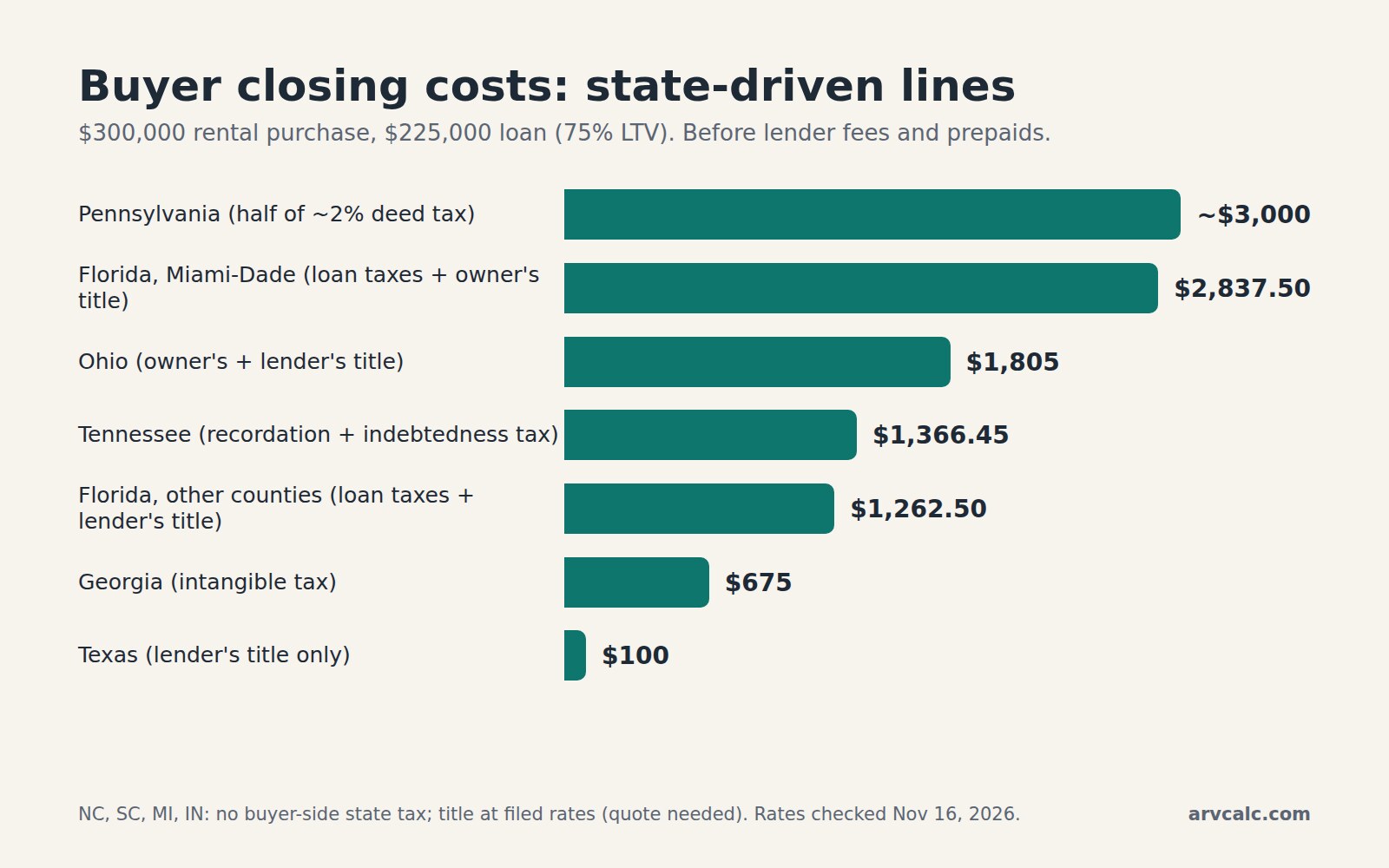
Three patterns stand out. Tennessee and Pennsylvania are the expensive buyer states because the buyer carries a deed tax. Florida and Georgia add a tax on the mortgage, so a larger loan means a larger closing bill. Texas, Indiana and Michigan buyers usually face only lender fees and the lender’s policy, which is why those states look cheap on a buyer’s statement.
Where the table says “filed rates,” each title underwriter files its own premium schedule with the state, so the only reliable number is a written quote. Our title insurance guide explains how the promulgated rates in Texas, Florida and Ohio are calculated.
Lender fees on investment property loans
Lender charges usually outweigh every state line on the table. A DSCR or other investor loan often carries an origination fee of one to two points, plus underwriting, processing, appraisal and third-party fees. A rate buydown adds more points. Compare these lines across lenders before you compare interest rates, because a lower rate with two extra points can cost more over a short hold. Our DSCR loan rates guide shows how pricing moves with credit score and LTV.
One rule surprises many first-time investors. Under the official commentary to Regulation Z, credit to buy a rental that the owner will not occupy is treated as business-purpose credit, regardless of the number of units (CFPB, comment 3(a)-5). In practice that means many investor loans do not come with the standard Loan Estimate and Closing Disclosure forms. Ask for an itemized fee sheet in writing, and compare it line by line with the final settlement statement.
Conventional loans on investment property are still covered by agency rules on the lender side. If you are choosing between loan types, our DSCR vs conventional loan comparison and best loans for investment property overview cover rates, reserves and down payment requirements, and our LTV requirements guide explains how the loan size is capped.
Prepaids and escrow reserves: cash, not costs
Prepaids are the part of cash to close that buyers confuse with fees. They are your own money paid in advance: the first year of hazard insurance, interest from closing day to the end of the month, and an opening deposit into the escrow account for future tax and insurance bills. They do not make the deal more expensive, but they do raise the amount you need on closing day.
Federal rules limit how much extra a servicer can hold. Under RESPA’s escrow rule, the cushion in the account may be no more than one-sixth of the estimated annual escrow payments, which is about two months (12 CFR 1024.17). The opening deposit can still be larger than two months when the first tax bill is due soon after closing.
Prepaid interest depends on the closing date. Closing near the end of a month means fewer days of prepaid interest, but the first full payment still comes about a month later. Closing early in the month raises prepaid interest but does not change the total interest you pay over the loan. If cash is tight, ask the lender to show cash to close for two or three closing dates.
Worked example: cash to close on a $300,000 rental in Texas, Florida and Ohio
To isolate what the state changes, we hold every non-state line constant. The deal: a $300,000 single-family rental, 25% down ($75,000), a $225,000 investor loan at 7.5%, closing on June 15. Lender fees are assumptions for illustration: 1.5% origination ($3,375), a $650 appraisal and a $1,295 underwriting and processing fee. Settlement fee $700 and recording $150. Prepaids: $2,400 of insurance, $1,600 of escrow reserves (three months of a $4,800 tax bill plus two months of insurance) and 16 days of interest ($739.73).
State lines: in Texas we assume the seller pays the owner’s policy, so the buyer pays the $100 lender’s policy. In Florida outside Miami-Dade the seller pays the owner’s policy, and the buyer pays the $25 lender’s charge plus $1,237.50 of note stamps and intangible tax. In Ohio the buyer pays the $1,655 owner’s policy by custom, plus $150 for the lender’s policy.
| Line | Texas | Florida | Ohio |
|---|---|---|---|
| Lender fees (origination, appraisal, underwriting) | $5,320 | $5,320 | $5,320 |
| Settlement and recording | $850 | $850 | $850 |
| Lender’s title policy | $100 | $25 | $150 |
| Owner’s title policy | $0 (seller) | $0 (seller) | $1,655 |
| Note stamps and intangible tax | $0 | $1,237.50 | $0 |
| Closing costs before prepaids | $6,270 | $7,432.50 | $7,975 |
| Share of price | 2.09% | 2.48% | 2.66% |
| Prepaids and escrow reserves | $4,739.73 | $4,739.73 | $4,739.73 |
| Down payment | $75,000 | $75,000 | $75,000 |
| Cash to close | $86,009.73 | $87,172.23 | $87,714.73 |
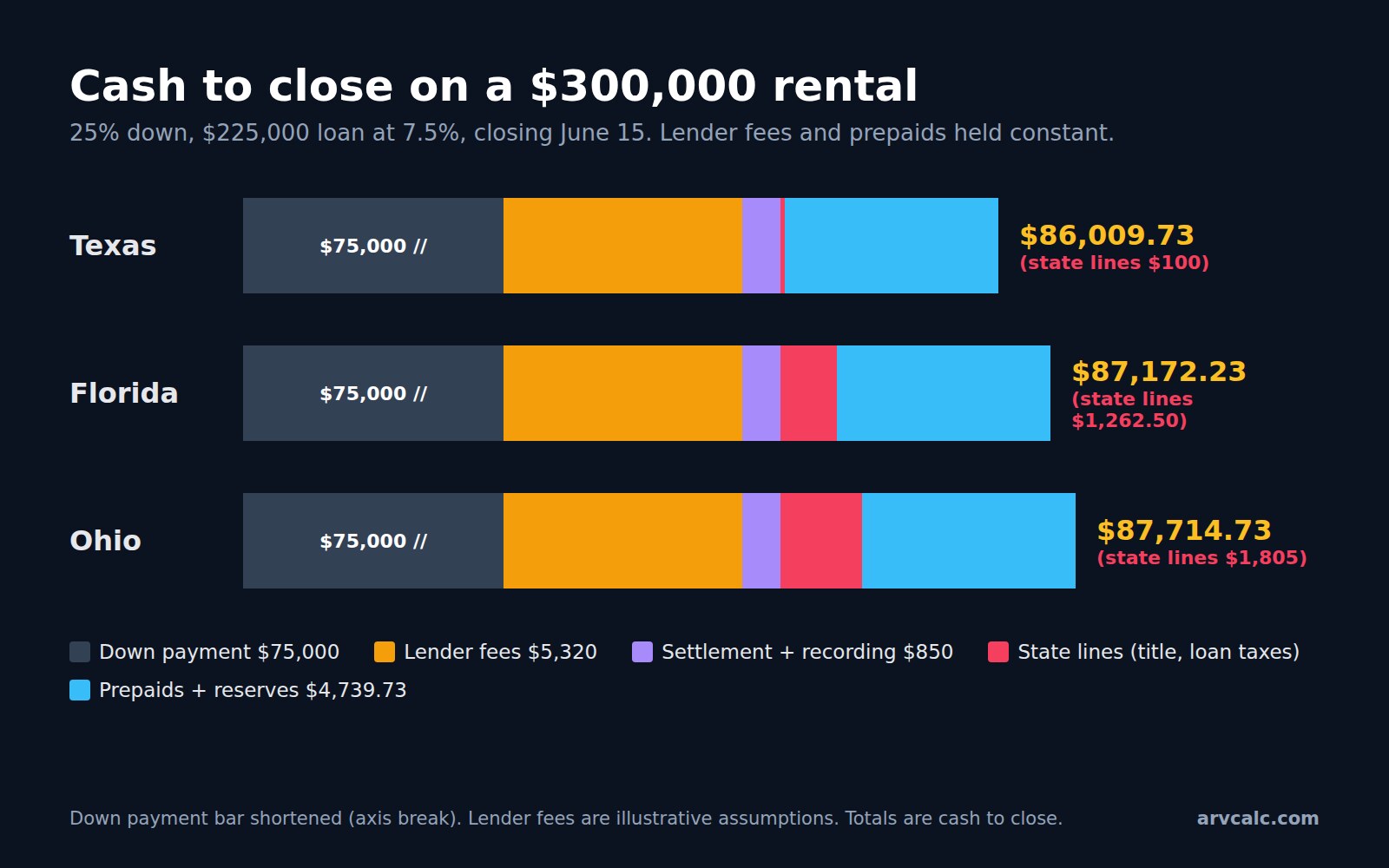
The spread between the cheapest and most expensive state is $1,705, all of it from title custom and loan taxes. That is real money, but it is smaller than the lender fees in every state. A one-point difference in origination on this loan is $2,250, more than the entire state gap. This is why shopping the loan usually saves more than shopping the market.
Closing costs also change your return. In Ohio, $7,975 of closing costs on top of a $75,000 down payment means $82,975 of invested cash before prepaids. If the property produces $6,000 of annual pre-tax cash flow, cash-on-cash return is 7.23% with closing costs counted and 8.0% without them. Always put closing costs into the denominator; our cash-on-cash return guide explains the benchmark.
Seller credits and other ways to cut cash to close
A seller credit, also called a concession, lets the seller pay part of your closing costs from the sale proceeds. On a conventional loan sold to Fannie Mae, credits on an investment property are capped at 2% of the price at every LTV (Fannie Mae Selling Guide B3-4.1-02). On the $300,000 example that cap is $6,000. Portfolio and DSCR lenders set their own limits, so confirm the number before you write it into an offer.
A credit cannot exceed your actual closing costs and prepaids, and any excess is usually lost or forces a price change. In the Ohio example, a $6,000 credit cuts cash to close from $87,714.73 to $81,714.73. The seller often asks for a higher price in return, which raises the loan, the loan-side taxes in states that have them, and the property tax assessment in some counties.
Other ways to lower cash to close:
- Negotiate the owner’s policy. In Ohio, Georgia, North Carolina and Miami-Dade, custom puts it on the buyer, but the contract can move it.
- Ask about reissue credits. If the seller bought recently, some title rate schedules give a discount on the new owner’s policy.
- Trade rate for points carefully. A lender credit in exchange for a higher rate lowers cash to close but raises the payment and lowers your DSCR.
- Pick the closing date. Late-month closings reduce prepaid interest.
Buyer closing costs and your tax basis
Buyer closing costs are not deducted in the year you buy a rental. Most of them go into the cost basis of the property and are recovered through depreciation, or through a smaller gain when you sell. IRS Publication 551 lists the settlement costs you add to basis: legal fees including title search and deed preparation, recording fees, surveys, transfer taxes, owner’s title insurance, and seller debts you agree to pay (IRS Pub 551). Amounts placed in escrow for future taxes and insurance are not settlement costs.
Loan costs follow different rules. Publication 551 keeps the costs of getting a loan out of basis, while Publication 527 says some expenses paid to obtain a mortgage on a rental, such as mortgage commissions and recording fees, are capital expenses, and points on a rental loan are deducted over the life of the loan (IRS Pub 527). Keep the settlement statement and let your preparer sort each line.
A quick illustration for Ohio: the $1,655 owner’s policy and the $700 settlement fee add $2,355 to basis. If 80% of the purchase price is building, $1,884 of that is depreciable over 27.5 years, about $68.51 a year. Small, but it compounds across a portfolio. Our cost basis calculator and depreciation calculator do the math, and the rental property tax deductions guide covers what you can deduct each year.
Five buyer closing cost mistakes investors make
- Budgeting closing costs as a flat 2% to 5%. The state lines alone run from $100 in Texas to about $3,000 in Pennsylvania on the same price. Price your actual state and lender.
- Treating prepaids as fees. Insurance and escrow reserves are your money. Mixing them with costs makes deals look worse than they are and makes lender comparisons meaningless.
- Forgetting loan-side taxes. In Florida, Georgia and Tennessee the tax grows with the loan. A higher LTV raises it even when the price stays the same.
- Skipping the owner’s policy to save money. The lender’s policy protects only the lender. Without an owner’s policy, the $25 to $150 simultaneous rate on the lender’s policy usually disappears too, and you carry title risk yourself.
- Leaving closing costs out of returns. Cash-on-cash, BRRRR and IRR calculations all need total cash invested. In our Ohio example, leaving out $7,975 of closing costs lifts cash-on-cash return from 7.23% to 8.0%.
How to use the ArvCalc closing costs calculator
The ArvCalc closing costs calculator estimates the buyer side of a purchase from the price, loan amount and state. It applies the state’s transfer tax and loan-side taxes, then lets you add lender fees and prepaids. State pages such as Texas, Florida, Ohio and Tennessee preload local rates and customs.
A practical workflow: run the calculator before your offer, then replace the estimates with the lender’s fee sheet and the title quote once you are under contract. Carry the total into the rental property calculator or cash-on-cash calculator so returns reflect real cash invested. Our closing costs calculator guide walks through each field, and the rental property expenses list covers the costs that start after closing.
Frequently asked questions
What are typical buyer closing costs on an investment property?
Lender fees, the lender’s title policy, loan-side taxes where the state charges them, the owner’s title policy where custom puts it on the buyer, and settlement and recording fees. In our $300,000 example they run from $6,270 in Texas to $7,975 in Ohio before prepaids, about 2.1% to 2.7% of the price.
Which states have the highest buyer closing costs?
Among the states ArvCalc covers, Pennsylvania and Tennessee, because the buyer pays a deed tax: about $3,000 (half of about 2%) and $1,110 on a $300,000 purchase. Florida and Georgia add a tax on the mortgage.
Does the buyer pay transfer tax?
Usually not. In most states on our list the seller pays it by custom or statute. Tennessee buyers pay the recordation tax, Pennsylvania splits the tax 50/50 by custom, and Miami-Dade leaves it to negotiation.
Are prepaids part of closing costs?
They are part of cash to close but not true costs. Prepaid insurance, interest and escrow reserves pay expenses you would owe anyway. Separate them when you compare lenders or calculate returns.
Can the seller pay the buyer’s closing costs on a rental?
Yes, through a seller credit. Fannie Mae caps it at 2% of the price for investment properties. DSCR and portfolio lenders set their own limits, and the credit cannot exceed your actual closing costs and prepaids.
Are buyer closing costs tax deductible on a rental?
Not in the year of purchase. Title, recording, legal and transfer tax costs are added to basis and recovered through depreciation. Loan costs and points are generally spread over the loan term. Ask your tax preparer about each line.
How much cash do I need to close on a $300,000 rental?
With 25% down, about $86,000 to $88,000 in Texas, Florida and Ohio in our example: $75,000 down, $6,270 to $7,975 of closing costs and about $4,740 of prepaids. Your lender’s fee sheet sets the final number.
Leave a Reply