
Last updated: November 24, 2026 · Originally published: November 19, 2026 · By Alex Petrov
Converting primary residence to rental property use is one of the most common ways people become landlords: a job move, a bigger house or a soft market makes renting the old place more attractive than selling it. The tax side changes the day you move out. Your home gets a new depreciation basis, your expenses move from Schedule A to Schedule E, and a clock starts on the home sale exclusion you have built up. This guide walks through each rule with the IRS references and a worked example you can copy.
Rules checked November 18, 2026, against IRS Publication 527 (Residential Rental Property, 2025), Publication 551 (Basis of Assets), Publication 523 (Selling Your Home, 2025), Publication 925 (Passive Activity and At-Risk Rules), Publication 946 and Tax Topics 409 and 559. Dollar amounts in the example are assumptions, not quotes. Educational analysis, not tax or legal advice. Confirm your own numbers with a tax preparer.
What changes when converting primary residence to rental property
For tax purposes your primary residence stops being personal-use property and becomes rental property held to produce rent. Four things follow from that:
- You must depreciate the building. Depreciation is not optional in practice. Your basis is reduced by the depreciation you were allowed to take, even if you never claimed it, so skipping it only costs you deductions.
- Expenses change forms. Rent, mortgage interest, property tax, insurance, repairs and management fees for the rental months go on Schedule E. Mortgage interest and property tax for the months you lived there stay on Schedule A if you itemize.
- The home sale exclusion starts to expire. The Section 121 exclusion needs 2 years of use as your primary residence in the 5 years before the sale. Every month you rent the house, one month of that window rolls off.
- Losses become passive. A loss on rental property is a passive loss. You may deduct up to $25,000 of it against wages if you actively participate and your income is under the phaseout range, explained below.
Converting primary residence to rental property needs no election and no special form on the day you move out. It shows up on your next return: Form 4562 for the first year of depreciation and Schedule E for the rental income and expenses.
When depreciation starts: the “ready and available” date
IRS Publication 527 says you can begin to depreciate rental property when it is ready and available for rent. You do not need a signed lease or a tenant in the house. If you moved out in May, cleaned and painted, and listed the home on June 1, the rental property is placed in service in June even if the first tenant arrives in August.
Write the date down and keep proof: the listing, the first showing, an email to a property manager. That date drives three things on your return. It sets the first-year depreciation percentage, it is the point where expenses switch from personal to rental, and it is the date on which you measure fair market value for the depreciation basis.
Residential rental property is depreciated over 27.5 years with the straight-line method and the mid-month convention. The first-year percentage depends on the month you place the home in service. For June it is 1.970% (Publication 946, Table A-6). A full year after that is 3.636%. You can check the yearly numbers with the ArvCalc depreciation calculator.
The depreciation basis of a converted home: lesser of two numbers
This is the rule that surprises most new landlords. When you convert personal property to rental use, the basis for depreciation is the lesser of:
- Fair market value of the property on the date of the change, or
- Your adjusted basis on that date: what you paid for the home, plus the closing costs that belong in basis, plus permanent improvements, minus casualty loss deductions and other decreases.
Land is never depreciated, so you run the comparison for the building only. Publication 527’s own example compares the adjusted basis of the house ($164,000) with the fair market value of the house alone ($147,000) and uses the lower figure.
In a rising market the lower number is almost always your adjusted basis, so years of appreciation while it was your primary residence do not raise your depreciation. In a falling market the fair market value can be lower, and that value becomes the starting point. The rule exists so that a loss in value from your personal years cannot be turned into rental deductions.
To find your adjusted basis, start with the purchase settlement statement. The items that belong in basis are the same ones an investor adds when buying a rental: owner’s title insurance, settlement fees, recording fees and transfer taxes you paid. Our rental property cost basis guide lists them line by line. Then add capital improvements such as a new roof, HVAC, an addition or a kitchen remodel. Repairs and maintenance do not count. The cost basis calculator keeps the running total.
For fair market value, use what you can document on the conversion date: a broker price opinion, an appraisal, or recent sales of similar homes nearby. An appraisal is not required, but it is the strongest record if the number is ever questioned, and it is the only practical way to prove a value below your basis.
Splitting land and building at conversion
You need two splits. The first is the land share of your original cost, which gives the building’s adjusted basis. The second is the land share of fair market value on the conversion date, which gives the building’s market value. Publication 551 allows the ratio from your property tax assessment when you have no better evidence, and a good appraisal will often state land value separately.
Keep the land at purchase cost in your records. It never gets depreciated, but it stays in the basis you use to figure gain at sale. A common mistake is to use today’s assessment for the purchase-year split. Use the assessment, or the appraisal, from the year you bought the home.
Splitting expenses in the year you convert
If converting primary residence to rental property happens on any date other than January 1, the year is split. Publication 527 gives the rule: yearly expenses such as property taxes and insurance are divided between rental and personal use by months. For a home rented from June 1, seven-twelfths go on Schedule E. For typical rates where your home is, see our property tax rates by state ranking.
- Mortgage interest and real estate taxes. The rental months go on Schedule E. The personal months can still be deducted on Schedule A if you itemize.
- Insurance and depreciation. Only the rental part is deductible. The personal part is not deductible anywhere.
- Utilities and other monthly bills. Deduct the bills for the months from the conversion date on.
- Get-ready costs. Publication 527 lets you deduct ordinary expenses for managing, conserving or maintaining rental property from the time you make it available for rent. Paint and repairs done while you still lived there are personal. Improvements are added to basis either way.
Two practical items fall outside the tax code but come up almost every time someone is converting primary residence to rental property. Your homeowner’s policy usually does not cover a home rented to someone else, so switch to a landlord (dwelling fire) policy before the tenant moves in; see our landlord insurance guide.
Then check your mortgage. Fannie Mae’s Selling Guide defines a principal residence loan as one where the borrower occupies the home within 60 days and keeps it as the main home for at least one year unless the lender agrees otherwise. Once that period has passed, turning a primary residence into a rental property after a job move or a new home purchase is common, but read your own loan documents first.
Worked example: converting a $250,000 home in 2026
Here is how converting primary residence to rental property works with real numbers. All amounts below are illustrative assumptions for one single filer and are computed exactly. Change them to your own numbers.
| Item | Amount | Note |
|---|---|---|
| Purchase price, March 2019 | $250,000 | Primary residence |
| Closing costs added to basis | $3,000 | Owner’s title, settlement, recording |
| Land at purchase (2019 assessment) | $50,000 | Not depreciable |
| Building at purchase | $203,000 | $253,000 minus $50,000 |
| Improvements (HVAC 2022, kitchen 2023) | $27,000 | $9,000 + $18,000 |
| Adjusted basis, whole property | $280,000 | $253,000 + $27,000 |
| Adjusted basis, building only | $230,000 | $203,000 + $27,000 |
| Fair market value, June 1, 2026 | $390,000 | Broker price opinion |
| Land share of value (20%) | $78,000 | Current assessment ratio |
| Building market value | $312,000 | $390,000 minus $78,000 |
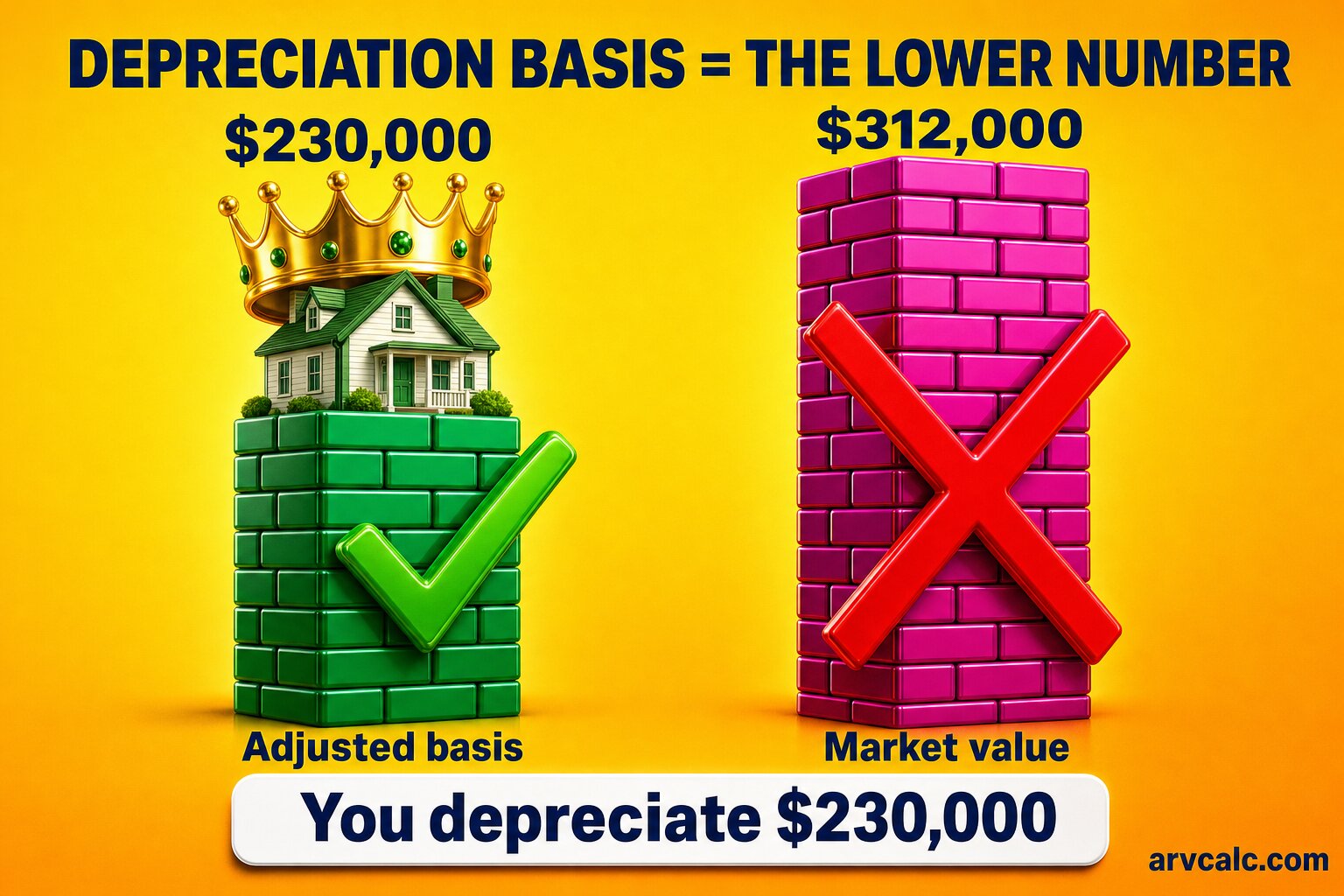
Depreciation basis. The lesser of the building’s adjusted basis ($230,000) and the building’s market value ($312,000) is $230,000. The $82,000 of extra value the building gained while it was a home is not depreciated.
Depreciation. The home was ready for rent on June 1, 2026:
- 2026: $230,000 × 1.970% = $4,531.00
- Each full year after: $230,000 × 3.636% = $8,362.80
First rental year on Schedule E (June to December 2026). Rent of $2,400 a month brings in $16,800. Cash expenses for those seven months: mortgage interest $5,250 (7/12 of $9,000), property tax $2,800 (7/12 of $4,800), landlord insurance $1,050, turnover and cleaning $1,500 and 8% management $1,344, for $11,944 in total. After depreciation of $4,531.00, the rental shows a taxable profit of $325.00. The other $3,750 of mortgage interest and $2,000 of property tax from January to May stay on Schedule A.
A full year (2027). Rent $28,800, cash expenses $19,104 (interest $9,000, tax $4,800, insurance $1,800, management $2,304, repairs $1,200) and depreciation $8,362.80 leave a taxable profit of $1,333.20, even though the cash flow before depreciation is $9,696. That gap is the main tax benefit of keeping a former home as a rental. Run your own version in the cash flow calculator or the rental property calculator.
The 3-year window: keeping the $250,000 home sale exclusion
Section 121 lets you exclude up to $250,000 of gain on the sale of your primary residence, or $500,000 for most married couples filing jointly, if you owned and used it as your main home for at least 24 months in the 5 years before the sale. The 24 months do not need to be continuous.
If the house was your primary residence for at least 2 years right before you moved out, the use test stays met until roughly 3 years after the move-out date. After that, fewer than 24 months of residence remain inside the 5-year lookback and the exclusion is gone.
What about the rental years inside that window? The rule on “nonqualified use” says gain from periods after 2008 when the home was not your primary residence cannot be excluded. But Publication 523 lists an exception: the time after the last date you used the home as your main residence does not count as nonqualified use. Its own Taylor example moves out on January 1, 2023, rents the house and sells on December 1, 2024; the whole gain other than depreciation is excluded. The proration only hurts people who rent first and move in later.
The exception does not reach depreciation. Gain equal to depreciation allowed or allowable after May 6, 1997 cannot be excluded. It is unrecaptured Section 1250 gain, taxed at your ordinary rate but no more than 25% (Tax Topic 409).
Scenario A: sell in March 2029, inside the window
The owner lived in the house from March 2019 to May 2026. A sale in March 2029 looks back to March 2024, which still holds 26 months of residence.
- Depreciation: $4,531.00 (2026) + $8,362.80 (2027) + $8,362.80 (2028) + $1,742.25 (2029, mid-month for 2.5 months) = $22,998.85
- Adjusted basis for gain: $280,000 − $22,998.85 = $257,001.15
- Sale price $430,000, selling costs 6% ($25,800), amount realized $404,200
- Gain: $404,200 − $257,001.15 = $147,198.85
- Excluded under Section 121: $124,200 (gain minus depreciation, under the $250,000 cap)
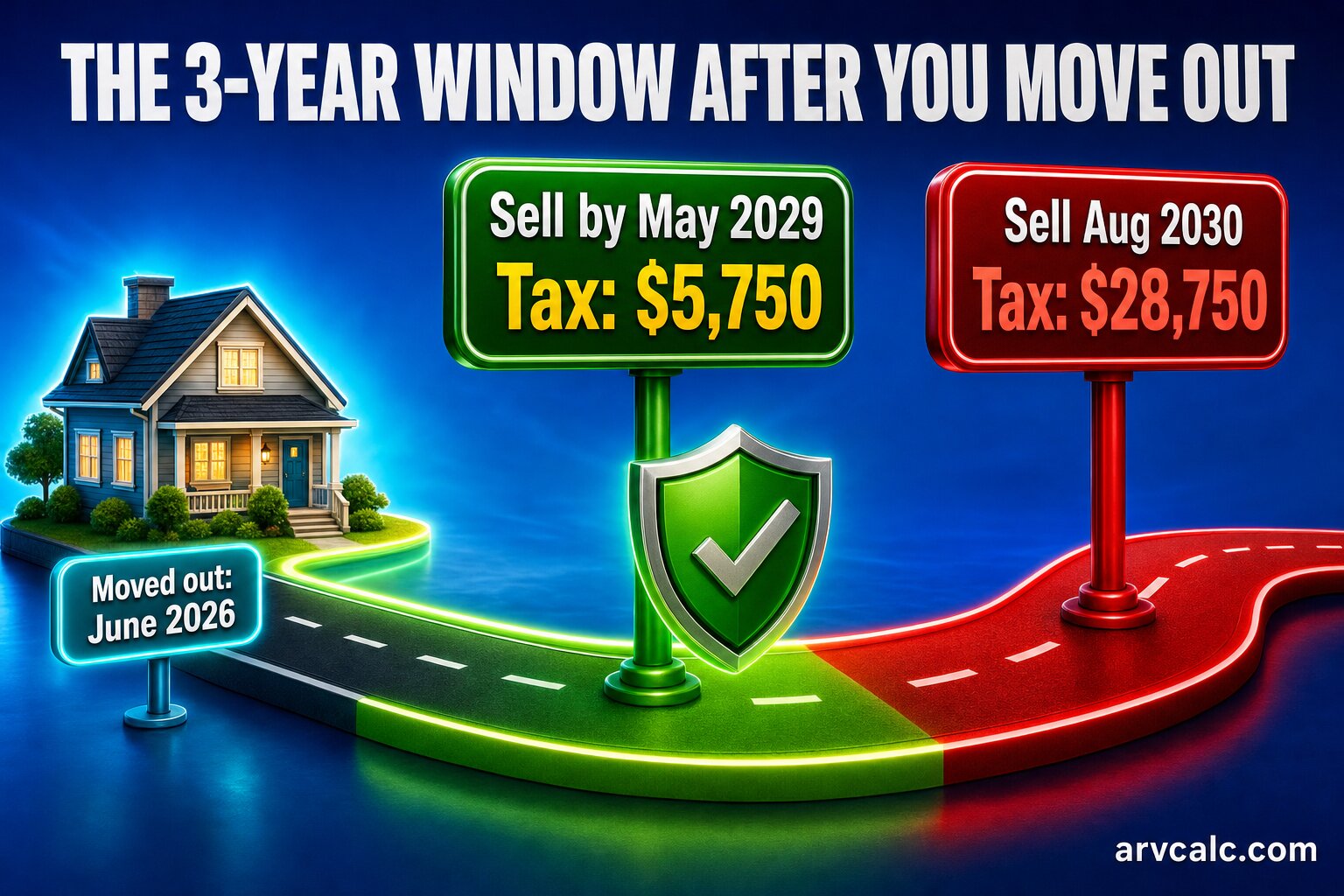
- Taxable: $22,998.85 of unrecaptured Section 1250 gain, at most 25% = up to $5,749.71
Scenario B: sell in August 2030, after the window
More than 3 years after moving out, the 5-year lookback starts in August 2025 and holds only 10 months of residence. No exclusion.
- Depreciation: $4,531.00 + 3 × $8,362.80 + $5,226.75 (2030, 7.5 months) = $34,846.15
- Adjusted basis: $280,000 − $34,846.15 = $245,153.85
- Sale price $440,000, selling costs $26,400, amount realized $413,600
- Gain: $168,446.15, all taxable
- Tax at an assumed 15% long-term rate plus the 25% maximum on depreciation: $8,711.54 + $20,040.00 = about $28,751.54, before any state tax or the 3.8% net investment income tax
One extra year of rent added roughly $23,000 of federal tax in this example. Plug your own sale price and holding period into the capital gains tax calculator and estimate your selling costs with the seller net sheet calculator.
The net investment income tax applies to gain that is taxable, not to gain excluded under Section 121 (IRS Q&A on the NIIT). It is 3.8% of the lesser of net investment income or modified AGI above $200,000 for single filers and $250,000 for joint filers (Tax Topic 559).
Selling at a loss: the dual-basis rule
A loss on the sale of a primary residence is not deductible. A loss on rental property can be, which is why converting primary residence to rental property brings a second basis rule. To stop owners from deducting a decline in value that happened while they lived in the house, Publication 551 uses a different basis for losses.
- Basis for gain: your adjusted basis (original cost plus improvements, land included), minus depreciation.
- Basis for loss: the smaller of your adjusted basis or the fair market value at conversion, then adjusted for changes after conversion, including depreciation.
If the sale price falls between the two, you have neither a gain nor a loss. In our example the market value at conversion ($390,000) is above the adjusted basis ($280,000), so the loss basis is the same as the gain basis and the rule does not change anything. It matters for homes converted after a price drop. For example, if the building had been worth only $200,000 on June 1, 2026, depreciation would run on $200,000 instead of $230,000.
Rental losses and the $25,000 allowance
Many owners converting primary residence to rental property show a tax loss in the early years, especially with a large mortgage. Rental income and losses are passive, and passive losses generally offset only passive income. Publication 925 has an exception for owners who actively participate, for example by approving tenants, setting the rent and approving repairs, even through a manager.
- Up to $25,000 of rental loss can offset wages and other nonpassive income.
- The allowance drops by 50% of modified AGI above $100,000 and is gone at $150,000 ($50,000 and $75,000 if married filing separately).
- At a modified AGI of $130,000 the allowance is $10,000. At $90,000 it is the full $25,000.
Losses you cannot use are not lost. They carry forward and are released when you have passive income or when you sell the rental property in a fully taxable sale. Track them each year; our rental property bookkeeping guide shows a simple setup, and the rental property tax deductions guide covers which expenses go on Schedule E.
Converting primary residence to rental property: a checklist
- Set the rent. Pull comparable rents before you move out; see how much can I rent my house for.
- Check the loan and the HOA. Occupancy terms, rental caps and local registration rules come before the listing.
- Switch insurance to a landlord policy effective on the rental date.
- Document fair market value on the ready-for-rent date: appraisal, broker opinion or comparable sales.
- Build the adjusted basis file: purchase settlement statement, improvement receipts, assessment for the land split.
- Record the placed-in-service date: the day the rental property was ready for rent, backed by the listing or the first showing.
- Screen tenants with a written standard; our tenant screening checklist covers the steps.
- Open a separate account for rent and expenses from day one.
- Put the 3-year date on your calendar. Decide well before it whether you will sell, keep renting or plan a 1031 exchange.
- File Form 4562 and Schedule E for the conversion year and split the personal-month expenses to Schedule A.
Five mistakes when renting out your former home
- Depreciating today’s value. The basis is the lesser of adjusted basis or market value. Using the appraisal of a former primary residence that has doubled in value overstates every deduction.
- Not claiming depreciation. Your basis drops by the depreciation you could have taken anyway, and the 25% maximum still applies to it when you sell.
- Depreciating the land. Only the building and improvements are depreciated. Keep the land share at its purchase cost for the gain calculation.
- Missing the 3-year window by a few months. The 24 months of use must fall inside the 5 years before the closing date, not the listing date.
- Deducting personal-period expenses on Schedule E. Paint and repairs done before the home was available for rent are personal. Insurance for the months you lived there is not deductible at all.
If you are still weighing converting primary residence to rental property against selling, compare the after-tax result of both paths in the rent vs buy calculator and read how to avoid capital gains tax on real estate. For recapture on a longer hold, see the depreciation recapture guide.
Frequently asked questions
Do I have to depreciate my house if I rent it out?
You are not forced to claim it, but your basis is reduced by the depreciation you were allowed to take whether you claim it or not. Not claiming it gives up the yearly deduction and still leaves you with the recapture at sale.
What is the depreciation basis of a home converted to a rental?
The lesser of the building’s adjusted basis or its fair market value on the date it becomes available for rent. Land is excluded. In a rising market this is usually your purchase cost of the building plus improvements.
How long can I rent my house and still avoid capital gains tax?
If you lived in it for at least 2 years before moving out, you can generally sell within about 3 years of the move-out date and keep the Section 121 exclusion of up to $250,000, or $500,000 for most joint filers. Depreciation taken after May 6, 1997 is still taxable. Selling a vacation property rather than a former main home follows different rules, covered in our guide to capital gains tax on a second home.
Is the rental period counted as nonqualified use?
Not when it comes after your last use of the home as your primary residence within the 5-year period. Publication 523 says that period is not nonqualified use. Renting before you move in is different and can reduce the exclusion.
Can I deduct mortgage interest after I move out?
Yes, as a rental expense on Schedule E for the months the home is held for rent. Interest for the months you lived there can still go on Schedule A if you itemize.
What if my home is worth less than I paid when I convert it?
Depreciation runs on the lower market value, and a later loss is figured from the smaller of adjusted basis or value at conversion. A decline that happened while you lived there cannot become a deductible loss.
Do I need an appraisal when I convert my home to a rental?
It is not required, but you need some record of fair market value on the conversion date. An appraisal is the strongest evidence, especially if the value is below your basis.
Sources
- IRS Publication 527, Residential Rental Property: property changed to rental use, basis of property changed to rental use, dividing expenses by months, placed in service when ready and available for rent, 27.5-year recovery.
- IRS Publication 551, Basis of Assets: basis for depreciation, basis for gain and basis for loss after a change to rental use, land and building split.
- IRS Publication 523, Selling Your Home: ownership and use tests, $250,000 and $500,000 exclusion, nonqualified use and its exceptions, depreciation after May 6, 1997.
- IRS Publication 925, Passive Activity and At-Risk Rules: $25,000 special allowance, active participation, phaseout from $100,000 to $150,000.
- IRS Publication 946, How To Depreciate Property: Table A-6 percentages and mid-month convention.
- IRS Tax Topic 409: 25% maximum rate on unrecaptured Section 1250 gain. Tax Topic 559 and the IRS NIIT Q&A: 3.8% tax, thresholds, excluded home sale gain.
- Fannie Mae Selling Guide B2-1.1-01, Occupancy Types: principal residence occupancy within 60 days and for at least one year.
Leave a Reply