Last updated: October 21, 2026 · Originally published: July 27, 2026 · By Alex Petrov
{
“@context”: “https://schema.org”,
“@type”: “FAQPage”,
“mainEntity”: [
{
“@type”: “Question”,
“name”: “How much are closing costs in Texas for an investment property?”,
“acceptedAnswer”: {
“@type”: “Answer”,
“text”: “Texas closing costs for investment property buyers typically range from 2% to 4% of the purchase price, not including the down payment. On a $350,000 rental property, expect $8,000 to $14,000 in closing costs. Investors pay more than primary residence buyers due to higher loan origination fees, no homestead exemptions, and larger escrow reserves for property taxes and landlord insurance.”
}
},
{
“@type”: “Question”,
“name”: “Does Texas have a transfer tax on real estate?”,
“acceptedAnswer”: {
“@type”: “Answer”,
“text”: “No. Texas is one of the few states with no real estate transfer tax. This saves investors significant money compared to states like New York (0.4%), Pennsylvania (2%), or Illinois (0.1% state + county). On a $350,000 property, you would pay $0 in transfer tax in Texas versus $1,400 in New York or $7,000 in Pennsylvania.”
}
},
{
“@type”: “Question”,
“name”: “Who pays for title insurance in Texas?”,
“acceptedAnswer”: {
“@type”: “Answer”,
“text”: “In most Texas markets, the seller pays for the owner’s title insurance policy and the buyer pays for the lender’s title insurance policy. Title insurance rates in Texas are regulated by the Texas Department of Insurance (TDI) and are the same regardless of which title company you use. As of March 2026, TDI reduced the basic premium rate schedule by 6.2%.”
}
},
{
“@type”: “Question”,
“name”: “Are closing costs tax deductible for investment property in Texas?”,
“acceptedAnswer”: {
“@type”: “Answer”,
“text”: “Some closing costs are deductible in the year you pay them, including prepaid mortgage interest (points) and prorated property taxes. Other costs like loan origination fees are amortized over the life of the loan. Title insurance, survey fees, and recording fees are added to your cost basis, which reduces your taxable gain when you sell the property. Consult a CPA who specializes in real estate investing for your specific situation.”
}
},
{
“@type”: “Question”,
“name”: “How much is a down payment on an investment property in Texas?”,
“acceptedAnswer”: {
“@type”: “Answer”,
“text”: “Most lenders require 20% to 25% down on investment properties in Texas. A conventional investment property loan typically requires 20% down for a single-family rental and 25% for a 2-4 unit property. DSCR loans may require 20-25% down but qualify based on the property’s rental income rather than your personal income. FHA and VA loans with low down payments are not available for investment properties.”
}
},
{
“@type”: “Question”,
“name”: “Can I negotiate closing costs in Texas?”,
“acceptedAnswer”: {
“@type”: “Answer”,
“text”: “Yes, several closing costs are negotiable. You can negotiate seller credits (up to 2% on investment properties with conventional loans), shop multiple lenders for lower origination fees, compare survey providers, and ask for lender credits in exchange for a slightly higher interest rate. However, title insurance rates are set by the state and cannot be negotiated. Property taxes and recording fees are also fixed.”
}
},
{
“@type”: “Question”,
“name”: “What changed with Texas title insurance rates in 2026?”,
“acceptedAnswer”: {
“@type”: “Answer”,
“text”: “In March 2026, the Texas Department of Insurance (TDI) approved a 6.2% reduction in the basic premium rate schedule for title insurance. This was the first rate adjustment since 2019. On a $350,000 property, the lender’s title policy dropped from approximately $1,045 to about $980. The owner’s policy (typically paid by the seller) also decreased proportionally. Rates remain uniform across all title companies statewide.”
}
}
]
}
You found a three-bedroom, two-bath rental in Houston listed at $350,000. The rent comps show $2,400/month. Your DSCR ratio checks out. You run the numbers through our Texas closing costs calculator, and the total shocks you: over $8,000 in texas closing costs on top of your $70,000 down payment. Where does all that money go, and is it different because you are buying an investment property instead of a primary home?
This guide breaks down every dollar of closing costs for Texas investment property purchases. We itemize each line, show two full worked examples, compare investor costs to primary residence costs, and cover county-level differences. If you are an out-of-state investor buying your first Texas rental or a seasoned landlord adding another property to your portfolio, this is the reference you need before wiring funds to the title company.
Quick Answer: Texas Closing Costs (2026)
- Total cost: 2%–4% of purchase price for investment property buyers
- On a $350K property: approximately $8,000–$14,000 in closing costs
- No state transfer tax — saves $700–$3,500 vs. other states
- Title insurance rates cut 6.2% as of March 2026 (TDI)
- Total cash needed: down payment (20-25%) + closing costs
→ Get exact numbers for your deal with the Texas Closing Costs Calculator
What Are Texas Closing Costs?
Texas closing costs are the fees, taxes, prepaid expenses, and service charges that both buyer and seller pay when a real estate transaction closes. For investors, these costs sit on top of the down payment and directly affect your cash-on-cash return in year one.
The good news: Texas has no state or county transfer tax. That alone saves you thousands compared to buying in New York, Pennsylvania, or Illinois. The less-good news: Texas property tax rates are among the highest in the country (averaging 1.60% to 2.20% of assessed value depending on the county, per the Texas Comptroller), and your escrow reserves will reflect that.
As an investor, you will not qualify for a homestead exemption, which means your property tax bill is higher than what an owner-occupant would pay on the same house. Your insurance premiums will also be higher because you need a landlord (DP-3) policy instead of a homeowner (HO-3) policy. Both of these increase the escrow portion of your closing costs.
Before we get into specifics, a quick clarification: the down payment is not a closing cost. Your lender and title company will combine them into a single “cash to close” number, but they are separate items. We will track both so you see the full picture.
Texas Closing Costs: Line-by-Line Breakdown
Here is every cost item you will see on a Texas investment property closing statement. Ranges assume a purchase price between $250,000 and $500,000 with a conventional or DSCR loan. Use our closing costs calculator to get numbers specific to your deal.
| Cost Item | Who Pays | Typical Range | Notes |
|---|---|---|---|
| Down payment | Buyer | 20%–25% of price | 20% for SFR, 25% for 2-4 units; not technically a “closing cost” |
| Loan origination fee | Buyer | 0.5%–1.5% of loan | DSCR loans often charge 1.0%–1.5%; conventional may be 0.5%–1.0% |
| Discount points | Buyer | 0%–2% of loan | Optional; each point = 0.25% rate reduction (roughly) |
| Appraisal | Buyer | $450–$700 | Investment property appraisals cost more; rent schedule adds $75–$150 |
| Property inspection | Buyer | $300–$600 | Paid before closing; not always on the closing statement |
| Title search & exam | Buyer or split | $200–$400 | Some title companies bundle into title insurance |
| Lender’s title insurance | Buyer | $800–$1,400 | TDI-regulated rate; reduced 6.2% in March 2026 |
| Owner’s title insurance | Seller (customary) | $1,800–$3,200 | TDI-regulated; seller pays in most Texas markets |
| Survey | Buyer or seller (negotiable) | $350–$600 | Required by most lenders; existing survey may be accepted if recent |
| Recording fees | Buyer | $100–$250 | County clerk fees for deed and mortgage recording |
| Escrow / prepaids — property tax | Buyer | 2–3 months of tax | No homestead exemption for investors; budget full assessed rate |
| Escrow / prepaids — insurance | Buyer | 14 months premium | Landlord (DP-3) policy; first year + 2 months reserve |
| Prepaid interest | Buyer | Per diem × days to month-end | Close early in the month to minimize this |
| HOA transfer fee | Varies | $150–$500 | Only if property is in an HOA; sometimes seller pays |
| Attorney / closing fee | Buyer | $350–$600 | Texas uses title companies, not attorneys, for closings |
| Credit report | Buyer | $30–$75 | Tri-merge report; may be collected at application |
| Flood certification | Buyer | $15–$25 | Required; separate from flood insurance |
| Tax service fee | Buyer | $50–$85 | Monitors property tax payments on behalf of lender |
| Transfer tax | N/A | $0 | Texas has no real estate transfer tax — saves $700–$3,500+ vs other states |
The absence of a transfer tax is a genuine advantage for Texas investors. On a $350,000 property, you would pay $1,400 in transfer tax in New York, $3,500 in Delaware, and $7,000 in Pennsylvania. In Texas, that line is zero.
However, Texas closing costs are not the only number that matters. Run the full deal through our Texas rental property calculator to see how closing costs affect your first-year cash-on-cash return.
Worked Example 1: Houston Single-Family Rental at $350,000
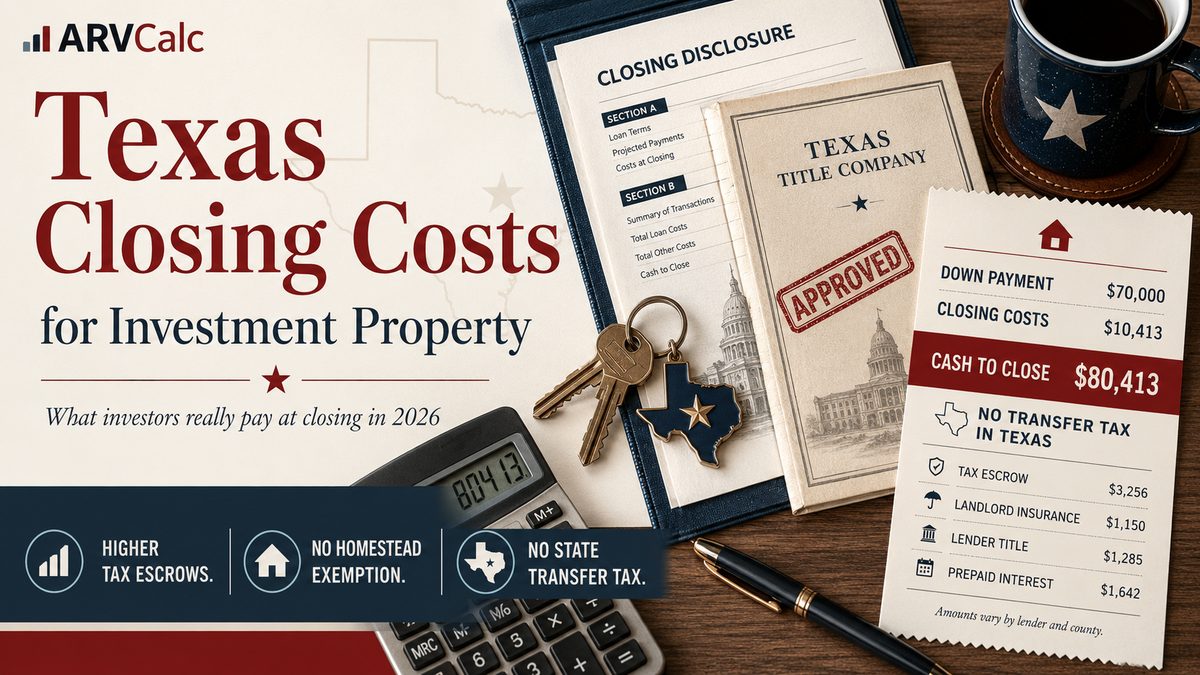
Let’s walk through a real scenario. You are buying a 3-bed/2-bath single-family rental in Harris County (Houston) for $350,000. You are using a conventional investment property loan with 20% down at 7.25% interest. Closing date: July 15.
| Line Item | Amount | Calculation / Notes |
|---|---|---|
| Down payment (20%) | $70,000 | $350,000 × 20% |
| Loan origination (0.75%) | $2,100 | $280,000 loan × 0.75% |
| Appraisal | $550 | Investment property with rent schedule |
| Inspection | $425 | Paid before closing; included for total cash outlay |
| Lender’s title insurance | $980 | TDI rate on $280,000 loan (post-March 2026 reduction) |
| Title search & exam | $300 | Bundled by title company |
| Survey | $475 | New survey; seller did not have a recent one |
| Recording fees | $175 | Harris County clerk — deed + deed of trust |
| Escrow — property tax (3 months) | $1,706 | $350,000 × 1.95% (Harris Co. avg, no homestead) ÷ 12 × 3 |
| Escrow — landlord insurance (14 months) | $2,217 | $1,900/yr ÷ 12 × 14 months (first year + 2 month reserve) |
| Prepaid interest (16 days) | $890 | $280,000 × 7.25% ÷ 365 × 16 days (July 15–31) |
| Credit report | $50 | Tri-merge |
| Flood certification | $20 | Standard |
| Tax service fee | $75 | Lender requirement |
| Closing / settlement fee | $450 | Title company |
| Transfer tax | $0 | None in Texas |
| Total closing costs (excl. down payment) | $10,413 | 2.98% of purchase price |
| Total cash to close | $80,413 | Down payment + closing costs |
That $10,413 in closing costs equals 2.98% of the purchase price — right in line with the 2%–4% range for Texas investment properties. Notice how escrow reserves ($3,923 combined) make up over a third of the total. This is where Texas’s high property tax rates hit investors hardest.
Want to adjust these numbers for your specific deal? Plug in your purchase price, down payment, and interest rate in the Texas closing costs calculator and get an instant breakdown.
Worked Example 2: San Antonio Duplex at $285,000
Now let’s look at a different scenario: a duplex in Bexar County (San Antonio) at $285,000. Because it is a 2-unit property, the lender requires 25% down. You are using a DSCR loan at 7.50% interest. Closing date: March 5.
| Line Item | Amount | Calculation / Notes |
|---|---|---|
| Down payment (25%) | $71,250 | $285,000 × 25% |
| Loan origination (1.25%) | $2,672 | $213,750 loan × 1.25% (DSCR loans charge more) |
| Appraisal | $650 | Duplex appraisal with two rent schedules |
| Inspection | $500 | Two units = higher inspection cost |
| Lender’s title insurance | $835 | TDI rate on $213,750 loan |
| Title search & exam | $325 | Bundled by title company |
| Survey | $525 | Duplex lot; slightly larger survey |
| Recording fees | $150 | Bexar County clerk |
| Escrow — property tax (3 months) | $1,354 | $285,000 × 1.90% (Bexar Co. avg) ÷ 12 × 3 |
| Escrow — landlord insurance (14 months) | $2,800 | $2,400/yr (duplex) ÷ 12 × 14 months |
| Prepaid interest (26 days) | $1,141 | $213,750 × 7.50% ÷ 365 × 26 days (March 5–31) |
| Credit report | $50 | Tri-merge |
| Flood certification | $20 | Standard |
| Tax service fee | $75 | Lender requirement |
| Closing / settlement fee | $475 | Title company |
| Transfer tax | $0 | None in Texas |
| Total closing costs (excl. down payment) | $11,572 | 4.06% of purchase price |
| Total cash to close | $82,822 | Down payment + closing costs |
The duplex has a higher closing cost percentage (4.06% vs 2.98%) for three reasons: the DSCR loan charges a higher origination fee, duplex insurance premiums are higher, and closing late in the month means 26 days of prepaid interest instead of 16. If you closed on March 28 instead, you would save about $960 in prepaid interest.
Check the rental income side of this deal with our Texas DSCR calculator to confirm the property cash-flows after all these costs.
Investment Property vs Primary Residence: Texas Closing Cost Differences
If you have only bought a primary residence before, your first investment property closing will look different. Here is a side-by-side comparison on the same $350,000 property in Houston.
| Cost Category | Primary Residence | Investment Property | Difference |
|---|---|---|---|
| Down payment | 3%–5% ($10,500–$17,500) | 20%–25% ($70,000–$87,500) | +$52,500 to $77,000 |
| Interest rate (typical 2026) | 6.50%–6.75% | 7.00%–7.75% | +0.50% to 1.00% |
| Loan origination | 0.5%–0.75% | 0.75%–1.5% | Higher for investment |
| PMI / mortgage insurance | Required if under 20% down | Not available; must put 20%+ down | N/A |
| Property tax (escrow) | With homestead exemption ($25K–$100K+ off assessed value) | No exemption; full assessed value | +$400–$1,200/yr in tax |
| Insurance (escrow) | HO-3 policy (~$1,500/yr) | DP-3 landlord policy (~$1,900/yr) | +$400/yr |
| Appraisal | $400–$550 | $450–$700 | Rent schedule adds cost |
| Seller credit limit | 3%–6% of price | 2% of price (conventional) | Less negotiation room |
| Estimated closing costs | $7,500–$9,500 | $9,500–$12,500 | +$2,000–$3,000 |
| Total cash to close | $18,000–$27,000 | $79,500–$100,000 | Significantly more |
The biggest hit for investors is the down payment, not the closing costs themselves. But the closing costs are still $2,000–$3,000 higher because of larger escrow reserves (no homestead exemption, pricier insurance) and higher origination fees. Read our full guide on investment property down payment requirements to understand your financing options.
Texas Closing Costs by County
Texas closing costs vary by county because property tax rates, recording fees, and local market conditions differ across the state. Here is a comparison of the five most active investment markets, assuming the same $350,000 purchase with 20% down.
| County (City) | Avg. Property Tax Rate (No Homestead) | 3-Month Tax Escrow | Recording Fees | Estimated Total Closing Costs |
|---|---|---|---|---|
| Harris (Houston) | 1.95% | $1,706 | $175 | $10,400 |
| Travis (Austin) | 1.68% | $1,470 | $200 | $10,100 |
| Bexar (San Antonio) | 1.90% | $1,663 | $150 | $10,250 |
| Dallas (Dallas) | 1.93% | $1,689 | $185 | $10,350 |
| Tarrant (Fort Worth) | 2.10% | $1,838 | $160 | $10,500 |
The spread between the lowest-cost county (Travis) and the highest (Tarrant) is about $400 on a $350,000 deal. That difference comes almost entirely from property tax escrow. Tarrant County’s higher tax rate means more cash locked up in reserves at closing.
For investors focused on Austin, see our Texas cap rate analysis to understand how these costs affect returns across metro areas. You can also model county-specific numbers with the Texas cap rate calculator.
How to Reduce Texas Closing Costs on Investment Property
You cannot eliminate closing costs, but you can reduce them by $1,500 to $3,000 with these strategies.
1. Negotiate seller credits
Ask the seller to contribute toward your closing costs. On investment property with a conventional loan, the seller can credit up to 2% of the purchase price. On a $350,000 deal, that is $7,000 — enough to cover nearly all non-escrow closing costs. In a buyer’s market or when the property has been sitting, sellers are more likely to agree.
2. Shop lenders aggressively
Origination fees on investment property loans range from 0.5% to 1.5%. On a $280,000 loan, that is a $1,400 to $4,200 spread. Get quotes from at least three lenders, including one DSCR lender and one portfolio lender. Compare the Loan Estimate (LE) forms side by side. Use our investment mortgage calculator to see how different rate and fee combinations affect your monthly payment.
3. Close early in the month
Prepaid interest covers the days between your closing date and the end of the month. Close on the 28th instead of the 5th and you save 23 days of per-diem interest. On a $280,000 loan at 7.25%, that is roughly $1,280 in savings.
4. Use an existing survey
If the seller has a survey from the last 5–10 years and no improvements have been made, ask the lender if they will accept it with a T-47 affidavit from the seller. This saves $350–$600. Not all lenders will agree, but it is worth asking.
5. Request a lender credit
Some lenders offer credits toward closing costs in exchange for a higher interest rate. For example, you might accept 7.50% instead of 7.25% and receive a $2,000 lender credit. This makes sense if you plan to refinance within 2–3 years, because you are trading a short-term rate increase for immediate cash savings.
Tax Deductibility of Texas Closing Costs for Investors
One advantage of buying investment property: more of your closing costs are tax-deductible or can be added to your cost basis. Here is how the IRS treats each category for rental property owners, according to IRS Publication 527.
| Cost Item | Tax Treatment | Details |
|---|---|---|
| Prepaid mortgage interest (points) | Amortized over loan term | Unlike primary residence, investor points cannot be deducted in year one; spread over 30 years |
| Loan origination fee | Amortized over loan term | Deduct a proportional amount each year |
| Prepaid property tax | Deductible in year paid | Full deduction; no $10K SALT cap for investment property |
| Prepaid insurance | Deductible in year of coverage | Allocate to the coverage period |
| Title insurance | Added to cost basis | Reduces taxable gain when you sell |
| Survey | Added to cost basis | Capital expense |
| Recording fees | Added to cost basis | Capital expense |
| Appraisal | Added to cost basis | Capital expense |
| Inspection | Not deductible (if property purchased) | Considered personal due diligence; some CPAs argue basis addition |
The most valuable item for Texas investors: property tax paid at closing is fully deductible with no SALT cap (the $10,000 limit applies only to personal, not investment property). If you close mid-year and pay a prorated tax bill of $3,400 at closing, that entire amount reduces your taxable rental income.
Work with a CPA who specializes in real estate investing. The tax treatment of closing costs can save you $1,000–$3,000 in your first year alone. For a deeper look at how closing costs factor into your investment returns, read our closing costs on investment property guide.
Recent Changes: Title Insurance Rate Cut (March 2026)
In March 2026, the Texas Department of Insurance (TDI) approved a 6.2% reduction in the basic premium rate schedule for title insurance. This was the first rate adjustment since 2019.
What this means for investors buying in 2026:
- On a $280,000 loan, the lender’s title insurance policy dropped from approximately $1,045 to about $980 — a savings of $65
- The owner’s title policy (typically paid by the seller) also decreased proportionally
- Rates remain uniform across all title companies statewide — you cannot get a “better deal” by shopping title companies for the insurance premium itself
- Title company service fees (closing fee, document prep, courier) are still negotiable and do vary by company
Texas is one of the only states where title insurance rates are set by the government rather than the market. This protects consumers from overcharging but also means you cannot negotiate the premium down. Check the current rate schedule on the TDI website.
For a broader look at how closing costs work across all property types, see our closing costs calculator guide.
Common Mistakes Investors Make with Texas Closing Costs
Mistake 1: Not budgeting for escrow reserves
First-time investors see “closing costs: 2%–3%” and budget $7,000–$10,500 on a $350,000 deal. Then the title company shows $3,900 in escrow reserves they forgot about. Texas property tax rates are high, and without a homestead exemption, your reserves will be larger than what homebuyers pay. Always include 2–3 months of property tax plus 14 months of insurance in your cash-to-close estimate.
Mistake 2: Assuming FHA or VA loans work for investment property
FHA (3.5% down) and VA (0% down) loans are for primary residences only. Investment properties require conventional or DSCR loans with a minimum of 20% down. If someone tells you to “just use an FHA loan for your rental,” they either do not understand the rules or are suggesting you commit occupancy fraud.
Mistake 3: Forgetting the appraisal rent schedule
Investment property appraisals cost $50–$150 more than primary residence appraisals because the appraiser must complete a rent schedule (Form 1007 or Form 1025 for multifamily). Budget $450–$700, not the $350–$450 your friend paid on their house.
Mistake 4: Ignoring the seller credit cap
On a primary residence, sellers can credit 3%–6% of the purchase price toward your closing costs. On an investment property with a conventional loan, the cap drops to 2%. If you write your offer expecting a 3% seller credit, the lender will reject it and you will need to renegotiate — or bring extra cash.
Mistake 5: Not accounting for closing costs in your cash-on-cash return
Your cash-on-cash return should include all cash spent to acquire the property: down payment plus closing costs. If you only divide annual cash flow by the down payment, you are overstating your return by 10%–15%. Every dollar of closing costs is money you invested in the deal.
Frequently Asked Questions
How much are closing costs in Texas for an investment property?
Texas closing costs for investment property buyers typically range from 2% to 4% of the purchase price, not including the down payment. On a $350,000 rental property, expect $8,000 to $14,000 in closing costs. The exact amount depends on your loan type, lender fees, property tax escrow requirements, and insurance premiums. Investors pay more than primary residence buyers because of higher origination fees, no homestead exemption (which increases escrow), and more expensive landlord insurance policies.
Does Texas have a transfer tax on real estate?
No. Texas is one of the few states with no real estate transfer tax. This saves investors significant money at the closing table. On a $350,000 property, you would pay $0 in transfer tax in Texas compared to $1,400 in New York (0.4%), $7,000 in Pennsylvania (2%), or $3,500 in Delaware (1%). This is one of the financial advantages of investing in Texas real estate.
Who pays for title insurance in Texas?
In most Texas markets, the seller pays for the owner’s title insurance policy and the buyer pays for the lender’s title insurance policy. Title insurance rates in Texas are regulated by the Texas Department of Insurance (TDI) and are identical at every title company. As of March 2026, TDI reduced the basic premium rate schedule by 6.2%, lowering costs slightly for both buyers and sellers.
Are closing costs tax deductible for investment property in Texas?
Some closing costs are deductible or can be amortized. Prepaid property taxes are fully deductible in the year paid, with no SALT cap for investment properties. Loan origination fees and discount points are amortized over the loan term. Title insurance, recording fees, and survey costs are added to your property’s cost basis. Consult a CPA who works with real estate investors for guidance specific to your situation.
How much is a down payment on an investment property in Texas?
Most lenders require 20% to 25% down on investment properties in Texas. Single-family rentals typically require 20% down with a conventional loan, while 2–4 unit properties often require 25%. DSCR loans may accept 20% down but qualify based on the property’s rental income rather than your personal W-2 income. For a full explanation, see our investment property down payment guide.
Can I negotiate closing costs in Texas?
Several closing costs are negotiable. You can negotiate seller credits (up to 2% on investment properties with conventional loans), shop multiple lenders to compare origination fees, request lender credits in exchange for a higher interest rate, and compare survey costs between providers. Title insurance premiums are not negotiable because they are set by the state. Property taxes and government recording fees are also fixed.
What changed with Texas title insurance rates in 2026?
In March 2026, the Texas Department of Insurance approved a 6.2% reduction in the basic premium rate schedule. On a $350,000 property, the lender’s title policy dropped by approximately $65. The owner’s policy (typically paid by the seller) also decreased. This was the first rate change since 2019. All title companies in Texas must charge the same regulated rate.
Run Your Own Numbers
Every investment property deal is different. The purchase price, loan type, county, closing date, and insurance requirements all change the numbers. Instead of estimating, get an exact breakdown for your specific deal.
Use these free calculators to model your next Texas investment property:
- Texas Closing Costs Calculator — itemized breakdown of every fee, escrow amount, and cash to close
- Texas Rental Property Calculator — full investment analysis including cash flow, cash-on-cash return, and ROI
- Texas Cap Rate Calculator — compare cap rates across Texas metros and property types
- Texas DSCR Calculator — check if your property qualifies for a DSCR loan based on rental income
- Investment Mortgage Calculator — compare loan scenarios with different rates, points, and terms
For additional context on Texas as an investment market, read our full Texas rental property investment guide.
Texas closing costs are a known quantity. There are no hidden taxes, no surprise fees, and no transfer tax. The state regulates title insurance rates so you cannot be overcharged. Your biggest variable is the escrow reserve — driven by the county’s property tax rate and your landlord insurance premium. Budget 2%–4% of the purchase price for closing costs, add that to your 20%–25% down payment, and you will know exactly how much cash you need to close on your next Texas investment property.
Frequently Asked Questions
What is a good cap rate in this state?
Cap rates vary by city and neighborhood within each state. Metropolitan areas typically show 4-6% cap rates for Class A properties and 7-10% for Class B/C properties. Rural areas and secondary markets often have higher cap rates (8-12%) but may come with higher vacancy and less appreciation.
Are these numbers current?
Data is based on the most recent available market reports, Census Bureau statistics, and MLS data. Real estate markets change — always verify current numbers with local agents, property managers, and recent comparable sales before making investment decisions.
Should I invest in this state?
The best state for investment depends on your strategy (cash flow vs appreciation), budget, risk tolerance, and whether you plan to self-manage or hire property management. Compare multiple markets using our calculators and research landlord-tenant laws, property taxes, and insurance costs for each state.
How do property taxes compare?
Property tax rates vary significantly — from 0.28% (Hawaii) to 2.47% (New Jersey). Even within a state, rates differ by county. Always check the specific county tax rate and factor it into your investment analysis. Higher taxes reduce NOI and cap rate.
Do I need a local property manager?
For out-of-state investing, a property manager is essential. Budget 8-12% of collected rent for management fees plus leasing fees. Interview at least three local PMs before choosing one. Ask about their vacancy rates, maintenance markup, and portfolio size.
Leave a Reply