Last updated: September 24, 2026 · Originally published: September 8, 2026 · By Alex Petrov
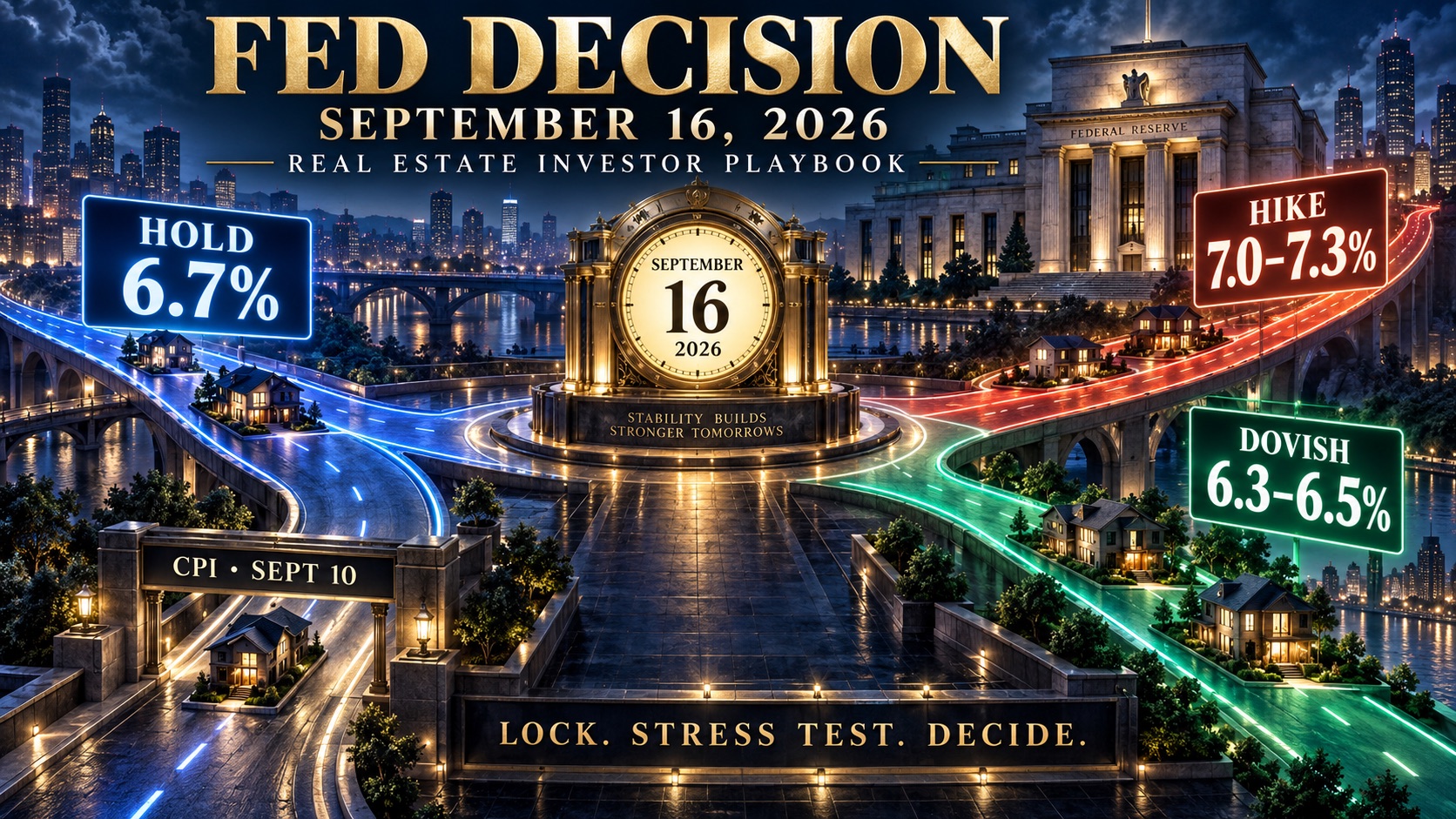
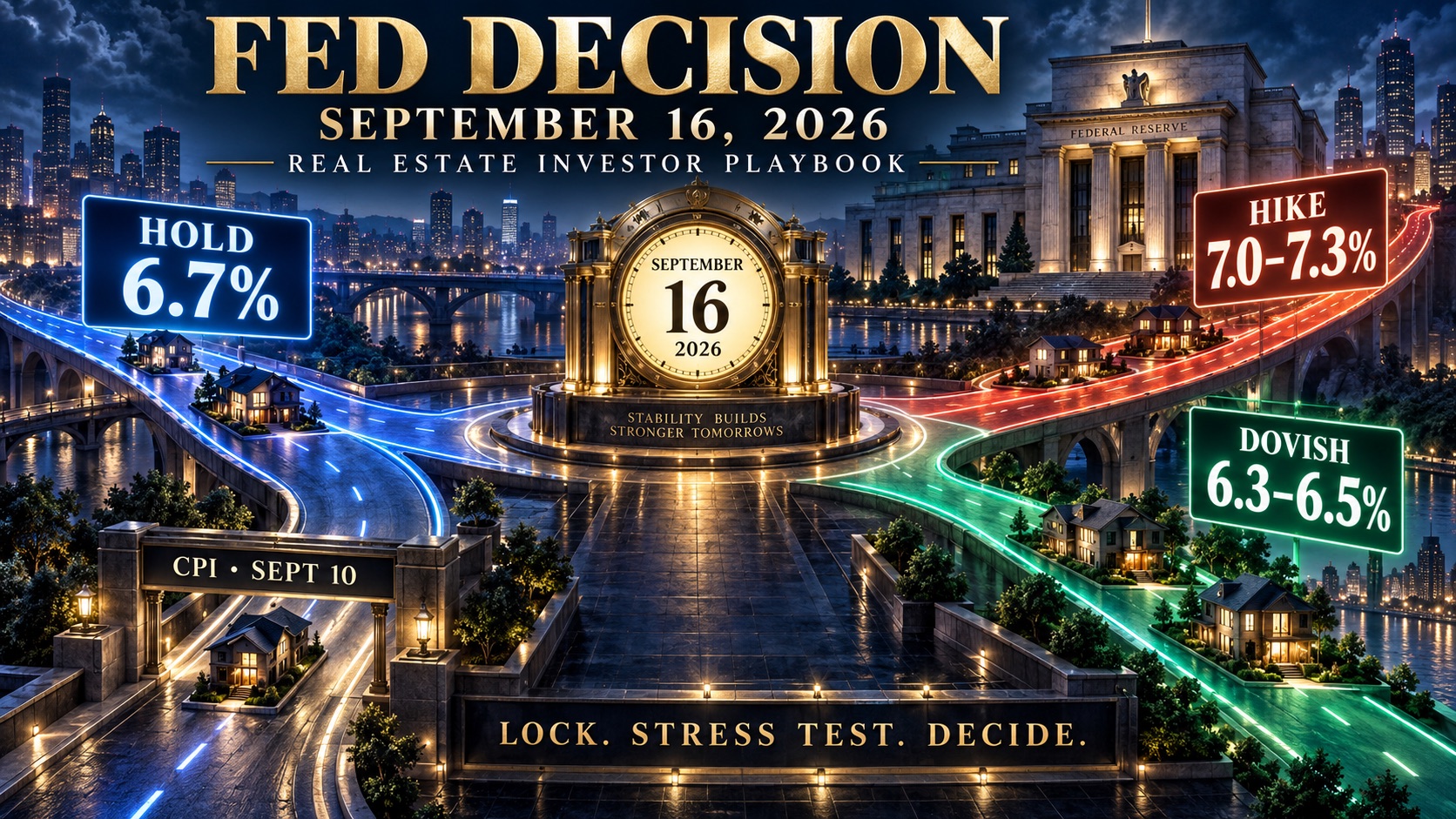
The September 2026 Fed meeting on September 15–16 is the most consequential for real estate investors this year. The Fed has held rates at 3.50–3.75% since December 2025 — but inflation at 3.7% remains above the 2% target, and three Fed officials have publicly discussed the possibility of a rate hike. If rates go up, 30-year mortgages move from 6.7% toward 7.0–7.5%. If they hold, markets stabilize. If they signal future cuts (unlikely but possible), mortgage rates could dip to 6.3–6.5%. Here is what each scenario means for rental property investors, flippers, and BRRRR operators — and what to do before September 16.
What the Fed Is Deciding on September 16
The Federal Open Market Committee (FOMC) meets September 15–16, 2026. The decision is announced Wednesday September 16 at 2:00 PM ET, followed by Chair Warsh’s press conference at 2:30 PM. Per Federal Reserve, this meeting includes updated economic projections (the “dot plot”) — showing where each Fed member expects rates over the next 2 years.
Three possible outcomes:
| Outcome | Probability | Mortgage Rate Impact | Investor Action |
|---|---|---|---|
| Hold at 3.50–3.75% | ~45% | Rates stay ~6.7% | Business as usual — close pending deals |
| Hike +0.25% | ~40% | Rates jump to 7.0–7.3% | Rate-lock immediately, stress test all deals |
| Dovish guidance | ~15% | Rates dip to 6.3–6.5% | Accelerate acquisitions, lock lower rates |
The key signal is not just the rate decision — it is the forward guidance. Even if the Fed holds rates, hawkish language (“prepared to tighten further”) pushes mortgage rates up. Dovish language (“patient, data-dependent”) brings them down. The dot plot tells you where rates are heading in 2027–2028.
Fed Meeting Scenarios: What Happens to Your Deals
Scenario 1: Hold (Rates Stay ~6.7%)
Most likely outcome. Mortgage rates stay at current levels. Impact on investors:
- Pending deals — close as planned. No urgency to renegotiate.
- DSCR loans — qualification unchanged. If your DSCR is borderline (1.0–1.15), it stays borderline.
- BRRRR refi — refinance at current rates. No improvement, no deterioration.
- Cash flow — remains as modeled. No surprise.
Scenario 2: Hike +0.25% (Rates Rise to 7.0–7.3%)
This is the scenario most investors are not prepared for. A 0.25% hike pushes 30-year investment rates from 6.7% to 7.0–7.3%. Impact:
On a $150,000 loan (typical $200K property, 25% down):

At 6.7%: P&I = $970/mo
At 7.0%: P&I = $998/mo (+$28/mo)
At 7.3%: P&I = $1,027/mo (+$57/mo)

$57/month is $684/year — directly subtracted from cash flow.
On a deal with +$87/month cash flow: it becomes +$30.
On a deal with +$30/month cash flow: it becomes -$27.
What to do before September 16:
- Rate-lock any loan in process. Rate locks cost 0.25–0.50% upfront but protect against a $684/year cash flow hit.
- Stress test every pending deal at +0.5% rate. If it breaks, renegotiate the purchase price or walk. Use the cash flow calculator at the higher rate.
- Check DSCR qualification at the higher rate. A deal at 1.25 DSCR at 6.7% drops to 1.20 at 7.0% — potentially below lender minimums. Run in the DSCR calculator.
Scenario 3: Dovish Guidance (Rates Dip to 6.3–6.5%)
Unlikely but possible if CPI on September 10 shows significant cooling. Impact:
- Cash flow improves — $150K loan at 6.3% vs 6.7%: P&I drops from $970 to $931 (+$39/month)
- DSCR improves — lower P&I means higher DSCR. Deals that failed at 6.7% may qualify at 6.3%.
- Competition increases — lower rates bring more buyers. Prices rise. The window to buy at current prices closes.
What to do: If you have deals ready, don’t wait for the rate drop — prices will rise faster than rates fall. Close at current prices and refinance later if rates drop. “Marry the property, date the rate.”
Fed Meeting Impact by Investment Strategy
| Strategy | Hold Impact | Hike Impact | Cut Impact |
|---|---|---|---|
| Buy-and-Hold | None | Cash flow drops $28–$57/mo per $150K loan | Cash flow improves $39/mo |
| BRRRR | None | Refi rate higher → worse post-refi CF | Better refi terms |
| Fix & Flip | None | Buyer pool shrinks → ARV may decline 2–3% | More buyers → ARV holds/rises |
| DSCR Loans | None | DSCR drops 0.03–0.05 → borderline deals fail | DSCR improves → more deals qualify |
| Hard Money | None | HM rates rise 0.5–1.0% → flip margins compress | Minimal impact (HM less rate-sensitive) |
CPI Report Before the Fed Meeting: The Preview
The Consumer Price Index for August is released September 10 — five days before the Fed decision. This is the single most important data point the Fed will consider. Per Bureau of Labor Statistics:
- CPI below 3.3% — dovish signal. Inflation cooling. Rate hike probability drops. Markets rally, mortgage rates dip.
- CPI 3.3–3.7% — neutral. Inflation not improving. Fed holds. Status quo.
- CPI above 3.7% — hawkish signal. Inflation rising. Rate hike probability jumps. Mortgage rates pre-emptively rise.
Watch September 10 carefully. If CPI comes in hot (above 3.7%), rate-lock your deals THAT DAY — don’t wait until September 16. Markets price in expectations instantly.
5-Step Fed Meeting Checklist for Investors
- Stress test every pending deal at +0.5% rate → Cash Flow Calculator
- Check DSCR qualification at higher rate → DSCR Calculator
- Rate-lock if under contract — contact your lender by September 10
- Verify ARV hasn’t shifted → ARV Calculator with latest comps
- Model total ROI at worst case → ROI Calculator at 7.5% rate
Five minutes of analysis now can save $5,000–$10,000 in bad decisions after September 16.
What Happened After Previous Fed Meetings
| Meeting | Decision | Mortgage Rate Before | Rate 30 Days After | Change |
|---|---|---|---|---|
| Dec 2025 | Cut -0.25% | 6.9% | 6.5% | -0.4% |
| Jan 2026 | Hold | 6.5% | 6.6% | +0.1% |
| Mar 2026 | Hold | 6.6% | 6.5% | -0.1% |
| May 2026 | Hold | 6.5% | 6.7% | +0.2% |
| Jul 2026 | Hold (hawkish) | 6.7% | 6.7% | 0.0% |
Pattern: mortgage rates have been range-bound (6.5–6.9%) for 9 months. The September meeting could break this range in either direction. Per FRED data, the 30-year fixed rate entered September at 6.66%.
What to Do After the September 16 Decision
If the Fed Holds (Most Likely)
Business as usual. Close pending deals at current terms. No urgency to change strategy. Focus on the dot plot — if it shows rate cuts in 2027, mortgage rates may drift lower in Q4 2026 even without an immediate change. This is the best scenario for BRRRR investors mid-refi: your refinance rate stays the same.
If the Fed Hikes +0.25%
Act fast. DSCR rates will jump 0.25-0.50% within 48 hours. If you have a DSCR loan in process without a rate lock, call your lender immediately — the rate you were quoted is gone. For pending purchases, renegotiate the price down by 1-2% to offset the higher mortgage cost. On a $200K property, a 0.25% rate increase costs $344/year — ask the seller for a $1,000-$1,500 price reduction. For BRRRR, delay refinance if possible — wait 2-3 months for the market to absorb the hike and rates to stabilize.
If the Fed Signals Cuts (Unlikely)
Move quickly. Rates will dip, but prices will rise as buyers flood back. Lock your purchase contracts ASAP — every week of delay means more competition. Do NOT wait for rates to drop further — the price increase will offset the rate savings. Close now at today’s price and refinance at the lower rate in 3-6 months.
Frequently Asked Questions
Should I wait until after the Fed meeting to buy rental property?
No — if your deal works at current rates + 0.5%, buy now. Waiting costs you: good deals get taken, and if the Fed signals dovishness, prices rise before rates drop. The smart play is stress test at higher rates, close if the deal works, and refinance later if rates improve. Use the cash flow calculator at +0.5% to verify.
Will a Fed rate hike crash the housing market?
Should I rate-lock before the Fed meeting?
How does the Fed rate affect DSCR loan qualification?
What is the CPI report on September 10 and why does it matter?
Related Calculators and Guides
- Cash Flow Calculator — Stress test at higher rates
- DSCR Calculator — Check loan qualification at +0.5%
- ROI Calculator — Total return at worst-case rate
- ARV Calculator — Verify property value
- Mortgage Calculator — Payment at different rates
- Cap Rate Calculator — Unlevered return (rate-independent)
- All 30+ Calculators
Related guides:
Leave a Reply